Best Healthcare Administration Schools in New Hampshire
Compare 7 accredited Healthcare Administration programs in New Hampshire at 5 colleges, with net price after aid, graduation rates, earnings and debt from IPEDS and the U.S. College Scorecard.

New Hampshire licenses nursing home administrators through its Board of Examiners of Nursing Home Administrators, a credential that sits on top of the degree. The bachelor's degree in healthcare administration is the standard entry point into managing clinics, hospitals and health systems, and schools generally award it as a Bachelor of Science (B.S.) in Healthcare Administration.
In New Hampshire that degree comes in several shapes: a health management and policy major at a public university, a small liberal arts college program, and fully online options from schools based in the state. The differences that matter are unglamorous: published tuition against average net price after aid, transfer credit caps, accreditation, and whether internships sit near where you live.
Key Points
- SNHU and UNH College of Professional Studies Online offer fully online study.
- Average net price includes housing, so it can exceed published tuition.
- New Hampshire nursing home administrator license applicants must be at least 21.
Best Bachelor's in Healthcare Administration Schools in New Hampshire, Ranked
Five New Hampshire institutions award bachelor's degrees in healthcare administration or health care management, and between them they cover traditional campus study and fully online study. Two are public universities, one is a small private liberal arts college, and one enrolls online students nationwide from its Manchester base. Each entry below notes what the school does best so you can compare fit, not just sticker price.
University of New Hampshire
#1Durham, NH · $24,000/yr (est. net price)
Best for: Campus students drawn to health policy
The state's flagship public university runs two separate campus bachelor's paths into the field: a Health Care Management major and a Health Management and Policy major. The management track leans on operations, reimbursement, informatics, law and population health, while the policy track adds epidemiology, data work and a 400-hour clinical placement along with a summer internship. Both close with a capstone or practicum, which gives graduates something concrete to talk about with New Hampshire employers.
- 120 total credit hours
- 2.0 GPA minimum for conferral
- Capstone required
- C- minimum in major coursework
- 30 credits must be taken at UNH
- Covers reimbursement, financing, informatics, law and ethics
- Emphasizes interprofessional collaboration
- 128 total credit hours
- 400 clinical hours plus a summer internship
- Practicum scheduled between junior and senior year
- Honors-in-major program offered
- C minimum in all major courses
- Covers data, epidemiology, finance and management
- Careers in consulting and data analysis
Colby-Sawyer College
#2New London, NH · ~$27,000/yr (est.)
Best for: Small liberal arts college setting
A small private liberal arts college in New London, Colby-Sawyer pairs a broad general education with a business-based healthcare administration major accredited by the ACBSP. Case studies, field study, internships and community partnerships put students inside regional providers before they graduate. A fifth-year MBA pathway lets students leave with both degrees, and the curriculum targets practical management roles in hospitals, nursing homes, assisted living, rehabilitation and managed care.
- ACBSP accredited
- Four-year program with an accelerated fifth-year MBA pathway
- Field study, internships and community partnerships
- Coursework in healthcare finance, marketing, human resources and biomedical ethics
- Strategic management and biomedical ethics included
- Prepares for administrative roles in nursing homes, hospitals and managed care
Franklin Pierce University
#3Rindge, NH · ~$27,000/yr (est.)
Best for: Accelerated three-year degree seekers
Franklin Pierce University offers its healthcare administration bachelor's on a traditional residential campus in Rindge, with business programs accredited by the IACBE. The curriculum covers leadership, ethics, economics, politics, quality improvement and strategic planning, and it closes with a capstone. Business students can compress the degree into three years or use 3+1 and 4+1 arrangements to move into a master's, and the university runs an MBA track in healthcare management for those who continue.
- IACBE-accredited business programs
- Capstone required
- Three-year accelerated option for business majors
- 3+1 and 4+1 undergraduate-to-graduate pathways
- MBA Healthcare Management track available
- Rindge, New Hampshire campus
- Student clubs and Sigma Beta Delta honor society
Southern New Hampshire University
#4Manchester, NH · $37,000/yr (est. net price)
Southern New Hampshire University runs one of the largest online healthcare administration bachelor's programs in the country from its Manchester base, with concentrations in health information management and in patient safety and quality. Courses run in eight-week terms with six start dates a year, up to 90 transfer credits are accepted, and the curriculum is aligned with AUPHA principles. It is built for working adults, with 24/7 tutoring, employer tuition reimbursement support and an accelerated path into a master's.
- 120 credits across 40 courses, capstone required
- $354 per credit, about $42,480 total program tuition
- Eight-week terms with six start dates per year
- AUPHA-aligned curriculum in health information systems
- Coursework in healthcare data, IT infrastructure and finance
- Prepares for business intelligence and quality systems roles
- Concentration in patient safety and quality
- Coursework in patient advocacy, risk, leadership and cultural change
- Test optional, with no entrance exam required
- Transfer up to 90 credits toward the degree
- Full-time and part-time enrollment
- Prepares for patient safety manager roles
University of New Hampshire College of Professional Studies Online
#5Manchester, NH · ~$11,000/yr (est.)
The University of New Hampshire's College of Professional Studies delivers a fully online health care management bachelor's designed for working adults who already have some college behind them. The 120-credit program runs in eight-week terms with rolling admissions, accepts up to 90 transfer credits and awards credit for prior learning. Employer partnerships across healthcare, municipalities and state and local government can lower tuition for eligible employees, which makes it a strong fit for people already working inside New Hampshire health systems.
- 100% online courses in eight-week terms
- 120 total credit hours across 22 courses
- Rolling admissions with a $0 application fee
- 2.0 GPA minimum and a required capstone
- Transfer up to 90 credits plus credit for prior learning
- Regionally accredited by NECHE
- Full-time and part-time options
- Accelerated graduate program pathway
Cost & outcomes by school
Federal data for the highest-earning Healthcare Administration programs, independent of the ranking above. Earnings are this field's bachelor's graduates four years after completing where the Scorecard reports them, else the school's undergraduate median.
| School | Net price / yr | Grad rate | Earnings | Debt | Grads/yr | Format |
|---|---|---|---|---|---|---|
| University of New Hampshire NH | $23,805 | 76% | $75,291 | $27,000 | 24 | Campus |
| University of New Hampshire College of Professional Studies Online NH | $10,864 | 30% | $75,291 | $27,000 | 9 | Online |
| Franklin Pierce University NH | $27,154 | 54% | $75,243 | $21,097 | 8 | Campus |
| Southern New Hampshire University NH | $36,708 | 43% | $63,292 | $25,000 | 1,329 | Online |
| Colby-Sawyer College NH | $27,431 | 58% | $46,474 | $27,000 | 2 | Campus |
Sources: U.S. Department of Education. Net price, graduation rate, earnings and debt: College Scorecard (earnings and debt for this field's bachelor's graduates where reported, else school-wide); graduates: IPEDS. A dash means no figure is reported.
Cost, debt & payoff
Median earnings of this field's bachelor's graduates (4 yrs after completing, else the school's undergraduate median) vs. their median federal loan debt · U.S. College Scorecard
Across these programs the median graduate earns about $75,243 and finishes with roughly $27,000 in debt — a ratio that clears a common rule of thumb (keep debt below first-year salary). Net price and debt vary widely school to school, so check the per-school figures in the table above before you shortlist.
How We Ranked These New Hampshire Schools
Some of the numbers behind this list describe the program you would enroll in; others describe the whole school. Four inputs drive the order: College Scorecard outcomes, net price, program format, and accreditation status.
Program-Level vs. Institution-Wide Figures
The two kinds of figures describe different things, so read them differently.
- Program-level: Earnings, debt and completions are tied to the specific healthcare administration or health management program.
- Institution-wide: Graduation rate and net price cover the whole school, not one major. A school's net price reflects every student, from nursing to business to education.
Mixing these up is the most common misreading. A strong campus-wide graduation rate says little about how one program performs, and a program's debt figure says nothing about what a typical freshman pays.
What the Estimates Can and Can't Tell You
Net price here is a sector-average estimate, not a quote for your household. Your own aid offer could land well above or below it, so treat it as a starting comparison and confirm with each school's net price calculator.
The pool is also small. New Hampshire offers only a handful of bachelor's options in this field, across campus and online formats. Small programs produce small completion counts, which makes outcome figures swing from year to year. Weigh them as signals, not verdicts.
No other result for this search publishes an independent methodology, so this is the basis you can check for yourself.
Side-by-Side: Earnings, Debt and Completions at New Hampshire Bachelor's Programs
The figures below come from U.S. Department of Education IPEDS and College Scorecard data for bachelor's degree graduates in healthcare administration and management, so you can compare what each program's alumni earned, what they borrowed and how many students finished. Franklin Pierce University posts the highest first-year median earnings ($66,556) and the lowest median debt ($21,097). The University of New Hampshire reports the strongest five-year median at $80,762. Southern New Hampshire University awards far more of these degrees than any other school here, and its online scale means its figures rest on a much larger graduate pool. UNH's Durham campus and its online College of Professional Studies show identical earnings and debt figures in the federal data. Colby-Sawyer College is not shown because no program-level earnings, debt or completion figures are reported for it.
| School | Format | Recent Graduates (Completions) | Median Earnings, 1 Year After Graduation | Median Earnings, 4 Years After Graduation | Median Earnings, 5 Years After Graduation | Median Debt at Graduation | Typical Monthly Loan Payment (10-Year Plan) |
|---|---|---|---|---|---|---|---|
| University of New Hampshire | Campus | 37 | $50,110 | $75,291 | $80,762 | $27,000 | $286 |
| University of New Hampshire College of Professional Studies Online | Online | 9 | $50,110 | $75,291 | $80,762 | $27,000 | $286 |
| Franklin Pierce University | Campus | 14 | $66,556 | $75,243 | N/A | $21,097 | $224 |
| Southern New Hampshire University | Online | 1,186 | $50,619 | $63,292 | $61,580 | $25,000 | $265 |
Online and Hybrid Bachelor's Options at New Hampshire Schools
An online bachelor's degree in healthcare administration is delivered through a school's learning management system, with lectures, discussions and assignments completed remotely; a hybrid program blends online coursework with in-person sessions. New Hampshire students can earn the degree entirely online. Southern New Hampshire University and University of New Hampshire College of Professional Studies Online, both based in Manchester, list fully online programs. University of New Hampshire in Durham, Colby-Sawyer College and Franklin Pierce University are listed as campus-based; no program in our data is listed as both or as hybrid. Ask each campus program whether any classes meet remotely.
Published tuition, online versus campus
Online rates vary. SNHU publishes $17,200 for its B.S. in Healthcare Administration, the same for in-state and out-of-state students. UNH College of Professional Studies Online lists $7,724 for New Hampshire residents and $9,284 for everyone else. Campus tuition for New Hampshire residents is $19,125 at Colby-Sawyer, $19,202 at UNH Durham and $41,836 at Franklin Pierce. These are sticker prices, not net price after aid.
Who each format suits
Online study fits working adults and career changers who need to keep earning while they study. SNHU runs 8-week terms with six start dates a year; UNH College of Professional Studies Online uses 8-week terms and rolling admissions. Campus study fits recent high school graduates who want internships, clubs and face-to-face faculty contact. Colby-Sawyer builds field study and community partnerships into its program, and Franklin Pierce requires a capstone.
Confirm the numbers before you apply
SNHU lists $342 per credit and a $42,480 total program tuition. The other schools publish tuition rates that may be annual or per term. Check each school's page for the current per-credit rate, fees and term length before you apply.
Admissions Requirements: GPA, Test Policy and Transfer Credit
Two schools an hour apart can ask applicants for very different things. One publishes a clear test-optional statement and a hard cap on transfer credits; another leaves GPA and test policy blank and asks you to call. Knowing which is which before you apply saves weeks.
What each school publishes
- University of New Hampshire: test-optional for first-year applicants since fall 2020. The 2.0 GPA in UNH materials is the minimum for conferring the degree, not an admission cut-off. Graduation requires 128 credits, at least 32 of them at UNH. No maximum on transfer credits is published.
- Southern New Hampshire University: the online B.S. in Healthcare Administration lists no general admission GPA and no entrance exam. Students may transfer up to 90 credits, with at least 30 completed at SNHU. The 3.00 GPA figure you may see belongs to the accelerated B.S.-to-M.S. pathway, which also asks for 90 completed credits and allows up to three graduate courses (9 credits) at undergraduate tuition.
- UNH College of Professional Studies Online: rolling admissions, no entrance exam, a 2.0 GPA minimum, transfer of up to 90 credits and credit for prior learning.
- Franklin Pierce University: no published minimum GPA, no stated SAT or ACT policy and no published transfer ceiling. The School of Business advertises 3-year, 3+1 and 4+1 options, but its materials do not confirm whether those apply to the healthcare administration bachelor's, so ask directly.
How selective are they?
Campus-wide acceptance rates run from roughly 80 percent at Colby-Sawyer College to about 88 percent at UNH, 93 percent at Franklin Pierce and nearly 100 percent at SNHU. Online divisions often admit on different terms than the residential campus, so treat these as context rather than a threshold.
The transfer trap at UNH
UNH's Health Management and Policy major is not accepting transfer applications from other institutions, and students who do enter the prescribed sequence late may need an extra year. If UNH is your target, plan for it as a first-year applicant or through the College of Professional Studies route instead.
A practical habit: finish general education and introductory business courses at a community college, then get the credit evaluation in writing before you enroll, capped against the 90-credit and 30-credit residency limits.
Related Articles
Cost of a Bachelor's Degree in Healthcare Administration in New Hampshire
What does a bachelor's degree in healthcare administration in New Hampshire actually cost after aid? The answer depends on the school, but the gap between published tuition and average net price is wide enough to change how you compare programs.
Every figure below is an undergraduate, school-wide number, not a program-specific price.
Sticker Price vs. Net Price
Published in-state tuition at the public options is $7,724 at University of New Hampshire College of Professional Studies Online and $19,202 at UNH in Durham. Private tuition is $17,200 at Southern New Hampshire University, $19,125 at Colby-Sawyer College and $41,836 at Franklin Pierce University. Out-of-state tuition at UNH in Durham is $39,852.
Average net price after grant aid is $10,864 at UNH College of Professional Studies Online, $23,805 at UNH in Durham, $27,154 at Franklin Pierce, $27,431 at Colby-Sawyer and $36,708 at SNHU. Net price includes living and other costs after aid, so it can exceed published tuition. Compare net price to net price, not to a tuition sticker.
School Context and State Aid
The share of students receiving Pell Grants runs from 34% at the UNH campuses to 65% at SNHU. Median debt for completers is $21,082 at SNHU, $26,814 at the UNH campuses and $27,000 at Franklin Pierce and Colby-Sawyer.
New Hampshire Treasury administers the state's undergraduate grant and scholarship programs. The Unique Annual Allocation Program pays $3,500 for 2026-27 to Pell-eligible New Hampshire residents at approved in-state institutions, prorated for part-time study.1 The Unique Endowment Allocation Program awards at least $1,000, capped at the cost of education, to Pell-eligible residents.1 The Governor's Scholarship pays $2,000 a year to first-year, full-time Pell-eligible New Hampshire Scholars and $1,000 a year to other eligible students, for up to four years.1 Granite Edvance, formerly NHHEAF, awards scholarships to New Hampshire residents enrolled at least six credits with a 2.0 GPA and financial need; the next deadline is November 18, 2026, and the application includes a 400 to 650 word essay.2
A Practical Order of Steps
- File the FAFSA first.
- Ask each New Hampshire school's aid office which state programs it administers and what documentation it needs.
- Apply for Granite Edvance and any school scholarships.
- Compare award letters by net price, not sticker price.
How Far Below Sticker Price Do New Hampshire Students Actually Pay?
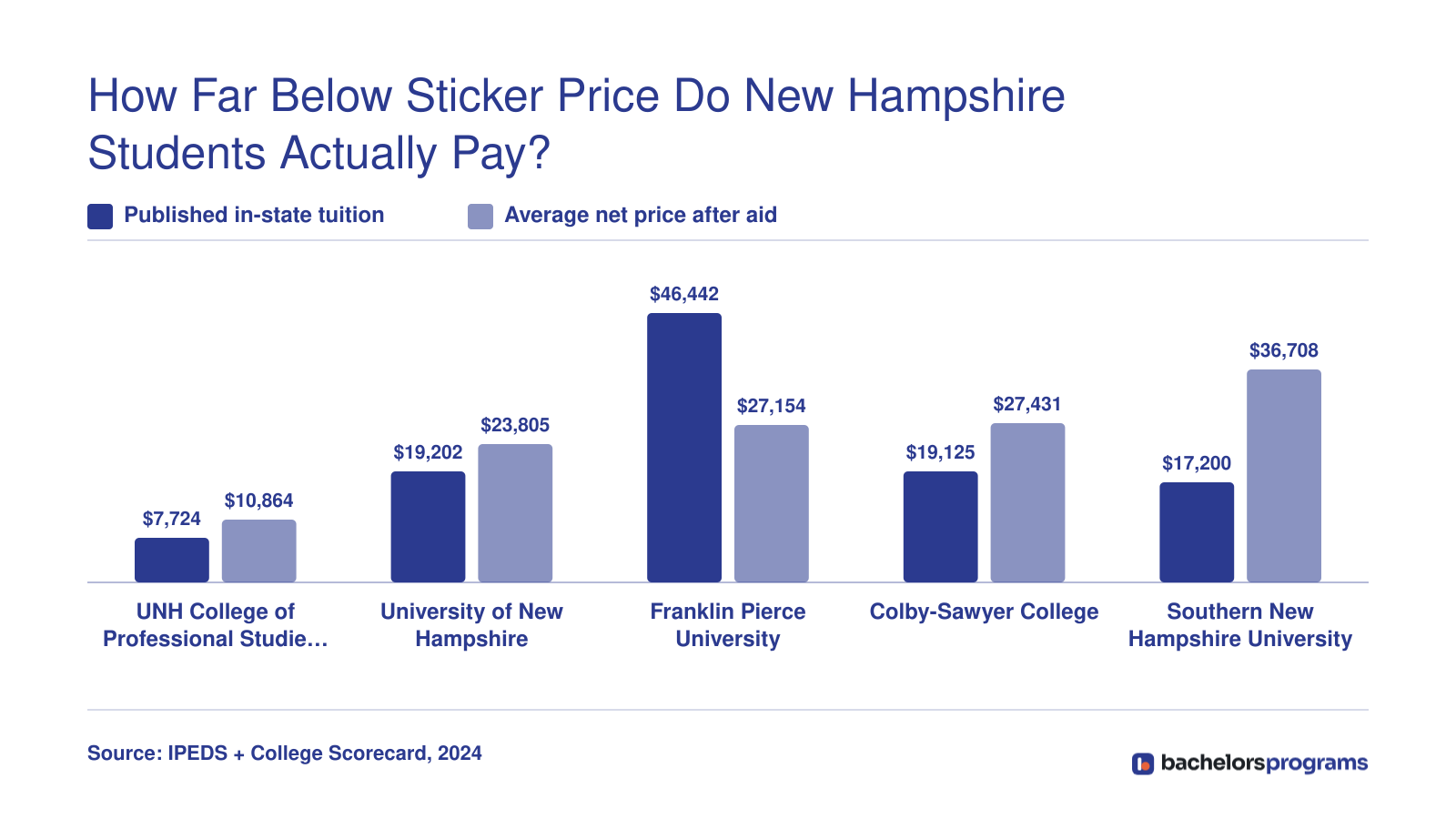
Published in-state tuition and average net price measure different things. Net price is the average yearly cost of attendance after grants and scholarships, including housing and other expenses, so it can sit above tuition alone at lower-tuition schools. At Franklin Pierce University, the average net price of $27,154 runs about $19,300 below its published $46,442 tuition, the widest sticker-to-net gap among the schools ranked here.
Questions to Ask Yourself
Do you want a program that requires an internship, or are you already working in a healthcare setting?
Will your target employer care about business-school accreditation, or about a health-specific program credential?
Would a degree-completion or accelerated route fit your timeline better than a standard four-year path?
New Hampshire Nursing Home Administrator Licensure at a Glance
Common Questions About Healthcare Administration Degrees in New Hampshire
These answers cover the questions prospective students ask most about studying healthcare administration in New Hampshire. Details such as tuition and transfer limits can change, so confirm them with each school's admissions office.
What is the best school for healthcare administration in New Hampshire?
Can you get a bachelor's degree in healthcare administration online in New Hampshire?
Do you need a license to work in healthcare administration in New Hampshire?
Can transfer credits shorten a bachelor's in healthcare administration in New Hampshire?
Compare Healthcare Administration programs on the data that matters
Explore more Business & Management majors or browse every field of study.
All Business & Management programs Browse every field of study