Best Online Healthcare Administration Degree Programs
Compare 380+ accredited online Healthcare Administration programs, with net price after aid, graduation rates, earnings and debt from IPEDS and the U.S. College Scorecard.

Healthcare administration is now one of the most crowded online bachelor's categories, and the degrees rarely share a name. Florida International University awards a Bachelor of Health Services Administration, Utah State University offers a Management degree with a healthcare emphasis, American Public University System accepts up to 90 transfer credits, and Western Governors University runs a self-paced, competency-based model. The differences are rarely lined up side by side with numbers.
All of them are 100% online, with no hybrid requirements and no on-campus residencies. Average net price runs from $3,148 at CUNY Lehman College to $14,936 at Utah State.
Price and payoff do not move together. Lehman graduates reported median first-year earnings of $42,389, while Western Governors graduates reported $66,651.
Key Points
- St. Petersburg College's $1,471 average net price undercuts its $2,682 in-state tuition.
- Western Governors University graduates earn a $66,651 median one year out.
- Running a nursing home requires a state license beyond your degree.
Top 10 Fully Online Healthcare Administration Degree Programs
Every program on this list can be completed without setting foot on campus, which matters if you are already working shifts, raising a family or both. These are the ten fully online healthcare administration programs that came out ahead once affordability, completion and graduate outcomes were weighed together; hybrid and campus-based options were excluded entirely. Each entry names the degree, the concentration options, published earnings and debt where the data exists, and the one detail that makes the school worth a closer look.
Florida International University
#1Miami, FL · ~$9,000/yr (est.)
Best for: South Florida health workers moving into management
Florida International University is a large public research university in Miami whose health services administration bachelor's is completed entirely through FIU ONLINE, and the school also runs a directly aligned online master's for graduates who want to keep going. Students enter at the junior level and finish 60 credits in as few as five semesters, part time or full time. The university graduates 74 percent of its students overall, and graduates of the health administration program report median first-year earnings near $39,000.
- Upper-division program of 60 credits, finishable in five semesters
- Full-time and part-time enrollment options
- Emphasizes ethical change management and interprofessional collaboration
- Covers systems engineering, financial management and health services research
- Builds in health law, policy and the economics of health systems
- Prepares students for entry-level management in hospitals and clinics
- Strong springboard for graduate study in health administration
- Delivered online through FIU ONLINE
CUNY Lehman College
#2Bronx, NY · $3,100/yr (est. net price)
Best for: Working New Yorkers aiming at a master's
CUNY Lehman College is a public senior college in the Bronx that offers its health services administration bachelor's fully online and is the only CUNY campus with a matching master's in the field, so students can move from bachelor's to graduate study without changing schools. The program pairs coursework with an internship, and the schedule is built for students who work full time. The college graduates about 51 percent of students overall, and program graduates report median first-year earnings near $42,000 with typical federal loan debt around $12,500.
- Fully online coursework plus an internship in a real-world setting
- Schedule built so students can work full time while enrolled
- Covers the industry knowledge needed for health services management
- Only CUNY college offering an M.S. in Health Services Administration
- Undergraduate and graduate degrees can be completed at one institution
- Prepares graduates to lead in a rapidly growing field
Eastern Florida State College
#3Melbourne, FL · $5,000 – $10,000/yr (est.)
Best for: Associate-degree holders finishing a bachelor's
Eastern Florida State College is a public state college in Melbourne that lets students who already hold an associate degree add a healthcare management specialization on top of its organizational management bachelor's, with the specialization courses taught fully online. The program adds 60 credits, including 39 upper-level credits, and runs on fall, spring and summer start terms. The college graduates about 52 percent of students overall.
- Healthcare Management specialization courses taught fully online
- Requires an accredited A.A. or A.S.; an A.A.S. does not qualify
- Adds 60 credits after transfer, including 39 upper-level credits
- Eight core management courses plus five specialization courses
- Specialization covers health information systems and quality improvement
- Also covers healthcare budgeting and healthcare administration
- Fall, spring and summer start terms
- Estimated $7,200 in tuition and fees for Florida residents
Indian River State College
#4Fort Pierce, FL · ~$3,800/yr (est.)
Indian River State College is a public college in Fort Pierce whose healthcare management bachelor's is a selective-admissions program with a capstone and practicum built around real operations work. Coursework covers leadership, finance, marketing and legal compliance, and students can join a Health Occupations Students of America chapter. The college graduates about 45 percent of students overall, and program graduates report median first-year earnings of roughly $41,000.
- Selective-admissions program with a hands-on capstone
- Case studies and practicum built around real operations problems
- Covers leadership, communications, marketing, finance and compliance
- Prepares students to run hospitals, clinics and long-term care sites
- Students can join the Health Occupations Students of America chapter
- Graduates report median first-year earnings near $41,000
University of West Florida
#5Pensacola, FL · $5,000 – $10,000/yr (est.)
The University of West Florida in Pensacola offers a health sciences bachelor's with a healthcare administration concentration, taught in eight-week terms and built for students who bring prior credit: up to 90 transfer credits, including military and vocational training, can count toward the degree. Coursework covers policy, law, finance, operations, quality improvement and informatics, capped by an ethics-focused capstone and an internship. The university graduates about 59 percent of students overall.
- Eight-week course terms designed around full-time work
- Accepts up to 90 transfer credits, including military and vocational credit
- Curriculum spans policy, law, finance, operations and quality improvement
- Ethics-focused capstone plus an internship in a care setting
- $220 per credit and a $30 application fee
- Military benefits accepted, including Yellow Ribbon support
- Installment plan and short-term loan options available
Utah State University
#6Logan, UT · $9,000 – $25,000/yr (est.)
Utah State University is a public research university in Logan where the healthcare management emphasis sits inside the management major at the Huntsman School of Business, so students study general management alongside healthcare-specific coursework. The degree is offered 100% online, students choose between a BA and a BS, and professional career coaches help with interviews, networking and job searches. The university graduates about 59 percent of students overall.
- 100% online bachelor's with a healthcare management emphasis
- Taught through the Huntsman School of Business
- Builds analytical, communication and problem-solving skills
- Prepares graduates for roles like operations analyst or HR analyst
- Career coaches help with interview prep, networking and job search
- Students choose a BA (foreign language required) or a BS
American Public University System
#7Charles Town, WV · $5,000 – $10,000/yr (est.)
American Public University System is a private online institution based in Charles Town, West Virginia, built around working adults and military-affiliated students, and its healthcare administration bachelor's carries five concentration options including emergency management and leadership. Courses run 8 to 16 weeks with monthly starts, transfer credit is accepted up to 90 credits, and there is no application fee. The university graduates about 57 percent of students overall.
- 120 credits, with up to 90 accepted in transfer
- Five concentration options, including emergency management and leadership
- Courses run 8 to 16 weeks with monthly start dates
- Senior seminar capstone applies learning to real decisions
- $360 per credit and no application fee
- Covers accounting, reimbursement, compliance and informatics
- Built for working adults and military-affiliated students
Pima Medical Institute-Tucson
#8Tucson, AZ
Pima Medical Institute in Tucson runs its health care administration bachelor's as a degree-completion program for people already working in healthcare, and most students finish in about 20 months. The final-semester capstone is designed to double as the start of a career e-portfolio, and career services stays available to graduates. The school graduates about 72 percent of students overall, and program graduates report median first-year earnings near $54,000.
- Degree-completion format for practicing health care professionals
- Can be completed in about 20 months
- Final-semester capstone can become the basis of a career e-portfolio
- Covers regulation and ethics, human resources and information management
- Prepares students for practice manager or clinic operations roles
- 100% online with career services support
Indiana University-Kokomo
#9Kokomo, IN · ~$4,000/yr (est.)
Indiana University Kokomo delivers its applied health science bachelor's fully online through a consortium of five IU regional campuses, which means students earn Indiana University credit while studying around a job. The Health Administration concentration covers strategic planning, budgeting, finance, supervision and resource management, and full-time students entering with 30 credits can finish in about three years. The Kokomo campus graduates about 46 percent of its students overall.
- Tracks: Health Administration, Community Health Education
- Delivered fully online by a consortium of five IU regional campuses
- 120 credits; full-time entrants with 30 credits can finish in about three years
- Health Administration track covers strategic planning, budgeting and finance
- Program requires a 2.0 GPA minimum
- Community Health Education track prepares students for CHES certification
- Students work closely with an academic advisor to stay on track
Western Governors University
#10Salt Lake City, UT · ~$13,000/yr (est.)
Western Governors University is a nonprofit, competency-based institution based in Salt Lake City that charges tuition per six-month term, so students who accelerate pay less for the same degree. Its healthcare administration bachelor's is 100% online and asynchronous, with 34 courses, embedded certificates and a capstone tied to a real workplace challenge. The university graduates about 46 percent of students overall, and program graduates report median first-year earnings near $67,000.
- Competency-based and self-paced, with asynchronous online classes
- 34 courses plus a capstone tied to a real workplace challenge
- 12 start dates per year; tuition charged per six-month term
- Embedded certificates in healthcare administration and leadership
- Dedicated program mentor assigned from day one
- Transfer-friendly credit policy accepts prior coursework
- Pathway to an MBA in Healthcare Administration
- University reports an average salary increase of $19,764
Cost & outcomes by school
Federal data for the highest-earning Healthcare Administration programs, independent of the ranking above. Earnings are this field's bachelor's graduates four years after completing where the Scorecard reports them, else the school's undergraduate median.
| School | Net price / yr | Grad rate | Earnings | Debt | Grads/yr | Format |
|---|---|---|---|---|---|---|
| Western Governors University UT | $12,548 | 46% | $82,644 | $14,909 | 1,420 | Online |
| University of St Francis IL | $13,006 | 67% | $79,421 | $20,827 | 34 | Hybrid |
| Syracuse University NY | $38,793 | 84% | $79,164 | $26,000 | — | Online |
| George Mason University VA | $17,915 | 68% | $76,343 | $19,500 | — | Online |
| University of Minnesota-Twin Cities MN | $16,778 | 85% | $72,862 | $19,400 | 48 | Hybrid |
| Charter Oak State College CT | $15,815 | 67% | $72,446 | $21,958 | 56 | Online |
| Muhlenberg College PA | $28,905 | 82% | $69,107 | $25,455 | — | Online |
| Saint Mary's University of Minnesota MN | $11,704 | 66% | $66,139 | $14,165 | 16 | Online |
| California State University-Chico CA | $14,480 | 63% | $64,172 | $16,552 | — | Hybrid |
| University of Oklahoma OK | $15,300 | 75% | $63,126 | $20,654 | 6 | Online |
| Saint Francis University PA | $23,526 | 74% | $62,101 | $27,000 | — | Online |
| Louisiana State University and Agricultural & Mechanical College LA | $19,151 | 69% | $61,251 | $20,500 | — | Online |
Sources: U.S. Department of Education. Net price, graduation rate, earnings and debt: College Scorecard (earnings and debt for this field's bachelor's graduates where reported, else school-wide); graduates: IPEDS. A dash means no figure is reported.
Cost, debt & payoff
Median earnings of this field's bachelor's graduates (4 yrs after completing, else the school's undergraduate median) vs. their median federal loan debt · U.S. College Scorecard
Across these programs the median graduate earns about $54,794 and finishes with roughly $24,427 in debt — a ratio that clears a common rule of thumb (keep debt below first-year salary). Net price and debt vary widely school to school, so check the per-school figures in the table above before you shortlist.
Inside Our Scoring: What Put These 100% Online Programs on Top
A low net price and a strong earnings record rarely belong to the same school, and a ranking that tracks only one of them tells you less than it seems to. Our composite scores both at once, plus two supporting signals, so the programs that rise hold up on cost and on results.
The Four Pillars
- Fully online delivery: The gate. A school was scored only if students can complete the entire degree without a campus visit or a hybrid residency.
- Affordability: Average net price after grants and scholarships, not the published sticker.
- Completion: The institution-wide graduation rate, used as a signal that students who start actually finish.
- Outcomes: Program-level earnings from College Scorecard and the federal debt students carry out the door.
Affordability and outcomes carry the heaviest emphasis, since cost and early earnings are what a prospective student can act on. Completion supports that picture. Delivery is pass or fail: meet it or the school is not scored at all.
What the Score Leaves Out
The composite says nothing about programmatic accreditation, and it cannot judge teaching quality, faculty credentials, advising, or clinical placement support. Those are the factors that decide whether a program fits your goals, and they do not reduce to a number.
Verify them yourself. The accreditation section below explains which credentials matter at the bachelor's level and how to confirm a program holds them.
Online Healthcare Administration Degree Cost: The Three Lowest-Priced Fully Online Options
Published tuition is only the sticker price. Average net price, what students actually pay after grants and scholarships, is the sharper measure: at St. Petersburg College, the average net price of $1,471 falls below even its $2,682 in-state tuition and fees, and all three schools below are public institutions, which explains why they undercut private online programs such as Liberty University ($410 per credit for full-time students in 2026-27) or APU Global ($535 per credit), where a typical 120-credit degree can run roughly $49,200 to $64,200 in tuition alone. Before you budget, check whether online students pay one flat rate regardless of residency (Avila University charges all U.S. residents the same $300 per credit), add recurring charges such as Abilene Christian's $310 resource fee or Champlain's $150 graduation fee, keep in mind that rates can change each year, and remember that every transfer credit you bring in lowers the final bill.
| School | Location | Program | Average Net Price (per year) | In-State Tuition and Fees | Out-of-State Tuition and Fees | Format and Program Notes |
|---|---|---|---|---|---|---|
| St. Petersburg College | St. Petersburg, FL | Health Services Administration (BAS) | $1,471 | $2,682 | $9,286 | Fully online, 8-week sessions; 120 credit hours; school lists $11,039 total program tuition |
| CUNY Lehman College | Bronx, NY | B.S. Health Services Administration | $3,148 | $7,410 | $15,360 | Fully online option; includes internship experience |
| Indian River State College | Fort Pierce, FL | Healthcare Management | $3,815 | $2,764 | $10,201 | Online; selective admissions; hands-on capstone courses |
Related Articles
Healthcare Administration Degree Online Accreditation: Regional Approval, AUPHA Certification and Where CAHME Fits
Which accreditation actually matters for an online healthcare administration bachelor's degree? Institutional accreditation from a recognized accreditor is the one that is non-negotiable. It determines whether you can use federal financial aid, whether your credits transfer if you switch schools, and whether a graduate program will accept your degree later. A program with every programmatic badge in the world is worthless if the institution behind it is not recognized.
Where CAHME and AUPHA Fit
CAHME accredits graduate healthcare management programs, not undergraduate ones. If a bachelor's program is not CAHME-accredited, that is expected, not a warning sign. Treat any undergraduate program claiming CAHME accreditation with suspicion.
At the bachelor's level, the main programmatic signal is AUPHA undergraduate certification. AUPHA describes it as peer-reviewed, a self-study plus an external panel review, no site visit, and is explicit that certification is not accreditation. Only programs in good standing as Associate Undergraduate members may enter review, and from 2026 a program must first enter candidacy, approved by AUPHA in 2024. Fees run $450 for candidacy, $4,050 for initial certification and $3,600 for recertification. Nothing external requires it, so plenty of solid programs skip it.
When the degree lives inside a business school, business accreditors such as AACSB, ACBSP or IACBE may apply instead.
A Three-Step Verification Routine
- Start with the federal database: Look up the institution in the Department of Education's DAPIP and record the accreditor, status and dates. The Department does not itself accredit, the data are self-reported and unaudited, and non-U.S. institutions are excluded.1
- Confirm through CHEA: Search the CHEA institutional directory, which covers more than 8,200 institutions and 44,000 programs, and verify the accreditor appears on CHEA's list of recognized accrediting organizations.
- Check the program page and AUPHA directory: The program page should name its accreditor outright. For certification, filter the AUPHA Program Directory for certified programs rather than trusting a marketing claim.
Unrecognized agencies with official-sounding names exist specifically to fool this search. Online delivery changes nothing: a distance program faces the same standards as one on campus.
Planning to Run a Nursing Home? Licensure Requirements Your Degree Should Meet
An online healthcare administration bachelor's degree can open the door to long-term care leadership, but nursing home administration is a licensed role controlled by the states. Check these items before you enroll.
- State nursing home administrator licenseAdministering a nursing home requires a license from the state board that oversees nursing home administrators. Each state sets its own mix of education, experience and exam rules.
- Education minimum and long-term care courseworkA bachelor's degree is a common baseline, but the degree alone may not be enough. New York, for example, requires a bachelor's plus 15 credit hours covering nursing home administration, health care financial management, legal issues in health care, gerontology and personnel management, along with a nursing home administration course.
- Administrator-in-Training (AIT) or field experienceRequirements vary by state. New York calls for a 12-month full-time AIT under a qualified preceptor or two years of qualifying full-time field experience. Wisconsin requires at least one year of administrative experience in a skilled nursing facility under a licensed administrator.
- National and state examsThe national pathway uses NAB's CORE exam and the nursing home administrator line-of-service exam. Some states add their own test, such as New York's Nursing Home Administrator Licensing Examination.
- NAB Health Services Executive (HSE) qualificationThe HSE Education Pathway requires a bachelor's or higher from an NAB HSE-accredited program, passing CORE, NHA, RCAL and HCBS exams, a clean NPDB self-query and a 1,000-hour AIT unless completed within the program. A general healthcare administration degree does not qualify automatically. HSE does not replace a state license, though Wisconsin accepts it for its education and exam requirements. If this career is your goal, confirm the program's long-term care courses and accreditation before enrolling.
Healthcare Administration Degree or Health Concentration? How the Program Titles Differ
A dedicated healthcare administration degree and a business or health-sciences degree with a healthcare management concentration can lead to the same jobs. The U.S. Bureau of Labor Statistics lists both health administration and management-plus-healthcare degrees as relevant for medical and health services managers, and it reports one occupation-level median wage of $123,860 per year rather than a figure by degree title. The differences show up in coursework, certification eligibility and flexibility, so use the table as a general guide and confirm details with each school.
| Factor | Dedicated BS in Healthcare or Health Services Administration | Business or Health-Sciences Degree with Healthcare Management Concentration |
|---|---|---|
| Share of healthcare-specific coursework | Usually the largest share, often covering health services management, accounting and budgeting, and health informatics | Typically smaller, with business core courses plus a set of healthcare electives on medical terminology, hospital organization and health information systems |
| Likely AUPHA certification eligibility | More likely, since AUPHA certification generally applies to programs built around a full healthcare management curriculum | Less likely, because a concentration usually does not meet the full curriculum standard; verify with the school and AUPHA |
| Fit for nursing home administrator licensure | Often a closer match, though licensure is set state by state and may require specific coursework, a training period and an exam | Can qualify in some states, but you may need to add long-term care or health-specific courses; check your state board |
| Flexibility to pivot outside healthcare | Narrower, since most of the curriculum is aimed at health settings | Broader, since the business core transfers to finance, operations, marketing and general management roles |
| How employers and MHA programs read the credential | BLS names health administration as a common major, and the title signals a clear healthcare focus. It reports no employer study ranking one title above the other | BLS also counts degrees that combine management and healthcare as relevant. MHA programs often look at coursework and experience, so confirm each program's prerequisites |
Median Pay for Medical and Health Services Managers
Healthcare administration graduates most often aim for medical and health services manager roles, and federal data shows strong pay and steady demand for the field.
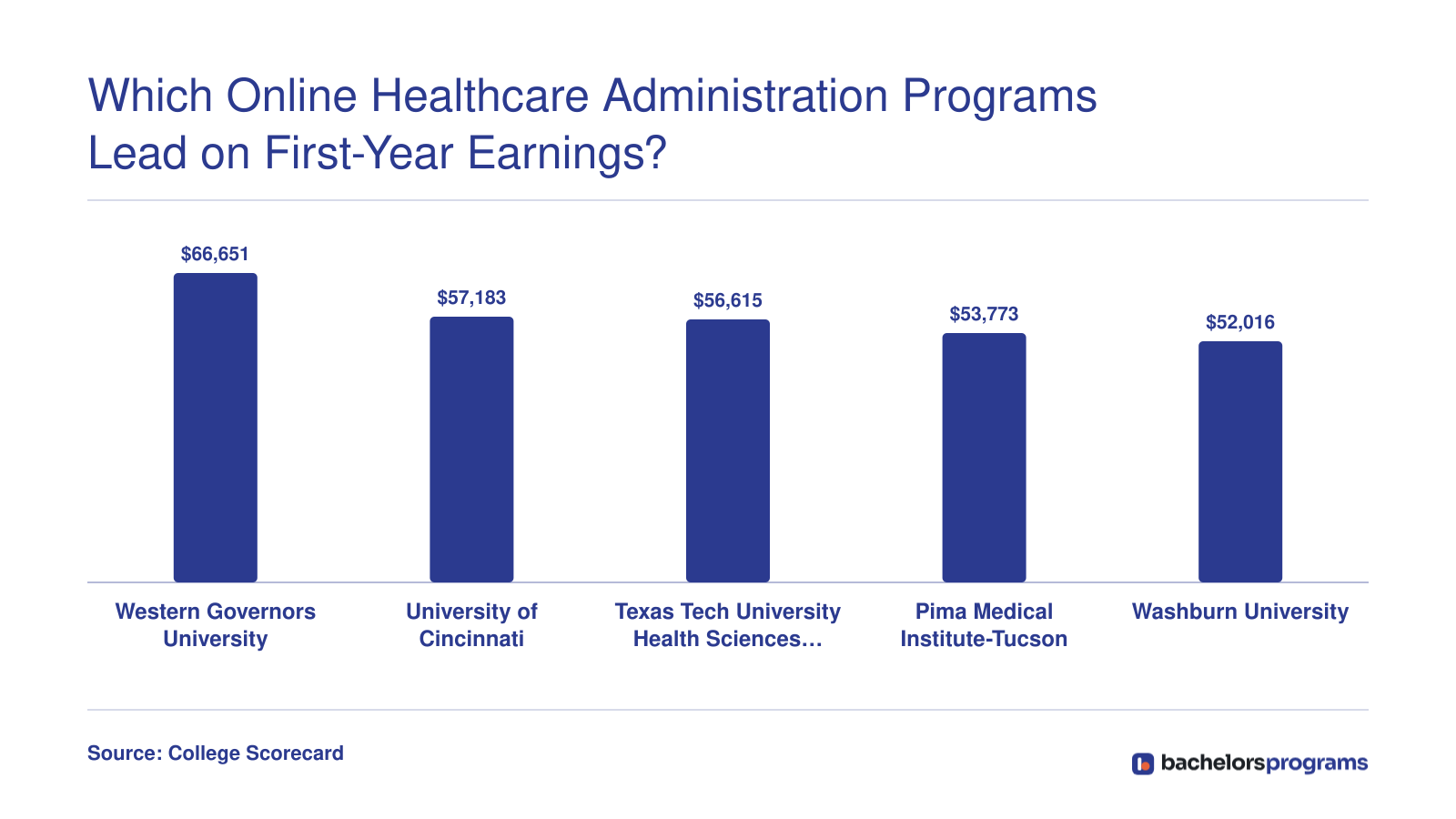
Which Online Healthcare Administration Programs Lead on First-Year Earnings?
Graduates of these fully online programs reported median earnings between $52,016 and $66,651 one year after completing their degree, according to the U.S. Department of Education's College Scorecard. Western Governors University leads this group at $66,651, about $14,600 ahead of Washburn University. Early earnings vary widely from school to school, so check a program's figure before you enroll. Keep in mind that degree-completion programs such as the University of Cincinnati's and Texas Tech University Health Sciences Center's admit students who already hold healthcare credentials. That prior experience can lift early pay.
Healthcare Administration programs by state
Quick Answers About Online Healthcare Administration Degrees
These short answers cover the questions prospective students ask most often. Use them as a starting point, then compare curriculum, credit rules and costs at the schools you are considering.
What is the best online healthcare administration degree program for most students?
What jobs can you get with an online healthcare administration bachelor's degree?
Can you earn an online healthcare administration degree with no prior healthcare experience?
Compare Healthcare Administration programs on the data that matters
Explore more Business & Management majors or browse every field of study.
All Business & Management programs Browse every field of study