Best Healthcare Administration Schools in Washington
Compare 6 accredited Healthcare Administration programs in Washington at 5 colleges, with net price after aid, graduation rates, earnings and debt from IPEDS and the U.S. College Scorecard.

For most Washington students, the first question is cost versus flexibility. In Washington, a bachelor's in healthcare administration prepares graduates to manage clinics, hospitals and long-term care operations. The degree often carries the title Bachelor of Science (B.S.) in Healthcare Administration, though some schools call it healthcare management.
The schools here differ sharply. Net price runs from $6,064 at Skagit Valley College to $13,886 at Eastern Washington University. Institution-wide graduation rates range from about 29 percent at Edmonds College to 43 percent at Eastern Washington. Formats span campus, hybrid and fully online.
A low net price means little if a cohort schedule clashes with a working adult's week.
Key Points
- Bellevue College graduates earned a median $72,695 four years after completion.
- Eastern Washington University's B.S. runs fully online at $8,586 in-state tuition.
- Nursing home administrators need a Department of Health license and national exam.
Best Healthcare Administration Schools in Washington: Our Ranked List
Washington has a compact but varied set of bachelor's-level healthcare administration options, and the five schools below run from a fully online university program to evening cohort models built around working adults. Each card gives the city, the format, in-state tuition, average net price after aid and an institution-wide graduation rate, so you can weigh cost against completion side by side. Graduation rates describe each school's entire undergraduate population, not the healthcare administration major alone.
Eastern Washington University
#1Cheney, WA · ~$14,000/yr (est.)
Best for: Transfer students entering the upper-division major
Eastern Washington University in Cheney offers a Bachelor of Science in Healthcare Administration delivered fully online with asynchronous classes, which makes it the most flexible university option on this list for students living anywhere in the state. The major includes a 200-hour internship that students complete in person within their own community, along with 100 service-learning hours, and it holds accreditation from the National Association of Long Term Care Administrator Boards. Students typically enter the upper-division major after roughly 90 quarter credits, an associate degree, or a direct-transfer pathway, and juniors can apply for the Maxine Keogh Health Services Administration Scholarship.
- Fully online asynchronous classes with a 200-hour internship in your own community
- 200-hour healthcare internship plus 100 service-learning hours
- Accredited by the National Association of Long Term Care Administrator Boards
- Enter after 90 quarter credits, an associate degree, or a transfer pathway
- Coursework in healthcare finance, operations, quality management, and HR
- Maxine Keogh scholarship for juniors with a 3.2 GPA and financial need
- American College of Healthcare Executives networking for students
- School cites the lowest tuition rates in Washington
Skagit Valley College
#2Mount Vernon, WA · $5,000 – $10,000/yr (est.)
Best for: Aspiring healthcare marketing and development leads
Skagit Valley College in Mount Vernon offers an applied bachelor's in healthcare management built around people-first leadership, systems thinking, and technology rather than a purely corporate approach. Online flexibility and community-based support let students keep working while they study, and the curriculum covers healthcare marketing, business development, human resources, and financial management. Graduates move toward roles such as healthcare marketing manager, business development lead, or HR director, and the program opens a fall entry point.
- Online flexibility with community-based support while you keep working
- Focus on people-first leadership, systems thinking, and technology
- Curriculum covers healthcare marketing, business development, and finance
- Prepares for roles such as business development lead or HR director
- Fall 2027 entry point
Bellevue College
#3Bellevue, WA · $11,000/yr (est. net price)
Best for: Radiologic technologists moving into management
Bellevue College runs a Bachelor of Applied Science in Healthcare Management and Leadership designed for working professionals who are ready to move into management, with two concentration options under one degree. The general healthcare management track covers leadership and the business side of hospitals, clinics, and health systems, while a second track is built specifically for imaging and radiation professionals. Students come in with healthcare, business, IT, or science backgrounds, and the degree also lays a foundation for master's-level study in health administration.
- Covers leadership plus the business and administrative side of healthcare
- For students with healthcare, business, IT, or science backgrounds
- Designed for working professionals moving into management roles
- Applies to hospitals, clinics, public health, and private practices
- Built for imaging and radiation professionals
- Develops practical healthcare administration skills for clinical leads
- Prepares students for master's-level education
Edmonds College
#4Lynnwood, WA · ~$11,000/yr (est.)
Edmonds College offers an applied bachelor's in integrated healthcare management through a hybrid evening format that blends on-campus and remote attendance, an arrangement aimed squarely at Seattle-area working professionals. Students move through as a cohort of about 25, meet twice a week from 6 to 9 pm, and complete two capstone projects that apply coursework to real problems in clinics, hospitals, and community health organizations. A dedicated program advisor stays with each cohort from start to finish, prerequisite courses are required before entry, and military benefits are accepted.
- Cohort-based: about 25 students move through the program together
- Evening classes from 6 to 9 pm, twice a week
- Attend on campus or remotely while keeping your job
- Two capstone projects, one per academic year
- A dedicated program advisor stays with you start to finish
- Coursework in systems thinking, equity, and health literacy
- Prerequisite courses required before entry
- Military benefits accepted
City University of Seattle
#5Seattle, WA
City University of Seattle is a private institution whose online Bachelor of Science in Healthcare Administration prepares graduates for leadership work in hospitals, clinics, long-term care facilities, and nonprofit health organizations. The curriculum spans healthcare finance, human resources, compliance, health informatics, policy, and marketing, ending in a hands-on capstone practicum, and the 10-week quarters let students move quickly through 180 credit hours. Rolling admissions, a $0 application fee, transfer credit options for accredited institutions, and support for veterans and active-duty service members make it an accessible route for adults balancing work and family.
- Rolling admissions with a $0 application fee
- 10-week quarters, 180 total credit hours across 36 courses
- Synchronous and asynchronous online courses, full time or part time
- Capstone practicum applying management skills to a real organization
- Transfer credits accepted from accredited institutions
- Coursework in healthcare finance, compliance, informatics, and policy
- Support for veterans and active-duty service members
Cost & outcomes by school
Federal data for the highest-earning Healthcare Administration programs, independent of the ranking above. Earnings are this field's bachelor's graduates four years after completing where the Scorecard reports them, else the school's undergraduate median.
| School | Net price / yr | Grad rate | Earnings | Debt | Grads/yr | Format |
|---|---|---|---|---|---|---|
| Bellevue College WA | $11,430 | 36% | $72,695 | $12,375 | 54 | Campus |
| City University of Seattle WA | — | — | $69,460 | $25,000 | 4 | Online |
| Eastern Washington University WA | $13,886 | 44% | $56,244 | $19,500 | 1 | Online |
| Edmonds College WA | $11,010 | 29% | $48,144 | $11,855 | 6 | Hybrid |
| Skagit Valley College WA | $6,064 | 36% | $43,505 | $13,805 | — | Online |
Sources: U.S. Department of Education. Net price, graduation rate, earnings and debt: College Scorecard (earnings and debt for this field's bachelor's graduates where reported, else school-wide); graduates: IPEDS. A dash means no figure is reported.
Cost, debt & payoff
Median earnings of this field's bachelor's graduates (4 yrs after completing, else the school's undergraduate median) vs. their median federal loan debt · U.S. College Scorecard
Across these programs the median graduate earns about $62,852 and finishes with roughly $13,090 in debt — a ratio that clears a common rule of thumb (keep debt below first-year salary). Net price and debt vary widely school to school, so check the per-school figures in the table above before you shortlist.
How We Ranked Washington Bachelor's in Healthcare Administration Schools
What the List Includes
Every school here is based in Washington and offers a bachelor's-level program in healthcare administration or a closely related healthcare management field. Campus, hybrid and online formats all qualify. The list works the same for a full-time student in Spokane and a working professional in Seattle.
The Measures Behind the Order
The list draws on federal College Scorecard data and focuses on outcomes that shape a student's return on the degree:
- Net price: what students pay on average once grants and scholarships are counted.
- Graduation rate: the share of students who finish their degree.
- Selectivity: how competitive admission is, based on acceptance rates.
- Earnings: what graduates earn after leaving school, where reported.
- Debt: how much graduates typically borrow to complete the degree.
What to Keep in Mind
Some of these figures describe the whole institution, not the healthcare administration program alone. The graduation rate and the net price describe the whole institution, and some earnings figures do too. Net price is an approximate average. Your own cost will depend on family income, residency and the aid package you receive.
Accreditation is verified school by school, and later sections on this page cover it in more detail. Treat these numbers as a starting point, then confirm current details with each school's admissions and financial aid offices before you apply.
Online and Hybrid Bachelor's in Healthcare Administration Options at Washington Schools
Eastern Washington University delivers its B.S. in Healthcare Administration fully online with asynchronous classes, at a listed in-state tuition of $8,586. It is one of three Washington-based schools here where a working adult can study online.
Fully Online
- Eastern Washington University: Asynchronous coursework means no set login times, which suits shift workers. The program is based in Cheney and includes a 200-hour internship.
- Skagit Valley College: The healthcare management bachelor's is delivered online, with listed tuition of $5,400. Classes start in fall.
- City University of Seattle: Synchronous and asynchronous online courses, part-time or full-time enrollment, rolling admissions and 10-week quarters. It is the priciest option here, at $515 per credit, with listed tuition of $13,929 for in-state and out-of-state students alike.
Hybrid and Campus
Edmonds College runs its Integrated Healthcare Management program as a hybrid cohort. Evening classes meet from 6 to 9 pm, and students can attend on campus or remotely. Tuition is listed at $4,810 in-state.
Bellevue College's Healthcare Management & Leadership program is listed as campus-based, so plan for regular attendance in Bellevue. Its in-state tuition of $4,436 is the lowest of the schools here.
What the Price Gap Tells You
Format does not drive cost as much as the type of institution does. The campus and hybrid programs at Bellevue and Edmonds cost less than the online programs at Eastern Washington and City University of Seattle. Skagit Valley's online option falls between them. Online students from outside the state would pay more at the public schools, since out-of-state rates run well above in-state tuition.
Internship logistics for online students, including how to complete placement hours away from campus, are covered in the accreditation and internship section.
Admission Requirements for a Bachelor's Degree in Healthcare Administration in Washington
Selectivity is not a major hurdle for these programs. Eastern Washington University admitted about 91 percent of applicants in the latest College Scorecard data, and statewide, bachelor's healthcare administration programs generally look for a cumulative GPA somewhere in the 2.0 to 2.7 range. Several of the schools below are built for students who already hold college credit. If you are finishing an associate degree at a Washington public community college, aim for a Direct Transfer Agreement (DTA) associate degree: qualifying graduates are generally eligible for junior standing with lower-division general education complete at Washington baccalaureate institutions. The DTA does not guarantee admission, so confirm each program's own prerequisites before you apply.
| School | Minimum GPA | SAT/ACT Policy | Transfer Credit | Entry Notes |
|---|---|---|---|---|
| Eastern Washington University | No published policy | No published policy | Requires prior coursework equal to at least 90 quarter credits (EWU lower-division courses, an AA-DTA, a related associate degree, or other coursework meeting EWU general education requirements) | Fully online, asynchronous Healthcare Administration (BS); transfer credits accepted |
| Skagit Valley College | No published policy | No published policy | No published policy | Online Management degree with a Healthcare Management focus; fall start |
| Bellevue College | No published policy | No published policy | No published policy | Campus-based Healthcare Management & Leadership degree designed for students with healthcare, business, IT or science backgrounds |
| Edmonds College | No published policy | No published policy | No published policy | Hybrid Integrated Healthcare Management degree; prerequisite courses required; cohort-based with fall start and evening classes |
| City University of Seattle | No published policy | No published policy | Accepts transfer credits from accredited institutions | Online B.S. in Healthcare Administration; rolling admissions and $0 application fee |
Cost of a Bachelor's Degree in Healthcare Administration in Washington
Tuition is the smallest part of what a healthcare administration bachelor's costs in Washington. The bigger number is net price, which adds living expenses and subtracts aid. Published in-state tuition and fees run from $4,436 a year at Bellevue College to $8,586 at Eastern Washington University. Average net price after grants, which folds in housing, books and other costs, runs from $6,064 at Skagit Valley College to $13,886 at Eastern Washington. Treat net price as an approximate average for aided students, since your figure depends on household income and size.
Washington College Grant
The Washington College Grant is need-based aid for state residents who hold a diploma or equivalent, have no prior bachelor's degree and enroll at an eligible Washington college.1 For 2026-27, a family of four earning up to $83,500 qualifies for the full award, and partial awards continue up to $139,500.1 Above 60% of state median family income, awards are prorated, dropping to 10% of the maximum at the top of the eligible range.4
Maximum awards vary by school. For 2026-27 the cap is $8,535 at Eastern Washington and $8,634 for applied bachelor's programs at community and technical colleges, which covers the Skagit Valley, Bellevue and Edmonds options.4 The grant cannot exceed tuition and required fees. Part-time students receive 75%, 50% or 25% of a full award depending on credit load3, and eligibility ends after 15 full-time quarters.2 College Bound Scholarship recipients get additional aid calculated after the College Grant, with amounts set by institution.5 Eastern Washington also lists a Maxine Keogh scholarship for healthcare administration juniors.
Debt and Monthly Payments
Graduates of Bellevue College's healthcare management program carry median debt of $17,586. On a standard 10-year repayment plan, that is about $147 a month before interest. School-wide median debt for all graduates sits at $19,500 at Eastern Washington, $13,805 at Skagit Valley and $11,855 at Edmonds College.
Lowering Your Cost
Complete general education credits at a Washington community college, where tuition is lowest, before moving into upper-division coursework. Eastern Washington accepts transfer credits, while Skagit Valley, Bellevue and Edmonds let you finish the entire bachelor's at a community college campus.
What Graduates Earn and Borrow: Program Outcomes by School
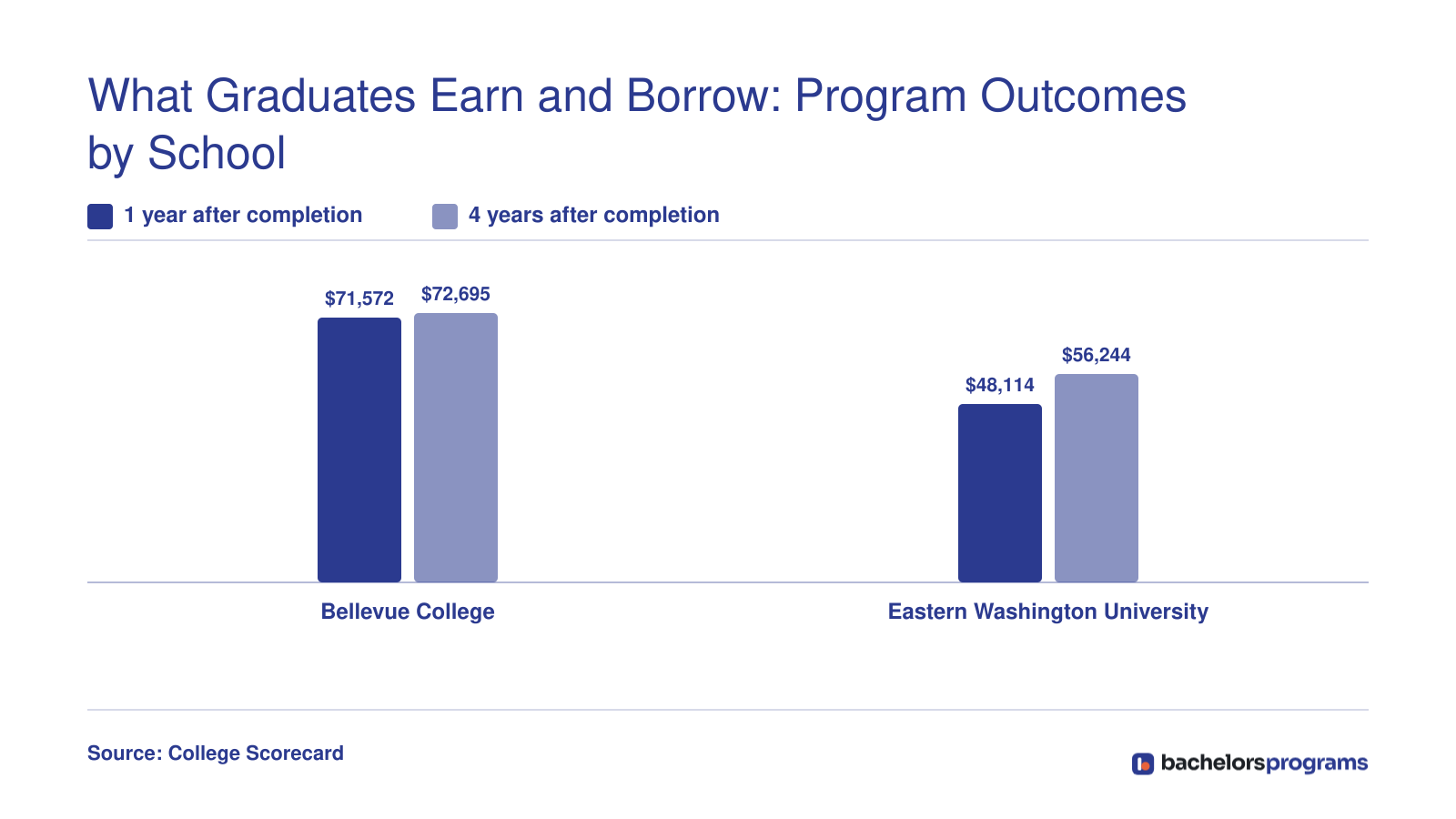
Bellevue College's healthcare management graduates earned a median $72,695 four years after completing the program, against a median program debt of $17,586, or roughly a quarter of one year's pay. Eastern Washington University's healthcare administration graduates earned a median $56,244 four years after finishing and $62,119 at five years. The chart below compares both programs at one year and four years after completion.
Related Articles
Healthcare Administration Careers and Earnings in Washington
Healthcare administration careers in Washington are concentrated in the places where care is delivered and paid for: hospitals and health systems, outpatient clinics, long-term care communities, public health agencies, and the managed care organizations that coordinate coverage. A bachelor's degree in healthcare administration prepares graduates for the operational side of those settings, including scheduling, billing, compliance, staffing, and department-level budgeting.
Where the Jobs Are
Hospitals and large health systems in the Puget Sound region and Spokane hold the largest number of administrative roles, from patient access to service-line operations. Clinics and physician groups hire practice managers and office supervisors. Long-term care and assisted living providers need administrators and resident-services leaders, while public health agencies and community organizations hire program coordinators and grants administrators.
What the Pay Looks Like
Washington employs about 7,660 medical and health services managers, with an employment concentration of 1.6, meaning the occupation is more concentrated here than nationally.1 The statewide median annual wage is $176,0001, well above the national median of $123,860 for 2025.2 Pay at the lower end is still substantial: the 10th percentile in Washington is $110,660.1 Across all occupations, the Seattle-Tacoma-Bellevue area averaged $44.13 an hour in May 2025, compared with $33.54 nationally, a broad sign of the metro's higher wage floor.3
Starting Below the Median
New graduates rarely step straight into a manager role. Typical first jobs include patient services coordinator, clinic office supervisor, operations analyst, and assistant department administrator, and those positions generally pay below the manager median. The graduate earnings reported in our outcomes section are a separate measure from these occupational wages, so compare them as two different signals: what early-career alumni earn and what experienced managers in the field earn statewide.
Washington Median Pay for Medical and Health Services Managers
For graduates who move into management roles, Washington pay for this occupation sits well into six figures.
Nursing Home Administrator Licensure in Washington: How a Bachelor's Degree Fits In
What does it take to become a licensed nursing home administrator in Washington? The Washington Department of Health issues the license, and the path runs through a degree, supervised training and a national exam.1
The Department of Health Pathway
Applicants must be at least 21 and hold a baccalaureate degree from a recognized institution.1 Unless an exemption applies, they also complete a board-approved 1,500-hour Administrator in Training program, generally a nine-month Administrator Residency, in a Washington-licensed nursing home. Board approval comes before training begins, and the preceptor must have at least three years of experience as a licensed administrator, work full time at the facility, hold an unrestricted license and complete a NAB preceptor course.2 The exam is the NAB National Examination, with a passing score of 113; Washington does not require a separate state exam.2 Documentation of prior health care or management experience is part of the application3, and the Department publishes current rules and fees on its licensing page.
How a Healthcare Administration Degree Counts
The state requires a bachelor's degree but does not limit it to one major. Health administration and nursing are named in the training rules as fields that qualify for the reduced-hour pathway, which makes a B.S. in Healthcare Administration a natural fit on both counts. Students may enroll in a degree program while completing training if they submit proof of enrollment, but the completed transcript must reach the Department before approval to sit for the NAB exam. Transcripts go directly from the school.
Ask Before You Enroll
Programs rarely advertise licensure readiness, so ask admissions directly whether the curriculum covers long-term care administration and whether graduates have used the degree toward this license. Confirm the current requirements with the Department of Health licensing page, since rules and fees change.
Questions to Ask Yourself
Can you keep working while you study, and still complete an internship close to home?
Do you intend to pursue nursing home administrator licensure in Washington?
How many community college credits will actually transfer?
Does the program's focus match the job you want?
Compare Healthcare Administration programs on the data that matters
Explore more Business & Management majors or browse every field of study.
All Business & Management programs Browse every field of study