Best Management Information Systems Degree Programs
Compare 270+ accredited Management Information Systems programs, with net price after aid, graduation rates, earnings and debt from IPEDS and the U.S. College Scorecard.

Employers increasingly want hires who can read a balance sheet and scope a database project. That overlap is the core of a bachelor's degree in management information systems, most often awarded as the Bachelor of Science (B.S.) in Management Information Systems.
The programs ranked here vary more than the shared major name suggests. Net price after aid starts at $9,812 for the University of South Florida and reaches $21,620 at Binghamton University. Median first-year earnings span $55,972 at USF to $86,622 at UT Austin.
Because curricula overlap heavily, that gap tends to trace back to internship access, recruiter pipelines, and the regional job market each campus feeds.
Key Points
- The University of Texas at Austin posts the strongest first-year earnings here.
- Most MIS majors finish with a B.S. or a BBA degree.
- Online MIS degrees usually come from different schools than flagship campus programs.
The 10 Best Management Information Systems Degree Programs for 2027
The strongest management information systems programs are not separated by name recognition alone. What defines this group is a combination of solid completion outcomes, net prices that stay within reach after aid, and curricula that pair business fundamentals with real technical coursework. Every school here offers a bachelor's degree in management information systems, or a close business-school equivalent, on campus, and each entry notes the net price and schoolwide graduation rate a family would weigh before applying.
University of Georgia
#1Athens, GA · ~$14,000/yr (est.)
Best for: Business majors adding analytics depth
The University of Georgia runs its MIS major through the Terry College of Business, where a compact 21-hour major sits inside a 120-hour degree. Students choose electives such as business intelligence, cloud computing, and information security, and can add an area of emphasis in analytics or cybersecurity. Median earnings for MIS graduates one year after finishing were about $78,190, among the strongest in this group.
- 21 hours of major coursework inside a 120-hour degree
- Required courses include data management and systems analysis
- Area of emphasis options in business analytics and cloud computing
- Electives span business intelligence, cybersecurity, and energy informatics
- Admission requires a 2.6 GPA plus math and accounting prerequisites
- Double Dawgs pathway links the bachelor's to a master's degree
- Industry advisory board awards scholarships to MIS majors
Florida State University
#2Tallahassee, FL · ~$11,000/yr (est.)
Best for: Students who want a set four-year map
Florida State University's MIS major lives in the Department of Business Analytics, Information Systems and Supply Chain inside the College of Business. Students typically certify into the college in junior year and follow an eight-semester academic map that keeps a four-year finish on track. An Association for Information Systems chapter, international programs, and a combined bachelor's/master's pathway that double counts up to nine credits give majors room to specialize.
- Housed in the Department of Business Analytics, Information Systems and Supply Chain
- Students typically certify into the College of Business in junior year
- Eight-semester academic map supports a four-year finish
- Combined bachelor's/master's pathway double counts up to nine credits
- Association for Information Systems student chapter on campus
- Coursework covers systems design, databases, and programming languages
The University of Texas at Austin
#3Austin, TX · ~$20,000/yr (est.)
Best for: Future analysts targeting corporate technology roles
The University of Texas at Austin delivers its MIS degree through the McCombs School of Business as a 120-hour BBA with 21 hours of major coursework. Required courses run from database management and web application development to business system development and strategic IT management, and at least 24 business hours must be completed in residence. MIS graduates reported median earnings of about $86,622 one year after finishing, the highest figure in this group.
- 21 hours of major coursework within a 120-hour degree
- Required courses include database management and web application development
- Also required: business system development and strategic IT management
- 2.0 GPA in business courses required to stay in the major
- 24 business hours, including 12 upper-division major hours, in residence
- Suggested plan sequences calculus, statistics, accounting, and finance
University of South Florida
#4Tampa, FL · ~$10,000/yr (est.)
The University of South Florida's Muma College of Business houses the School of Information Systems, which offers a bachelor's degree in Business Analytics and Information Systems alongside two other undergraduate programs. Majors pick a concentration in business intelligence or healthcare analytics, and the school also runs a separate bachelor's in information assurance and cybersecurity management. A certificate in business analytics gives non-business students a shorter entry point.
- Two concentrations: business intelligence and healthcare analytics
- One of three undergraduate programs in the School of Information Systems
- Coursework applies technology to business problems
- Separate bachelor's in information assurance and cybersecurity management
- Undergraduate certificate in business analytics open to non-business majors
University of Wisconsin-Madison
#5Madison, WI · ~$17,000/yr (est.)
The University of Wisconsin-Madison School of Business, which holds AACSB International accreditation, builds its information systems BBA around a required capstone and a blend of databases, systems analysis, digital strategy, and data science programming. Students work in teams on real business applications and are assigned both an academic advisor and a career coach. The Information Systems Society and a 120-credit total round out a program with strong placement in technology-driven roles. Median earnings one year after finishing were about $73,506.
- School of Business holds AACSB International accreditation
- 120 credit hours with a required capstone
- 3.0 GPA minimum and prerequisite courses to declare
- Coursework spans databases, systems analysis, digital strategy, and data science
- Each student is assigned an academic advisor and a career coach
- Information Systems Society student organization
Ohio State University
#6Columbus, OH · $17,000/yr (est. net price)
Ohio State's Fisher College of Business admits Columbus campus students directly to the information systems major and its management information systems specialization. The curriculum stacks accounting, economics, and statistics principles under major courses in discrete mathematics, programming, data structures, file processing, and database systems. Internships are optional, though 95 percent of students registered with the Office of Career Management have held one, and four Honors programs are available.
- Fisher College of Business major with an information systems specialization
- Columbus campus admits are admitted directly to the Fisher major
- Required: programming, data structures, file processing, database systems
- Internships optional, but 95% of registered students have held one
- Four Honors programs available to business students
- Information Systems Association student organization
- Study abroad through Global Business
Texas A&M University-College Station
#7College Station, TX · ~$21,000/yr (est.)
Texas A&M University splits its 120-hour MIS degree evenly between lower-level business courses and upper-level MISY coursework in the Department of Information and Operations Management. Students add a business programming course in the second-year fall, then move into network communications, systems analysis and design, database programming, and a capstone project. A three-semester seminar sequence, an international elective, and MISY directed electives round out the degree.
- 120 credit hours split between lower-level business and upper-level MISY
- Business programming logic required in the second-year fall
- Upper-level courses include network infrastructure and database programming
- Information systems capstone project required
- Three semesters of ISTM seminar, three credits total
- International elective and MISY directed electives required
University of Houston
#8Houston, TX · $10,000 – $23,000/yr (est.)
The University of Houston's C.T. Bauer College of Business frames its MIS major around business analysis rather than software development, with 42 credit hours of major coursework. Students take systems analysis and design, information systems development tools, database management, and IT project management before choosing six credit hours of advanced MIS electives. An accelerated B.B.A./M.S. pathway lets undergraduates count graduate courses toward the bachelor's, and a business writing evaluation must be cleared before graduation.
- 42 credit hours of MIS major coursework
- Trains business analysts rather than programmers
- Required: systems analysis and design, database management, IT project management
- 6 credit hours of advanced MIS electives
- Accelerated B.B.A./M.S. pathway counts graduate courses toward the bachelor's
- Bauer Code of Ethics and a business writing evaluation required
Binghamton University
#9Vestal, NY · $20,000 – $25,000/yr (est.)
Binghamton University's School of Management offers MIS as one of seven concentrations inside its BS in Business Administration, and analytics requirements are built into the curriculum so students learn to interpret and communicate data. The school describes itself as the top provider of new hires to PwC and EY in New York City, with KPMG, Deloitte, Bank of America, and Citi also recruiting. Students manage a half-million-dollar portfolio in a student-run trading room and often intern over winter and summer breaks.
- MIS is one of seven concentrations in the business administration BS
- Analytics requirements built into the curriculum
- Top provider of new hires to PwC and EY in New York City
- Student-run trading room manages a $500,000 portfolio
- Internships typically fall in winter and summer breaks
- MBA can be added with one extra year
University of Oklahoma
#10Norman, OK · $15,000 – $20,000/yr (est.)
The University of Oklahoma's business school holds AACSB accreditation, and its MIS curriculum was built with industry representatives to cover programming, database design, cybersecurity, data visualization, and enterprise systems. The capstone works as a mini internship, and a field project has students propose technology solutions for actual companies. The MIS Student Association and Center for MIS Studies add community and scholarship support, and an accelerated BBA/MS option shortens the path to a graduate degree.
- Business school holds AACSB accreditation
- Capstone works as a mini internship with a real-world field project
- Coursework includes programming, database design, cybersecurity, data visualization
- Curriculum developed with industry representatives
- Accelerated BBA/MS option shortens the path to a graduate degree
- MIS Student Association and Center for MIS Studies
Cost & outcomes by school
Federal data for the highest-earning Management Information Systems programs, independent of the ranking above. Earnings are this field's bachelor's graduates four years after completing where the Scorecard reports them, else the school's undergraduate median.
| School | Net price / yr | Grad rate | Earnings | Debt | Grads/yr | Format |
|---|---|---|---|---|---|---|
| Santa Clara University CA | $50,062 | 88% | $153,926 | $19,995 | — | Campus |
| The University of Texas at Austin TX | $19,857 | 89% | $127,158 | $18,750 | 203 | Campus |
| Villanova University PA | $43,756 | 92% | $118,712 | $25,874 | 1 | Campus |
| University of Illinois Urbana-Champaign IL | $14,355 | 85% | $116,339 | $19,300 | — | Campus |
| Carnegie Mellon University PA | $31,944 | 94% | $114,862 | $21,750 | — | Campus |
| University of Georgia GA | $13,936 | 90% | $113,184 | $17,261 | 391 | Campus |
| University of Pennsylvania PA | $28,699 | 97% | $111,371 | $15,715 | — | Campus |
| Ohio State University OH | $17,339 | 88% | $110,192 | $20,500 | 108 | Campus |
| Binghamton University NY | $21,620 | 82% | $109,721 | $16,808 | 98 | Campus |
| University of Dayton OH | $29,533 | 80% | $107,354 | $26,500 | 35 | Campus |
| University of Delaware DE | $17,799 | 81% | $107,062 | $25,182 | 104 | Campus |
| Lehigh University PA | $36,931 | 88% | $105,584 | $21,960 | — | Campus |
Sources: U.S. Department of Education. Net price, graduation rate, earnings and debt: College Scorecard (earnings and debt for this field's bachelor's graduates where reported, else school-wide); graduates: IPEDS. A dash means no figure is reported.
Cost, debt & payoff
Median earnings of this field's bachelor's graduates (4 yrs after completing, else the school's undergraduate median) vs. their median federal loan debt · U.S. College Scorecard
Across these programs the median graduate earns about $62,117 and finishes with roughly $22,182 in debt — a ratio that clears a common rule of thumb (keep debt below first-year salary). Net price and debt vary widely school to school, so check the per-school figures in the table above before you shortlist.
Behind the Numbers: Scoring Outcomes, Cost, and Completion
A glossy brochure promises outcomes, while federal data has to show them. Each program was measured against the second kind of evidence.
What Goes Into the Scores
Four inputs shape each program's standing:
- Net price: what students pay on average once grants and scholarships are applied, not the sticker tuition.
- Completion and retention: how many students finish and how many return after the first year.
- Earnings and debt: College Scorecard figures for the MIS program itself, where they are published.
- Delivery format: whether the degree is offered on campus, online, or both.
Two Levels of Data
The numbers describe different things, and it helps to keep them apart. Earnings and debt for MIS graduates come from Scorecard program-level data. Graduation rate and 10-year earnings describe the whole institution, so they reflect every major on campus, not just information systems.
That difference matters when you compare schools. A strong institutional graduation rate is a good sign of student support, but it does not prove the MIS major itself performs the same way.
Limits Worth Knowing
The net price figure averages aid across all students, so your own quote will differ based on income, residency, and scholarships. Some smaller programs have no published earnings or debt figures. Those schools are ranked on the remaining measures rather than left out.
What a Bachelor's Degree in Management Information Systems Covers
A bachelor's degree in management information systems pairs a standard business education with hands-on training in how organizations build, run, and secure their technology. Graduates typically earn a Bachelor of Science or a Bachelor of Business Administration, and the coursework trains you to translate between business leaders and technical teams.
Core Coursework and Credits
The business side usually includes accounting, finance, and management. The technology side adds systems analysis and design, database management, networking, programming fundamentals, and project management. Business strategy, applied technology, and data analysis are the three threads that run through most curricula.
Published program pages from the University of Massachusetts Dartmouth, Florida Atlantic University, and Northwest Missouri State University all list 120 credit hours, which is a four-year full-time path.1 Several ranked schools, including Texas A&M, the University of Texas at Austin, and the University of Houston, also list 120. How those credits are divided varies. Northwest Missouri State publishes a split: 44 to 47 general education credits, 48 common professional credits, 18 required MIS credits, a 9-credit cybersecurity emphasis, and a 3-credit advisor-approved elective.1 Mount Vernon Nazarene University lists a 36-credit MIS core.2
Common Concentrations
Concentrations differ by school, but these themes recur:
- Cybersecurity: Prepares you to assess technology risk and protect systems and data.
- Business analytics: Builds skills in turning data into decisions. Mount Vernon Nazarene lists it among five 15-credit concentrations.2
- Databases and data management: Often built into the core rather than offered separately. Miami University, for example, requires a database course.3
- Enterprise systems: Focuses on the large platforms that run finance, supply chain, and operations.
Among the ranked schools, the University of Georgia lists four concentration options and Binghamton lists seven, and the University of South Florida runs a separate cybersecurity management major.
The Capstone
Many programs finish with a capstone that integrates earlier coursework. Temple, Miami, the University of Wisconsin-Madison, and Texas A&M all require one.4 At the University of Oklahoma, the capstone course works like a mini internship, giving you a chance to apply your skills to a real business problem before graduation.
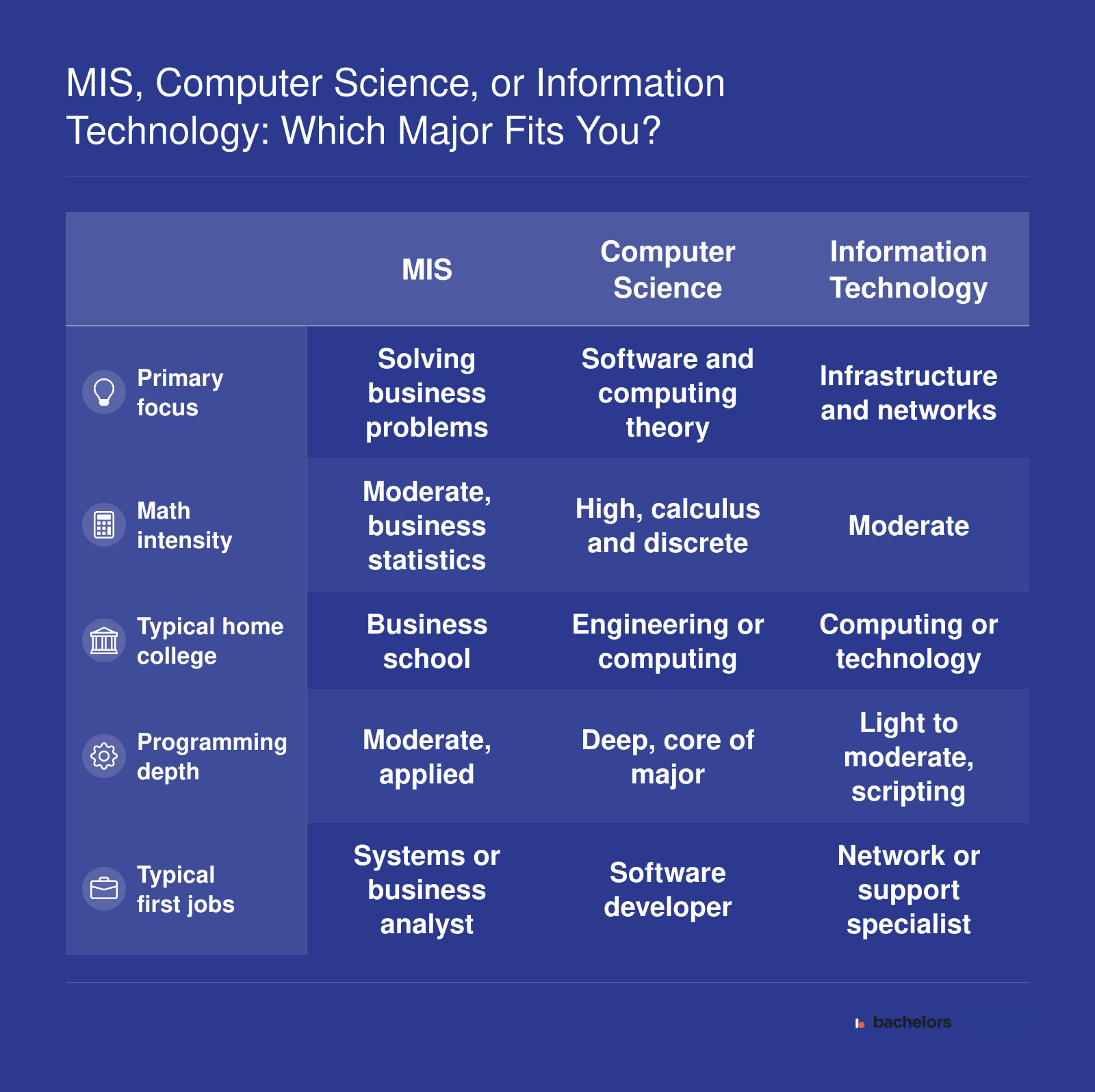
MIS, Computer Science, or Information Technology: Which Major Fits You?
Management information systems, computer science, and information technology are often confused, but each major trains you for a different role. MIS suits students who want to translate between executives and technical teams. CS is for students who want to build software, and IT is for students who want to run and secure systems.
Online vs. Campus MIS Programs: How Delivery Really Differs
Can you finish a management information systems degree online without ever setting foot on campus?
At some schools, yes, but the online route usually runs through a different kind of institution than the flagship campus programs. The programs ranked here are campus-based degrees at their main locations, so a reader set on fully online study will mostly be comparing schools that built separate online divisions, such as Colorado State University Global, Washington State University Global Campus, the University of Illinois Springfield, and Maryville University.
What "Online" Usually Means
Most online MIS coursework runs through a learning management system on terms shorter than a semester. Colorado State University Global delivers its MIS and business analytics courses 100% online and asynchronously in 8-week blocks. Washington State's Global Campus runs a completely online MIS major with 7-week upper-division sessions and estimates 15 to 20 hours of study per week.1 UMass Dartmouth describes its online MIS Technology & Management program as mostly asynchronous, Maryville requires no campus visits, and UIS's online MIS follows the same curriculum as its on-campus version.2
Proctoring and Technology
Asynchronous does not always mean unmonitored. A Summer 2026 MIS course at Texas A&M-Texarkana was fully online yet required Respondus Monitor for three closed-book, multiple-choice exams of 50 questions in 120 minutes, taken remotely or at an approved testing center.3 Washington State specifies a Windows computer, so ask about webcam, browser, and software licensing before enrolling.1
Which Format Fits You
Working adults tend to do better in 7- or 8-week asynchronous terms that let them take one course at a time. Internships complicate the picture: UIS's MIS bachelor's includes at least 3 semester hours of internship coursework, and the catalog does not promise it can be completed remotely.2 Transfer students should confirm how many credits the shorter term format will accept.
Same Diploma, Same Accreditation
Memphis states that eligible online coursework earns the same MIS degree as studying on campus.4 Confirm the online version carries the same business accreditation as the in-person program before you commit.
How Much Does a Management Information Systems Degree Cost?
The price of a management information systems degree comes in several different numbers: the tuition a university publishes, the net price students actually pay once grants and scholarships are counted, and the federal debt they carry when they finish. At public universities, published tuition also splits by residency, which is where the widest gaps appear.
Net Price After Aid
Among the schools here, average net price ranges from $8,752 at Florida Atlantic University to $17,339 at Ohio State University. Much of the group lands in the low-to-mid teens: University of South Florida at $9,812, Florida State at $11,297, University of Georgia at $13,936, and University of Houston at $14,276.
That figure is an average, not a sticker quote. It spreads grants and scholarships across all first-year full-time students, so a student paying full freight, or one holding a large merit award, will land above or below it.
Why Residency Moves the Number
In-state and out-of-state rates diverge sharply. Florida Atlantic publishes $4,879 for Florida residents against $17,324 for everyone else, a gap of roughly $12,400 a year. Ohio State runs $13,244 in-state and $40,022 out-of-state, Michigan Tech $20,532 against $44,807, and Wayne State $16,159 against $34,650. Check residency rules, regional tuition agreements, and any separate program fee before comparing financial aid offers side by side.
Program-Level Debt at Completion
Median federal debt among graduates of these MIS programs clusters fairly tightly. It sits at $15,250 at the University of Hawaii at Manoa, $15,375 at Houston, $16,250 at Florida Atlantic, and $17,318 at Florida State. Michigan Tech ($28,000) and Montana Tech ($28,125) run highest. On a standard 10-year repayment plan, those program-level medians translate to roughly $162 to $298 a month.
Top First-Year Earnings for MIS Graduates
The University of Texas at Austin posts the strongest early payoff among the schools ranked here.
Related Articles
Where an MIS Career Can Lead: Systems Manager Pay
Computer and information systems management is a common long-term goal for MIS graduates, and it is one of the higher-paying paths in the field.
Checklist for Choosing an Accredited MIS Program
Use this checklist to confirm that a bachelor's in management information systems carries the credentials, transfer terms, and career support that match your goals. Check every claim against official directories and the school catalog, not marketing pages.
- Confirm institutional (regional) accreditation firstThis is the baseline. Federal financial aid and smooth credit transfer depend on it, and ABET only accredits programs at regionally accredited institutions.
- Check AACSB status for the business schoolMost MIS majors sit inside business schools, so AACSB accreditation signals the quality of the business core around your major. AACSB accredits the school or unit, not the MIS major itself. Search the AACSB directory by institution name.
- Look for ABET accreditation where it adds valueFew MIS programs hold ABET Computing Accreditation Commission status. It matters most if you want a technical, systems-heavy curriculum. ABET's information systems criteria require at least 30 semester credit hours of core IS topics plus 15 more of cohesive IS coursework. Use ABET's Accredited Program Search to match the exact degree title, campus, and delivery format.
- Get transfer credit evaluated in writingEach school sets its own transfer limits. Many accept about half of a 120-credit degree, but the cap varies, and accepted credits may count as electives rather than toward the major. Ask whether your community college has an articulation agreement for MIS specifically, and whether industry certifications earn credit.
- Review accelerated pathways closelySome degree-completion formats have strict entry rules. Bellevue University's online accelerated B.S. in MIS, for example, requires 60 transfer credits or an associate degree plus IT work experience.
- Ask for career outcomesLook for internships, capstones built with employer partners, and placement data published by career services.
Management Information Systems programs by state
Compare Management Information Systems programs on the data that matters
Explore more Business & Management majors or browse every field of study.
All Business & Management programs Browse every field of study