Best Computer Information Systems Degree Programs
Compare 460+ accredited Computer Information Systems programs at 450+ colleges, with net price after aid, graduation rates, earnings and debt from IPEDS and the U.S. College Scorecard.

A bachelor's degree in computer information systems blends business problem-solving with hands-on technology: database design, systems analysis, networking, and the software an organization runs on. The credential is typically the Bachelor of Science (B.S.) in Computer Information Systems, and every program here is undergraduate.
Cost against outcome drives the decision. Where programs report first-year results, median earnings run from about $49,000 to more than $80,000, while median graduate debt spans roughly $11,000 to $32,000.
Employers want cloud, database and security fluency layered on business analysis, so a program that thins its technical core sends graduates out with coursework instead of a portfolio.
Key Points
- BYU graduates' median earnings rise from $80,934 to $113,338 by year four.
- The lowest net price schools here are public, with in-state tuition near $7,400.
- Planning a cybersecurity focus? Look for the NSA- and DHS-backed CAE-CD designation.
Best Schools for a Bachelor's Degree in Computer Information Systems
These ten schools offer the strongest bachelor's degree in computer information systems programs across every delivery format, from large public business schools to a fully online option. Each entry covers what the program teaches, how students progress through it, and what graduates report earning after finishing, so you can compare cost, completion and outcomes in one place.
University of Florida
#1Gainesville, FL · ~$7,000/yr (est.)
Best for: Business-track students aiming at analyst roles
The University of Florida runs information systems inside the Heavener School of Business, pairing a full business core with database, networking and systems analysis coursework. JPMorganChase is a named program partner and regular recruiter. Median earnings reach $126,268 four years after finishing, with $15,000 in median debt.
- 120 total credit hours, 2.0 GPA minimum in core and major work
- Internship or externship of at least 150 hours required
- Six weeks of study abroad can waive the internship requirement
- Major includes Database Management and Business Data Communications
Brigham Young University
#2Provo, UT · $15,000 – $20,000/yr (est.)
Best for: Applicants who already finished business prerequisites
BYU's Marriott School keeps the major compact at 64 credit hours, with a seven-course core that runs from database systems to AI in business and 22 upper-level electives to choose from. The university graduates 81% of its students, and program graduates report median earnings of $113,338 four years after finishing.
- 64 credit hours in the major after prerequisites
- Seven-course IS core runs from database systems to AI in business
- Students choose 2 of 22 upper-level electives
- Prerequisites include accounting, intro to IS and programming
- Formal application and acceptance required for the major
Amridge University
#3Montgomery, AL · $5,000 – $10,000/yr (est.)
Best for: Working adults needing a fully online degree
Amridge University is a small private institution in Montgomery, Alabama, built around distance learning. The information systems management degree totals 128 semester hours, including a 32-hour concentration, and courses run four semester hours at a time. Full-time tuition is $395 per semester hour.
- 128 semester hours: 40 general education, 60 required, 28 electives
- 32-hour concentration in information systems management
- Courses carry 4 semester hours each
- $395 per semester hour full-time, $455 part-time
- At least 40 of the 128 hours must be earned at Amridge
University of Wisconsin-Madison
#4Madison, WI · ~$17,000/yr (est.)
The Wisconsin School of Business offers a 19-credit information systems major inside a 120-credit BBA, blending systems coursework with a broad business foundation. Admission requires a 3.0 GPA and a fall start, and the university graduates about 90% of its students. Program graduates report median earnings of $119,655 four years after finishing, with $20,500 in median debt.
- 19-credit major inside a 120-credit BBA
- Major courses include Introduction to Databases and Systems Analysis and Design
- 3.0 GPA and prerequisite courses required for admission
- Fall start only, with applications due mid-March
- AACSB International accreditation
The University of Texas at Dallas
#5Richardson, TX · $18,000/yr (est. net price)
UT Dallas awards its CIS degree through the Naveen Jindal School of Management, which U.S. News placed at No. 16 among undergraduate MIS programs. Coursework centers on turning business requirements into IT solutions, with internships and a Professional Leadership Program adding experience. Graduates report median earnings of $103,603 four years after finishing.
- Fast-track path lets students earn a bachelor's and a master's
- Internships and a Professional Leadership Program available
- Coursework covers data analytics, AI and machine learning, cloud computing
- Scholarships offered to incoming freshmen and transfer students
California State University-Long Beach
#6Long Beach, CA · $7,000 – $20,000/yr (est.)
Cal State Long Beach combines a business administration core with three required information systems courses and a choice of application development, business analytics or cyber security. The College of Business is AACSB accredited, and an advisory board connects students to internships. Program graduates report median earnings of $76,664 four years after finishing, with $12,500 in median debt.
- Three core courses: Business Programming, Database, Systems Analysis
- Three paths: Application Development, Business Analytics, Cyber Security
- SAP University Alliance partner with an IS Advisory Board
- Information Systems minor also available
CUNY Bernard M Baruch College
#7New York, NY · $7,000 – $15,000/yr (est.)
Baruch College blends technical and managerial coursework, so programming and data warehousing sit alongside IT audit and e-business. The BBA comes from the Paul H. Chook Department of Information Systems and Statistics, and graduates move into IT roles across finance, media and public agencies. Graduates report median earnings of $85,870 four years after finishing, with $10,750 in median debt.
- Technical work in programming, data warehousing, web application design
- Managerial courses cover IT audit, e-business and green IT
- Learning goals include relational database design and systems analysis
- Offered by the Paul H. Chook Department of Information Systems and Statistics
California State Polytechnic University-Pomona
#8Pomona, CA · $10,000 – $15,000/yr (est.)
Cal Poly Pomona runs the CIS option inside its business administration degree with a learn-by-doing emphasis on business applications, cybersecurity and business intelligence. A student cyber team competes internationally in ethical hacking, and graduates move into roles such as computer forensics examiner and DevOps engineer. The university graduates 68% of its students.
- Learn-by-doing coursework in business apps, cybersecurity, business intelligence
- Student cyber team competes internationally in ethical hacking
- Career paths include computer forensics examiner and DevOps engineer
- College of Business Administration scholarships available
Indiana University-Bloomington
#9Bloomington, IN · $12,000 – $42,000/yr (est.)
Indiana University Bloomington delivers information systems as a Bachelor of Science in Business through the Kelley School of Business, following a published academic pathway built around on-time completion. The university graduates about 80% of its students. Program graduates report median earnings of $98,539 four years after finishing, with $19,500 in median debt.
- Bachelor of Science in Business from the Kelley School of Business
- Academic pathway mapped for on-time completion
Florida International University
#10Miami, FL · ~$9,000/yr (est.)
Florida International University splits its 120-credit information systems BBA evenly between lower and upper division and offers an optional Business Information Security Track of four electives. Required courses cover application programming, systems analysis and design, database applications and security. Graduates report median earnings of $90,397 four years after finishing, with $16,500 in median debt.
- 120 credits: 60 lower-division and 60 upper-division
- Required IS courses include Business Application Programming and Database Applications
- Capstone: Managing Digital Services and Innovation
- Business Information Security Track adds 12 elective credits
- Major courses require a grade of C or higher
Cost & outcomes by school
Federal data for the highest-earning Computer Information Systems programs, independent of the ranking above. Earnings are this field's bachelor's graduates four years after completing where the Scorecard reports them, else the school's undergraduate median.
| School | Net price / yr | Grad rate | Earnings | Debt | Grads/yr | Format |
|---|---|---|---|---|---|---|
| Northwestern University IL | $29,167 | 95% | $163,740 | $11,425 | 141 | Online |
| Boston College MA | $41,704 | 91% | $131,090 | $16,803 | 22 | Campus |
| Bentley University MA | $37,930 | 87% | $120,959 | $25,023 | — | Campus |
| Carnegie Mellon University PA | $31,944 | 94% | $114,862 | $21,750 | — | Campus |
| Stevens Institute of Technology NJ | $41,346 | 87% | $108,772 | $27,000 | — | Campus |
| Clemson University SC | $22,253 | 87% | $105,646 | $25,225 | 30 | Campus |
| George Washington University DC | $36,586 | 84% | $105,145 | $20,449 | 27 | Campus |
| University of Utah UT | $16,200 | 65% | $105,127 | $23,920 | 126 | Campus |
| Worcester Polytechnic Institute MA | $43,071 | 90% | $103,470 | $27,000 | — | Campus |
| Colorado State University-Fort Collins CO | $21,279 | 67% | $102,765 | $23,869 | 1 | Campus |
| University of Maryland Global Campus MD | $22,063 | 33% | $100,208 | $19,140 | 1,112 | Online |
| University of Maryland-Baltimore County MD | $16,467 | 70% | $95,435 | $19,500 | 258 | Campus |
Sources: U.S. Department of Education. Net price, graduation rate, earnings and debt: College Scorecard (earnings and debt for this field's bachelor's graduates where reported, else school-wide); graduates: IPEDS. A dash means no figure is reported.
Cost, debt & payoff
Median earnings of this field's bachelor's graduates (4 yrs after completing, else the school's undergraduate median) vs. their median federal loan debt · U.S. College Scorecard
Across these programs the median graduate earns about $54,458 and finishes with roughly $23,000 in debt — a ratio that clears a common rule of thumb (keep debt below first-year salary). Net price and debt vary widely school to school, so check the per-school figures in the table above before you shortlist.
How We Ranked These Computer Information Systems Schools
A ranking stands or falls on its inputs, and this one is built on outcomes you can verify yourself.
What Goes In
Each program is weighed on program-level earnings after completion, median federal debt and the monthly payment that follows, net price after aid, the number of completions, retention and graduation rates, and admissions selectivity. Earnings and debt carry real weight here, because a degree that costs four years of tuition and forgone wages should be judged on what graduates actually earn.
Where the Numbers Come From
The figures trace to the U.S. Department of Education's College Scorecard and IPEDS, the federal postsecondary data system. Only bachelor's-level computer information systems programs were eligible; graduate certificates and master's offerings were set aside because they answer a different question.
What the Numbers Cannot Tell You
Graduation rate and net price are institution-wide averages, not program-specific ones, so a strong CIS department can sit inside a school with a middling overall rate. Some small programs publish no earnings data at all, and those gaps stay visible rather than filled with guesswork.
Many competitor lists publish a ranking with no stated method, asking you to trust a number without seeing its ingredients. Treat this one as a shortlist: use the outcomes to narrow the field, then check faculty, course sequence, internship pipelines, and cost after your own aid package.
Computer Information Systems Degree Cost and Net Price Compared
The schools below post the lowest average net price (the yearly cost after grants and scholarships, based on 2024 federal IPEDS and College Scorecard data) among the ranked programs, and all three are public universities: in-state tuition sits near $7,400 to $7,500, while out-of-state tuition roughly doubles to about $15,400 to $17,200, and private colleges generally report higher net prices because they lack the state funding that keeps public tuition down. A lower net price does not always mean less borrowing, since Texas A&M University-Central Texas has the smallest net price at $1,300, yet its CIS graduates carry a median debt of $18,940, about double the $9,000 median at CUNY Brooklyn College. Net price is an average across all students who receive grant aid, not a personal quote, so run each school's net price calculator with your own family's financial details before comparing offers.
| School | Location | In-State Tuition | Out-of-State Tuition | Average Net Price (After Aid) | Median Program Debt | Typical Monthly Loan Payment |
|---|---|---|---|---|---|---|
| Texas A&M University-Central Texas | Killeen, TX | $7,363 | $17,155 | $1,300 | $18,940 | $201 |
| CUNY Bernard M Baruch College | New York, NY | $7,464 | $15,414 | $3,033 | $10,750 | $114 |
| CUNY Brooklyn College | Brooklyn, NY | $7,452 | $15,402 | $3,103 | $9,000 | $95 |
Computer Information Systems Degree Salary and Return on Investment
Early-Career Earnings by Program
Brigham Young University's information systems graduates earned a median of $80,934 one year after completing the program, rising to $113,338 at four years and $123,638 at five years. Two CUNY programs start lower but climb quickly:
- CUNY Baruch College: $51,864 at one year, $85,870 at four years and $88,714 at five years.
- CUNY Brooklyn College: $51,862 at one year, $89,943 at four years and $98,829 at five years.
What Repayment Looks Like
Borrowing is modest at all three schools. BYU graduates carried a median federal loan balance of $13,500, or about $143 a month on a 10-year repayment plan. Baruch's median was $10,750 ($114 a month), and Brooklyn's was $9,000 ($95 a month). Even against first-year earnings, those payments equal roughly 2 to 3 percent of gross pay.
How CIS Pay Compares Nationally
The Bureau of Labor Statistics reports a median annual wage of $105,850 for computer systems analysts as of May 2025. That figure covers everyone in the role, not just new graduates. The gap between first-year program earnings and the national median signals room to grow rather than a shortfall, and BYU's five-year median already exceeds it. BLS projects 8 percent employment growth for the occupation from 2025 to 2035, much faster than average, with about 32,900 openings each year. A bachelor's degree is the typical entry credential, and no prior work experience is usually required.
Is a Computer Information Systems Degree Worth It?
For most students, yes, as long as total borrowing stays well below expected first-year earnings. At each program above, median debt is less than a quarter of one-year pay. Employment outcomes are strong as well: one year after completion, about 98 percent of BYU graduates were employed, compared with 92 percent at Baruch and 83 percent at Brooklyn. Before you enroll, compare a program's net price and your likely loan total against these benchmarks. If your projected debt approaches or exceeds a full year of starting salary, look harder at in-state public options or schools with stronger aid.
Top Early-Career Earnings for CIS Graduates
Among the schools ranked here, one program posts the highest median earnings for recent graduates.
Related Articles
CIS vs MIS vs Computer Science vs IT: Choosing the Right Degree
Our view: computer science is for building software and working with theory, IT is for running infrastructure, and CIS and MIS bridge business needs and technology, with CIS usually the more technical of the two. The short answer to "What is the difference between computer information systems and computer science?" is that CIS applies computing to build and deploy business information systems, while computer science studies how software and computation themselves are designed. The distinctions below follow the ACM and AIS curriculum guidelines, though individual schools vary.
| Factor | Computer Information Systems (CIS) | Management Information Systems (MIS) | Computer Science (CS) | Information Technology (IT) |
|---|---|---|---|---|
| Guiding framework | Draws on both IS2020 and computing guidelines, since programs blend the two fields | IS2020 (ACM and AIS), which defines ten required competency areas | CS2023 (ACM) | IT2017 (ACM) |
| Core focus | Developing and deploying information systems with solid technical skills | Using information systems and data to support business decisions | Theory, algorithms and software design | Installing, configuring and maintaining computing infrastructure |
| Math and programming intensity | Moderate: programming, databases and systems analysis, with lighter math | Lighter: some programming, with emphasis on data and analytics | Highest: heavy programming and typically calculus and discrete math | Moderate: scripting and programming, with less theory-driven math |
| Typical home department | Shared between computing and business, often using both CS and MIS faculty | Business school | Computing or engineering college | Computing, technology or applied science college |
| Signature courses | Systems analysis and design, database development, senior capstone project | Data management, business analytics, IS strategy and project management | Data structures, algorithms, computer architecture, operating systems | Networking, cloud and systems administration, security fundamentals |
| Typical first jobs | Systems analyst, application developer, database or IT support specialist | Business analyst, IT consultant, project coordinator | Software engineer, developer, researcher | Network or systems administrator, IT support, cloud technician |
| Best-fit student | Likes technology and wants to build business systems without a theory-heavy path | Prefers business strategy and wants a technology-literate management track | Wants to design software and enjoys abstract problem solving | Prefers hands-on infrastructure work over writing software |
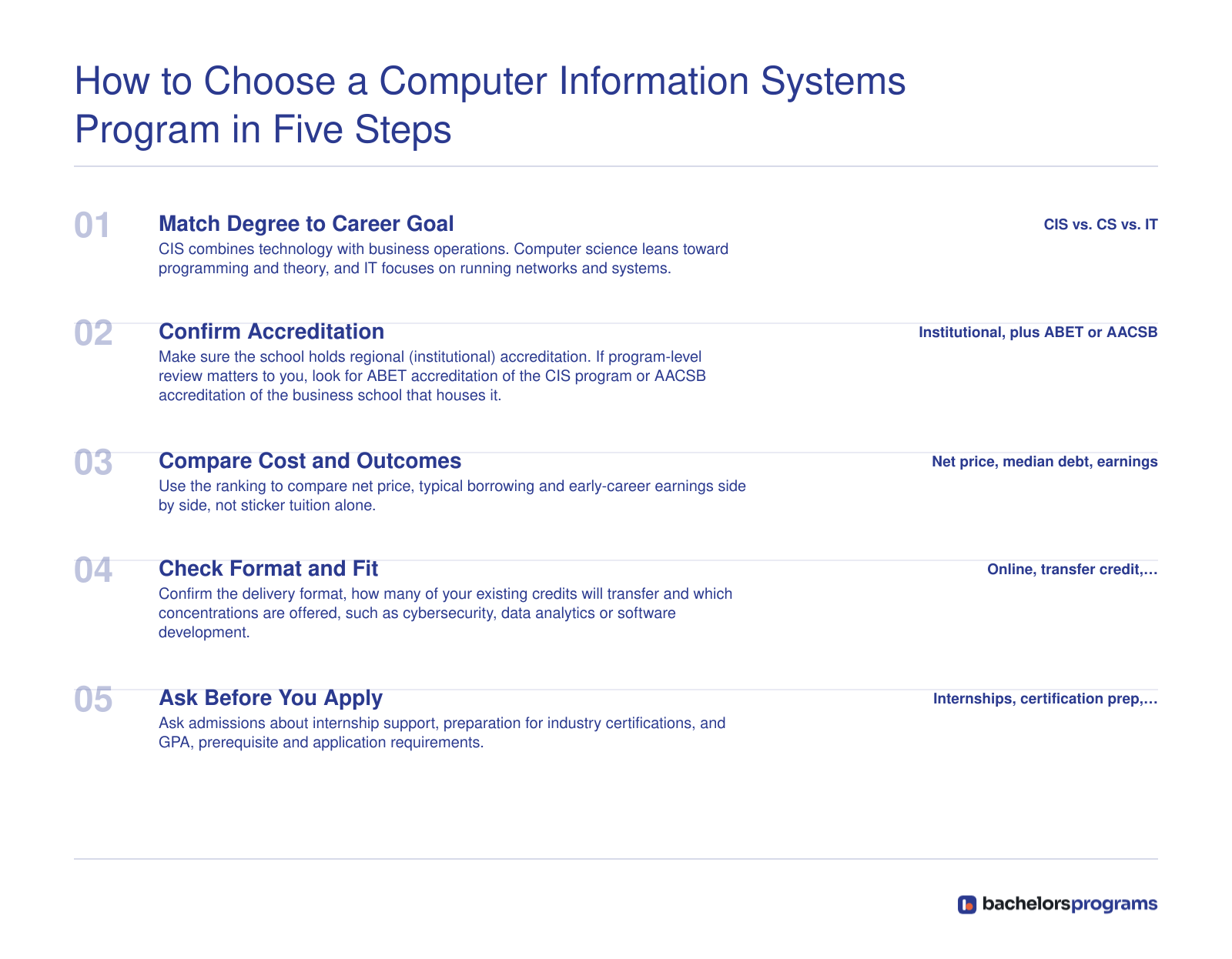
How to Choose a Computer Information Systems Program in Five Steps
A computer information systems degree pays off when the program fits your goals, your budget and your schedule. Work through these steps in order before you apply.
Computer Information Systems programs by state
Computer Information Systems Degree FAQs
These answers cover the questions prospective students ask most often about a bachelor's degree in computer information systems. Figures are national benchmarks, so use them to set expectations rather than to predict your own results.
What is the best college for computer information systems?
How much do computer information systems graduates make?
Can a CIS graduate become a software developer?
Do I need a master's degree after a bachelor's in CIS?
Compare Computer Information Systems programs on the data that matters
Explore more Computers & IT majors or browse every field of study.
All Computers & IT programs Browse every field of study