Best Marketing Schools in Maine
Compare 14 accredited Marketing programs in Maine at 7 colleges, with net price after aid, graduation rates, earnings and debt from IPEDS and the U.S. College Scorecard.

Public and private Maine schools price the same bachelor's degree in marketing very differently: University of Southern Maine lists $11,284 in tuition and fees, while University of New England lists $44,210. The common credential is the Bachelor of Science (B.S.) in Marketing, though some schools award a business administration degree with a marketing focus.
The ranked list covers Maine schools, campus and online, with cost, outcomes, accreditation and format side by side. University of Maine at Presque Isle has the lowest tuition and an online path, and University of Maine graduates post a $50,655 median one year out.
Net price after aid narrows the public-private gap, but it rarely closes it.
Key Points
- University of Maine leads, posting a $50,655 median one year after graduation.
- Aid drops Saint Joseph's College of Maine from $44,420 to $27,555 net.
- Online options range from self-paced, competency-based sessions to conventional per-credit programs.
Best Marketing Schools in Maine: Our Ranked List
For a bachelor's degree in marketing in Maine, the University of Maine in Orono is our top pick: it pairs an AACSB-accredited business school with a broad, analytics-heavy curriculum and a net price after aid of about $17,500 for Maine families. Husson University follows for students who want agency-style, portfolio-building work, and Saint Joseph's College of Maine rounds out the top three with the strongest completion rate of the group. Each school below offers a bachelor's degree in marketing on campus, online or both.
University of Maine
#1Orono, ME · $18,000/yr (est. net price)
Best for: Brand strategy students wanting a research-heavy core
The University of Maine is the state's flagship campus, and its marketing major sits inside an AACSB-accredited business school. Students work through market assessment, consumer behavior, digital marketing analytics and marketing research before a strategic management capstone, and can add concentrations such as International Business or Innovation and Entrepreneurship. Maine residents pay roughly $13,300 in tuition and fees, the net price after aid comes to about $17,500, and the institution-wide graduation rate is 55%.
- AACSB-accredited business school
- 3 concentration options, including International Business
- 120 total credit hours with a 2.0 GPA minimum
- 37 business core credits plus 49 general foundation credits
- Strategic management capstone required
- Transfer credit judged to AACSB standards
- Up to 19 free elective credits
- 50% of major courses must be taken at UMaine
Husson University
#2Bangor, ME · $20,000 – $25,000/yr (est.)
Best for: Portfolio builders drawn to agency client work
Husson University in Bangor built its marketing degree around promotion and production rather than pure theory, and the student-run One Circle Agency has teams writing plans for real clients. Marketing Communications students can stack certificates in digital marketing, sales, graphic design or web media, and the university also offers a bachelor's-to-MBA path. Tuition and fees run about $23,300, the net price after aid is roughly $21,000, and the institution-wide graduation rate is 59%. The program is offered on campus and online.
- Student-run One Circle Agency serving real clients
- Certificates in digital marketing, sales, graphic design or web media
- 121 total credit hours
- Project-based curriculum with simulations of real ad placements
- Internship builds a professional portfolio
- Skills in design, photo, video and web
- Housed in the New England School of Communications
- Optional bachelor's-to-MBA pathway
- 7 concentration options
- Digital advertising and social media simulations
- Same business foundation as the campus track
Saint Joseph's College of Maine
#3Standish, ME · $25,000 – $30,000/yr (est.)
Best for: Small-campus learners wanting local business projects
Saint Joseph's College of Maine in Standish keeps its Marketing, B.S.B.A. inside the business administration core, so majors take the same accounting, economics and management foundation as their peers and then add marketing coursework. Team projects and experiential work with local companies are built into the major, and every student completes the college's core curriculum alongside a 120-credit degree. Tuition and fees are about $44,400, the net price after aid is roughly $27,600, and the institution-wide graduation rate is 66%.
- 120 total credit hours plus the college core curriculum
- Built on the business administration core
- Team projects and experiential learning with local companies
- First Year Experience Seminar, 1 credit, required
- Core includes Philosophical Inquiry and Quantitative Reasoning
- Emphasis on ethics and integrity in business decisions
Thomas College
#4Waterville, ME · $19,000/yr (est. net price)
Thomas College in Waterville runs three separate marketing tracks: Marketing Management, Digital Marketing Management, and Communications, Public Relations and Marketing. Each can be finished in three years, each is 121 credits, and the Harold Alfond Institute for Business Innovation adds workshops and one-on-one mentorship on top of coursework. Tuition and fees are about $31,800, the net price after aid is roughly $18,900, and the institution-wide graduation rate is 54%.
- Three-year degree option
- 121 total credit hours
- Internships drawn from real-world marketing work
- Courses in services marketing and consumer behavior
- Access to the Harold Alfond Institute for Business Innovation
- Innovation challenges and one-on-one mentorship
- Phi Beta Lambda membership
- Coursework in advertising and promotion
- Marketing research coursework
- Event planning and management courses
- Leadership development training
- Internship opportunities available
- Alumni leaders working in marketing and public relations
- Access to the Digital Marketing Media Lab
- Careers in social media management and content creation
- Innovation challenges, workshops and seminars
- One-on-one counseling and mentorship
- Internships included in the curriculum
University of Southern Maine
#5Portland, ME · $11,000 – $28,000/yr (est.)
The University of Southern Maine in Portland houses its marketing major in the School of Business and runs it both on campus and fully online, which makes it the most flexible public option in the state. The major is compact, at 15 credits inside a 120-credit degree, and leans on experiential coursework in digital marketing, retailing, branding, advertising and sport marketing, with internships for local and regional clients. Maine residents pay about $11,300 in tuition and fees, the net price after aid is roughly $13,600, and the institution-wide graduation rate is 40%.
- 15-credit marketing major inside a 120-credit degree
- Courses in digital marketing, retailing, branding and sport marketing
- Experiential learning model in major courses
- Student marketing association chapter
- Internships with local, regional or international clients
- Accelerated pathway to the MaineMBA
- Double majors and business minors possible
- Fully online version of the marketing major
- Rolling admissions with no entrance exam
- Test optional for applicants
- One-on-one career advising
University of Maine at Presque Isle
#6Presque Isle, ME · ~$7,000/yr (est.)
The University of Maine at Presque Isle delivers its Business Administration, B.A. with a Marketing concentration entirely online, organized around a Finish in Four plan with advisor check-ins each semester. Students take marketing research, consumer behavior, integrated marketing communications, global marketing and e-commerce alongside accounting, finance and business analytics, plus a 100-hour preceptorship. It has the lowest sticker price on this list, about $9,400 in tuition and fees, a net price after aid near $7,000, and an institution-wide graduation rate of 52%.
- 120 total credit hours
- Finish in Four plan with advisor guidance each semester
- 100-hour preceptorship component
- Concentration courses in marketing research and consumer behavior
- Includes e-commerce and social media coursework
- Meets the General Education Curriculum
University of New England
#7Biddeford, ME · $38,000/yr (est. net price)
The University of New England in Biddeford has the strongest completion record of this group: its institution-wide graduation rate is 68%. The B.S. in Marketing mixes consumer behavior, market research, advertising, digital and social media marketing and sales management with internships at regional businesses and an interdisciplinary innovation challenge. Admissions are test-blind, the application fee is $40, merit scholarships run up to $22,000, tuition and fees are about $44,200, and the net price after aid lands near $38,100.
- Test-blind admissions; no ACT or SAT required
- $40 application fee
- Merit scholarships up to $22,000
- Semester abroad option in Tangier, Morocco
- Internships with regional business partners
- Student Innovation Challenge competition
- Women in Business Club
- 95% job placement rate reported by the university
Cost & outcomes by school
Federal data for the highest-earning Marketing programs, independent of the ranking above. Earnings are this field's bachelor's graduates four years after completing where the Scorecard reports them, else the school's undergraduate median.
| School | Net price / yr | Grad rate | Earnings | Debt | Grads/yr | Format |
|---|---|---|---|---|---|---|
| University of Maine ME | $17,510 | 55% | $67,863 | $25,000 | 121 | Campus |
| Saint Joseph's College of Maine ME | $27,555 | 66% | $66,233 | $27,000 | 13 | Campus |
| University of Southern Maine ME | $13,596 | 40% | $57,968 | $18,916 | 43 | Campus |
| University of New England ME | $38,107 | 68% | $55,921 | $25,250 | — | Campus |
| Husson University ME | $21,005 | 59% | $45,025 | $27,000 | 6 | Campus |
| Thomas College ME | $18,885 | 54% | $44,991 | $24,250 | 6 | Campus |
| University of Maine at Presque Isle ME | $7,035 | 52% | $40,956 | $16,000 | — | Online |
Sources: U.S. Department of Education. Net price, graduation rate, earnings and debt: College Scorecard (earnings and debt for this field's bachelor's graduates where reported, else school-wide); graduates: IPEDS. A dash means no figure is reported.
Cost, debt & payoff
Median earnings of this field's bachelor's graduates (4 yrs after completing, else the school's undergraduate median) vs. their median federal loan debt · U.S. College Scorecard
Across these programs the median graduate earns about $45,025 and finishes with roughly $24,250 in debt — a ratio that clears a common rule of thumb (keep debt below first-year salary). Net price and debt vary widely school to school, so check the per-school figures in the table above before you shortlist.
How We Ranked Maine's Bachelor's in Marketing Programs
Students now judge a marketing degree by its price and payoff as much as by a school's name. We built the list around those priorities, from campus programs in Orono and Portland to online options at schools based in Maine. Only Maine institutions offering a bachelor's in marketing, on campus or online, are included.
The Four Things We Looked At
- Cost and net price: What students actually pay after grants and scholarships, not just the sticker tuition.
- Outcomes: Graduation rate, plus what marketing graduates earn after finishing where federal data reports it.
- Accreditation: Regional accreditation is the baseline. Business accreditation such as AACSB counts in a program's favor.
- Format flexibility: Whether a school offers online, hybrid or evening paths for working students and transfers.
How to Read the Numbers
Both measures describe the whole institution, not the marketing program alone. A school's overall graduation rate reflects every major on campus, so treat it as context about the school rather than a verdict on its marketing department.
These rankings are guided editorial opinion built on public College Scorecard and IPEDS data. They are a starting point, not a guarantee of fit. A program lower on the list may still be your best choice if its location, concentration or schedule matches your plans.
Online and Hybrid Bachelor's in Marketing Options at Maine Schools
Maine's online marketing degrees come in two shapes: a self-paced, competency-based program charged by the session and a conventional online degree charged by the credit. The campus programs on this page are built around in-person attendance.
Fully Online: Two Different Models
University of Maine at Presque Isle runs its B.A. in Business Administration with a Marketing concentration through YourPace, fully online and competency-based. Students advance by demonstrated mastery rather than seat time across 120 credits: 40 in general education, 59 to 62 in the business core and concentration, and 18 to 21 electives. Tuition is $1,800 per 8-week session and does not change with the number of courses taken inside that session, so faster completion lowers the total bill. Applicants must be at least 20 when they apply. The format suits working adults who already hold some transfer credit and control their own schedule.
The University of Southern Maine offers a fully online B.S. in Marketing priced by the credit. Online undergraduates pay e-tuition of $355 per credit for 2025-26, a separate rate from the on-campus in-state figure. USM publishes no competency-based or flat-rate version of this degree.
Hybrid and Campus Formats
The University of Southern Maine is the exception: it lists a blended format alongside its fully online marketing major. The other marketing degrees here are campus programs at the University of Maine, Husson University, Saint Joseph's College of Maine, Thomas College and the University of New England. Campus study fits students who want client projects, internships and student agency work in person.
Three-Year and Accelerated Paths
A three-year route does exist in Maine. Thomas College lists its Marketing Management BS as a three-year program built on 121 credits. The University of New England describes its marketing degree as a four-year program. UMPI's mastery-based progress can shorten completion, but the university publishes no guaranteed three-year timeline, and USM publishes no accelerated option for its online Marketing B.S.
Admission Requirements for a Bachelor's Degree in Marketing in Maine
Admissions standards vary more than Maine's small size suggests, and the schools publish very different levels of detail. Where a requirement is not posted, the honest answer is to call the admissions office rather than assume a number.
Where the Requirements Are Published
- University of Southern Maine: SAT and ACT are optional, and applications run on an early-action and rolling basis. The marketing major does not post a separate minimum admission GPA.
- University of New England: Test-blind admissions, meaning SAT and ACT scores are not considered even if you submit them. The B.S. in Marketing totals 120 credits. The catalog does not publish a minimum GPA or a dated deadline for 2026.
- University of Maine at Presque Isle: The YourPace format asks for a cumulative college GPA of at least 1.75 from your most recently attended institution, an age of at least 20, and prior college credit or work experience. Starts run six times a year, with documents due before each one. Traditional first-year admission follows separate rules that the program page does not spell out.
- Thomas College: The Marketing Management B.S. takes 121 credit hours and can be completed in three years. The program page lists no minimum GPA, test policy or application deadline.
University of Maine, Husson University and Saint Joseph's College of Maine publish their own first-year criteria on their admissions pages, so check those directly rather than relying on a summary.
Transfer Credit and the Community College Route
University of New England is the most explicit of the group: it accepts credit from regionally accredited institutions, Advanced Placement, CLEP and accredited military training, and may count some prior experiential learning subject to restrictions. Other schools describe transfer in general terms and post no maximum, so ask for a written, course-by-course evaluation before you enroll. Finishing an associate degree at a community college first, then confirming which courses satisfy the business core, is the least expensive route into a Maine marketing bachelor's degree, and it keeps you from paying full tuition for credits that will not count.
How Selective Are These Schools?
Published admission rates at the Maine schools here span roughly 79 percent to nearly 100 percent, so admission is usually within reach for a prepared applicant. The real filter is the business core: accounting, economics and statistics early, then the marketing sequence.
Cost of a Marketing Degree in Maine: Tuition, Net Price and Aid
Published tuition tells only part of the story. Net price, the average cost after grants and scholarships, drops sharply at Maine's private colleges: Saint Joseph's College of Maine lists $44,420 in tuition and fees but averages a $27,555 net price, while the University of Maine at Presque Isle is the lowest-cost option here at a $7,035 net price. Maine residents can also apply for the Maine State Grant from the Finance Authority of Maine. It pays $2,500 a year for full-time study ($1,250 for half-time) to students with a Student Aid Index of 10,000 or below who have lived in Maine for at least one year and file the FAFSA by November 13, 2026 for the 2026-27 year.
| School | Sector | In-State Tuition and Fees | Out-of-State Tuition and Fees | Average Net Price | Median Debt at Graduation |
|---|---|---|---|---|---|
| University of Maine at Presque Isle | Public | $9,402 | $14,862 | $7,035 | $16,000 |
| University of Southern Maine | Public | $11,284 | $27,944 | $13,596 | $19,060 |
| University of Maine | Public | $13,326 | $36,756 | $17,510 | $25,000 |
| Thomas College | Private | $31,824 | $31,824 | $18,885 | $24,250 |
| Husson University | Private | $23,304 | $23,304 | $21,005 | $27,000 |
| Saint Joseph's College of Maine | Private | $44,420 | $44,420 | $27,555 | $27,000 |
| University of New England | Private | $44,210 | $44,210 | $38,107 | $25,250 |
Accreditation: AACSB and Other Credentials Compared
The accredited marketing schools in Maine fall into two groups: business schools with AACSB accreditation and programs whose published credentials stop at institutional accreditation.
Two Levels of Accreditation
Institutional accreditation reviews the entire college or university and is the baseline for federal aid and degree recognition. Programmatic business accreditation reviews the business school itself against standards set by a business accreditor. AACSB is the most widely recognized of these; ACBSP also accredits business programs with a stronger teaching focus.
Which Maine Schools Hold What
- University of Southern Maine: Its School of Business is AACSB-accredited1, and the Bachelor of Science in Business Administration in Marketing sits within that accredited business school.
- University of Maine: The business school reports AACSB accreditation dating to 1974, with a review in 2020, and its Bachelor of Science in Business Administration in Marketing is listed as AACSB-accredited.2
- University of Maine at Presque Isle, University of New England, Husson University, Saint Joseph's College of Maine and Thomas College: available program information does not identify AACSB, ACBSP or IACBE accreditation for their marketing or business programs. Their degrees rest on the institution's overall accreditation.
What This Means in Practice
AACSB status is a recognizable signal to employers, particularly larger companies that recruit through business school career offices. It is not a licensing requirement for marketing jobs in Maine. For transfer credit, receiving schools generally require accreditation at the institutional level and may separately evaluate business courses; programmatic accreditation can affect whether upper-level business credits count. Graduate business schools often view AACSB-accredited undergraduate preparation favorably, though admissions decisions weigh work experience, test scores and GPA as well. Ask each school's registrar and transfer office how credits will be treated before you enroll.
Related Articles
What Do Maine Marketing Graduates Earn One and Four Years Out?
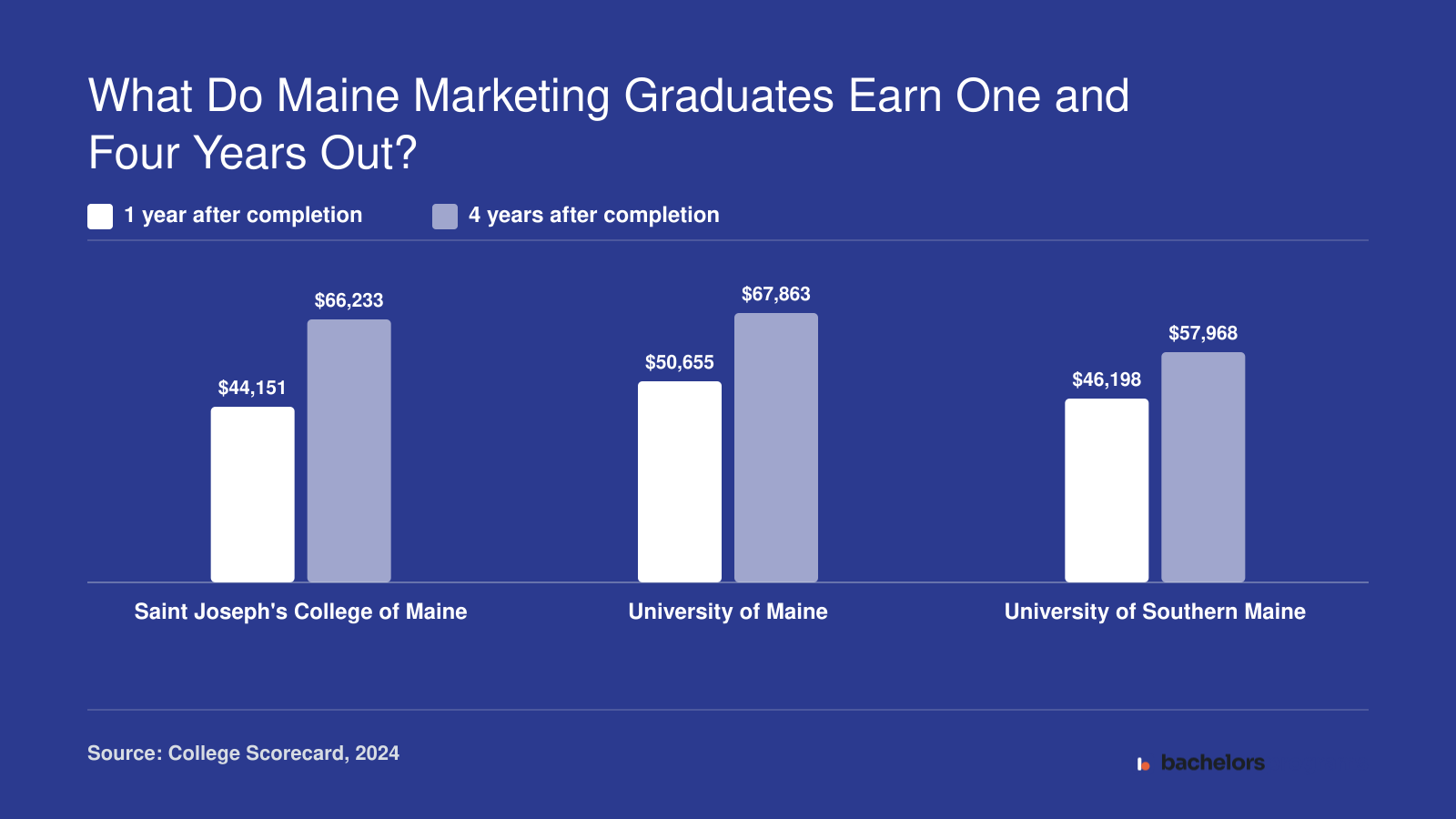
This chart compares median earnings for bachelor's in marketing graduates one year and four years after completing the program, using program-level College Scorecard data. The University of Maine posts the highest median at both points, at $50,655 after one year and $67,863 after four. Saint Joseph's College of Maine shows the steepest climb, from $44,151 to $66,233. Schools without a published figure are omitted.
Maine Marketing Salary Benchmark
For a clear benchmark of what marketing work pays in Maine, start with the state's median wage for market research analysts and marketing specialists.
Questions to Ask Yourself
Do you need to be on campus in Maine, or does a self-paced online bachelor's degree in marketing fit your schedule better?
Will the employers you are targeting care whether the business school holds AACSB accreditation?
Could transferring community college credits cut your net price more than choosing the lowest tuition?
Maine Marketing Degree FAQs
These answers cover the questions Maine students ask most often about a bachelor's degree in marketing. Each one draws on the program details published by the schools themselves.
Which Maine marketing program is the best overall?
Which schools in Maine offer a fully online bachelor's degree in marketing?
Can you finish a bachelor's degree in marketing in three years in Maine?
Does a marketing job in Maine require a license?
Does AACSB accreditation matter to employers?
Compare Marketing programs on the data that matters
Explore more Business & Management majors or browse every field of study.
All Business & Management programs Browse every field of study