Best Operations Management Degree Programs
Compare 190+ accredited Operations Management programs, with net price after aid, graduation rates, earnings and debt from IPEDS and the U.S. College Scorecard.

A bachelor's degree in operations management trains students to run what a business cannot let stall: production scheduling, quality control, capacity planning, and service delivery. Employers in manufacturing, health care, logistics, and retail hire for exactly that. The credential is usually the Bachelor of Science (B.S.) in Operations Management, housed in a business school beside supply chain and analytics coursework.
The tension is price against payoff. Among the programs ranked here, annual net price after aid runs from about $6,500 to $21,800, while median earnings a year after graduation span roughly $48,000 to $86,000.
Accreditation is the quieter variable: it attaches to the business school, not the major.
Key Points
- University of Pennsylvania graduates report the highest early-career median earnings here.
- Most graduates start as analysts or supervisors before six-figure manager roles.
- Operations management is broader than supply chain management, covering quality and capacity.
Best Bachelor's Degree in Operations Management Programs Ranked
The ten programs below put operations management at the center of the degree, whether as a named major, a concentration, or an area of emphasis inside a business school. Each card covers what the school is known for, how the program is built, and, where the data supports it, what graduates earn soon after finishing. Cost, graduation rate and delivery format sit alongside every entry so the comparisons are easy to make.
University of Florida
#1Gainesville, FL · ~$7,000/yr (est.)
Best for: Florida students drawn to supply chain management
The University of Florida houses operations management inside its Information Systems and Operations Management department at the Heavener School of Business, where teaching and research center on supply chain management. The school graduates about 91% of students, and the Gainesville campus combines a large public research university with a business school that describes itself as one of the top-ranked undergraduate public programs in the country. An Information Systems minor gives students a second, data-facing credential alongside the operations coursework.
- Top-ranked undergraduate public business school
- Operations management taught within a dedicated ISOM department
- Coursework and research centered on supply chain management
- Information Systems minor available to business students
- Department offices in Stuzin Hall on the Gainesville campus
- Median earnings one year after finishing: $52,032
Georgia Institute of Technology
#2Atlanta, GA · ~$12,000/yr (est.)
Best for: Quantitatively minded students eyeing operations careers
Georgia Tech treats operations and supply chain management as a concentration inside its Bachelor of Science in Business Administration, and the 122-credit degree leaves room for electives in operations strategy, supply chain modeling and service operations. The school graduates about 94% of students, and the Atlanta campus puts students in a metro area with deep freight, logistics and consulting employment. Admission is selective, with roughly 14% of applicants offered a place in a recent cycle.
- 122 credit hours for the BSBA with the operations concentration
- Concentration requires four operations and supply chain electives
- Electives include operations strategy, global operations, service operations
- Minimum grade of C required in concentration courses
- Internship credit up to 3 hours; undergraduate research up to 9 credits
- Pass-fail grading allowed only for free electives
- Median earnings one year after finishing: $73,557
University of North Carolina at Chapel Hill
#3Chapel Hill, NC · ~$12,000/yr (est.)
Best for: Business students stacking multiple areas of emphasis
Operations management at UNC-Chapel Hill is one of nine Areas of Emphasis inside the Bachelor of Science in Business Administration at the Kenan-Flagler Business School, and students may stack up to two of those nine-credit tracks. The school graduates about 91% of students, and the business school runs a symposium that draws hundreds of students and more than a hundred companies each year. At least 15 credit hours must be taken outside the business school, which keeps the degree from becoming purely vocational.
- 9-credit Area of Emphasis inside the BSBA
- Supply Chain Management is the required course
- Electives include Project Management, Retail Operations, Sustainable Operations
- 120 credit hours; 27 credit hours of core business courses
- Up to two Areas of Emphasis allowed, 9 credits each
- At least 15 hours of coursework outside Kenan-Flagler
- Study abroad scholarships and a yearly business symposium
- Median earnings one year after finishing: $85,618
University of California-Irvine
#4Irvine, CA · $14,000/yr (est. net price)
UC Irvine's Paul Merage School of Business offers a Bachelor of Arts in Business Administration with an Operations and Decision Technologies emphasis among six options. The school graduates about 87% of students, and the Irvine campus sits in the middle of Orange County's technology and business corridor. The major is structured so that transfer students can enter with IGETC certification and up to 105 quarter units already completed.
- Six emphasis areas, including Operations & Decision Technologies
- 2.70 cumulative UC GPA required to change into the major
- Transfer applicants can use IGETC to waive lower-division GE
- Transfer up to 105 quarter units
- AP scores of 3, 4 or 5 earn UC Irvine graduation credit
- Median earnings one year after finishing: $48,786
University of Washington-Seattle Campus
#5Seattle, WA · ~$14,000/yr (est.)
The University of Washington's Foster School treats Operations and Supply Chain Management as one of eight discipline-specific majors under its Bachelor of Arts in Business Administration. The school graduates about 85% of students, and the Seattle campus puts students next to the port, aerospace and e-commerce employers that hire operations graduates. Coursework leans quantitative, with operations research, programming and production and inventory modeling built into the major.
- One of eight discipline-specific majors under the BABA
- Coursework covers operations research, programming and inventory models
- Prepares logistics planners, buyers, demand planners and logistics analysts
- Operations Supply Chain Management Club for students
- Students may declare up to two Foster majors
- Median earnings one year after finishing: $49,004
University of Georgia
#6Athens, GA · ~$14,000/yr (est.)
The University of Georgia awards a Bachelor of Business Administration in Management through the Terry College of Business, with an Operations/Supply Chain Management Area of Emphasis for students who want the functional specialty. The school graduates about 90% of students, and the Athens campus pairs the degree with a supply chain advisory board, internship and co-op credit, and a study abroad option in Verona, Italy. Admission to the major is competitive and requires ACT or SAT scores along with a 2.6 GPA and specific prerequisite courses.
- 12-hour Area of Emphasis in Operations/Supply Chain Management
- Built on Supply Chain Management plus three electives
- Electives include Supply Chain Analytics, Quality Management, Project Management
- 2.6 GPA, MATH 1113, ACCT 2101 and BUSN 3000 required for admission
- 30-hour Terry College residency requirement
- Study abroad option in Verona, Italy
- Median earnings one year after finishing: $56,630
Brigham Young University
#7Provo, UT · $15,000 – $20,000/yr (est.)
Brigham Young University offers a BS in Operations Management on its Provo, Utah campus, and the private university graduates about 81% of students. Published tuition is among the lowest in this group, which is unusual for a private institution and changes the cost math for students comparing programs. The program is small relative to the large public options here, with about 107 bachelor's degrees awarded in the most recent reporting year.
- Median earnings one year after finishing: $71,163
- About 107 bachelor's degrees awarded in the most recent reporting year
University of Maryland-College Park
#8College Park, MD · $16,000/yr (est. net price)
The University of Maryland's Robert H. Smith School of Business awards a bachelor's degree in Operations Management and Business Analytics, an 18-credit major that leans heavily on quantitative modeling and data work. The school graduates about 89% of students, and the College Park campus sits inside the Washington, D.C. metro, where logistics, consulting and federal contractors hire for these skills. Two specializations let students push further into data analytics or decision modeling.
- 18 credits of major requirements in operations and analytics
- Core courses include Operations Analytics and Data Modeling in Business
- Specializations in data analytics and decision modeling
- Applies statistical modeling to large datasets for business insight
- Named industries: energy, finance, insurance, healthcare, logistics
- Median earnings one year after finishing: $65,842
California State University-Fullerton
#9Fullerton, CA · $7,000 – $20,000/yr (est.)
California State University, Fullerton offers a Bachelor of Arts in Business Administration with a 27-unit Operations and Supply Chain Management concentration, and it awards more degrees in this field than any other program on this list. The school graduates about 70% of students, and the Fullerton campus serves a largely commuter population in Orange County at one of the lower net prices in the ranking. Students enter as Pre-Business and apply to the major after completing the lower-division core.
- 27-unit Operations and Supply Chain Management concentration
- 120 units total for the B.A. in Business Administration
- Required courses in purchasing, quality, supply chain and project management
- 3-unit business practicum and 3-unit global business requirement
- Admission starts as Pre-Business; 2.0 GPA to apply to the major
- Capstone seminar in strategic management
- Median earnings one year after finishing: $48,256
Washington University in St Louis
#10St. Louis, MO · ~$22,000/yr (est.)
Washington University in St. Louis offers a BSBA in Operations and Supply Chain Management as one of eight majors at the Olin Business School, with students declaring during sophomore year. The school graduates about 94% of students, and the private St. Louis campus pairs small classes with an accelerated pathway that lets students earn the BSBA and a Master of Supply Chain Management together. The program frames operations broadly, covering service settings such as healthcare as well as goods delivery.
- BSBA in Operations and Supply Chain Management, one of eight Olin majors
- Students declare the major during sophomore year
- Coursework in process optimization, data analysis and leadership
- Accelerated pathway combines the BSBA with the MS in Supply Chain Management
- Applies to services such as healthcare as well as goods delivery
Cost & outcomes by school
Federal data for the highest-earning Operations Management programs, independent of the ranking above. Earnings are this field's bachelor's graduates four years after completing where the Scorecard reports them, else the school's undergraduate median.
| School | Net price / yr | Grad rate | Earnings | Debt | Grads/yr | Format |
|---|---|---|---|---|---|---|
| Carnegie Mellon University PA | $31,944 | 94% | $160,783 | $23,250 | 204 | Campus |
| University of Pennsylvania PA | $28,699 | 97% | $136,806 | $20,348 | 86 | Campus |
| University of North Carolina at Chapel Hill NC | $11,655 | 91% | $135,874 | $14,239 | 435 | Campus |
| Boston College MA | $41,704 | 91% | $123,144 | $18,125 | 74 | Campus |
| Bismarck State College ND | $10,270 | 47% | $122,948 | $15,250 | 48 | Online or campus |
| Boston University MA | $24,402 | 89% | $108,412 | $23,196 | 812 | Campus |
| University of Illinois Urbana-Champaign IL | $14,355 | 85% | $107,904 | $19,087 | 81 | Campus |
| Babson College MA | $40,514 | 93% | $107,520 | $22,766 | 762 | Campus |
| Georgia Institute of Technology GA | $12,116 | 94% | $106,155 | $21,500 | 416 | Campus |
| Brigham Young University UT | $15,564 | 81% | $105,544 | $11,000 | 167 | Campus |
| University of Wisconsin-Madison WI | $17,354 | 90% | $100,005 | $20,000 | 226 | Campus |
| Miami University OH | $28,384 | 80% | $95,796 | $24,250 | 96 | Campus |
Sources: U.S. Department of Education. Net price, graduation rate, earnings and debt: College Scorecard (earnings and debt for this field's bachelor's graduates where reported, else school-wide); graduates: IPEDS. A dash means no figure is reported.
Cost, debt & payoff
Median earnings of this field's bachelor's graduates (4 yrs after completing, else the school's undergraduate median) vs. their median federal loan debt · U.S. College Scorecard
Across these programs the median graduate earns about $68,815 and finishes with roughly $22,125 in debt — a ratio that clears a common rule of thumb (keep debt below first-year salary). Net price and debt vary widely school to school, so check the per-school figures in the table above before you shortlist.
How We Ranked These Operations Management Schools
Cheapest up front and strongest payoff after graduation are rarely the same school.
What Goes Into the Score
Five inputs drive each placement: net price after aid, completion (graduation and retention), program-level earnings after completion, median federal debt and the monthly payment that follows it, and delivery format. Each one answers a question a prospective student would ask anyway: what will this cost me, will I finish, what will I earn, what will I owe, and can I attend the way I need to.
The Data Behind the Rankings
The U.S. Department of Education's College Scorecard supplies program-level outcomes by field of study; IPEDS supplies the cost and completion data. Both are public datasets updated annually, so the comparison rests on federal reporting rather than on marketing pages.
What the Data Does Not Cover
Both graduation rates and net price describe the whole institution rather than the operations management major. Earnings reflect median outcomes for completers who received federal aid, so they describe that group rather than every graduate.
How to Use the List
Start with format: find the online, hybrid, or campus option that fits your life, then compare its net price against the early-career earnings graduates report. A program that costs more but places graduates into higher-paying roles can still be the better buy.
Operations Management Degree Cost and Debt: Lowest Net Price Picks
According to U.S. Department of Education data from IPEDS and the College Scorecard, these programs post the lowest average net price, which is what students actually paid per year after grants and scholarships; treat it as an approximate benchmark rather than a quote, since the tuition columns show the published sticker price before any aid. Graduates who borrowed finished with median debt of $12,000 to $15,000, which means budgeting $127 to $159 each month (roughly $1,500 to $1,900 a year) on a standard 10-year repayment plan. All three are public universities where state residents pay the lowest rates; private programs in the ranking do not discount tuition by residency, so compare their aid offers against these net prices rather than relying on sticker price alone.
| School | Average Net Price (per year) | In-State Tuition and Fees | Out-of-State Tuition and Fees | Median Program Debt at Completion | Median Monthly Payment (10-Year Plan) |
|---|---|---|---|---|---|
| CUNY Bernard M Baruch College (New York, NY) | $3,033 | $7,464 | $15,414 | $12,000 | $127 |
| California State University-Stanislaus (Turlock, CA) | $6,067 | $8,246 | $20,846 | $13,000 | $138 |
| University of Florida (Gainesville, FL) | $6,541 | $6,381 | $28,659 | $15,000 | $159 |
Online vs. Campus Operations Management Degrees and Degree-Completion Paths
The choice between online and campus operations management degrees is less about prestige than about how you will finish. Online formats buy scheduling flexibility; campus programs buy structured recruiting and hands-on exposure. For working adults, online is often the only realistic route. For students seeking co-ops, plant tours, and on-campus recruiting, residential study can justify the higher cost.
Online vs. Campus Formats
Asynchronous online courses let you study around shift work, travel, or family obligations, which is why adult-focused completion programs rely on them. Campus programs trade that flexibility for co-op placements, plant tours, and employer recruiting visits. Employers do not favor one format over the other; accreditation and coursework carry more weight than delivery mode.
Transfer Credits and Degree-Completion Paths
Transfer caps vary by institution. Traditional universities commonly accept up to 60 credits; adult-focused online programs often accept up to 90. An associate degree can cover roughly the first two years of a 120-credit bachelor's, leaving about 60 credits, or two to two and a half years of full-time study. Residency rules apply: many regionally accredited programs require 25 to 30 percent of the degree, usually 30 to 36 credits, at the awarding school. Southern New Hampshire University accepts up to 90 transfer credits but requires 30 at SNHU; Norwich University and the University of Oklahoma Online publish 90-credit ceilings.
Prior Learning and Completion Time
Military training, professional certifications, exams, and assessed portfolios can earn prior-learning credit. A 2026 estimate puts typical awards at 15 to 30 credits; they are not always additive with transfer credit. Completion time follows the credits you bring. A first-time full-time student should plan on about four years for 120 credits. Entering with 60 accepted credits, expect roughly two to two and a half years; with 80 to 90 credits, one to two years. Part-time study can stretch that to five or six years.
Before You Apply
Request an unofficial transcript evaluation before applying to see which courses transfer and which count as electives. Confirm that the online program holds the same regional accreditation as the campus version, and ask about residency requirements, prior-learning limits, and whether military or certification credit can combine with transfer credit.
Related Articles
Top Early-Career Earnings for Operations Management Graduates
UNC-Chapel Hill's business major, which offers operations management as a concentration, shows strong pay soon after graduation.
Operations Management Degree Salary and Jobs
A first job and a manager title are two stages of one career. Most graduates start as analysts or supervisors, and the six-figure manager roles come after several years of experience.
Program-Level Earnings
The figures below are median earnings of program graduates five years after completion, reported at the program level.
- University of North Carolina at Chapel Hill: $125,645
- University of Pennsylvania: $116,666
- Babson College: $110,754
- Boston University: $102,943
- University of Maryland-College Park: $102,325
These are medians for graduates of selective schools, so treat them as the upper end of what the degree can lead to, not a typical starting salary.
Typical Roles
Entry-level and early-career titles include:
- Operations analyst
- Production supervisor
- Logistics coordinator
- Purchasing agent
With experience, graduates move toward general and operations manager positions. Many of those titles ask for several years of hands-on work first, which is why the first job is rarely a manager role.
Federal Pay and Demand
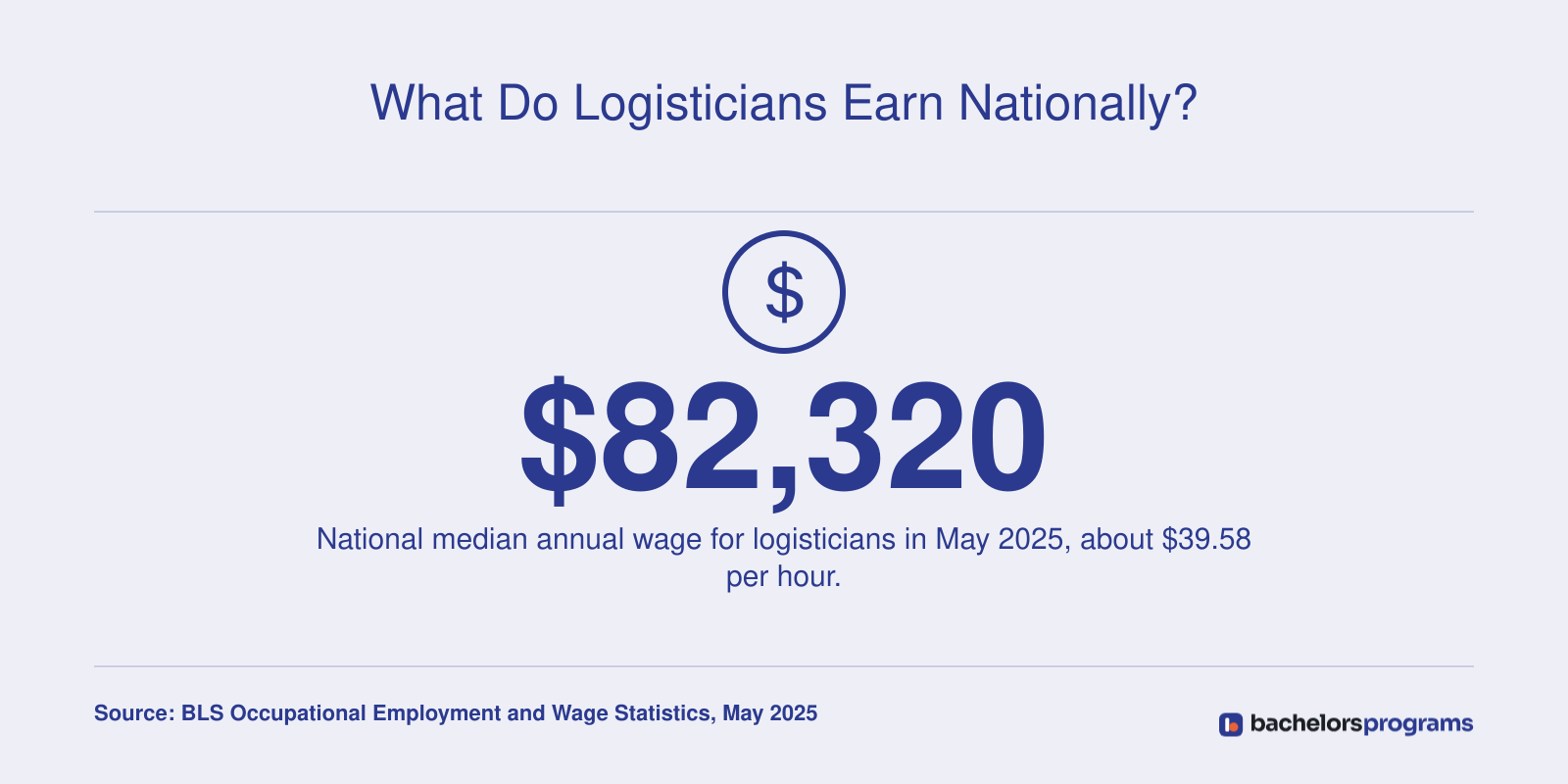
The Bureau of Labor Statistics reports a median annual wage of $102,950 (2024) for general and operations managers.1 Logisticians, who coordinate the movement of goods and materials, had a median annual wage of $82,320 in May 2025.2 BLS projects logistician employment to grow 18% from 2025 to 2035, adding about 44,900 jobs, with roughly 26,600 openings a year over that period.2
Pay for managers varies widely. The 2023 data put the 10th percentile near $46,340 and the 90th percentile at $232,110, so industry, region and company size matter as much as the degree.3 For a career that starts in logistics or purchasing, the logistician figures are a more realistic early benchmark than the manager median.
What Do Logisticians Earn Nationally?
Logistician is one of the most direct career matches for a bachelor's degree in operations management, and its pay gives a useful benchmark. This figure covers every logistician in the country at all experience levels, so it is not the starting pay of new graduates. Manager roles such as general and operations managers, industrial production managers, and purchasing managers usually require several years of experience before you qualify.
Operations Management vs. Supply Chain Management Degrees (Plus Industrial Engineering and Analytics)
Two Business Degrees With Different Centers
Operations management and supply chain management overlap, but they are not the same degree. A bachelor's degree in operations management is the broader of the two, covering the processes, quality systems, capacity planning, and project work that keep an organization running. Supply chain management narrows in on sourcing, logistics, transportation, and distribution, meaning the movement of goods and materials from suppliers to customers.
Typical operations coursework includes operations strategy, forecasting and inventory control, total quality management, statistical quality control, lean manufacturing, scheduling, and project management.1 Supply chain programs add supply chain planning and control, transportation, purchasing, and supply management.2 Both are commonly awarded as a B.S. or a B.S.B.A. from a business school, and both usually require business core math plus one calculus or statistics course.3
Industrial Engineering and Business Analytics
Industrial engineering is a different degree altogether. It is usually an ABET-accredited engineering degree with heavier math, often through calculus and differential equations plus probability and statistics, and it emphasizes systems design, manufacturing processes, and human factors. Business analytics sits closer to the business side but builds quantitative depth through statistics, data management, and programming for modeling and visualization.
First Jobs and a Decision Rule for Each
Entry-level operations roles cluster in manufacturing and service management, operations strategy consulting, purchasing, project management, and quality management.4 Supply chain graduates move into logistics analysis, plant management, procurement, warehouse management, and consulting.2 Industrial engineers often start as process, manufacturing, or quality engineers, while analytics graduates step into business analyst and data analyst roles.
- Operations management: choose it if you want to run and improve day-to-day processes across a business.
- Supply chain management: choose it if sourcing, transportation, and distribution are the parts you find most interesting.
- Industrial engineering: choose it if you want an engineering credential and the heaviest quantitative design work.
- Business analytics: choose it if you would rather build models and dashboards from data than manage operations directly.
Operations Management programs by state
Operations Management Degree FAQs
These answers cover the questions prospective students ask most often about a bachelor's degree in operations management. Requirements vary by school, so confirm details with the admissions office before you apply.
Is a bachelor's degree in operations management worth it?
How long does an operations management degree take for transfer students?
What are typical admission requirements for an online operations management bachelor's program?
Can I get an operations management job without a manager title or prior supervisory experience?
Compare Operations Management programs on the data that matters
Explore more Business & Management majors or browse every field of study.
All Business & Management programs Browse every field of study