Best Engineering Management Degree Programs
Compare 40+ accredited Engineering Management programs, with net price after aid, graduation rates, earnings and debt from IPEDS and the U.S. College Scorecard.

A traditional engineering major builds technical depth, while a business major builds management skill. Engineering management combines the two, and the degree is usually awarded as a Bachelor of Science (B.S.) in Engineering Management. It suits first-year and transfer students who want to design systems and manage the budgets, schedules and teams behind them.
Programs are delivered on campus, online or in a hybrid format. Compare programs on cost, earnings, accreditation and career outcomes alongside their rank.
Price varies widely. Average net price runs from $9,873 a year at New Mexico Tech to $41,346 at Stevens Institute of Technology. ABET accreditation, the standard route toward state engineering licensure, also varies from program to program.
Key Points
- Purdue University leads our 2027 engineering management ranking.
- New Mexico Tech is the most affordable option here, near $10,000.
- The B.S. in Engineering Management pairs engineering coursework with business skills.
Best Engineering Management Schools for Bachelor's Students
The ten bachelor's programs below all award a degree in engineering management, and they span public flagships, a federal service academy, and private technical universities. Some can be completed online, others are campus-only, and the list mixes programs housed inside engineering colleges with ones run through a business school. Each entry covers what the school reports about completion, cost after aid, and what graduates of the program earn after finishing.
Purdue University
#1West Lafayette, IN · ~$15,000/yr (est.)
Best for: Engineers moving toward plant operations leadership
Purdue is a large public research university in West Lafayette, Indiana, and the school graduates 83% of students, one of the strongest completion rates in this group. Engineering management is a concentration inside the Multidisciplinary Engineering major, so students earn a Bachelor of Science in Engineering on a plan of study that adds data analytics, personnel and project management, and entrepreneurship to a traditional engineering core. The concentration points toward manufacturing operations leadership, logistics and supply chain work, technical consulting, and quality improvement across healthcare, construction, technology, and energy employers. Median pay for program graduates was $72,252 one year after finishing and $87,914 four years after finishing.
- Engineering management concentration inside the Multidisciplinary Engineering major
- Bachelor of Science in Engineering plan of study
- Core work in data analytics and project management
- Adds personnel management and entrepreneurship coursework
- Prepares for manufacturing operations and logistics leadership
- Pathways into technical consulting and continuous improvement
- Industries include healthcare, construction, retail, technology, and energy
United States Military Academy
#2West Point, NY
Best for: Future officers building technical leadership skills
The United States Military Academy is a federal service academy in West Point, New York, and the school graduates 87% of students. The ABET-accredited engineering management major sits in the Department of Systems Engineering and layers engineering economy, production operations management, supply chain engineering, and project management onto a technical foundation the cadet chooses, from civil and electrical to nuclear, environmental, and software engineering. Majors can apply for an honors track and a summer Academic Individual Advanced Development program, and within five years of graduation they can pursue the Professional Engineer license and Project Management Professional certification. Admission runs through congressional nomination and military standards rather than the usual first-year application.
- ABET-accredited major in the Department of Systems Engineering
- Eight technical foundation options, from civil to software engineering
- Required coursework in engineering economy and production operations management
- Includes supply chain engineering and computer modeling
- Honors track available to qualified majors
- Six engineering electives chosen by the cadet
- Summer Academic Individual Advanced Development program
- Prepares cadets for the Professional Engineer license and PMP certification
Arizona State University
#3Tempe, AZ · ~$15,000/yr (est.)
Best for: Working adults needing a fully online pathway
Arizona State University is a large public research university in Tempe, and the school graduates 68% of students. The engineering management BSE is ABET-accredited, runs 120 credit hours, and is offered on campus in Tempe, fully online, and at ASU Local sites, which makes it the most flexible option in this group. Core coursework covers operations management, financial engineering, risk management, configuration management, and product liability, and graduates move into project engineer, operations analyst, and production supervisor roles. Median pay was $76,149 one year after finishing, $102,320 four years after finishing, and $107,203 five years after finishing.
- ABET-accredited, 120 credit hours
- Offered on campus, fully online, and at ASU Local sites
- Core topics include operations management and financial engineering
- Also covers configuration management and product liability
- First required math course is Calculus for Engineers I
- STEM-OPT eligible with a 24-month work extension
- Student chapters of ASEM and the Institute of Industrial and Systems Engineers
- Career paths: project engineer, operations analyst, production supervisor
Missouri University of Science and Technology
#4Rolla, MO · ~$16,000/yr (est.)
Missouri University of Science and Technology is a public STEM-focused campus in Rolla, and the school graduates 64% of students. The department describes its engineering management degree as one of only six ABET-accredited programs in the field nationally, and students add 15 hours in one of three emphasis areas: Management of Technology, Industrial Engineering, or a general option they design themselves. Seniors finish a capstone that ties technical and managerial work together, and the program requires the Associate Engineering Manager certification plus a department assessment exam before graduation. Median pay was $72,708 one year after finishing, $91,035 four years after finishing, and $90,103 five years after finishing.
- One of only six ABET-accredited engineering management degrees in the country
- Three emphasis areas: Management of Technology, Industrial Engineering, General
- 15 additional hours in the chosen emphasis area
- Management of Technology covers logistics, scheduling, budgeting, and technology management
- Industrial Engineering emphasis covers productivity analysis and system optimization
- Senior capstone integrates technical and managerial skills
- Associate Engineering Manager certification required for graduation
- 15-hour minor in engineering management open to other engineering majors
University of Illinois Chicago
#5Chicago, IL · ~$11,000/yr (est.)
University of Illinois Chicago is a large public research university in Chicago, and the school graduates 62% of students. The Bachelor of Science in Engineering Management is housed in Mechanical and Industrial Engineering and takes 128 credit hours, split between general education, the College of Engineering core, and electives outside the major. The upper-level sequence is unusually quantitative for the field, covering operations research I and II, discrete event computer simulation, advanced quality control and reliability, safety engineering, and manufacturing facilities design, alongside accounting, finance, and economics. Average net price after aid is among the lowest in this ranking.
- 128 credit hours total
- Housed in the Department of Mechanical and Industrial Engineering
- Upper-level work in operations research I and II
- Includes discrete event computer simulation
- Covers advanced quality control and reliability, plus safety engineering
- Business foundation in accounting, finance, economics, and marketing
- Elective hours required outside the major rubric
- Four-year sample plan of study published
Illinois Institute of Technology
#6Chicago, IL · ~$18,000/yr (est.)
Illinois Institute of Technology is a private technical university in Chicago, and the school graduates 75% of students. Its engineering management bachelor's pairs an engineering core with business administration coursework in product and process development, business plans, marketing strategy, and economic analysis for new products, and students pick from 12 concentration options. The program is STEM designated and meets F-1 visa requirements, which matters for international students planning to stay and work after graduation. Median pay was $72,164 one year after finishing and $84,305 four years after finishing.
- 12 concentration options
- STEM designated and meets F-1 visa requirements
- Combines engineering, management, and business administration coursework
- Work in product and process development and business plan writing
- Economic analysis and technology evaluation for new products
- Career paths include automation, design, and product engineer roles
- On-campus study in Chicago
University of Arizona
#7Tucson, AZ · ~$17,000/yr (est.)
The University of Arizona is a large public research university in Tucson, and the school graduates 68% of students. Engineering management sits in Systems and Industrial Engineering and is built to be paired with a second engineering major, so students keep a technical specialty while adding the business side of engineering. Coursework centers on manufacturing process improvement and customer demand for new products, and undergraduates can join design, entrepreneurship, and internship programs. Median pay was $75,109 one year after finishing and $101,557 four years after finishing.
- Housed in Systems and Industrial Engineering
- Designed to pair with a specific engineering major
- Focus on manufacturing process improvement and product demand
- Design, entrepreneurship, and internship programs for undergraduates
- Prepares students for industry and entrepreneurial leadership
Stevens Institute of Technology
#8Hoboken, NJ · ~$41,000/yr (est.)
Stevens Institute of Technology is a private university in Hoboken, New Jersey, across the river from Manhattan, and the school graduates 87% of students, one of the highest completion rates here. The Bachelor of Engineering in Engineering Management offers two concentrations, Systems Engineering and Financial Engineering, and pairs an engineering core with business and management courses along a Design Spine that runs every semester and ends in a team Senior Design capstone for a real company. Seniors can sit for the Engineer in Training exam, and students can roll undergraduate credits into a Stevens master's to finish in five years. Median pay was $79,755 one year after finishing, $101,798 four years after finishing, and $103,480 five years after finishing.
- ABET-accredited Bachelor of Engineering
- Two concentrations: Systems Engineering and Financial Engineering
- Design Spine course every semester, ending in Senior Design
- Senior Design teams build prototypes for real business problems
- Eligible to sit the Engineer in Training exam senior year
- Accelerated Master's Program finishes a master's in five years
- Nearly 30% of engineering students complete a co-op
- Employers include Apple, Amazon, Goldman Sachs, and Verizon
Michigan Technological University
#9Houghton, MI · $10,000 – $15,000/yr (est.)
Michigan Technological University is a public university in Houghton, Michigan, and the school graduates 68% of students. Engineering management is offered through the College of Business rather than the engineering college, so the degree leans on a full business curriculum while keeping science, engineering, and math coursework, and it is AACSB-accredited and recognized by the American Society of Engineering Management. Students can join the ASEM student chapter, work on enterprise teams with real clients, and add an accelerated master's in two extra semesters, while more than 400 employers recruit on campus each year. Median pay was $68,919 one year after finishing and $93,993 four years after finishing.
- Offered through the College of Business with engineering and math coursework
- AACSB-accredited and recognized by the American Society of Engineering Management
- One of two ASEM-recognized programs in Michigan
- Enterprise teams work with real clients
- More than 400 employers recruit on campus each year
- Accelerated master's available in two extra semesters
- ASEM student chapter on campus
- Career paths: operations, continuous improvement, technical sales
New Mexico Institute of Mining and Technology
#10Socorro, NM · ~$10,000/yr (est.)
New Mexico Institute of Mining and Technology is a small public science and engineering university in Socorro, and the school graduates 57% of students. The 120-credit engineering management bachelor's balances accounting, economics, and finance with entrepreneurship, technology leadership, and analytical work on risk and uncertainty, plus a 15-credit management elective sequence chosen with a faculty advisor. Required classes and technical electives cannot be taken on a pass/fail basis, and two semesters of one foreign language are strongly suggested though not required. Average net price after aid is the lowest in this ranking.
- 120 credit hours with a published four-year plan of study
- Accounting, economics, and finance paired with technology leadership
- 15-credit management elective sequence approved by an advisor
- Analytics for risk and uncertainty in engineering contexts
- Required classes and technical electives may not be taken pass/fail
- Two semesters of one foreign language strongly suggested
- Prepares graduates to lead interdisciplinary project teams
Cost & outcomes by school
Federal data for the highest-earning Engineering Management programs, independent of the ranking above. Earnings are this field's bachelor's graduates four years after completing where the Scorecard reports them, else the school's undergraduate median.
| School | Net price / yr | Grad rate | Earnings | Debt | Grads/yr | Format |
|---|---|---|---|---|---|---|
| University of Arkansas Grantham AR | $8,370 | 43% | $108,380 | $21,956 | 5 | Online |
| Worcester Polytechnic Institute MA | $43,071 | 90% | $103,470 | $27,000 | 16 | Campus |
| Arizona State University AZ | $14,967 | 68% | $102,320 | $28,125 | 35 | Online or campus |
| Arizona State University AZ | — | — | $102,320 | $28,125 | 37 | Online or campus |
| Stevens Institute of Technology NJ | $41,346 | 87% | $101,798 | $26,975 | 22 | Campus |
| University of Arizona AZ | $16,674 | 68% | $101,557 | $24,777 | 17 | Campus |
| Miami University OH | $28,384 | 80% | $99,473 | $26,800 | 19 | Campus |
| Michigan Technological University MI | $14,182 | 68% | $93,993 | $27,875 | 27 | Campus |
| The University of Tennessee-Chattanooga TN | $14,265 | 50% | $92,900 | $24,570 | 62 | Online or campus |
| University of the Pacific CA | $25,447 | 69% | $92,718 | $19,500 | 8 | Campus |
| Missouri University of Science and Technology MO | $16,298 | 64% | $91,035 | $27,000 | 68 | Campus |
| Clarkson University NY | $30,305 | 75% | $88,793 | $27,000 | 59 | Campus |
Sources: U.S. Department of Education. Net price, graduation rate, earnings and debt: College Scorecard (earnings and debt for this field's bachelor's graduates where reported, else school-wide); graduates: IPEDS. A dash means no figure is reported.
Cost, debt & payoff
Median earnings of this field's bachelor's graduates (4 yrs after completing, else the school's undergraduate median) vs. their median federal loan debt · U.S. College Scorecard
Across these programs the median graduate earns about $70,080 and finishes with roughly $24,227 in debt — a ratio that clears a common rule of thumb (keep debt below first-year salary). Net price and debt vary widely school to school, so check the per-school figures in the table above before you shortlist.
How We Ranked These Bachelor's Programs
Online and hybrid options have blurred the line between campus and distance study, so comparing engineering management programs fairly now takes more care.
What Goes Into the Ranking
The list is built from federal data, not school-supplied marketing or reputation surveys. For each program we looked at College Scorecard outcomes: what graduates earn, how much debt they typically carry, and how many students complete the degree. We added average net price, what a student pays once grants and scholarships are subtracted, plus graduation and retention rates for the institution as a whole. Delivery format is noted for every school.
One Scale for Every Format
Online, hybrid, and campus programs compete against one another on the same measures. A program is not boosted or penalized for how it is delivered, so you can set a distance option directly beside a residential one.
Limits Worth Knowing
- Net price: It is an average after aid. What you actually pay depends on your aid package, residency, and transfer credits.
- Graduation rate: It covers the whole institution, not only engineering management students.
- Small programs: Some programs graduate too few students for the federal government to publish earnings, so those schools are judged on the remaining measures.
- Timing: Federal figures trail current conditions by a year or more.
Treat the rankings as a starting point, and confirm current costs and program details with each school before you apply.
What a Bachelor's Degree in Engineering Management Involves
A bachelor's degree in engineering management trains you as an engineer who can also run the business side of technical work. The B.S. in Engineering Management pairs a standard engineering foundation in math, physics and engineering science with coursework in accounting, economics, finance and project management.
Core Curriculum
ABET, the main accreditor for U.S. engineering programs, does not dictate a fixed course list for engineering management. It names subject areas that accredited programs must cover.1 Under its general engineering criteria, students complete at least 30 semester credit hours of college-level math and basic sciences.2 Beyond that foundation, expect coursework in:
- Financial topics: engineering economics, accounting, estimating and finance
- Quantitative methods: operations research, probability and statistics
- People and organizations: human factors and managing technical personnel
- Project and technology management: planning, scheduling and leading technical work
Common Concentrations
Many programs let you focus your electives. Titles vary by school, and not every program offers each option, but these clusters appear often:
- Project management: prepares you to control schedules, budgets and teams on engineering projects.
- Systems engineering: builds skills in requirements, integration and testing for complex systems.
- Operations and supply chain: focuses on improving production and service processes, logistics and quality.
- Data analytics: teaches you to apply statistical models and data tools to technical and business decisions.
How It Differs From Industrial and Systems Engineering
Industrial engineering centers on the quantitative design and improvement of production and service systems. Systems engineering follows complex systems across their full lifecycle, from requirements through verification. Engineering management overlaps with both but usually trades some depth in technical design for more attention to managing people, budgets, projects and organizations. The lines blur by school: an operations concentration can closely resemble industrial engineering.
Is It the Best Degree for Engineering Management?
For undergraduates who want both technical credibility and a path into leadership, yes. The B.S. in Engineering Management is the most direct route because it builds both skill sets from the first year. If you would rather spend your career in hands-on design, a traditional engineering discipline may fit better.
Engineering Management Degree Cost and Earnings: Three Best-Value Programs
How much does an engineering management degree cost? Among these best-value programs, the average net price after aid runs from $10,974 a year at the University of Illinois Chicago to $41,346 a year at Stevens Institute of Technology, according to IPEDS and College Scorecard data from the U.S. Department of Education. Program earnings are median earnings for engineering management graduates five years after completing the degree. The school-wide columns describe all students at each institution and are shown only for context.
| School | Average Net Price (per year, after aid) | Median Program Debt | Monthly Payment (10-Year Plan) | Program Median Earnings (5 Years After Graduation) | School-Wide Median Earnings (10 Years After Entry) | School-Wide Median Debt |
|---|---|---|---|---|---|---|
| University of Illinois Chicago (Chicago, IL) | $10,974 | N/A | N/A | N/A | $68,740 | $16,704 |
| Stevens Institute of Technology (Hoboken, NJ) | $41,346 | $26,975 | $286 | $103,480 | $108,772 | $27,000 |
| University of the Pacific (Stockton, CA) | $25,447 | N/A | N/A | $108,953 | $78,445 | $19,500 |
Related Articles
Admission and Transfer Requirements to Expect
Admission standards for a bachelor's degree in engineering management differ by school, so treat the examples below as a guide and confirm each requirement with the admissions office before you apply.
- Math readinessExpect a calculus-heavy start. Arizona State University's 2026 B.S.E. begins with MAT 265 or MAT 270 and requires a C or better, with placement setting your first math course. Arkansas State University asks transfer applicants for College Algebra or qualifying entrance-exam scores.
- Science preparationHigh school chemistry or physics is commonly recommended. Arizona State requires General Chemistry I with a lab. Students without pre-engineering preparation may need preparatory courses that can extend time to graduation.
- GPA and test scoresArizona State admits first-year students who meet one benchmark: a 3.00 GPA, a 1210 SAT, a 24 ACT, or a top-25% class rank. Arkansas State requires the ACT or SAT from all freshmen and offers automatic admission at a 3.0 GPA, ACT 19, SAT 990, or top-20% rank.
- Transfer GPAMinimums vary. Arkansas State requires a 2.0 cumulative GPA. Arizona State requires a 2.75 GPA.
- Transfer creditSchools typically evaluate credits transcript by transcript and require official transcripts from every college you attended. Grade thresholds can apply. CSUN, for example, requires a C- or better in major courses. Ask how your associate-degree credits will apply and how many credits you must complete on campus.
Engineering Management vs. MBA and Business Degrees
Is engineering management better than an MBA? It depends on what you want to lead. A bachelor's in engineering management suits students who want to run technical teams, projects, and operations. A business administration bachelor's, often followed by an MBA later, suits students who want to manage broad business functions such as marketing, finance, or general operations. The table compares the three undergraduate paths at the decision point. Details vary by school, so check each program's catalog.
| Factor | B.S. Engineering Management | B.S. Business Administration (MBA route) | B.S. Industrial Engineering |
|---|---|---|---|
| Core coursework | Project and technology management, engineering economics, accounting, finance, production management, quality control, simulation, and operations research | Typically accounting, finance, marketing, management, and economics (varies by school) | Productivity analysis, operations research, probability, statistics, engineering economy, and human factors |
| Math and technical depth | Engineering-level: math through differential equations, calculus-based physics, and chemistry | Generally lighter: business math and statistics, with no engineering science requirement | Engineering-level: the same math and science baseline, with a deeper systems and analytics focus |
| Main focus | Managing technical personnel, projects, and organizations | Managing business functions and organizations across industries | Designing and improving integrated systems of people, materials, information, equipment, and energy |
| Typical first jobs | Project coordinator, technical project engineer, operations or quality analyst | Analyst, sales, marketing, or management trainee roles | Process improvement, manufacturing, supply chain, or quality engineer |
| PE licensure eligibility | Usually a path to licensure if the program is ABET-accredited; confirm with your state board | Not an engineering degree, so generally not a direct route | Usually a path to licensure if the program is ABET-accredited; confirm with your state board |
| Best fit | Students who want to lead engineers and technical projects | Students who want broad business leadership and may add an MBA later | Students who want hands-on optimization and systems design before moving into management |
What Engineering Managers Earn
Engineering management leads toward one of the better-paid leadership tracks in the technical workforce.
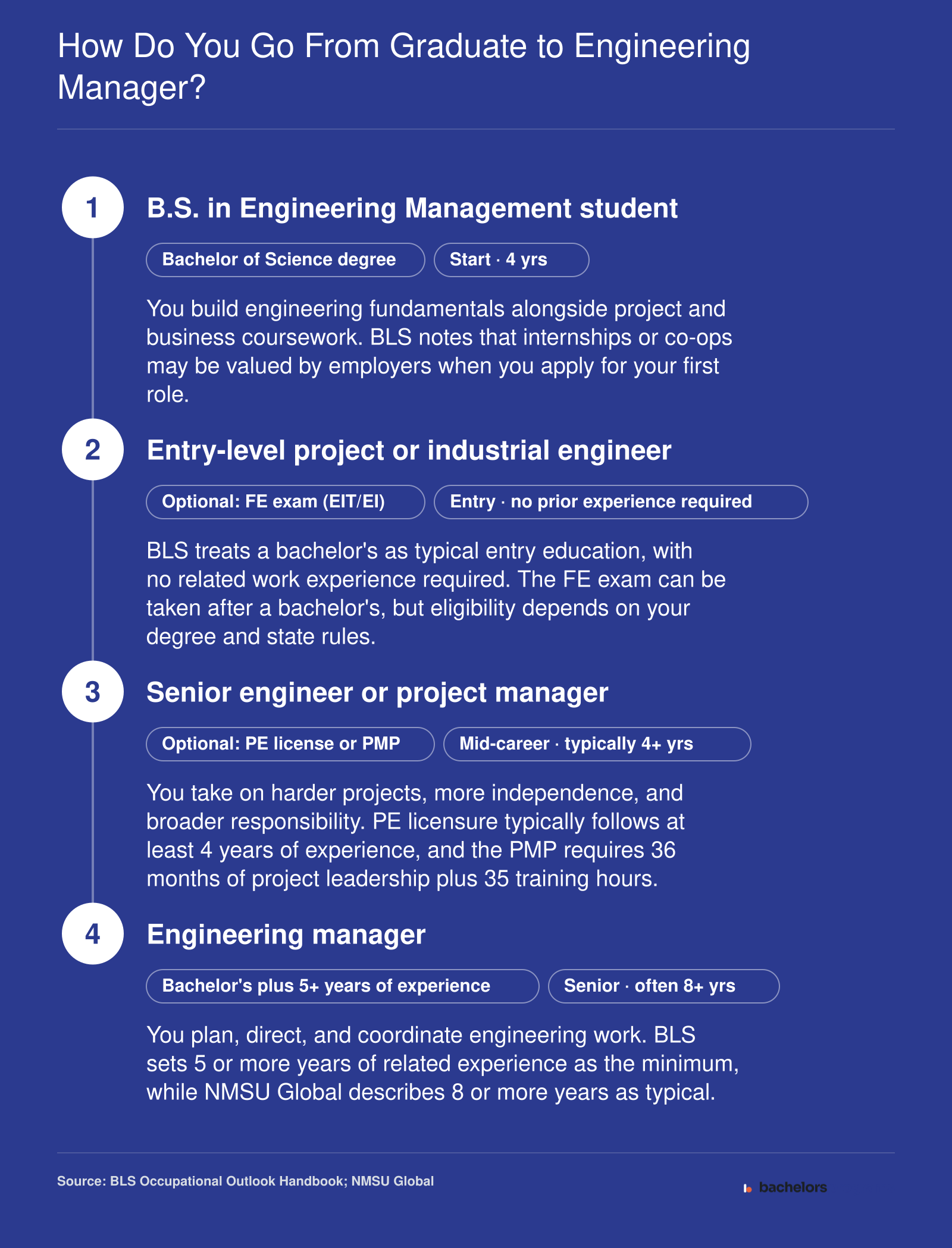
How Do You Go From Graduate to Engineering Manager?
The Bureau of Labor Statistics does not prescribe a fixed title sequence, and titles and timing vary by discipline, employer, and individual. The ladder below reflects a common route from a bachelor's degree to a management role, with the optional credentials that often support each step.
Engineering Management programs by state
Engineering Management Degree FAQs
These answers cover the questions bachelor's students ask most often about engineering management: value, online options, licensure, and math. Requirements vary by school and state, so confirm details with each program and your state licensing board.
Is a bachelor's degree in engineering management worth it?
Can you get an engineering management degree online?
Can engineering management graduates become licensed Professional Engineers (PE)?
How much math does an engineering management degree require?
Compare Engineering Management programs on the data that matters
Explore more Science & Engineering majors or browse every field of study.
All Science & Engineering programs Browse every field of study