Best Online Operations Management Degree Programs
Compare 70+ accredited online Operations Management programs, with net price after aid, graduation rates, earnings and debt from IPEDS and the U.S. College Scorecard.

Operations work has shifted from the shop floor to the spreadsheet: forecasting, inventory flow, and vendor performance are now daily software tasks. A bachelor's degree in operations management teaches that mix, and the Bachelor of Science (B.S.) in Operations Management is the most common credential.
Working adults need three things at once: a fully online, accredited format with no campus visits, a price that survives a tuition-reimbursement cap, and a transfer-friendly path into supply chain, logistics, or production roles.
Every program below is fully online, and the spread in net price and reported earnings is wide enough to change the payback math.
Key Points
- Every ranked program is fully online, with no residencies or hybrid sessions.
- Compare net price after grants, not just published per-credit tuition.
- A B.A.S. suits students who already hold an applied associate degree.
Best Fully Online Bachelor's in Operations Management Programs for 2027
Every program below is delivered fully online, with no hybrid format and no in-person residency required. Hybrid programs were left off this list, and the fully online programs that remain are ordered by a mixed quality composite that weighs cost, graduation and student outcomes together rather than leaning on any single metric.
Texas A & M International University
#1Laredo, TX · $3,600/yr (est. net price)
Best for: Budget-conscious Texas learners
Texas A&M International University in Laredo, Texas, delivers its Bachelor of Business Administration with a Production and Operations Management concentration entirely online, with coursework in purchasing, inventory control, quality management, systems and business logistics. The 133-credit degree carries a 24-credit concentration and a final-semester Business Strategy course, and the school's institution-wide graduation rate is 46%. Students who finished the program reported median earnings of $48,187 four years after finishing, and median program debt was $14,375.
- 133 total credit hours, including a 24-credit operations concentration
- Concentration covers purchasing, inventory control, quality control and logistics
- Business Strategy taken in the final semester before graduation
- 2.0 cumulative GPA required for good standing
- Maximum 15 semester credit hours in a regular semester
- No correspondence credit accepted; independent study carries 1 to 3 credits
George Mason University
#2Fairfax, VA · $15,000 – $20,000/yr (est.)
Best for: Analytics-minded business students
George Mason University in Fairfax, Virginia, offers an Operations and Supply Chain Management concentration inside its Bachelor of Science in Business, with coursework in government contracting, project management, quality management, socially responsible operations and business analytics. The school's institution-wide graduation rate is 68%, and graduates reported median earnings of $85,224 four years after finishing, with median program debt of $23,471. Faculty mentors advise concentrators on operations and supply chain careers, and students can join the Mason Information Systems and Operations Management Association.
- Business degree with 8 concentration options, including operations and supply chain
- Concentration coursework in government contracting and project management
- Builds modeling, analytics and technology skills for planning
- Faculty mentors advise on operations and supply chain careers
- Student organization: Mason Information Systems and Operations Management Association
- Honors program available within the Costello College of Business
Arizona State University
#3Tempe, AZ · ~$15,000/yr (est.)
Best for: AAS holders finishing a bachelor's
Arizona State University in Tempe offers a Bachelor of Applied Science in Applied Science with an operations management concentration, built for students who already hold an Associate of Applied Science from a regionally accredited school. The 120-credit degree covers process improvement, operations strategy, quality management and leadership, and up to 75 credits may transfer in. The university's institution-wide graduation rate is 68%, and graduates reported median earnings of $82,535 four years after finishing, with median program debt of $22,000.
- 120 credit hours with a concentration in operations management
- Requires a completed AAS degree; not open to first-year students
- Up to 75 credits may transfer from an Arizona AAS
- 2.00 cumulative GPA required for change of major
- STEM-OPT extension eligible for F-1 students
- Higher Learning Commission accredited
California State University-East Bay
#4Hayward, CA · $8,000 – $20,000/yr (est.)
California State University, East Bay in Hayward delivers an Operations and Supply Chain Management concentration within its AACSB-accredited Bachelor of Science in Business Administration. The 120-unit degree pairs a 72-unit business major with a 27-unit concentration drawn from eight options, and an online degree-completion format is available through Continuing Education. The school's institution-wide graduation rate is 48%, and graduates reported median earnings of $77,567 four years after finishing, with median program debt of $17,140.
- AACSB International accreditation
- 120 total units: 72-unit major plus 52 units of general education and graduation requirements
- 27-unit concentration selected from 8 options
- Coursework covers process improvement, capacity, lean and inventory management
- Operations courses carry the MGMT prefix and expire after ten years
- Transfer credit accepted only from AACSB-accredited schools
College of Southern Idaho
#5Twin Falls, ID · ~$6,000/yr (est.)
College of Southern Idaho in Twin Falls awards a Bachelor of Applied Science in Operations Management that extends the technical skills students build in a two-year Associate of Applied Science beyond a single vocation. Coursework covers communication, project management, critical thinking, computation, people management and decision-making, and the program sits in the Business and Information Systems Department. The school's institution-wide graduation rate is 33%, and students who already hold an AA or AS can enroll but must add career-technical education credits with an advisor's guidance.
- Builds on a completed two-year Associate of Applied Science
- AA or AS holders add career-technical education credits
- Coursework includes project management and decision-making
- Housed in the Business and Information Systems Department
- NextGen scholarships award up to $3,500 for tuition each year
- Housing awards up to $5,000 yearly for eligible students
Kansas State University
#6Manhattan, KS · $11,000 – $29,000/yr (est.)
Kansas State University in Manhattan delivers a Bachelor of Science in Business Administration with an operations and supply chain management concentration entirely online, taught by on-campus professors. The 120-credit program traces the flow of goods from material sources and suppliers through manufacturing and processing to delivery to the final customer, with analytical techniques for coordinating vendors, carriers, distribution centers and retailers. The university's institution-wide graduation rate is 71%, and graduates reported median earnings of $69,735 four years after finishing, with median program debt of $23,250.
- 120 credit hours delivered entirely online
- Taught by on-campus professors
- Covers sourcing, manufacturing, warehousing and transportation
- Analytical techniques for coordinating suppliers, carriers and retailers
- Separate admission routes for freshman, transfer, international and nondegree students
- Online tools show how prior coursework from another accredited institution transfers
Mississippi State University
#7Mississippi State, MS · ~$18,000/yr (est.)
Mississippi State University offers an Operations Management Engineering emphasis within its online Bachelor of Applied Science, aimed at students who want to design, assess, analyze and improve systems in manufacturing, service, entertainment and military settings. Coursework spans statistical analysis, systems engineering tools, industrial ergonomics, engineering economy, production and inventory planning, project management and quality control. The university's institution-wide graduation rate is 67%, and graduates reported median earnings of $55,993 four years after finishing, with median program debt of $24,700.
- Emphasis area within the online Bachelor of Applied Science
- Covers manufacturing, service, entertainment and military systems
- Coursework in production and inventory planning and control
- Project management taught with CPM, PERT and GERT
- Statistical quality control and acceptance sampling
- Prerequisites include Calculus I, Calculus II and engineering statistics
University of Kansas
#8Lawrence, KS · $12,000 – $30,000/yr (est.)
The University of Kansas in Lawrence offers an online Bachelor of Applied Science in Operations Management as a degree-completion program for transfer students who arrive with an associate degree or equivalent credits. The major covers supply chain management, project management, logistics, quality control and business analytics through case studies, group projects and scenario-based assignments, and it is designed to be finished in about two years. The university's institution-wide graduation rate is 69%, and graduates reported median earnings of $77,725 four years after finishing, with median program debt of $21,469.
- Online degree-completion program designed to finish in two years
- For transfer students entering with an associate degree or equivalent credits
- Covers supply chain, project management, logistics and quality control
- Business analytics coursework included
- Case studies, group projects and scenario-based assignments
- Rolling admissions with five annual start dates
- Part of the KU School of Professional Studies
Thomas Edison State University
#9Trenton, NJ · $5,000 – $10,000/yr (est.)
Thomas Edison State University in Trenton, New Jersey, awards a Bachelor of Science in Business Administration in Operations Management entirely online, with a 120-credit curriculum spanning supply chain, logistics, manufacturing, production control, distribution, inventory and quality management. A capstone project integrates the coursework and validates strategic management knowledge, and credit can be earned through university courses, TECEP exams or prior learning assessment. Graduates reported median earnings of $89,947 four years after finishing, with median program debt of $12,500.
- 120 credits, fully online
- Capstone required to complete the degree
- Credit through TESU courses, TECEP exams or prior learning assessment
- Covers manufacturing, production control, distribution and inventory
- Focus on supply chain and logistics management
- Cost accounting and business ethics recommended as supporting courses
Utah State University
#10Logan, UT · $9,000 – $25,000/yr (est.)
Utah State University in Logan offers an Operations and Supply Chain Management emphasis inside its management major at the Jon M. Huntsman School of Business, awarding either a Bachelor of Science or a Bachelor of Arts with added foreign language proficiency. The emphasis covers process improvement and supply chain management, and classes are available online as well as at the Logan campus and statewide campuses. The university's institution-wide graduation rate is 59%, and graduates reported median earnings of $79,875 four years after finishing, with median program debt of $14,000.
- BA or BS in management with an operations and supply chain management emphasis
- BS requires all major courses; the BA adds foreign language proficiency
- Emphasis covers process improvement and supply chain management
- Available online, at the Logan campus and statewide campuses
- Huntsman School admission requirements must be met before declaring the major
- Professional career coaches for interview prep and job search
- Other emphasis options include human resource management and wealth management
Cost & outcomes by school
Federal data for the highest-earning Operations Management programs, independent of the ranking above. Earnings are this field's bachelor's graduates four years after completing where the Scorecard reports them, else the school's undergraduate median.
| School | Net price / yr | Grad rate | Earnings | Debt | Grads/yr | Format |
|---|---|---|---|---|---|---|
| Bismarck State College ND | $10,270 | 47% | $122,948 | $15,250 | 48 | Online or campus |
| George Mason University VA | $17,915 | 68% | $85,224 | $19,440 | 2 | Online or campus |
| Western Governors University UT | $12,548 | 46% | $83,654 | $14,816 | 3,455 | Online |
| Arizona State University AZ | $14,967 | 68% | $82,535 | $20,490 | 284 | Online or campus |
| Utah State University UT | $14,936 | 59% | $79,875 | $14,000 | 112 | Online or campus |
| University of Kansas KS | $18,059 | 69% | $77,725 | $20,500 | 115 | Online |
| California State University-East Bay CA | $9,320 | 48% | $77,567 | $16,125 | 635 | Online or campus |
Sources: U.S. Department of Education. Net price, graduation rate, earnings and debt: College Scorecard (earnings and debt for this field's bachelor's graduates where reported, else school-wide); graduates: IPEDS. A dash means no figure is reported.
Cost, debt & payoff
Median earnings of this field's bachelor's graduates (4 yrs after completing, else the school's undergraduate median) vs. their median federal loan debt · U.S. College Scorecard
Across these programs the median graduate earns about $68,815 and finishes with roughly $22,125 in debt — a ratio that clears a common rule of thumb (keep debt below first-year salary). Net price and debt vary widely school to school, so check the per-school figures in the table above before you shortlist.
How We Ranked These 100% Online Operations Management Programs
"Mostly online" and fully online are not the same thing, and this list counts only the second kind. Any bachelor's program that required campus visits, residencies, or hybrid sessions was excluded before any other comparison began.
What We Compared
For the programs that cleared that filter, we weighed three measures:
- Net price: the average cost after grants and scholarships, not the sticker tuition.
- Graduation rate: the share of students who finish at the institution overall.
- Earnings and debt: College Scorecard figures for graduates of operations-related programs, including federal loan debt.
Where the Data Has Limits
Graduation rates cover the whole school, not the operations management program specifically, so a strong rate signals institutional support rather than a guarantee. Net price averages across all students, so your own aid package may land higher or lower. A few programs publish no earnings figures, usually because too few graduates were reported. We did not fill those gaps with estimates. Those schools are judged on the measures that do exist.
Where the Numbers Come From
Every figure comes from federal sources: IPEDS and the College Scorecard. No school paid for placement, and no position here can be bought. That is a neutral starting point, but confirm current tuition, format, and accreditation with each school before you apply.
What a Bachelor's Degree in Operations Management Covers
The coursework teaches how organizations turn inputs into products and services efficiently, from sourcing materials to delivering the finished result. Most online programs build on the same core: supply chain management, quality management, project management, operations analytics, inventory and forecasting, and logistics.
What You Actually Study and Build
- Process improvement: Quality courses cover Lean, Six Sigma, Total Quality Management and the Theory of Constraints. Colorado State University Global's operations and supply chain program, for example, covers Six Sigma, the Toyota Production System and Agile Manufacturing.1
- Data-driven planning: Analytics and forecasting courses teach you to model demand, set inventory levels and spot bottlenecks, usually in spreadsheets and business software.
- Coordination skills: Project management coursework covers scheduling, budgeting and managing cross-functional teams.
How Concentrations Change the Coursework
The concentration listed for each school in the ranking tells you where the electives go. A logistics focus leans toward transportation, warehousing and distribution. A supply chain focus adds sourcing, procurement and global trade. A project management focus shifts time toward planning methods and team leadership. Penn State World Campus pairs project and supply chain management in a single B.S., while Western Governors University combines supply chain and operations.
Certification Alignment
Some programs line up with industry credentials, though alignment is not the same as an included exam or credential.
- ASCM (APICS) CSCP and CPIM: Colorado State University Global, Western Governors University and Penn State World Campus align with these. York College of Pennsylvania adds CLTD and SME Lean Bronze.
- Lean Six Sigma: Western Governors University covers DMAIC. Appalachian State's SCM 3670 makes students eligible to pursue a Six Sigma Green Belt through the Council for Six Sigma Certification.2 Southern New Hampshire University grants prior-learning credit for an existing Green Belt with a score of 280 or higher.
- Broader options: University of Maryland Global Campus targets CSCP, Six Sigma Black Belt, CPSM, PMP and CAPM.3
ASCM's exam prep runs through APICS Learning Systems, and program pages generally do not say schools cover those materials or exam fees, so confirm with admissions.4
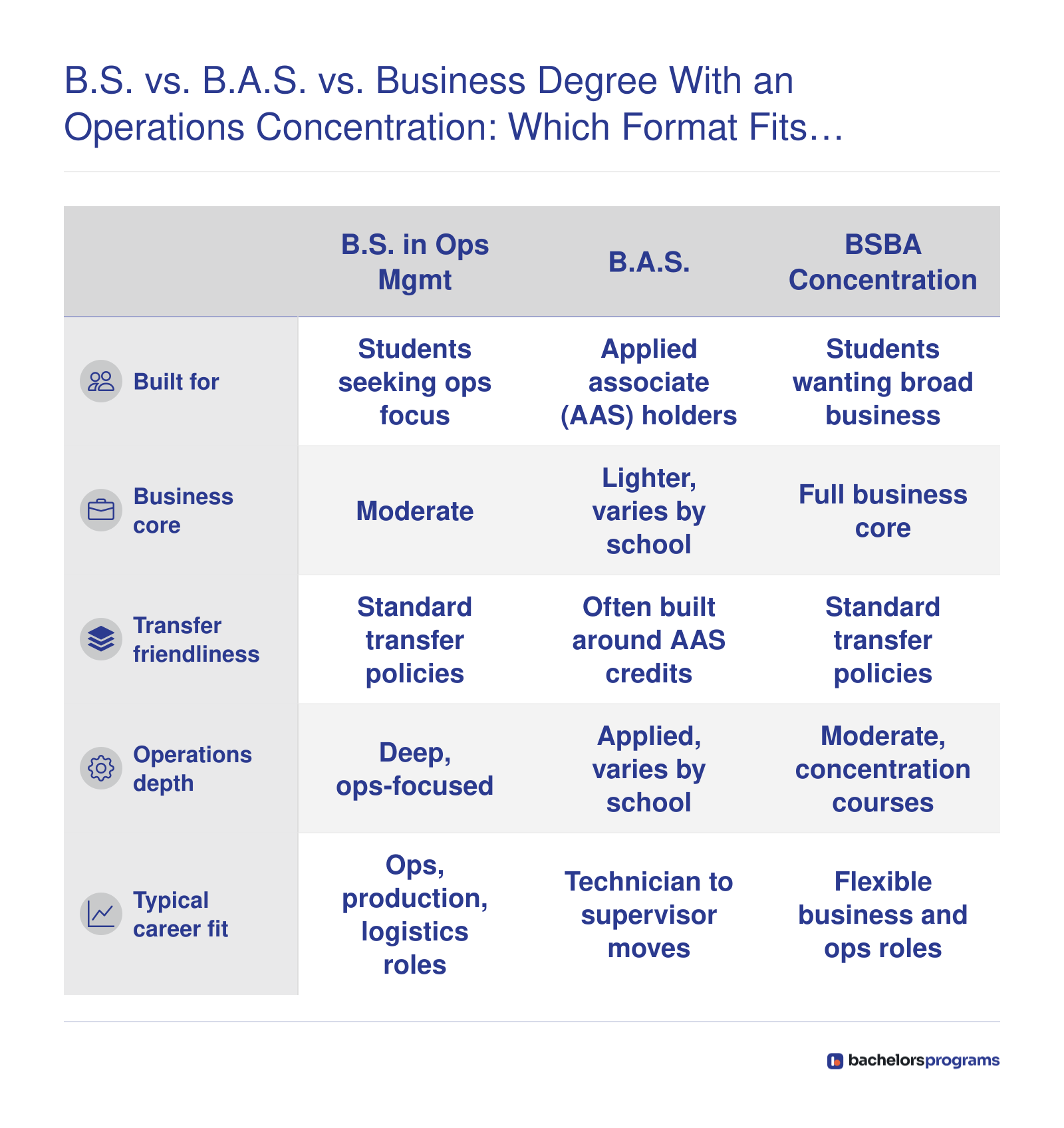
B.S. vs. B.A.S. vs. Business Degree With an Operations Concentration: Which Format Fits Your Background?
Operations management is offered under three common credential formats, and the right one depends on where you are starting. A B.A.S. is usually built for students who already hold a technical or applied associate degree, a B.S. in Operations Management suits students who want focused operations depth, and a business degree (BSBA) with an operations concentration fits students who want broader business flexibility. Curricula vary by school, so confirm the details with each program.
Online Operations Management Degree Cost: Per-Credit Tuition vs. Net Price
What does an online operations management degree actually cost? It depends on which number you trust. Sticker tuition is the published rate multiplied by credits. Net price is what students pay on average after grants and scholarships, so it is usually lower, and it reflects the whole institution rather than the online program alone.
Sticker Cost for Full Degrees
Most bachelor's programs require 120 credits, so per-credit rates translate quickly into totals.
- Southern New Hampshire University: The B.S. in Operations Management costs $354 per credit, or $42,480 for all 120 credits, before fees.
- Penn State World Campus: The closest match is a B.S. in Project and Supply Chain Management at $644 to $692 per credit for Fall 2026 through Summer 2027, depending on credits accrued. At the lower rate, 120 credits is about $77,000.
- Western Governors University: The Supply Chain and Operations Management bachelor's charges a flat $3,850 per six-month term, plus a $200 resources fee.1 Your total depends on how many terms you need, so faster pacing cuts the bill.
Public vs. Private Net Price
The ranked schools here are all public, and their average net prices vary widely: Texas A&M International University sits at $3,637, Cal State East Bay at $9,320, and Kansas State at $19,406. Compare that with SNHU's private nonprofit sticker price above. Public schools often cost less, but check whether out-of-state online students pay the same rate as residents.
What 60 Transfer Credits Save
Transfer credits reduce the number of credits you pay for. At SNHU, 60 accepted credits leave 60 to pay for, or $21,240 instead of $42,480. SNHU accepts up to 90 credits but requires 30 from SNHU itself. At Penn State's upper rate of $692, the remaining 60 credits would cost about $41,500.
Check What Graduates Borrowed
Federal Scorecard data shows median debt among graduates of $15,000 at Texas A&M International and $21,250 at Kansas State. Use those figures as a reality check against any estimate you build.
Lowest Net Price Fully Online Operations Management Programs
These three public schools post the lowest average net price after grants and scholarships among the online programs here, based on 2024 U.S. Department of Education data from IPEDS and the College Scorecard. Treat each figure as an approximate yearly average, not a quote, and run each school's net price calculator for an estimate based on your own income and aid. Low cost does not come with standout completion: graduation rates range from 33% to 46%, so Texas A&M International pairs the lowest price with the strongest rate of the three. Note that the two Bachelor of Applied Science programs admit only students who already hold an associate degree or higher.
| School | Location | Program | Average Net Price (per year) | Graduation Rate | Median Debt (Program Level) |
|---|---|---|---|---|---|
| Texas A&M International University | Laredo, TX | Bachelor's, Production and Operations Management | $3,637 | 46% | $13,686 |
| Bellingham Technical College | Bellingham, WA | Bachelor of Applied Science, Operations Management | $5,997 | 42% | N/A |
| College of Southern Idaho | Twin Falls, ID | Bachelor of Applied Science, Operations Management | $6,095 | 33% | N/A |
Related Articles
Transfer Credits, Completion Time, and Degree-Completion Paths
A short timeline and a full degree are only compatible if a school accepts most of what you have already earned. Start with the realistic baseline: a bachelor's degree is 120 credits, which takes about four years of full-time study with no prior credit. Advertised "18-month" timelines usually assume an associate degree or 60-plus transfer credits.
Transfer Limits and Residency Rules
Policies vary widely, so check them before you apply.
- Southern New Hampshire University: Up to 90 of the 120 credits can transfer into the B.S. in Operations Management, but at least 30 must be completed at SNHU. Transfer courses need a C- or higher.
- Penn State World Campus: The Project and Supply Chain Management major lists no numerical transfer cap, though not every credit will count toward the degree. Students must complete 36 of their last 60 credits at Penn State, and direct entry with 45 or more transferable credits requires a dean's review. A $25 fee applies per transcript for credits submitted after enrollment.
- Arizona State University Online: The Supply Chain Management B.S. typically accepts up to 64 undergraduate transfer credits toward its 120.
Associate Degrees and Prior Learning
The usual route is an associate degree from a regionally accredited community college, then a bachelor's completion program. Confirm the courses map to the major before you enroll, because accepted credits do not always apply to the degree.
SNHU also considers military training and work or life experience for credit. Its published waivers include an active CAPM certification and a Six Sigma Green Belt with an exam score of 280 or higher, each of which may replace a specific course. Penn State acknowledges credit for prior learning, but the policy material does not spell out limits for this major, so ask an advisor.
Accelerating Without Burning Out
Competency-based formats and 8-week terms can shorten the path, since you can move quickly through material you already know. They work best for students who can carry a heavier load alongside a job. If your schedule is already full, a steady pace with maximum transfer credit is usually the safer way to finish.
Accreditation and Certifications to Look For
Does an online operations management degree need AACSB accreditation? Not strictly. But check two layers of accreditation before you apply, and consider a third credential afterward.
Institutional Accreditation Comes First
Regional institutional accreditation applies to the whole college or university. It is the non-negotiable baseline because it affects federal financial aid eligibility, whether credits transfer, and how employers view the diploma. Arizona State University and the University of Kansas, for example, both list Higher Learning Commission accreditation, one of the regional accreditors.
AACSB vs. ACBSP
Both are business-specific accreditors, and they signal different things.
- AACSB: Accredits a business unit by reviewing mission, governance, faculty, curriculum, student learning, research, engagement, and continuous improvement.2 It is often regarded as the more selective of the two.
- ACBSP: Covers business, accounting, and business-related programs, with an emphasis on teaching excellence and student learning outcomes.1
Among the schools here, Kansas State University and California State University-East Bay list AACSB accreditation. University of Wisconsin-Eau Claire, which offers a fully online business degree in production/operations management, is AACSB accredited as well.3 I could not confirm ACBSP status for any school, so check the ACBSP member directory directly.
No Operations-Specific Accreditor Exists
Because operations programs have no dedicated accreditor, the business school's accreditation is your quality signal. Confirm that it covers the program you want and that the program is delivered fully online, since neither fact guarantees the other. AACSB's directory has filters for Production/Operations Management and Fully online.
Certifications That Strengthen the Degree
A bachelor's degree plus a Lean Six Sigma belt or an ASCM credential such as CPIM or CSCP gives a resume both academic breadth and applied skill. Many students pursue these alongside or soon after their coursework.
What Operations Managers Earn Nationally
Here is what the occupation pays across the U.S. labor market. This is a wage for the job itself, not a figure for program graduates.
Operations Management programs by state
Compare Operations Management programs on the data that matters
Explore more Business & Management majors or browse every field of study.
All Business & Management programs Browse every field of study