Best Real Estate Degree Programs
Compare 170+ accredited Real Estate programs, with net price after aid, graduation rates, earnings and debt from IPEDS and the U.S. College Scorecard.
Which real estate degree programs deliver strong outcomes without heavy debt, online or on campus? Average net price after aid ranges from about $3,000 at Baruch College to roughly $28,700 at the University of Pennsylvania.
Becoming a licensed agent does not require a degree. What a bachelor's adds is access to commercial brokerage, development, appraisal, and investment roles, where finance coursework and a four-year credential usually carry more weight than a license alone.
Key Points
- NYU's campus BS in Real Estate posts the highest early-career earnings here.
- Texas requires 180 pre-licensing hours, and a bachelor's degree waives none.
- The University of Memphis awards the same real estate BBA online and on campus.
The 10 Best Real Estate Degree Programs, Ranked
These ten programs range from dedicated real estate BBAs and BS degrees to finance tracks with a real estate concentration, and every one sits inside an AACSB-accredited business school or an architecture and planning college. Each entry lists the campus, delivery format, net price after aid, and graduation rate so you can compare programs on the numbers that matter most.
University of Wisconsin-Madison
#1Madison, WI · ~$17,000/yr (est.)
Best for: Commercial underwriting and appraisal aspirants
The University of Wisconsin–Madison anchors this list with the Graaskamp tradition of real estate education, taught through the Wisconsin School of Business. Undergraduates analyze every property type with Excel and ARGUS modeling, then finish with a business solutions capstone. The program has added a Real Estate in Rome semester abroad and a climate-risk research partnership with Hong Kong University of Science and Technology, and it enrolled roughly 662 undergraduate real estate majors in spring 2026.
- AACSB International accredited
- 120 total credit hours with a required capstone
- 3.0 GPA minimum plus prerequisite courses
- Commercial real estate underwriting with Excel and ARGUS
- Ranked #1 in the U.S. by U.S. News
- One assigned academic advisor and a major-specific career coach
- New Real Estate in Rome semester-abroad option
- Careers in private equity, lending, development, and asset management
University of Georgia
#2Athens, GA · ~$14,000/yr (est.)
Best for: Data-minded students eyeing a fast-track master's
The University of Georgia's Terry College of Business runs a structured Real Estate BBA that follows a property through site selection, acquisition, financing, development, valuation, and disposition. Students can add a Business Analytics Area of Emphasis or use a Double Dawgs pathway to fast-track a graduate degree in accounting, financial planning, or urban planning. A 2026–27 corporate-sponsor network supplies market data, advanced software, and direct employer connections.
- 120 total credit hours, designed for four-year completion
- 2.6 GPA minimum plus prerequisite courses
- Terry Foundations First business core
- Courses in investment, finance, valuation, and real estate law
- Optional Business Analytics Area of Emphasis
- Double Dawgs pathway into accounting, financial planning, or urban planning
- Real Estate Society with scholarships, internships, and a resume book
- 2026–27 corporate-sponsor network for market data and software
Florida State University
#3Tallahassee, FL · ~$11,000/yr (est.)
Best for: Florida students targeting appraisal and lending
Florida State University's real estate major sits in the Herbert Wertheim College of Business and takes an analytical view of urban land economics, appraisal, investment analysis, and risk theory. Students learn to weigh property decisions from the developer, lender, and consumer side, and use software to work through actual cases. Admission is specialized and in-person only, requiring 52 completed semester hours and a 2.9 GPA.
- 120 total credit hours, in-person at Tallahassee only
- 2.9 GPA minimum with 52 completed hours for admission
- Specialized admission beyond general University admission
- Coursework in valuation, market analysis, finance, and risk theory
- Software-based analysis of actual real estate cases
- Examines decisions from developer, lender, and consumer perspectives
- Prepares for roles as investment analyst, appraiser, or broker
CUNY Bernard M Baruch College
#4New York, NY · $7,000 – $15,000/yr (est.)
Baruch College places its real estate BBA inside the Zicklin School of Business, in the middle of the New York City market students are training to work in. The curriculum covers law, principles, finance and investment, capital markets, and development, with three electives drawn from urban economics, property management, construction, and analytics. Networking events, work-study, internships, and scholarships connect students to investment and development firms, banks, and regulatory agencies.
- BBA housed in the Zicklin School of Business
- Coursework in real estate law, finance, capital markets, and development
- Three electives from urban economics, property management, and analytics
- Real estate minor available for students in other majors
- Networking events, work-study, internships, and scholarships
- Employers include investment firms, banks, and regulatory agencies
University of Maryland-College Park
#5College Park, MD · $16,000/yr (est. net price)
The University of Maryland–College Park takes a broader view than most programs on this list. Its Bachelor of Arts in Real Estate and the Built Environment lives in the School of Architecture, Planning and Preservation and pulls in construction, policy, urban planning, design, and transportation around a "Quadruple Bottom Line" of financial, environmental, social, and design outcomes. Students work with practicing developers through the Colvin Institute, study abroad in places such as Cuba, India, Italy, and Japan, and can use a 4+1 pathway into a Master of Real Estate Development. The program's teams won the 2026 NAIOP DC|MD Capital Challenge, their fourth first-place finish.
- 120 total credit hours spanning construction, policy, and planning
- Quadruple Bottom Line framework for feasible, responsible projects
- Mentorship from practicing developers via the Colvin Institute
- Global programs in Cuba, India, Italy, and Japan
- Accelerated 4+1 pathway to a Master of Real Estate Development
- Project work on affordable housing and climate resilience
- 2026 NAIOP DC|MD Capital Challenge winner
Florida International University
#6Miami, FL · ~$9,000/yr (est.)
Florida International University's Hollo School of Real Estate offers a BBA in Real Estate with an international bent, covering residential, commercial, and cross-border transactions. It is one of the few U.S. schools pairing an undergraduate real estate major with a related graduate program, and it enrolled nearly 220 students across both in fall 2025. The school ranked first worldwide for real estate research productivity for 2021–25 in the REAL rankings, and its REact conference ties students to the Miami industry.
- 120 total credit hours
- Covers residential, commercial, and international real estate
- Coursework in finance, investment, legal environment, and appraisal
- Ranked No. 1 worldwide for real estate research productivity, 2021–25
- Careers in brokerage, mortgage banking, appraisal, and property management
- Employers include CBRE and Wells Fargo
- Financial aid and scholarships available
University of Pennsylvania
#7Philadelphia, PA · $29,000/yr (est. net price)
The Wharton School's BS in Real Estate is the most selective program here, combining 37 course units of Wharton business fundamentals with a required real estate finance and investment analysis course and a senior capstone. Electives reach into development, urban fiscal policy, real estate law, housing markets, data analytics, and international real estate. Small cohorts train inside one of the strongest business school alumni networks in the country.
- 37 total course units including Wharton's business core
- Required course in real estate finance and investment analysis
- Senior capstone required
- Electives in development, urban fiscal policy, law, and data analytics
- International real estate coursework available
- Concentration in Real Estate within the BS degree
University of Central Florida
#8Orlando, FL · ~$10,000/yr (est.)
UCF's BSBA in Real Estate runs through the Miller College of Business and the Dr. Phillips School of Real Estate, covering law, appraisal and valuation, commercial and residential finance, investment analysis, and market analysis. An Appraisal Track and an Honors in the Major research option give students room to specialize, and every student finishes with a strategic management capstone. The program draws on Orlando's development and sales market for internships and hiring.
- 120 total credit hours with a strategic management capstone
- Coursework in real estate law, appraisal, finance, and market analysis
- Dedicated Appraisal Track
- Honors in the Major research option
- Dr. Phillips School of Real Estate industry network
- $212.28 per credit hour for in-state students
Ohio State University
#9Columbus, OH · $17,000/yr (est. net price)
Ohio State's BS in Real Estate and Urban Analysis pairs Fisher College of Business core courses with real estate finance, law, and property management, and about 95% of students hold an internship before graduating. The curriculum prepares students for Ohio salesperson or broker licensure, and the Fisher Real Estate Society links them to alumni and recruiters. Study abroad options add an international dimension to a program built around valuation, development, brokerage, and finance.
- Combines management, economics, marketing, and finance
- Coursework in real estate finance, law, and property management
- Prepares for Ohio real estate salesperson or broker licensure
- About 95% of students complete an internship
- Fisher Real Estate Society with alumni and recruiter access
- Study abroad options available
- Direct admission to the Fisher major
Texas A&M University-College Station
#10College Station, TX · ~$21,000/yr (est.)
Texas A&M delivers real estate as a track inside its Finance BBA rather than a standalone major, aimed squarely at commercial real estate careers in finance, development, investment, and asset management. Students complete 120 credit hours of financial analysis, investment strategy, valuation, and property development coursework, with real estate electives and international options. The commercial emphasis maps to Texas growth markets and to employers such as developers, lenders, and asset managers.
- Real estate track within the Finance BBA, not a standalone major
- 120 total credit hours plus prerequisite courses
- Focus on commercial real estate finance and development
- Coursework in financial analysis, investment strategy, and valuation
- International coursework options
- Prepares for roles with developers, lenders, and asset managers
Cost & outcomes by school
Federal data for the highest-earning Real Estate programs, independent of the ranking above. Earnings are this field's bachelor's graduates four years after completing where the Scorecard reports them, else the school's undergraduate median.
| School | Net price / yr | Grad rate | Earnings | Debt | Grads/yr | Format |
|---|---|---|---|---|---|---|
| University of Southern California CA | $32,740 | 92% | $143,977 | $19,500 | 41 | Campus |
| Villanova University PA | $43,756 | 92% | $131,911 | $27,000 | 20 | Campus |
| New York University NY | $37,050 | 88% | $130,716 | $20,500 | 86 | Campus |
| University of Wisconsin-Madison WI | $17,354 | 90% | $120,483 | $20,138 | 225 | Campus |
| University of Pennsylvania PA | $28,699 | 97% | $111,371 | $15,715 | 27 | Campus |
| Lehigh University PA | $36,931 | 88% | $105,584 | $21,960 | — | Campus |
| Boston College MA | $41,704 | 91% | $103,937 | $19,000 | — | Campus |
| Texas Christian University TX | $36,660 | 86% | $103,547 | $25,000 | 150 | Campus |
| Marquette University WI | $31,487 | 83% | $99,583 | $19,500 | 49 | Campus |
| Virginia Polytechnic Institute and State University VA | $24,953 | 86% | $95,576 | $26,529 | 108 | Campus |
| Northeastern University MA | $30,915 | 91% | $92,538 | $24,250 | — | Campus |
| Ohio State University OH | $17,339 | 88% | $91,213 | $17,323 | 38 | Campus |
Sources: U.S. Department of Education. Net price, graduation rate, earnings and debt: College Scorecard (earnings and debt for this field's bachelor's graduates where reported, else school-wide); graduates: IPEDS. A dash means no figure is reported.
Cost, debt & payoff
Median earnings of this field's bachelor's graduates (4 yrs after completing, else the school's undergraduate median) vs. their median federal loan debt · U.S. College Scorecard
Across these programs the median graduate earns about $62,743 and finishes with roughly $21,500 in debt — a ratio that clears a common rule of thumb (keep debt below first-year salary). Net price and debt vary widely school to school, so check the per-school figures in the table above before you shortlist.
What Earned a School a Spot on This List
Low cost and strong outcomes rarely arrive together. A modest price can sit on top of weak earnings, and a famous name can come with debt that outlasts the degree, so the programs below had to justify their cost with results a family can check.
Each school here offers a four-year bachelor's program in real estate or a closely related business major, delivered online, on campus, or both. All are worth comparing on the same short list:
- Net price after aid: the average a student in that sector actually pays after grant and scholarship aid.
- Graduation rate: how many first-time students finish within six years.
- Earnings and debt: median pay for program graduates, plus median federal debt where the government publishes it.
Three cautions. The graduation rate describes the whole institution, not the real estate major. The net price shown is a sector-wide average, not a personal quote, and your own aid offer will differ. Earnings figures also come with a time window, often one year out and four years out, and some programs publish no program-level numbers at all.
Highest Early-Career Earnings Among Ranked Programs
Among the schools ranked here, New York University's campus BS in Real Estate posts the strongest program-level earnings in federal data.
Most Affordable Real Estate Degree Programs
These real estate bachelor's programs carry the lowest average net price after grants and scholarships, based on 2024 IPEDS and College Scorecard data from the U.S. Department of Education. Pell share signals how many students come from lower-income households, and median program debt shows typical borrowing where it is reported. Public universities charging in-state rates tend to produce the lowest net prices, which is why public campuses in New York and California lead this list.
| School | Location | Program | Average Net Price After Aid (per year) | In-State Tuition and Fees | Pell Grant Share | Median Program Debt |
|---|---|---|---|---|---|---|
| CUNY Bernard M Baruch College | New York, NY | Real Estate (Bachelor's) | $3,033 | $7,464 | 89.5% | $15,500 |
| California State University-Los Angeles | Los Angeles, CA | Business Administration, B.S.: Option in Real Estate | $3,967 | $7,160 | 86.9% | N/A |
| California State University-Northridge | Northridge, CA | Business Administration, B.S. (Real Estate Option) | $7,021 | $7,458 | 86.0% | N/A |
Online vs. Campus Real Estate Degrees: What Actually Differs
An online real estate degree from a regionally accredited school is generally the same credential as the campus version. The University of Memphis, for example, awards the same BBA in Finance with a Real Estate Concentration across its approved online, blended, and campus pathways. The real differences show up in networking, recruiting, and scheduling. Several of the programs here are offered in both formats, so you can often choose based on how you work rather than on prestige.
| What to compare | Online | Campus |
|---|---|---|
| Degree and diploma | Same BBA awarded as other pathways at the school. Online courses use the same faculty, learning outcomes, and credit weight. | Same BBA, taught by the same faculty. |
| Accreditation | Comes from the institution. Penn State World Campus, for instance, is covered by Middle States accreditation. | Same institutional accreditation. Business school accreditation is also worth checking. |
| Career services | Often full access. ASU online students get career advising, resume and cover-letter feedback, interview prep, and CareerLink job and internship searches. | Often more hands-on. Temple Fox offers workshops, mentoring, internship guidance, and employer connections through its career center. |
| Internship access | Approved internships or independent study are possible. Memphis offers FIR 4911 for finance, insurance, and real estate experience. | Guided search and placement support, with Handshake listings at Temple Fox. |
| Industry networking | Mostly through alumni networks. UMass Lowell online graduates can use the worldwide UMass alumni network. | In-person events. Cincinnati offers monthly Roundtable Series programs and the UC Real Estate Association. |
| Clubs, case competitions, recruiting | Fewer in-person touchpoints. Participation usually takes deliberate effort. | The campus edge. Real estate clubs, case competitions, and on-site recruiting by commercial firms are easier to reach. |
| Schedule and pace | Coursework fits around a job. Completion pace depends on term structure and transfer credit, so confirm with each school. | Fixed class meetings suit full-time students. Pace follows the standard semester calendar. |
Related Articles
Accreditation and Licensing: Where a Degree Helps and Where It Doesn't
Texas requires 180 hours of pre-licensing education before a sales agent exam, and a bachelor's degree does not waive any of it. That gap between what a diploma signals and what a license demands is where most confusion starts.
Two Kinds of Accreditation
Institutional accreditation covers the entire college, and it is the one you cannot skip: it governs transfer credit, graduate admission, and whether an employer treats the school as legitimate. AACSB accreditation is programmatic and narrower, reviewing the business school itself, including the faculty and curriculum behind a real estate major. A degree carrying both is the strongest combination. Accredited real estate degree programs clear the institutional bar first.
Licensing Runs on Its Own Track
No state requires a degree to sell real estate. Every state licenses agents through pre-licensing hours and an exam: Texas asks for 180 hours at the sales agent level, Florida 63.1 A degree changes what you know, not whether the state lets you practice.
Where a Degree Does Count
Broker licensing is where college work starts to pay off. Texas requires 270 hours plus 630 hours of additional education, and an accredited bachelor's degree is deemed to satisfy 300 classroom hours of related education, with a transcript required. Without a degree, applicants can face up to 900 education hours. Florida exempts only holders of a four-year real estate degree from an accredited institution; an unrelated bachelor's degree is not named in the statute.1
Confirm With Your State Commission
Rules vary by state and change often. Ask your state real estate commission in writing whether specific courses will count before you build a schedule around them.
What Real Estate Brokers Earn Nationally
Moving from a sales license to a broker license brings a measurable pay increase at the national level.
Real Estate Degree vs. Finance, Business, or Urban Planning
Should you major in real estate, or is a finance degree the safer bet for a career in commercial real estate?
Both can work. A real estate major gives earlier exposure to development, valuation, leasing, brokerage, and property management, plus industry recruiting pipelines.1 A finance major offers broader portability across banking, corporate finance, and investment management2, but you will need to build property-specific knowledge yourself. Employers commonly accept finance, economics, accounting, architecture, civil engineering, or general business degrees; a real estate concentration is an advantage, not a requirement.2
Three routes to compare
- Real estate major: deepest industry specialization and the most direct path to property-focused roles.
- Finance or general business major with a real estate minor or concentration: keeps banking, corporate finance, and investment management open while adding property coursework; a sound choice if you are undecided.
- Bachelor's-to-master's track: a business bachelor's followed by an MS in Real Estate suits students who decide late or want a graduate credential.
Match the goal to the path
- Commercial investment, acquisitions, or lending: finance plus a real estate concentration; expect Excel modeling tests.
- Residential brokerage: real estate or business major, with the state license earned separately.
- Development or planning policy: real estate for private development, urban planning for public-sector and policy roles.
- Property management: real estate concentration with property management coursework.
Compare programs by cost, format, and curriculum before you commit.
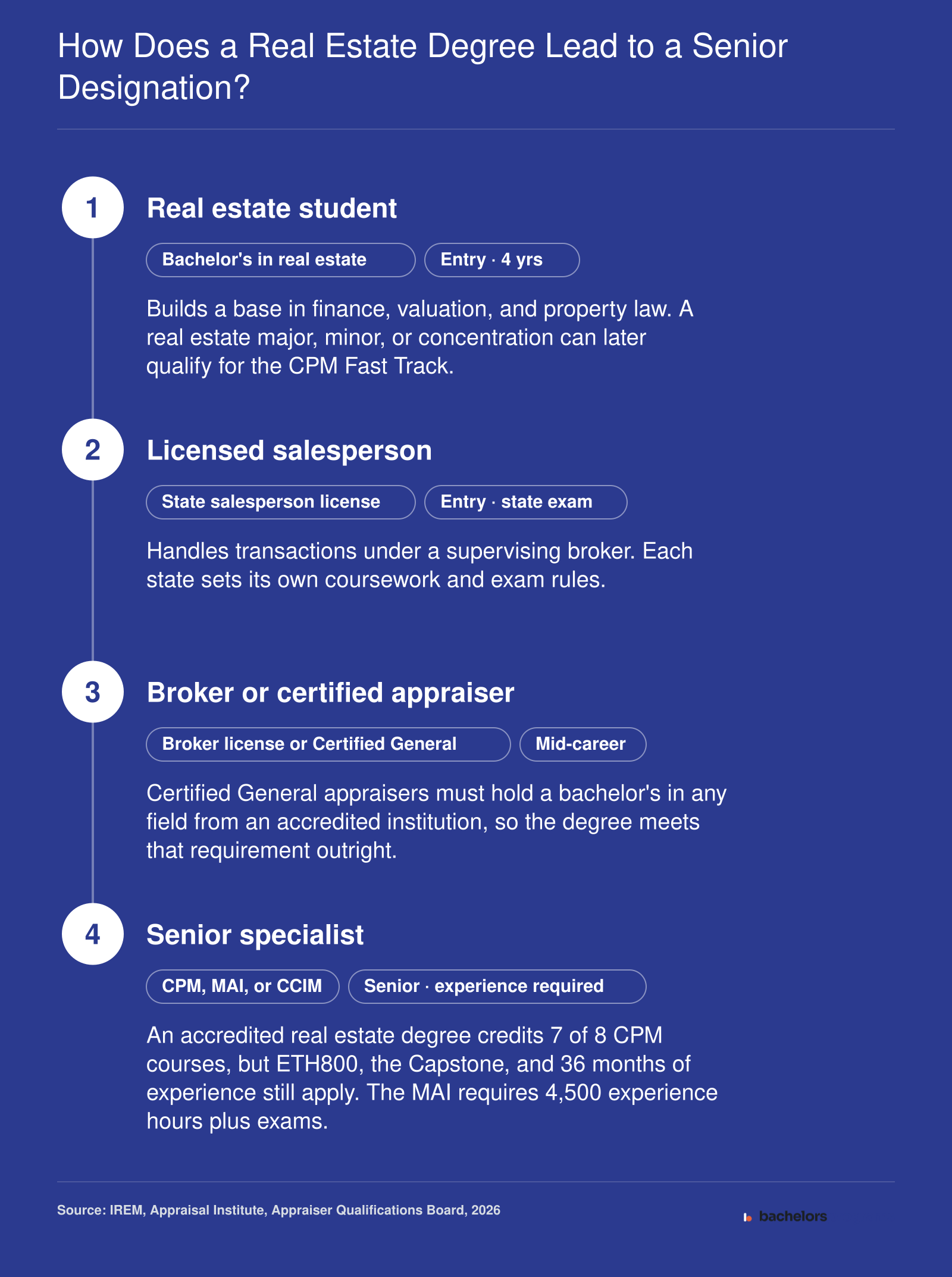
How Does a Real Estate Degree Lead to a Senior Designation?
Most real estate careers climb from a degree to a state license and then to a professional designation. A bachelor's degree is required for some steps and can shorten others.
Real Estate programs by state
Compare Real Estate programs on the data that matters
Explore more Business & Management majors or browse every field of study.
All Business & Management programs Browse every field of study