Best Online Real Estate Degree Programs
Compare 18 accredited online Real Estate programs, with net price after aid, graduation rates, earnings and debt from IPEDS and the U.S. College Scorecard.

A bachelor's in real estate covers brokerage, property management, appraisal and real estate finance, and you can earn the whole degree online. Each program in this ranking is 100% online, with no hybrid residency or campus visits.
The lowest net price here is $7,022, at Louisiana State University-Shreveport; the highest is $22,371, at Sterling College.
A degree is not a license. States issue real estate licenses through pre-licensing coursework and an exam, separate from any diploma. The degree qualifies you for finance, development and appraisal work that licensing alone does not reach.
Key Points
- Average net price ranges from $7,022 (LSU-Shreveport) to $22,371 (Sterling College).
- At Penn State, median earnings of $63,435 are roughly 2.5 times debt.
- Agent licenses require state pre-licensing courses and an exam, not degrees.
Best Fully Online Real Estate Degree Programs for 2027
Every program here is offered online, and hybrid or campus-only formats were excluded from the list. Order reflects a composite of delivery, cost, and outcomes, with format notes only where schools publish them.
Columbia College
#1Columbia, MO · ~$23,000/yr (est.)
Best for: Aspiring agents wanting industry association connections
Columbia College's real estate management bachelor's covers finance, law, sales, and customer experience, with digital marketing built in. It is the exclusive educational partner of the National Association of REALTORS, and the school's graduation rate is 42 percent.
- Exclusive educational partner of the National Association of REALTORS
- Coursework in real estate finance, law, strategic sales and customer experience
- Digital marketing, consumer behavior and advertising included
- Online coursework plus selected classes at nationwide locations
Louisiana State University-Shreveport
#2Shreveport, LA · ~$7,000/yr (est.)
Best for: Finance students adding a real estate track
LSU Shreveport offers an AACSB-accredited finance degree with a real estate concentration in investing, financial planning, and insurance. Students can study online and prepare for CFA, CFP, and Louisiana licensure exams; the school's graduation rate is 38 percent.
- AACSB-accredited finance degree with a real estate concentration
- Covers real estate investing, financial planning and insurance
- Prepares for CFA, CFP and Louisiana real estate licensure exams
- Fully online option or in-person study in Shreveport
- At least 30 of the final 40 term hours must be completed in residence
- Up to 60 transfer credits accepted from two-year institutions
University of Memphis
#3Memphis, TN · $10,000 – $15,000/yr (est.)
Best for: Career switchers wanting a broad business base
The University of Memphis pairs a broad business core with an 18-hour real estate concentration inside its finance BBA. Electives cover law, property management, and appraisal, and the school's graduation rate is 51 percent.
- 120-credit BBA with an 18-hour real estate concentration
- Business core includes accounting, economics, marketing and management
- Electives in real estate law, property management and appraisal
- Internship elective in finance, insurance and real estate
- 2.0 GPA minimum for the program
Sterling College
#4Sterling, KS · ~$22,000/yr (est.)
Sterling College offers real estate as a concentration inside a business administration major, alongside finance, entrepreneurship, management, and marketing. The curriculum integrates a Christian worldview, and the school's graduation rate is 41 percent.
- Real estate concentration inside a business administration major
- Concentration options include finance, entrepreneurship and marketing
- Christian worldview integrated across the curriculum
- One of more than 80 programs of study at the college
Purdue University Global
#5West Lafayette, IN · $5,000 – $10,000/yr (est.)
Purdue Global's real estate concentration sits inside its business administration bachelor's and leans applied: contracts, property management, sales, development, and finance. Students prepare a competitive market analysis; the school's graduation rate is 50 percent.
- 17 concentration options within the business administration degree
- Covers contracts, property management, sales, development and finance
- Applied project: competitive market analysis for a client
- Introduces concepts tied to the national real estate licensing exam
- Not intended to lead to state real estate certification
- Transfer credit not guaranteed; request a written evaluation
Pennsylvania State University-Penn State Erie-Behrend College
#6Erie, PA · $25,000/yr (est. net price)
Penn State Behrend's Smeal real estate major blends finance, investment, and development analysis with property law and valuation. The STEM-designated, AACSB-accredited degree offers appraisal credit and Borrelli Institute mentoring; the school's graduation rate is 44 percent.
- AACSB-accredited, STEM-designated real estate major
- Professional credit toward appraisal designation requirements
- Mentoring, internships and annual Real Estate Boot Camp
- 120 credits; 3.1 GPA required for entrance to the major
Pennsylvania State University-Penn State Schuylkill
#7Schuylkill Haven, PA · ~$20,000/yr (est.)
Penn State Schuylkill offers the Smeal real estate major, blending finance, law, investment valuation, appraisal, and project management. The STEM-designated, AACSB-accredited degree includes Borrelli Institute access; the school's graduation rate is 32 percent.
- STEM-designated, AACSB-accredited 120-credit degree
- Coursework in appraisal, investment valuation and property development
- Professional credit toward appraisal designation
- 3.10 GPA required for entrance to the major
Pennsylvania State University-Penn State Greater Allegheny
#8McKeesport, PA · $14,000 – $24,000/yr (est.)
Penn State Greater Allegheny offers the 120-credit Smeal real estate major, covering finance, investment, development analysis, law, and appraisal. Students tap Borrelli Institute mentoring and the annual Real Estate Boot Camp; the school's graduation rate is 19 percent.
- 120-credit STEM-designated real estate major
- Covers real estate finance, investment, law and appraisal
- Borrelli Institute mentoring and Real Estate Boot Camp
- Wide career reach: brokerage, valuation, lending and development
Pennsylvania State University-Penn State Lehigh Valley
#9Center Valley, PA · $18,000/yr (est. net price)
Penn State Lehigh Valley offers the Smeal real estate major, covering finance, law, valuation, appraisal, and project management. The STEM-designated, AACSB-accredited program includes Borrelli Institute internships; the school's graduation rate is 18 percent.
- STEM-designated, AACSB-accredited real estate major
- Covers finance, law, investment valuation and project management
- Internships and mentoring through the Borrelli Institute
- Annual Real Estate Boot Camp and student association
Pennsylvania State University-Penn State Abington
#10Abington, PA · ~$18,000/yr (est.)
Penn State Abington offers the Smeal real estate major, with coursework in finance, law, appraisal, and property development. The STEM-designated, AACSB-accredited program includes Borrelli Institute mentoring; the school's graduation rate is 20 percent.
- STEM-designated, AACSB-accredited curriculum
- Covers finance, law, appraisal and property development
- Access to Borrelli Institute mentoring and industry executives
- Annual Real Estate Boot Camp and Real Estate Association
None of the ranked Real Estate programs match the online lens yet. The full ranking is at the link above.
Cost, debt & payoff
Median earnings of this field's bachelor's graduates (4 yrs after completing, else the school's undergraduate median) vs. their median federal loan debt · U.S. College Scorecard
Across these programs the median graduate earns about $62,743 and finishes with roughly $21,500 in debt — a ratio that clears a common rule of thumb (keep debt below first-year salary). Net price and debt vary widely school to school, so check the per-school figures in the table above before you shortlist.
How Much Does an Online Real Estate Degree Cost?
What you pay depends far more on the school you choose than on whether the program is online. Among the programs here, average net price runs from $7,022 at Louisiana State University-Shreveport to $22,371 at Sterling College. Net price is a school-wide average after grants and scholarships, not a quote for your own bill, so treat it as a benchmark.
Public vs. Private
Public schools hold the low end. LSUS and Purdue Global ($7,770) sit under $8,000, while the Penn State campuses climb from $15,521 at Greater Allegheny to $22,213 at Altoona. Private schools can compete, though. Peirce College's net price of $12,148 is lower than the University of Memphis at $12,397.
Residency can still matter online. Memphis lists tuition and fees of $10,728 in-state and $15,384 out-of-state. Penn State Altoona lists $15,972 versus $26,958. LSUS, Peirce and Sterling charge one rate to everyone.
Debt Levels
School-wide median federal debt for graduates gives a sense of borrowing: $22,500 at LSUS, $23,300 at Memphis, $24,625 at Sterling and $31,250 at Peirce.
Before You Apply
Run each school's net price calculator with your own household numbers, and ask admissions whether online students pay a flat online rate or the residency-based rate. That one question can shift your total by thousands of dollars.
What Real Estate Careers Pay: Agents, Brokers, Managers and Appraisers
A bachelor's in real estate prepares you for brokerage, property management, appraisal and real estate finance roles, and the table below shows what those occupations pay nationally, using U.S. Bureau of Labor Statistics median wages from May 2025 and projected job growth from 2025 to 2035. Of these roles, the BLS lists a bachelor's degree as the typical entry-level education only for appraisers and assessors. Sales agents, brokers and property managers can enter with a high school diploma, though valuation, finance and management coursework applies directly to their work. These are occupation-wide figures for all workers in each field, not the program-level graduate earnings reported elsewhere on this page.
| Occupation | Median Annual Wage | Projected Job Growth | Typical Entry Education |
|---|---|---|---|
| Real estate sales agents (brokerage specialization) | $52,830 | 2% (2025 to 2035) | High school diploma or equivalent |
| Real estate brokers (brokerage and finance specializations) | $73,220 | 2% (2025 to 2035) | High school diploma or equivalent |
| Property, real estate, and community association managers (property management specialization) | $69,990 | 4% (2025 to 2035) | High school diploma or equivalent |
| Real estate appraisers and assessors (appraisal and valuation specialization) | $67,960 | 3% (2025 to 2035) | Bachelor's degree |
Related Articles
Is an Online Real Estate Degree Worth It? Earnings vs. Debt by School
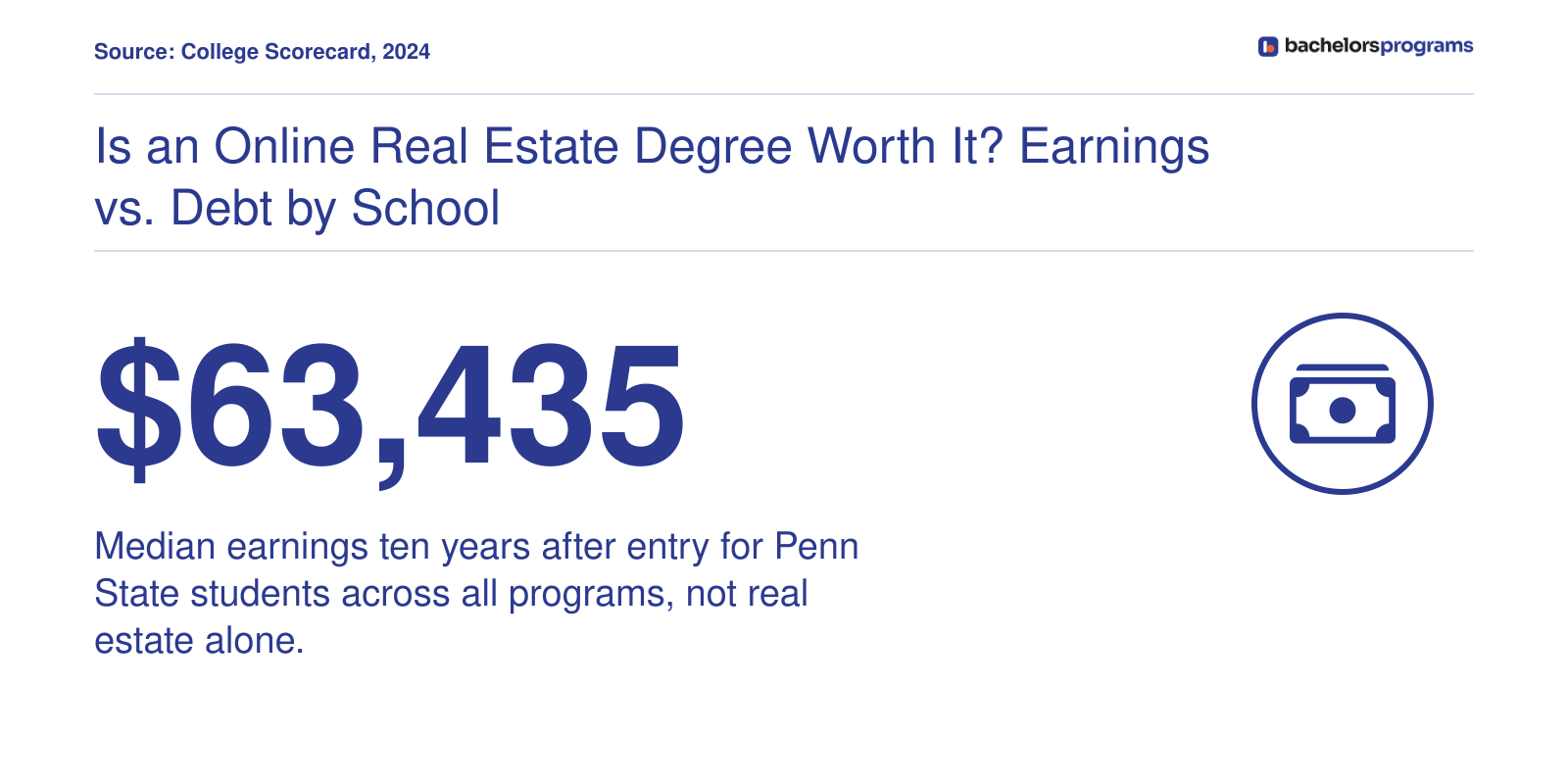
Penn State's Real Estate, B.S. fills the top of this ranking, and university-wide its students earn a median $63,435 ten years after entry against a median federal debt of $25,000 at graduation, roughly 2.5 times what they borrow. Earnings and debt for the real estate major alone are not yet reported for these campuses, so read this as a university-wide benchmark rather than a figure for the real estate program.
Accreditation, Licensing and Transfer Credits: What Your Degree Does and Doesn't Cover
You do not need a degree to become a real estate agent. State pre-licensing coursework and an exam are what earn the license. Most states set a minimum age, require a high school diploma or equivalent, and ask for approved education hours. Michigan, for example, requires 40 hours of pre-licensure education, including 4 hours on civil rights and equal opportunity.1
Where a Degree Can Help
Degree coursework can still shorten the path in some states:
- Pennsylvania: A JD or a real estate bachelor's can substitute for the 75-hour salesperson education requirement.
- California: The salesperson license requires three college-level courses,2 and the broker license requires eight. A four-year degree with a real estate major or minor may waive the broker experience requirement, though not necessarily the coursework.3
- New York: A real estate concentration may support a waiver of broker coursework on written request.4
Rules change, so confirm the details with your state regulator.
Check Accreditation Twice
Institutional accreditation (formerly called regional) determines federal financial aid eligibility, credit transfer and graduate school acceptance. AACSB accreditation covers only a university's business school, and many employers and MBA programs read it as a mark of rigor.
To verify a school, search its exact legal name in DAPIP, the U.S. Department of Education's accreditation database. Then cross-check CHEA, which is a separate database whose records can differ.5 Finally, look up the business school in AACSB's directory.
Transfer Credits for Working Adults
Ask each school three questions before you apply:
- Transfer cap: How many credits can you bring in?
- Prior learning: Can licenses or work experience earn credit?
- Term length: Are courses offered in accelerated 7- or 8-week terms?
Real Estate programs by state
Compare Real Estate programs on the data that matters
Explore more Business & Management majors or browse every field of study.
All Business & Management programs Browse every field of study