Best Sports Management Schools in California
Compare 20 accredited Sports Management programs in California, with net price after aid, graduation rates, earnings and debt from IPEDS and the U.S. College Scorecard.

Los Angeles will host the 2028 Summer Olympics, and the state already supports franchises in every major league plus a deep bench of college athletics programs. That concentration of teams, venues and events draws students to the state's sports management programs. The common credential is the Bachelor of Science (B.S.) in Sports Management, though many schools house the major inside kinesiology, business or recreation departments.
The tension is cost against access: public campuses charge far less, while private schools tend to sit closer to the teams and networks. Entry-level sports jobs are competitive, so internships often decide outcomes more than the name on the diploma.
Key Points
- Public California campuses here charge $7,341 to $13,596 in-state tuition yearly.
- Saint Mary's and Pacific top $57,000 tuition; net price runs about half.
- Each ranked school teaches its sports management bachelor's on campus.
Best Bachelor's in Sports Management Schools in California
The ten programs below are ordered using completion and net price data alongside program-level records from each school. What they share is a campus-based bachelor's degree in California and a real internship requirement; what separates them is the academic home, whether kinesiology, business, communication, or recreation management. Each card names the degree, the concentration, and the experiences that distinguish the program.
California Polytechnic State University-San Luis Obispo
#1San Luis Obispo, CA · ~$17,000/yr (est.)
Best for: Experiential learners drawn to outdoor recreation
Cal Poly's sport management path sits inside the Experience and Event Management bachelor's degree, with a Sport and Recreation Management concentration built on the university's Learn by Doing model. Students choose a career track in professional and intercollegiate sport, adventure and outdoor recreation, coaching and youth development, or community recreation, then apply it in a 400-hour internship and a senior project. It is one of the few programs on this list accredited by the Council on Accreditation of Parks, Recreation, Tourism and Related Professions.
- COAPRT accredited program
- 120 total credit hours on a four-year plan
- 400-hour internship plus senior project
- Four career tracks, from pro sport to outdoor recreation
- Coursework in sport marketing, ethics, and event planning
- Community and nonprofit recreation option
San Jose State University
#2San Jose, CA · ~$14,000/yr (est.)
Best for: Bay Area students seeking international coursework
San Jose State houses its sport management option inside the kinesiology department, so students study human movement science alongside the business and cultural side of athletics. Coursework runs through sport facility and event management, sports and fitness marketing, sport psychology, and a senior seminar, and the program requires an international experience that few California peers ask for. The Bay Area location keeps internships within reach of professional and collegiate sports organizations.
- Sport management option inside the Kinesiology department
- International experience required for graduation
- Four-year advising roadmap available to students
- Senior seminar caps the major coursework
- Internship in kinesiology available for credit
- 60+ units required before SJSU Studies courses
California State University-San Bernardino
#3San Bernardino, CA · $4,600/yr (est. net price)
Best for: Business-minded students eyeing sponsorship careers
California State University, San Bernardino takes a business-first route: the Sports and Entertainment Marketing concentration lives inside the B.A. in Administration and adds 18 units of marketing research, professional selling, and advanced strategy to a broad management core. Students study sponsorships, promotions, and brand building for teams, venues, media companies, and entertainment firms, then finish with an administration capstone. It suits students who want marketing depth rather than a stand-alone sport studies degree.
- 18-unit concentration inside the B.A. in Administration
- 120 total credit hours with an administration capstone
- Covers marketing research, professional selling, and strategy
- Focus on sponsorships, promotions, and brand building
- Marketing or hospitality electives may count toward the concentration
- One of 17 concentration options in the major
California State University-Sacramento
#4Sacramento, CA · $8,000 – $21,000/yr (est.)
Sacramento State's B.A. in Sport and Recreation Management blends business fundamentals with programming and event work across community, collegiate, and professional sport. The 39-unit major covers budgeting, marketing, facility management, legal issues, and event design, and 12 units of electives let students push toward outdoor recreation, nonprofit engagement, or public agency recreation. Grant writing, volunteer management, and youth development electives give the degree a community-service tilt.
- 39 units in the major, 120 units to graduate
- 12 units of electives to shape the degree
- Covers budgeting, marketing, facility management, and law
- Event design and program evaluation coursework
- Electives in grant writing and volunteer management
- Prepares for community, collegiate, and professional sport roles
University of the Pacific
#5Stockton, CA · ~$25,000/yr (est.)
The University of the Pacific delivers sport management through its AACSB-accredited Eberhardt School of Business, so students take a full business core plus data analysis aimed at sports organizations. The program requires internships and offers a sport-specific study abroad option, and its alumni network includes a vice president with the Golden State Warriors. Small cohorts in Stockton mean close faculty relationships and early industry exposure.
- AACSB-accredited Eberhardt School of Business
- Business core plus data analysis for sports organizations
- Required internships with sports organizations
- Sport-specific study abroad opportunity
- Curriculum follows sport management accreditation standards
- Alumni network includes a Golden State Warriors vice president
California State University-Northridge
#6Northridge, CA · ~$7,000/yr (est.)
California State University, Northridge approaches the field through recreation: the Recreational Sport Management concentration sits inside the B.S. in Tourism, Hospitality, and Recreation Management. Students work with a faculty advisor to shape electives around event planning, club management, or outdoor recreation, then complete a minimum 400-hour professional internship. The degree prepares graduates for parks, recreation, tourism, and hospitality roles as well as community and campus sport programs.
- Recreational Sport Management concentration
- Minimum 400-hour professional internship
- Faculty advisor helps select career-aligned electives
- Coursework in event planning, club management, outdoor recreation
- One of 11 concentration options in the major
- Prepares for parks, recreation, tourism, and hospitality roles
California State University-Fresno
#7Fresno, CA · ~$7,000/yr (est.)
Fresno State places sport management in its kinesiology department as the Sport Administration option, pairing biomechanics, exercise physiology, and sport psychology with marketing, finance, and facility management coursework. A 12-unit internship supplies hands-on experience in collegiate athletics, professional teams, or recreation centers. The 66-unit major is one of the more science-grounded routes into the sports business on this list.
- 120 total units; 66-unit major requirement
- 51-unit sport administration option
- 12-unit internship in sport administration
- 23 units of approved electives
- C or higher required in major courses
- 43 units of general education
Saint Mary's College of California
#8Moraga, CA · ~$30,000/yr (est.)
Saint Mary's College of California runs its Sport Management concentration inside a B.A. in Kinesiology, with small classes and a liberal arts setting in Moraga. Students cover sport marketing, facility and event management, sports economics, law, finance, and data analytics, then complete a required internship that often runs through the college's own athletics department. The Human Performance Lab adds a hands-on science component that a pure business program would not offer.
- Required internship, often with College Athletics
- Coursework in sport marketing, economics, law, and finance
- Data analytics plus facility and event management courses
- Hands-on work in the Human Performance Lab
- Small classes in a liberal arts setting
- Prepares for athletic director and facility manager roles
California Lutheran University
#9Thousand Oaks, CA · ~$30,000/yr (est.)
California Lutheran University offers a standalone B.S. in Sports Management that blends business, communication, and marketing with sports sociology, economics, analytics, and a capstone research project. The curriculum was developed with input from organizations including the Los Angeles Rams and LA Galaxy, and an industry advisory board plus thousands of employer contacts support internships around the LA sports market. Students have visited the Los Angeles Kings practice facility to study team, facility, and revenue operations, and a 4+1 option lets them fast-track a graduate degree.
- Bachelor of Science developed with the LA Rams and LA Galaxy
- Industry advisory board backs the curriculum
- 4+1 option to fast-track a graduate degree
- 20,000+ employer contacts for internships
- Business of Sports Club for students
- Free career services for life after graduation
Pepperdine University
#10Malibu, CA · $55,000 – $60,000/yr (est.)
Pepperdine's Sport Administration major at Seaver College is an interdisciplinary program that combines sport, business, communication, and leadership rather than nesting the field in kinesiology or business alone. A required senior internship, often with the university's athletics department, and a capstone project anchor the final year, and faculty bring backgrounds from professional sport, intercollegiate athletics, and sport media. The Malibu setting and Christian foundation shape an ethics-focused lens on leadership in the industry.
- Required senior internship, often with Pepperdine athletics
- Capstone project in the final year
- Blends sport, business, communication, and leadership
- Faculty with professional sport and sport media backgrounds
- Industry events connect students with employers
- Christian foundation frames ethical leadership
- 13:1 student-to-faculty ratio
Cost & outcomes by school
Federal data for the highest-earning Sports Management programs, independent of the ranking above. Earnings are this field's bachelor's graduates four years after completing where the Scorecard reports them, else the school's undergraduate median.
| School | Net price / yr | Grad rate | Earnings | Debt | Grads/yr | Format |
|---|---|---|---|---|---|---|
| San Jose State University CA | $13,760 | 69% | $78,988 | $15,000 | 241 | Campus |
| Menlo College CA | $31,100 | 54% | $76,419 | $21,750 | 23 | Campus |
| Saint Mary's College of California CA | $30,378 | 70% | $66,265 | $21,625 | 37 | Campus |
| Pepperdine University CA | $58,098 | 83% | $65,100 | $23,336 | 76 | Campus |
| California Polytechnic State University-San Luis Obispo CA | $16,665 | 86% | $64,579 | $15,000 | 76 | Campus |
| California Baptist University CA | $26,285 | 62% | $60,816 | $26,490 | 104 | Campus |
| California Lutheran University CA | $30,109 | 70% | $59,820 | $24,000 | 68 | Campus |
| Concordia University-Irvine CA | $28,115 | 58% | $59,648 | $27,000 | 40 | Campus |
| Vanguard University of Southern California CA | $21,241 | 57% | $59,541 | $22,000 | 50 | Campus |
| California State University-Sacramento CA | $9,338 | 56% | $59,142 | $17,000 | 283 | Campus |
| University of the Pacific CA | $25,447 | 69% | $59,012 | $19,500 | 51 | Campus |
| The Master's University and Seminary CA | $32,647 | 68% | $57,106 | $20,000 | 35 | Campus |
Sources: U.S. Department of Education. Net price, graduation rate, earnings and debt: College Scorecard (earnings and debt for this field's bachelor's graduates where reported, else school-wide); graduates: IPEDS. A dash means no figure is reported.
Cost, debt & payoff
Median earnings of this field's bachelor's graduates (4 yrs after completing, else the school's undergraduate median) vs. their median federal loan debt · U.S. College Scorecard
Across these programs the median graduate earns about $59,142 and finishes with roughly $21,188 in debt — a ratio that clears a common rule of thumb (keep debt below first-year salary). Net price and debt vary widely school to school, so check the per-school figures in the table above before you shortlist.
Most Affordable Bachelor's in Sports Management Programs in California
If cost is your first filter, start here: these are the lowest-priced sports management bachelor's programs among the schools ranked on this page, based on 2024 IPEDS and College Scorecard data. Average net price is what students paid after grants and scholarships, averaged across aid recipients, so your own cost may be higher or lower depending on family income and the aid you receive. Every school in this table is a public California State University campus. Public versus private status is the main reason for the price gap across the full ranking, and where federal data reports median debt for program graduates, it is shown.
| School | Location | Program | Average Net Price (After Aid) | In-State Tuition and Fees | Median Program Debt |
|---|---|---|---|---|---|
| California State University-San Bernardino | San Bernardino, CA | Bachelor of Arts in Administration (Sports and Entertainment Marketing concentration) | $4,564 | $8,093 | $15,000 |
| California State University-Fresno | Fresno, CA | Kinesiology, Sport Administration Option, B.S. | $7,000 | $7,350 | $14,426 |
| California State University-Northridge | Northridge, CA | Tourism, Hospitality, and Recreation Management (Recreational Sport Management) | $7,021 | $7,458 | $14,865 |
| California State University-Sacramento | Sacramento, CA | BA in Sport and Recreation Management | $9,338 | $8,018 | $17,000 |
| San Jose State University | San Jose, CA | Kinesiology, Area of Specialization in Sport Management | $13,760 | $8,410 | N/A |
How to Choose a Bachelor's Degree in Sports Management in California
A famous name carries weight, but a program that matches the job you want usually does more for your career. Use these checks to compare schools.
Accreditation
AACSB is the business-school accreditor. California State University-San Bernardino is the clearest example here: AACSB lists its Bachelor of Arts in Administration with a Sports Management focus under the university's accreditation.1 That covers the business school, and it does not show whether the sports curriculum is separately accredited. COSMA is the accreditor built specifically for sport management programs. COSMA status is unconfirmed for the California schools listed here, so check COSMA's directory or ask admissions before you rely on it.
Internships and the 2028 Olympics
Ask whether the internship is required or optional, how many credits it carries, and who places students. Look at the setting too. Los Angeles hosts the 2028 Olympics, so schools in the Southern California region, such as Pepperdine, California Lutheran and Cal State Northridge, are worth asking about event and operations roles. Ask each one which event and operations roles it can place students in.
Specializations
Start from the job and work backward.
- Analytics: Pick a program with data coursework, such as University of the Pacific's Sport Management & Analytics.
- Marketing and sponsorship: Look for a business-heavy curriculum, like Simpson University's Bachelor of Business Administration.
- Events: Cal Poly San Luis Obispo's Experience and Event Management (B.S.) fits venue and festival work.
- NIL and athletics administration: Check course catalogs for compliance, law and college-sports topics.
Degree Home
The credential name signals the coursework. Business-based degrees (B.S. or BBA) lean toward finance, marketing and management. Kinesiology-housed options, such as San Jose State, Fresno State, Saint Mary's and Whittier, add exercise science and sport behavior. B.A. programs, such as Sacramento State's, often pair management with broader liberal arts study.
Do You Need a License?
The bachelor's degree does not require one, and ordinary entry-level jobs in event operations, ticketing, marketing and athletics administration carry no California license. Athlete agents are the exception. Under the Miller-Ayala Athlete Agents Act, an agent must file with the California Secretary of State before doing business. This is a filing and registration process, not a conventional license.2 Talent agencies are regulated separately by the Labor Commissioner.3 Leagues' players associations, such as the NBPA and NFLPA, run their own agent credentials.
Online and Hybrid Bachelor's in Sports Management at California Schools
An online bachelor's in sports management delivers its lectures and coursework entirely at a distance. A hybrid program mixes online classes with scheduled time on campus. Among the ranked California schools, the sports management bachelor's is a campus program at each one: Cal Poly, San Jose State, Cal State San Bernardino, Sacramento State, University of the Pacific, CSUN, Fresno State, Saint Mary's College of California, California Lutheran University and Pepperdine University.
Where the Formats Stand
- Campus-based: Every ranked program listed above is delivered on campus.
- Online or hybrid: If you need remote study, check current delivery options directly with the other California schools listed later on this page. Formats can change from one catalog year to the next.1
Why Campus Delivery Matters in This Field
Sports management depends heavily on hands-on placements, and these programs build them into the degree:
- CSUN requires a professional internship of at least 400 hours.
- Fresno State includes a 12-unit internship in sport administration.
- University of the Pacific requires internships.
- Saint Mary's and Pepperdine place students with their own athletics departments.
- California Lutheran developed its program with the LA Rams and LA Galaxy and offers internships near the Los Angeles sports hub.
Living near teams, venues and alumni makes this kind of networking easier. If you find an online option elsewhere, ask how it handles field hours, whether any in-person sessions are mandatory, and whether online tuition differs from the on-campus rate.
Options for Transfer Students
Community college transfers should ask each school about upper-division entry. Cal State San Bernardino requires 60 semester units before upper-division courses. San Jose State expects 60 or more units before its SJSU Studies courses. Arriving with a full two years of transferable credit puts you close to both thresholds.
Related Articles
Admission Requirements: GPA, Test Policy and Transfer Credit
The tradeoff in California is access versus selectivity: most public campuses here admit the large majority of applicants, while a few programs are far harder to enter. Check each school's own admissions page before you commit, because requirements shift by campus, program and term.
How Selective the Schools Are
Admission rates show the spread. Fresno State admits about 95% of applicants, Sacramento State 94%, Cal State San Bernardino 94% and Cal State Northridge 93%. San Jose State is at about 85%. Cal Poly San Luis Obispo is the tight one at roughly 31%, so expect a much higher bar for its Experience and Event Management program. Among private schools, Saint Mary's College of California admits about 87%, Cal Lutheran 76%, University of the Pacific 71% and Pepperdine 63%.
Some public campuses and programs are designated impacted and can require a higher college-prep ("a-g") GPA than the standard minimum. Impacted status is unconfirmed for any specific sports management major here, so ask admissions directly.
GPA, Test Policy and Deadlines
The public campuses among these schools are test-blind for freshmen, meaning SAT and ACT scores are not used in admission.1 No single GPA applies across all of them, and fall and spring application windows differ by campus.
For the private schools, we could not confirm a published minimum GPA, test policy or deadline for Pacific, Saint Mary's, Cal Lutheran or Pepperdine. Treat those as unconfirmed until you read their pages. Do not assume test-optional.
Community college is a practical route into these programs, and public four-year campuses generally give priority to California community college students.3 Fall transfer applications to the public campuses typically open October 1 and close November 30, with spring applications running July 1 to August 312, when the campus and major are accepting transfers.
There is no universal transfer GPA or credit cap. Upper-division coursework at Cal State San Bernardino, for example, requires 60 semester units first. Sports management-specific course matching is not established for most schools, so take these steps:
- Pick the campus early: Choose a target school and major before selecting community college courses.
- Map each course: Ask an advisor to confirm that business, kinesiology or recreation courses count toward the major rather than only general education.
- Finish general education first: Completing it before transfer usually leaves you free to focus on major coursework.
Cost of a Sports Management Bachelor's Degree in California
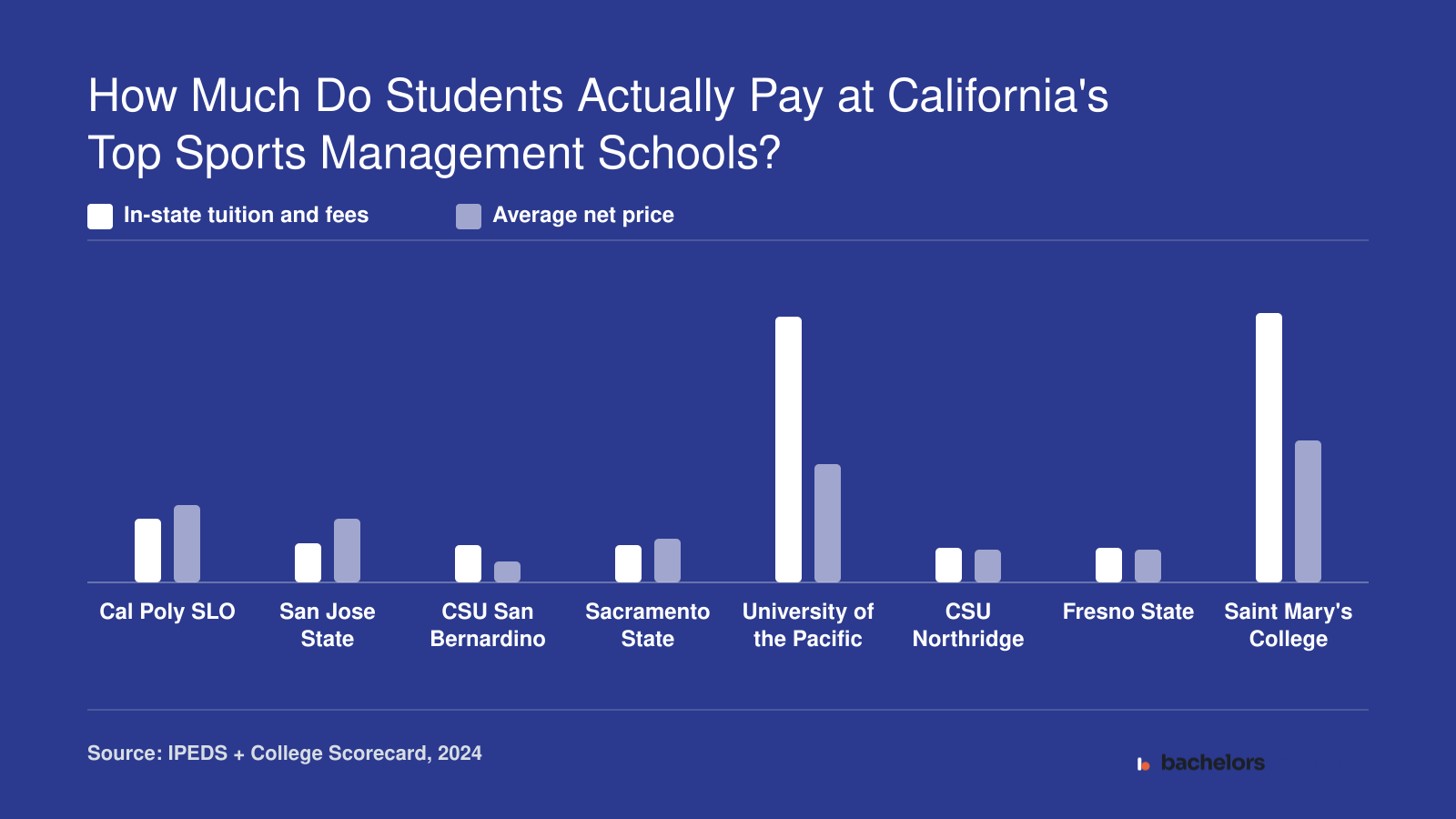
Cost is where California's public and private campuses diverge most sharply. At the public campuses ranked here, published in-state tuition runs from $7,341 to $13,596 a year, and average net price after grants and scholarships ranges from about $4,564 to $16,665. Net price is an average across all students at a school, not a prediction for your own bill. At University of the Pacific, the private university ranked here, published tuition is $57,080 while average net price is about $25,447.
State aid for 2026-27
Cal Grant A pays $6,838 toward tuition at CSU campuses and $9,358 at eligible nonprofit institutions, for up to four years.1 The Middle Class Scholarship has no fixed dollar award: the Legislative Analyst's Office estimates most 2026-27 awards cover about 23 percent of the remaining cost of attendance once an $8,616 student self-help amount and other gift aid are subtracted.2 It requires CSU or UC enrollment, at least 6 degree-required units, California residency or AB540 status, and household income under $250,000 for dependent students and students with dependents.3
Where the aid actually goes
Federal Pell shares at the CSU campuses ranked here run from about 77 percent to 87 percent, against 46 percent at Cal Poly and 62 percent at Pacific. Heavier Pell enrollment usually means a campus is well practiced at packaging need-based aid.
Stacking aid in the right order
File the FAFSA, or the CADAA if you are AB540-eligible, by March 2, 2026, the California priority deadline that gates both Cal Grant and the Middle Class Scholarship.4 Then apply for each school's own scholarships, which often stack on top of state and federal aid rather than replacing it. Ask the financial aid office how outside awards affect your package before you accept.
How Much Do Students Actually Pay at California's Top Sports Management Schools?
Published tuition at Saint Mary's College of California and University of the Pacific tops $57,000, but their average net price falls to about half that after grants. At several CSU campuses, net price is higher than tuition because it counts housing, books and other costs after aid, not tuition alone. Net price is a sector-conditional average: public figures cover in-state students receiving aid, while private figures cover all aided full-time students.
Sports Management Careers and Salaries in California
Where are the sports management jobs in California, and what do they pay?
Where the Jobs Are
Los Angeles anchors the state's sports economy, with franchises in every major league, major college athletics, and venues that host events year-round. The Bay Area and San Diego add teams, college programs, agencies and event operators, while Sacramento and the Central Valley lean on collegiate athletics and minor league operations. Employers include teams, athletic departments, sponsorship agencies, facility management firms and event promoters.
Entry-Level Roles and Wages
Common first jobs include marketing coordinator, ticket sales representative, event operations assistant, athletics department staff and community relations assistant. Sales roles often pay a base plus commission.
For a longer view, the Bureau of Labor Statistics May 2023 estimates for California put agents and business managers of artists, performers and athletes at a mean annual wage of $136,450 across 5,660 jobs.1 In the Los Angeles-Long Beach-Anaheim metro, the mean was $138,050.2 That occupation spans all industries, not sports alone. Coaches and scouts in California averaged $65,560 across 28,700 jobs.1
Reading the Two Measures Separately
Occupational wages cover everyone holding a job title, including people with a decade of experience. Graduate earnings reported for individual programs, shown earlier on this page, describe one school's alumni early in their careers. Keep them apart: the occupation figure suggests where a career can lead, while the program figure shows roughly where graduates start.
Licensing
California regulates athlete agent representation, and the requirements can change, so confirm the current registration rules with the state before signing a client. Most entry-level roles, from ticket sales to event operations, need no license at all.
Common Questions About Sports Management Degrees in California
These answers cover the questions students ask most about studying sports management in California. Program details come from each school's own catalog and program pages.
Does UCLA have sports management?
What is the best school for sports management in California?
Is a bachelor's degree in sports management worth it?
Can you get a bachelor's degree in sports management online from a California school?
Compare Sports Management programs on the data that matters
Explore more Business & Management majors or browse every field of study.
All Business & Management programs Browse every field of study