Best Sustainability Degree Programs
Compare 410+ accredited Sustainability programs, with net price after aid, graduation rates, earnings and debt from IPEDS and the U.S. College Scorecard.

A sustainability degree can cost $6,541 a year in net price at the University of Florida or more than $28,000 at Cornell, and the label on the diploma rarely tells you which one leads to a better job. Programs also differ in kind: Harvard offers a concentration, Michigan a minor, and the University of Illinois Urbana-Champaign a fully online B.S. built for transfers.
The real tradeoffs are price paid, how much of the curriculum is applied work, and whether the format fits your life. Earnings data for this major is thin at many schools, so those gaps matter as much as the figures.
The field has no single accrediting body, so employers weigh the school and the skills over the title.
Key Points
- University of Florida posts the lowest average net price: $6,541 per year.
- No accreditor certifies sustainability degrees, so check institutional accreditation first.
- Expect roughly four years and 120 credits; transfer credits can shorten it.
Top 10 Sustainability Degree Programs for 2027
The ten programs below range from a four-track liberal arts degree at a research university to a fully online Bachelor of Science built for transfer students. Some are majors, one is a minor that attaches to a major, and one is a concentration inside a public policy degree, so read the format and program notes on each card before you compare them. Every entry is regionally accredited and offered by a U.S. institution.
Harvard University
#1Cambridge, MA · $15,000 – $20,000/yr (est.)
Best for: Interdisciplinary thinkers spanning science and policy
Harvard splits its undergraduate climate offering into four tracks under a single A.B., with coursework shared between the engineering school and the Faculty of Arts and Sciences. Students build depth in one track while learning to work alongside engineers, humanists, and social scientists. University-wide partnerships with governments, nonprofits, and businesses give the program a practical edge beyond the classroom.
- Bachelor of Arts (A.B.) in Energy, Climate, and the Environment
- Four tracks, including Science and Engineering for Sustainable Solutions
- Jointly offered by Harvard SEAS and the Faculty of Arts and Sciences
- Also covers Markets, Politics, and Societies and Nature, Ethics, and the Human Imagination
- Coursework on climate change, pollution, biodiversity loss, and energy demand
- Builds literacy across engineering, humanities, social science, and science
University of Florida
#2Gainesville, FL · ~$7,000/yr (est.)
Best for: Florida residents seeking an affordable campus degree
The University of Florida's BA in Sustainability Studies is a 120-credit interdisciplinary major that treats environmental health, economic welfare, and social justice as one connected problem. Foundation courses in culture, natural systems, and quantitative methods lead into three applied upper-division courses and a capstone internship called Sustainability in Action. Undergraduates can also angle coursework toward the built environment, including architecture and urban planning. Median earnings for sustainability graduates were $39,261 one year after completion.
- 120-credit interdisciplinary Bachelor of Arts
- Foundation in culture, society, natural systems, and quantitative tools
- Three upper-division applied courses in sustainability themes
- Capstone internship: Sustainability in Action
- Experiential options include research, study abroad, community projects
- Flexible specialization through course clusters
- Coursework toward architecture and urban planning interests
University of California-Berkeley
#3Berkeley, CA · ~$13,000/yr (est.)
Best for: Design-minded students drawn to the built environment
Berkeley's Sustainable Environmental Design degree sits in the College of Environmental Design, the first college in the country to unite architecture, planning, and landscape architecture. Core work in systems thinking and environmental science is paired with technical courses in GIS and energy-efficient building design, and a capstone workshop asks students to research real sites and communities. The campus also carries deep research strength in energy and climate policy, including the Energy and Resources Group.
- Bachelor of Arts in Sustainable Environmental Design
- Core in design frameworks, systems thinking, and environmental science
- Technical courses in GIS and energy-efficient building design
- Capstone workshop with independent and collaborative research
- No portfolio required for admission
- Gateway course builds a student cohort early
- Housed in the College of Environmental Design, founded in 1959
Columbia University in the City of New York
#4New York, NY · ~$22,000/yr (est.)
Columbia's Sustainable Development major blends natural science, social science, and quantitative methods, then moves students through a practicum and a senior capstone workshop on live sustainability problems. Each major is paired with an Earth Institute adviser for course and career guidance, and strong students can continue into an accelerated five-year BA/MS in Sustainability Management. Median earnings for sustainability graduates were $53,957 one year after completion.
- 47 credit hours across 15 courses
- Interdisciplinary core in natural science, social science, and quantitative methods
- Practicum plus a senior capstone workshop
- Earth Institute adviser assigned after declaring the major
- Accelerated five-year BA/MS in Sustainability Management
- Senior thesis option for departmental honors
- Research assistant openings with the Climate School
- Internship and study abroad resources
Stanford University
#5Stanford, CA · $10,000 – $15,000/yr (est.)
Stanford's sustainability offering is a concentration inside the public policy major, centered on natural resources and energy. Faculty come from political science, law, economics, and engineering, and students can propose directed reading, overseas study, or Washington-based research to round out the degree. Students interested in the Doerr School of Sustainability apply to Stanford first and declare a Doerr major after enrolling.
- Concentration inside the public policy major
- Focus on natural resource and energy policy
- Examines government, corporate, and environmentalist strategies
- Faculty drawn from political science, law, economics, and engineering
- Directed reading, overseas study, or Washington-based research possible
- Career paths in government, corporations, NGOs, and research
University of Michigan
#6Ann Arbor, MI · $18,000 – $61,000/yr (est.)
Michigan's sustainability offering is an 18-credit minor rather than a standalone bachelor's, designed to attach to a major in literature, science, or the arts. A required off-campus field experience and a small, discussion-driven capstone separate it from purely classroom minors. Students pull coursework from five distribution areas spanning environmental justice, sustainable business, public policy, natural science, and technology and design.
- 18-credit interdisciplinary minor
- Requires an off-campus internship or field experience
- Small, discussion-driven capstone design experience
- Courses from at least three of five distribution areas
- Pre-approved study abroad courses count toward the minor
- Cannot be paired with the Environment minor
- Not open to School for Environment and Sustainability students
- At least 9 credits must be upper-level
University of Virginia
#7Charlottesville, VA · $22,000/yr (est. net price)
UVA pairs sustainability with a global lens through its Global Studies track in Environments and Sustainability, and the same curriculum is open as a minor. Courses are curated across disciplines, schools, and majors by the Office for Sustainability, so the degree bends toward a student's own interests rather than a single department. It suits students who want environmental questions framed internationally.
- BA in Global Studies: Environments and Sustainability
- Also available as a minor
- Sustainability courses curated across disciplines and schools
- Curriculum maintained by the Office for Sustainability
- Frames environmental challenges from a global perspective
The University of Texas at Austin
#8Austin, TX · ~$20,000/yr (est.)
UT Austin's BA in Sustainability Studies is housed in Geography and the Environment but draws on architecture, geoscience, communications, economics, and policy. Three concentrations plus a required capstone and internship keep the degree customizable without losing the applied piece. Median earnings for sustainability graduates were $35,255 one year after completion.
- Three concentrations, including Natural Resource Management
- Courses pulled from architecture, geoscience, communications, economics, and policy
- Required capstone and internship
- Curriculum blends social science, earth science, and economics
- Alumni enter consulting, planning, nonprofits, and state and local government
- Customizable degree plan built around student interests
University of Illinois Urbana-Champaign
#9Champaign, IL · ~$14,000/yr (est.)
Illinois runs the only fully online Bachelor of Science in environmental sustainability in this group, taught asynchronously in eight-week blocks and designed for transfer students. Two concentrations let students lean toward earth-system science or toward society and environment, and the diploma matches the on-campus version. Median earnings for sustainability graduates were $50,678 one year after completion.
- Fully online Bachelor of Science, mostly asynchronous
- Two concentrations: Science of the Earth System and Society and Environment
- Most classes run in eight-week blocks
- Remotely proctored exams with flexible scheduling
- Built for transfer students; 2.7 GPA minimum
- $434 per credit hour for 2026
- Same diploma as the on-campus program
- Offered online for more than a decade
Cornell University
#10Ithaca, NY · $29,000/yr (est. net price)
Cornell's Environment and Sustainability major is jointly offered by two colleges, which lets it pair a natural science core with social science and humanities electives. Students choose among concentrations such as sustainable business, environmental policy, land and water resources, and environmental humanities, or design their own plan, with fieldwork, study abroad, and research honors available. Cornell also maintains one of the broadest sustainability degree portfolios in the country, from undergraduate through graduate study.
- Seven concentration options, including a self-designed plan
- Jointly offered by Agriculture and Life Sciences and Arts and Sciences
- 120 credit hours across eight semesters
- Core in biology, chemistry, economics, statistics, and environmental thought
- Capstone, study abroad, and research honors available
- In-person instruction on the Ithaca campus
- C- or higher required in major courses
Cost & outcomes by school
Federal data for the highest-earning Sustainability programs, independent of the ranking above. Earnings are this field's bachelor's graduates four years after completing where the Scorecard reports them, else the school's undergraduate median.
| School | Net price / yr | Grad rate | Earnings | Debt | Grads/yr | Format |
|---|---|---|---|---|---|---|
| Harvey Mudd College CA | $35,924 | 92% | $138,687 | $25,000 | — | Campus |
| Stanford University CA | $13,807 | 92% | $124,080 | $12,000 | — | Campus |
| Bentley University MA | $37,930 | 87% | $120,959 | $25,023 | — | Campus |
| Carnegie Mellon University PA | $31,944 | 94% | $114,862 | $21,750 | — | Campus |
| University of Pennsylvania PA | $28,699 | 97% | $111,371 | $15,715 | — | Campus |
| Santa Clara University CA | $50,062 | 88% | $109,183 | $19,162 | — | Campus |
| Cornell University NY | $28,690 | 95% | $104,043 | $14,000 | — | Campus |
| Georgetown University DC | $40,815 | 95% | $103,494 | $15,500 | — | Campus |
| Harvard University MA | $19,066 | 98% | $101,817 | $14,000 | — | Campus |
| Yale University CT | $23,777 | 96% | $100,533 | $12,975 | — | Campus |
| Villanova University PA | $43,756 | 92% | $100,423 | $25,874 | — | Campus |
| Duke University NC | $29,612 | 97% | $97,800 | $13,000 | — | Campus |
Sources: U.S. Department of Education. Net price, graduation rate, earnings and debt: College Scorecard (earnings and debt for this field's bachelor's graduates where reported, else school-wide); graduates: IPEDS. A dash means no figure is reported.
Cost, debt & payoff
Median earnings of this field's bachelor's graduates (4 yrs after completing, else the school's undergraduate median) vs. their median federal loan debt · U.S. College Scorecard
Across these programs the median graduate earns about $58,181 and finishes with roughly $22,500 in debt — a ratio that clears a common rule of thumb (keep debt below first-year salary). Net price and debt vary widely school to school, so check the per-school figures in the table above before you shortlist.
How We Ranked Sustainability Degree Programs
What Went Into the Ranking
Each program was scored on a mix of cost, student outcomes, and access. The inputs are:
- Net price: the average price paid after grants and scholarships, not the sticker tuition.
- Graduation and retention: how many students finish at the school and how many return after the first year.
- Earnings and debt: median figures for graduates of the specific sustainability program, taken from the U.S. Department of Education's College Scorecard.
- Selectivity: the share of applicants a school admits.
- Format: whether the degree is offered on campus, online, or both.
Why Program-Level Earnings Count More
School-wide earnings blend every major on campus, from engineering to art history. Program-level figures reflect only graduates of this field, so they say more about what a sustainability degree is likely to do for your paycheck and your loan balance. That is why they carry more weight than institution-wide numbers.
Limits Worth Knowing
No dataset tells the whole story, so keep these caveats in mind:
- Graduation and retention rates describe the whole institution, not the sustainability major alone.
- Net price is an average across students. Your own aid offer could come in higher or lower.
- Some small or newer programs have no published earnings or debt data. Where that is the case, we scored them on the inputs that are available rather than guessing.
Every Format Is Included
The ranking covers all delivery formats. If you need to study online, options such as the University of Illinois Urbana-Champaign's online environmental sustainability degree sit alongside traditional campus programs, so you can compare them on the same terms.
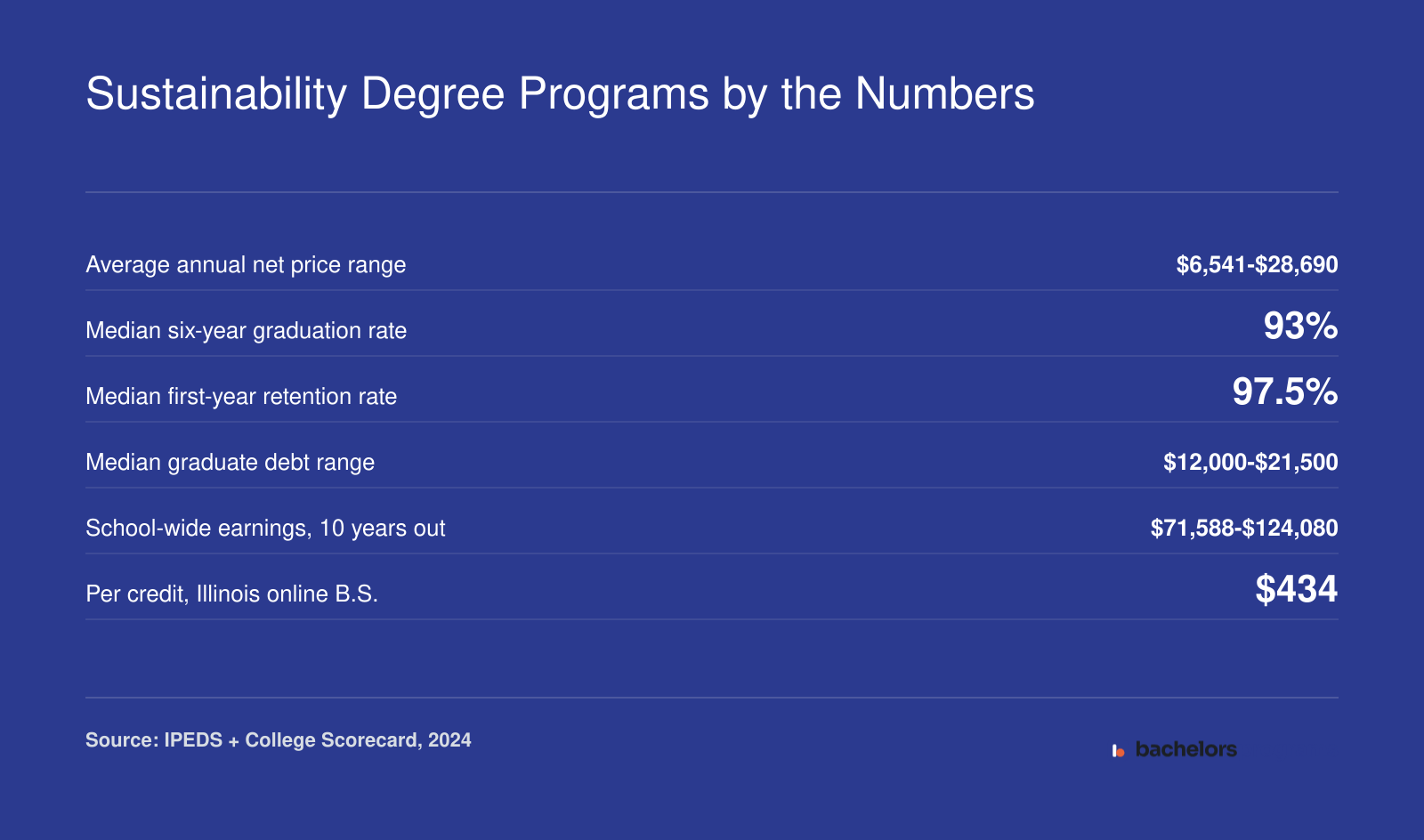
Sustainability Degree Programs by the Numbers
These figures summarize the schools ranked here, using 2024 federal data from IPEDS and the College Scorecard. Most of the outcome numbers describe each school as a whole, not the sustainability major alone, so read them as context for comparing options rather than as a promise of what any one program will deliver. Net price reflects what students typically pay after grants and scholarships, which is why it runs far below published tuition at several of the private universities.
Can You Earn a Sustainability Degree Online? Online vs. Campus Options
The debate in sustainability education has moved on from whether an online degree can match a campus one. At several of the schools ranked here, the online version is not a side project but a full program with its own admission rules and start calendar.
What Online Programs Actually Require
Arizona State University Online delivers its Bachelor of Arts in Sustainability as 120 credit hours across 39 classes, each running 7.5 weeks. New starts open multiple times each semester, and the next is listed for January 11, 2027. The program accepts up to 64 transfer credits, and applicants who earned 12 or more credits after high school need a cumulative transfer GPA of at least 3.00, with the School of Sustainability reviewing borderline cases individually.3 Oregon State University Ecampus lists 212 quarter credits for a sustainability double degree paired with a primary major. It also requires at least 45 of the final 75 credits in residence, which can be completed online or on campus.4 The University of Wisconsin's Bachelor's in Sustainable Management runs 100% online at 63 credits and 21 courses, and students can begin in any month. Terms include September 8 to December 18, 2026, and January 26 to May 7, 2027.
Fieldwork and lab sections belong to the campus versions, where students work on living-lab projects and site-based coursework. The online formats described above are delivered remotely.
Which Format Fits You
Campus programs suit students who want hands-on fieldwork, lab sections and campus sustainability projects, plus the internships and study abroad that residential departments arrange. Online formats suit working adults and transfer students who need to keep a job and a schedule, and who want to apply credits they have already earned.
One Check Before You Enroll
Confirm that the online track awards the same degree title and holds the same accreditation as the campus version, and ask whether any field requirement can be satisfied where you live.
Related Articles
Most Affordable Sustainability Degree Programs
Public universities in Florida post the lowest average net prices among the sustainability programs we reviewed, led by the University of Florida at $6,541 per year after grants and scholarships, but net price is an average across aided students, not a guaranteed bill, so your actual cost will depend on income, residency, and the aid you receive. Federal Pell Grants, employer tuition benefits, and national awards can push costs lower: the NOAA Hollings Scholarship provides up to $9,500 a year for junior and senior years plus a paid 10-week summer internship at $700 a week (applicants generally need a 3.0 GPA, and the deadline is Jan. 31, 2027), and the Udall Scholarship supports sophomores and juniors committed to environmental leadership or public service. File the FAFSA as early as possible, then ask your sustainability department about its own scholarships, since awards like Seattle University's $2,500 Miller Scholarship are open only to majors in the program.
| School | Program | Location | Avg. Annual Net Price | In-State Tuition and Fees | Out-of-State Tuition and Fees | School Graduation Rate | Median Debt at Graduation |
|---|---|---|---|---|---|---|---|
| University of Florida | B.A. in Sustainability Studies (campus) | Gainesville, FL | $6,541 | $6,381 | $28,659 | 91% | $15,000 |
| Florida International University | B.A. in Sustainability and the Environment (campus) | Miami, FL | $9,288 | $6,565 | $18,964 | 74% | $16,500 |
| University of South Florida | B.A. in Sustainability Studies (campus, offered at USF St. Petersburg) | Tampa, FL | $9,812 | $6,410 | $17,324 | 77% | $17,988 |
Highest Early-Career Earnings Among Ranked Sustainability Programs
Program-level earnings show what sustainability graduates typically make in their first year on the job.
Accreditation: What Makes a Sustainability Program Legitimate
Sustainability is a young field, and no accrediting body certifies a sustainability degree as such, which leaves students to sort out which credentials matter.
Start With Institutional Accreditation
The baseline is accreditation of the college or university itself. The U.S. Department of Education recognizes institutional accreditors, and attending an accredited school is what generally opens the door to federal financial aid and credit transfer.1 You may still see the older term "regional accreditation," which federal materials now usually describe as institutional accreditation. CHEA, a nongovernmental body, also recognizes accreditors, but check the school and its accreditor against the Department of Education's current listings.1 Institutional accreditation covers the whole school, not a specific major.
Where ABET and AACSB Fit
Programmatic accreditation is a bonus, not a requirement. ABET accredits specific applied science, engineering, and engineering technology programs, so it can apply if your sustainability track sits in one of those areas. AACSB accredits business schools, so it is relevant when the degree is housed in an accredited business unit. Neither covers sustainability degrees as a category, and a program without them is not unaccredited. Confirm the scope of any such claim.
What AASHE STARS Does and Doesn't Tell You
STARS, from AASHE, is a self-reported framework that rates a campus's overall sustainability performance across academics, engagement, operations, and planning.2 Ratings run from Bronze through Platinum.3 It is a useful signal about institutional commitment, but it is not academic accreditation and says nothing about whether a particular degree is rigorous.2
A Quick Test for a Real Sustainability Degree
Some schools lightly rebrand an existing major. Look for these markers:
- Dedicated core: Required courses taught as sustainability, not a handful of electives borrowed from other departments.
- Applied capstone: A capstone project or practicum that puts you to work on a real problem.
- Home faculty: Instructors who sit in a sustainability school or department, not scattered across unrelated units.
If a program has all three and sits within an institutionally accredited school, it is likely the real thing.
Sustainability vs. Environmental Science and Related Majors
The best degree for sustainability is the one that matches the job you want, because these majors overlap in topic but lead to different desks. Program design varies by school, so treat the patterns below as typical, not universal.
Coursework and Intensity
- Sustainability: Interdisciplinary by design, blending environmental science, economics, policy, ethics, systems thinking and statistics. Math and science load is moderate. Some B.S. versions, such as Southern Oregon University's, add more lab science and technical methods.1
- Environmental science: Rooted in natural science, with the heaviest lab, field and quantitative work. Duke's B.S. in environmental sciences and policy, for example, runs 17 to 18 courses.2
- Environmental policy: Centers on governance, regulation, economics, law and planning. Quantitative demands are lower, though not absent, and it is often a B.A.
- Renewable energy: The most variable.5 Engineering-oriented tracks may require calculus, physics and thermodynamics, while policy-oriented versions, like Penn State's Energy and Sustainability Policy B.A., lean on economics, regulation and finance.4
A B.S. generally signals more math, lab and technical analysis. A B.A. generally signals more writing, policy and communication. The degree title alone does not guarantee either, so read the course list.
Typical First Jobs
Sustainability graduates often start as coordinators, analysts or planners.1 Environmental science graduates look toward scientist, specialist or technician roles. The Bureau of Labor Statistics notes these usually call for a natural-science bachelor's, and employers may also want GIS, field or lab experience.3 Environmental policy graduates tend to become policy analysts, planners or coordinators, while law and economist careers usually require further graduate education. Renewable energy graduates land in varied roles depending on technical depth, and environmental engineering requires an engineering pathway that may involve licensure.
One-Line Takeaways
- Sustainability: Best for corporate and municipal program roles.
- Environmental science: Best for lab or field science careers and graduate study.
- Environmental policy: Best for regulation, planning and advocacy work.
- Renewable energy: Best for energy-sector careers, technical or policy-focused depending on the track.
How Long It Takes and Whether a Sustainability Degree Is Worth It
How Long It Takes
A bachelor's in sustainability typically takes about four years of full-time study, or eight semesters. Cornell's program, for example, is built on that eight-semester, 120-credit structure. Transfer credits and accelerated online terms can shorten the timeline, though most programs here are on-campus.
Does the Math Work?
The University of Florida is the one school here with program-level figures for sustainability graduates. Its median debt is $15,000. Median earnings are $39,261 one year after graduation and $61,281 four years out. That debt load is manageable, and earnings clear it within a few years.
For the other schools, the available figures cover the whole institution, not the sustainability major. Median earnings ten years after entry reach $124,080 at Stanford and $101,817 at Harvard, with median graduate debt of $12,000 and $14,000. Treat those as a ceiling set by highly selective admissions, not a promise for the major.
The Risk
Sustainability is broad. Outcomes depend heavily on what you add to the degree: internships, a technical minor in GIS, data analysis or business, or a focused concentration. Georgetown builds an internship into the program, and Cornell, Georgetown, USC and Carnegie Mellon all require a capstone. Those experiences give employers something concrete to evaluate.
A Simple Decision Rule
Choose programs that meet three tests:
- Published earnings data: You can see what graduates actually make.
- Low net price: Florida's is $6,541 a year and Berkeley's is $13,481, versus $40,815 at Georgetown.
- Required experience: An internship or capstone should be part of the degree, not optional.
Sustainability programs by state
Compare Sustainability programs on the data that matters
Explore more Business & Management majors or browse every field of study.
All Business & Management programs Browse every field of study