Best Environmental Engineering Degree Programs
Compare 250+ accredited Environmental Engineering programs at 190+ colleges, with net price after aid, graduation rates, earnings and debt from IPEDS and the U.S. College Scorecard.

Environmental engineers design the water treatment, air quality, and waste systems communities depend on, and most state boards expect an ABET-accredited degree before the Professional Engineer path begins.
Your school choice also sets the price: in-state tuition runs $6,381 at the University of Florida and $62,396 at MIT.
The list below spans campus, online, and hybrid formats, all at the bachelor's level. Accreditation is where big names diverge: Stanford's environmental systems engineering degree is not ABET-accredited, and Berkeley's is listed as in process.
Key Points
- Net prices at the lowest-cost publics run $6,541 to $10,411 yearly (2024).
- ABET EAC accreditation offers the most direct route to a PE license.
- Licensure runs degree, FE exam, qualifying experience, then the PE exam.
Top 10 Best Environmental Engineering Schools Ranked
What separates the strongest environmental engineering programs is not a single metric but three things moving together: students who finish on time and land solid work, a net price families can absorb, and enough curriculum range to fit different interests. The ten schools below combine those in different ways, and each card shows where a program stands on selectivity, training, and outcomes. Almost every program here is campus-based, and a few keep environmental engineering inside a broader civil or public health department rather than standing alone.
Georgia Institute of Technology
#1Atlanta, GA · ~$12,000/yr (est.)
Best for: Future engineers drawn to water research
Georgia Tech's environmental engineering program marked its 20th anniversary in 2026 and sits inside one of the most research-active civil and environmental engineering departments in the country. Undergraduates can add concentrations in sustainability, air pollution, or biological processes, and the department runs flood-modeling work with coastal Georgia communities plus a multiyear hydrogen mobility partnership with Hyundai. Admission is highly selective at roughly 14 percent of applicants, and the school graduates about 94 percent of its students.
- 129 credit hours for the Bachelor of Science in Environmental Engineering
- Concentrations in sustainability, air pollution, and biological processes
- Co-op work experiences and undergraduate research available
- BS/MS degree option shortens the path to a master's
- Study abroad and flexible technical electives in the fourth year
- Median earnings four years after finishing: $81,818
University of Florida
#2Gainesville, FL · ~$7,000/yr (est.)
Best for: Florida residents seeking affordable engineering degrees
The University of Florida pairs a 128-credit environmental engineering degree with the campus-wide Water Institute, which runs more than 70 sponsored projects with 400-plus affiliated faculty on problems such as harmful algal blooms and water management. Engineering students also take part in coastal storm impact research through national partnerships. Admission runs around 24 percent, and about 91 percent of students graduate.
- 128-credit BS in Environmental Engineering
- ABET-accredited curriculum
- Fundamentals of Engineering exam required before graduation
- Major admission needs a 2.5 GPA and C or better in tracking courses
- Coursework covers air and water quality, waste management, and hydrology
- Median earnings four years after finishing: $80,635
Massachusetts Institute of Technology
#3Cambridge, MA · ~$20,000/yr (est.)
Best for: Hands-on researchers wanting climate-focused coursework
MIT's environmental work lives in Civil and Environmental Engineering, where undergraduates choose between a Climate, Environment, and Sustainability concentration and a dedicated Environmental Engineering Science track. Recent coursework has leaned into clean energy, coastal resilience, nature-based solutions, and carbon and nutrient dynamics. Admission is among the most selective in the country at about 4.6 percent, and roughly 96 percent of students graduate.
- Concentration inside the Civil and Environmental Engineering degree
- Blends engineering with climate and environmental science
- Undergraduate research through MIT's UROP program
- Listed in program materials as ABET-accredited
- Dedicated Environmental Engineering Science track
- Coursework emphasizes clean energy and coastal resilience
- Research on nature-based solutions and carbon cycling
University of Michigan
#4Ann Arbor, MI · $18,000 – $61,000/yr (est.)
Michigan's environmental engineering bachelor's pairs environmental science with engineering practice across water quality, atmospheric systems, and sustainable infrastructure. Undergraduates can move into an accelerated master's and join faculty research early. Admission runs about 16 percent, and roughly 93 percent of students graduate.
- Bachelor of Science in Engineering in Environmental Engineering
- Interdisciplinary curriculum with a water quality focus
- Accelerated master's option available
- Hands-on research opportunities for undergraduates
- Major admission requires a 2.0 GPA plus calculus and physics prerequisites
- Median earnings four years after finishing: $84,973
Johns Hopkins University
#5Baltimore, MD · $19,000/yr (est. net price)
Johns Hopkins offers its environmental engineering bachelor's through the environmental health and engineering department based in the Bloomberg School of Public Health, which gives the degree an unusual public health orientation. Students build critical thinking and communication skills alongside engineering fundamentals, and graduates move into industry, government, and doctoral programs. Admission is highly selective at about 6.4 percent.
- BS in Environmental Engineering housed in Environmental Health and Engineering
- ABET-accredited program
- Public health framing of air pollution and resource depletion
- Prepares graduates for industry, government, and graduate study
Stanford University
#6Stanford, CA · $10,000 – $15,000/yr (est.)
Stanford's Environmental Systems Engineering degree is a 96-unit, multidisciplinary program rather than a traditional ABET-accredited engineering track, which matters if professional licensure is the goal. Students specialize in coastal, energy, or freshwater systems, with field trips and sustainable design work built in. Admission is extremely selective at roughly 3.6 percent, and about 92 percent of students graduate.
- 96-unit multidisciplinary BS in Environmental Systems Engineering
- Program materials state it is not ABET-accredited
- Tracks: coastal systems, energy systems, freshwater systems
- Coursework spans engineering, science, and policy
- Field trips and sustainable design projects included
- Positions graduates for graduate study as well as practice
California Institute of Technology
#7Pasadena, CA · ~$16,000/yr (est.)
Caltech's Environmental Science and Engineering major is a 212-unit, science-first degree with tracks in environmental physics and environmental chemistry. It is smaller and more research-oriented than most programs on this list, and undergraduates work in labs early. Admission is the most selective here at about 2.6 percent, and the school graduates around 94 percent of students.
- 212-unit Environmental Science and Engineering major
- Tracks in Environmental Physics and Environmental Chemistry
- Lab work and data analysis built into the core
- Optional senior thesis and a science writing requirement
- Prepares students for academia, public service, or industry
University of California-Berkeley
#8Berkeley, CA · ~$13,000/yr (est.)
UC Berkeley's environmental engineering major is a newer standalone degree that has been moving through ABET review, so confirm current status before enrolling. The curriculum emphasizes engineering science and design practice, with concentrations in air quality, water quality, and environmental fluid mechanics and hydrology. Admission runs about 11 percent, and roughly 93 percent of students graduate.
- Bachelor of Science in Environmental Engineering
- Program materials list ABET accreditation as in process
- Tracks: air quality, water quality, environmental fluid mechanics and hydrology
- Undergraduate research and study abroad options
- No double major with civil engineering
- Graduate courses open to upper division students with a 3.0 GPA
Columbia University in the City of New York
#9New York, NY · ~$22,000/yr (est.)
Columbia's Earth and Environmental Engineering degree combines a liberal arts core with 18 credits of technical electives and a year-long senior design project. It is accredited by the Engineering Accreditation Commission of ABET, and graduates go on to employers such as AECOM, ARUP, and the Port Authority of New York, with many continuing to master's and doctoral work. Admission runs about 4 percent, and about 96 percent of students graduate.
- BS in Earth and Environmental Engineering
- Accredited by the Engineering Accreditation Commission of ABET
- Year-long senior design project
- 18 credits of technical earth and environmental engineering electives
- Combined liberal arts and engineering degree plan
- No entrance exam required; physics and calculus coursework expected
- Entrepreneurship seed funding competitions available
Rice University
#10Houston, TX · ~$13,000/yr (est.)
Rice's environmental engineering bachelor's requires 124 credits and lets students choose among four specializations: sustainable water; air, climate and energy; resilient infrastructure; and environmental management. The program emphasizes hands-on design, engineering ethics, and preparation for professional licensure. Admission runs about 8 percent, and roughly 95 percent of students graduate.
- 124-credit BS in Environmental Engineering
- Four specializations including sustainable water and resilient infrastructure
- Senior design project required
- Prepares students for professional licensure
- Minimum 33 major courses, 19 of them upper level
- No online option
Cost & outcomes by school
Federal data for the highest-earning Environmental Engineering programs, independent of the ranking above. Earnings are this field's bachelor's graduates four years after completing where the Scorecard reports them, else the school's undergraduate median.
| School | Net price / yr | Grad rate | Earnings | Debt | Grads/yr | Format |
|---|---|---|---|---|---|---|
| Massachusetts Institute of Technology MA | $20,111 | 96% | $143,372 | $14,768 | 1 | Campus |
| California Institute of Technology CA | $16,075 | 94% | $128,566 | — | 2 | Campus |
| Stanford University CA | $13,807 | 92% | $124,080 | $12,000 | 14 | Campus |
| Carnegie Mellon University PA | $31,944 | 94% | $114,862 | $21,750 | 10 | Campus |
| Princeton University NJ | $6,128 | 98% | $110,066 | $10,320 | — | Campus |
| Santa Clara University CA | $50,062 | 88% | $109,183 | $19,162 | — | Campus |
| Lehigh University PA | $36,931 | 88% | $105,584 | $21,960 | 14 | Campus |
| Cornell University NY | $28,690 | 95% | $103,016 | $13,176 | 38 | Campus |
| California Polytechnic State University-San Luis Obispo CA | $16,665 | 86% | $102,702 | $20,500 | 40 | Campus |
| Columbia University in the City of New York NY | $21,590 | 96% | $102,491 | $21,500 | 13 | Campus |
| Harvard University MA | $19,066 | 98% | $101,817 | $14,000 | — | Campus |
| Yale University CT | $23,777 | 96% | $100,533 | $12,975 | 7 | Campus |
Sources: U.S. Department of Education. Net price, graduation rate, earnings and debt: College Scorecard (earnings and debt for this field's bachelor's graduates where reported, else school-wide); graduates: IPEDS. A dash means no figure is reported.
Cost, debt & payoff
Median earnings of this field's bachelor's graduates (4 yrs after completing, else the school's undergraduate median) vs. their median federal loan debt · U.S. College Scorecard
Across these programs the median graduate earns about $72,097 and finishes with roughly $21,250 in debt — a ratio that clears a common rule of thumb (keep debt below first-year salary). Net price and debt vary widely school to school, so check the per-school figures in the table above before you shortlist.
How We Ranked These Environmental Engineering Programs
A ranking earns its place only if it measures what you will actually pay and what you are likely to earn, not how many papers a department publishes.
Bachelor's Degrees Only
Every program here awards a bachelor's degree in environmental engineering or a closely related field. That restriction matters: the bachelor's is the entry credential. It satisfies the education requirement to sit for the Fundamentals of Engineering exam, and it is what most employers expect before a first engineering job. Graduate-only programs, certificates, and loosely related majors sit outside the comparison.
Two Kinds of Numbers, Two Different Meanings
- Program-level figures: earnings and debt for graduates of this specific major, collected after they complete the degree. These describe people who studied environmental engineering at that school.
- Institution-wide figures: net price, admission rate, retention, and graduation rate for the entire undergraduate population, tracked from the point of entry. These describe the school, not the major.
Keep the two apart. Strong earnings for a major's graduates say nothing about what the school will charge you, and a healthy graduation rate covers every department on campus, from nursing to history.
What This Ranking Does Not Measure
Research output, faculty reputation, laboratory facilities, and curriculum quality are absent from every entry. They matter, and no public dataset captures them well. Before you commit, read the course sequence for the environmental engineering major, ask how early undergraduates get lab and field access, and check whether co-op placement is standard or optional.
Cost and Net Price Compared: Public vs. Private Schools
At the lowest-cost public universities here, an environmental engineering bachelor's degree costs about $6,400 a year in in-state tuition and fees, and the average annual net price runs from $6,541 to $10,411, according to 2024 U.S. Department of Education data from IPEDS and the College Scorecard. Net price is an average of what aided students actually paid for the full cost of attendance (tuition, housing, books) after grants, not a quote. That explains why in-state public options win on cost: out-of-state tuition at these Florida schools ranges from $17,324 to $28,659, yet average public net prices stay close to resident rates. Pell Grant shares of 66.7 to 70.5 percent show that these campuses serve many students who rely on need-based aid, so measure any private school's average net price against these public benchmarks before assuming a higher sticker price buys more value.
| School | Location | In-State Tuition and Fees | Out-of-State Tuition and Fees | Average Annual Net Price | Pell Grant Share |
|---|---|---|---|---|---|
| University of Florida | Gainesville, FL | $6,381 | $28,659 | $6,541 | 66.7% |
| University of South Florida | Tampa, FL | $6,410 | $17,324 | $9,812 | 68.6% |
| University of Central Florida | Orlando, FL | $6,368 | $22,467 | $10,411 | 70.5% |
Related Articles
ABET Accreditation: Why It Matters and How to Verify a Program
Most state licensing boards treat an ABET-accredited engineering degree, specifically one reviewed by the Engineering Accreditation Commission (EAC), as the most direct route to a Professional Engineer license. Without it you can still pursue a PE in many states, but usually through extra coursework or a board review of your transcript. Environmental engineers stamp designs and sign reports, so that license is worth protecting from day one.
How to Verify a Program in Five Minutes
- Open ABET's accredited program search.
- Search by institution name, or search the program name "Environmental Engineering."
- Set degree level to bachelor's and country to the United States.
- Open the record and read the accreditation dates and the commissioning body. You want EAC.
With those filters, the search currently returns roughly 98 institutions. That figure counts institutions, not programs, so treat it as a sense of scale rather than a program tally. Keep the result separate from Environmental Engineering Technology, which is a different search with far fewer hits.
Environmental Engineering vs. Environmental Studies
An accredited civil engineering degree with an environmental concentration is a legitimate path, and it is not the same credential as a standalone environmental engineering program. Environmental science and environmental health degrees are not engineering programs at all and will not satisfy an engineering board. If the word "engineering" is missing from the diploma, ask the department which license track its graduates actually take.
New Programs Need Graduates First
ABET does not accredit a program before it has at least one graduate.1 The initial visit is typically scheduled in the September to December window right after the first class finishes, and the evaluation request is due January 31 of that year, with one official transcript from a recent graduate.2 A brand-new program can be excellent and still show provisional or retroactive status. Confirm the dates before you enroll, and ask whether accreditation would reach back to your graduating class.
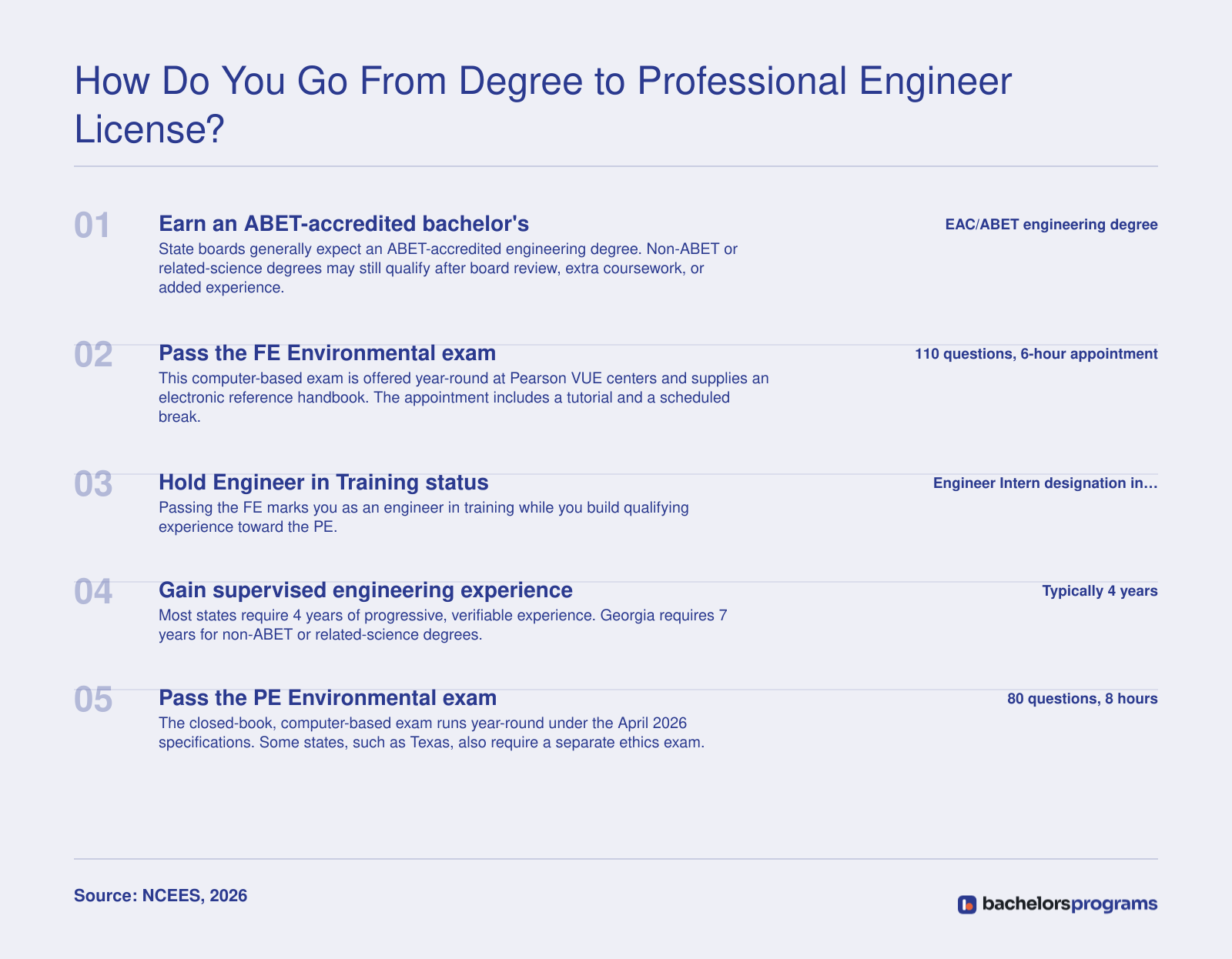
How Do You Go From Degree to Professional Engineer License?
Most environmental engineers follow the same licensure sequence: degree, FE exam, qualifying experience, then the PE exam. NCEES sets no single nationwide rule, so experience, supervision, and exam timing vary by state licensing board. Confirm the details with the board in the state where you plan to work.
Specializations, Co-Ops, and Online Options
The track you choose shapes your first job more than the school's name does, so decide early where you want to work. Most environmental engineering programs organize electives around a few recurring themes, though names and depth vary by school.
Common Tracks
- Water resources: Drinking water treatment, wastewater, and stormwater. This is the broadest employment pipeline, feeding consulting firms and municipal utilities.
- Air quality: Emissions control, atmospheric modeling, and permitting, often tied to industrial and regulatory roles.
- Solid and hazardous waste: Remediation, landfill design, and contaminated-site cleanup, common in consulting and federal facility work.
- Sustainability and climate resilience: Energy systems, life-cycle analysis, and adaptation planning. Offerings here change fastest, so check current course catalogs.
Standalone Major or Civil With a Concentration
A standalone environmental engineering major gives you more coursework in chemistry, microbiology, and process design. A civil engineering degree with an environmental concentration gives you stronger grounding in structures, geotechnics, and transportation, which widens your options if you change direction. Both paths can lead to licensure when the program is ABET accredited, so confirm accreditation for the specific degree title you plan to earn.
Online Availability
Fully online, ABET-accredited bachelor's programs in environmental engineering are rare. ABET notes that most accredited programs are primarily on-site, with some offered online1, and its public search lists 98 U.S. institutions with bachelor's-level environmental engineering programs.2 That listing does not say which ones are online or hybrid, and it does not show whether a format covers the whole degree or only selected courses. Hybrid and degree-completion routes are more realistic, largely because of lab-heavy coursework. Ask each school directly how labs are delivered and whether the accredited designation applies to that format.
Co-ops and Internships
Experience requirements differ sharply. Clarkson University requires every student to complete an internship or co-op.3 Employers it names include AECOM, Arcadis, Brown and Caldwell, General Electric, Norfolk Naval Shipyard, and the New York State Department of Environmental Conservation. Those names reflect where students and graduates land, not necessarily formal co-op partners.
Temple University offers optional co-op assignments and summer internships.4 Its listed employer examples include Amtrak, Boeing, Lockheed Martin, NASA, SEPTA, and the Pennsylvania Department of Transportation. Temple also reports that most interns are offered full-time jobs and that students can browse more than 1,000 postings, though not all are aimed at environmental engineers.4
If a paid, multi-semester co-op matters to you, ask every school for its placement structure and recent employer list.
What Environmental Engineers Earn Nationally
Before you weigh tuition, look at what the degree typically leads to. Environmental engineering pays well above the national median for all occupations.
Questions to Ask Yourself
Do you want a standalone environmental engineering degree or a civil engineering degree with an environmental track?
Is the program ABET-accredited under its exact name?
Does the school run paid co-ops that could offset tuition?
Would you rather pay in-state public tuition or chase aid at a selective private school?
Environmental Engineering programs by state
Environmental Engineering Degree FAQs
These answers cover the questions prospective students ask most often when comparing environmental engineering programs. Details such as licensure rules and transfer policies vary by state and school, so confirm specifics with the relevant board or admissions office.
What is the best school for environmental engineering?
Can you become a licensed PE with an environmental science degree instead of an engineering degree?
Is a master's degree necessary to work as an environmental engineer?
Can community college credits transfer into an ABET-accredited environmental engineering program?
Compare Environmental Engineering programs on the data that matters
Explore more Science & Engineering majors or browse every field of study.
All Science & Engineering programs Browse every field of study