Best Online Sustainability Degree Programs
Compare 30+ accredited online Sustainability programs, with net price after aid, graduation rates, earnings and debt from IPEDS and the U.S. College Scorecard.

Net price for a fully online sustainability bachelor's runs from $1,471 at St. Petersburg College to $22,383 at UMass Amherst, so the school you choose shapes cost as much as the major.
Every school here is 100% online, with hybrid programs excluded, and rankings draw on federal cost and outcome data.
Most of the strongest values are public universities, where credible, affordable options tend to concentrate.
Key Points
- St. Petersburg College's average net price after aid is just $1,471.
- University of Illinois Urbana-Champaign graduates earn a $63,604 median four years out.
- Transfer students: Unity Environmental University accepts up to 90 of 120 credits.
The 10 Best 100% Online Sustainability Degree Programs
This ranking covers only programs that can be completed fully online from start to finish, so hybrid and campus-based options are excluded. The order reflects a mix of average net price after aid, the school's overall graduation rate, and program-level outcomes. Cards appear in that order.
University of Illinois Urbana-Champaign
#1Champaign, IL · ~$14,000/yr (est.)
Best for: Transfer students wanting a research university
The University of Illinois Urbana-Champaign is a large public research university whose online environmental sustainability bachelor's is built for transfer students. Two concentrations let students lean toward natural science or social science, and coursework spans environmental consulting, sustainability policy, GIS, and sustainable business. Classes run mostly asynchronously in eight-week blocks with remotely proctored exams, and graduates earn the same diploma as on-campus students.
- Two concentrations: Science of the Earth System or Society and Environment
- Most classes run in eight-week asynchronous blocks
- Exams are remotely proctored with flexible scheduling
- Designed for transfer students; 2.7 GPA minimum
- Same diploma as the on-campus program
- Full access to campus library and career center
- Topics include sustainability policy, GIS and sustainable business
- Online for more than a decade
University of Massachusetts-Amherst
#2Amherst, MA · $20,000 – $25,000/yr (est.)
Best for: Self-directed learners designing their own concentration
UMass Amherst is a flagship public research university, and its online sustainability studies option runs through University Without Walls, an interdisciplinary bachelor's completion program. Students design their own concentration by pulling courses from agriculture, business, public health, and economics, with faculty drawn from the Stockbridge School of Agriculture and the Isenberg School of Management. Most courses are asynchronous, and prior work and life experience can translate into credit.
- Design your own concentration across departments
- Most courses are asynchronous and fully online
- Earn up to 105 credits for prior learning
- Courses taught by Stockbridge and Isenberg faculty
- Employer partnerships offer a 10% discount
- Community college friendly transfer pathway
- Career paths span sustainable food systems to green business
- Most classes asynchronous
The University of Tennessee-Knoxville
#3Knoxville, TN · ~$19,000/yr (est.)
Best for: Working adults needing fully asynchronous coursework
The University of Tennessee, Knoxville is a large public research university offering an online bachelor's in sustainability through its College of Arts and Sciences. The 120-credit degree runs asynchronously with no live sessions, and terms start in fall, spring, and summer. Coursework covers climate variability, land-use change, biodiversity, water resources, and sustainable development, plus a field experience placement in a campus, community, government, or business setting.
- 120 credit hours, estimated 48 months
- Asynchronous classes with no live sessions
- Terms start in fall, spring and summer
- Admission requires a 2.0 GPA and 24 transfer credits
- Field experience with community or business partners
- Topics include climate, biodiversity and water resources
- Careers in consulting, urban planning and conservation
- High school transcript required if under 24 credits
SUNY College of Environmental Science and Forestry
#4Syracuse, NY · $9,000 – $22,000/yr (est.)
SUNY ESF is a specialized environmental college in Syracuse, New York, focused entirely on sustainability and natural resource fields. Its online sustainability management bachelor's is built on three pillars, economics, society, and environment, with coursework in energy modeling, budgeting, financial analysis, GIS, and life cycle assessment. The program is fully online and asynchronous, and part-time students can finish in about two years.
- Fully online, asynchronous coursework
- Part-time option to finish in about two years
- Built on economics, society and environment pillars
- Coursework in GIS, energy modeling and life cycle assessment
- Develops project and people management skills
- Prepares for sustainability consulting and policy roles
- Graduates also enter renewable energy and solar policy
- Alumni may continue to graduate school
St Petersburg College
#5St. Petersburg, FL · ~$1,500/yr (est.)
St. Petersburg College is a Florida public college whose sustainability management bachelor's is offered completely online and built for students arriving with an associate degree. Eight-week courses cover sustainable business strategy, energy and environmental management, green construction, urban planning, and the legal side of sustainability. A capstone ties the degree together, and the program is designed as an affordable route into green-collar work.
- Fully online with eight-week courses
- Capstone project required
- Covers energy and environmental management
- Includes green building and supply chain topics
- Prepares students for sustainability manager roles
- Best fit for associate degree holders in related fields
- Local students may complete capstone in person
- Designed as an affordable path to green-collar jobs
Indiana University-Kokomo
#6Kokomo, IN · ~$4,000/yr (est.)
Indiana University Kokomo is part of the statewide IU system, and its sustainability studies bachelor's is a 100 percent online consortial degree taught by faculty across five IU campuses. The 120-credit curriculum spans climate, energy, geography, history, sociology, and economics, with a required capstone and experiential learning options such as internships and civic engagement. Students get 24/7 support, success coaching, and career services throughout the program.
- 120 credit hours with a required capstone
- 100% online consortial program across five IU campuses
- Coursework in climate, energy, geography and economics
- Experiential learning includes internships and civic engagement
- 24/7 student support and success coaching
- Career services included from enrollment to graduation
- Prepares for policy consultant and energy auditor roles
- Financial aid available
University of Wisconsin-River Falls
#7River Falls, WI · $10,000 – $15,000/yr (est.)
The University of Wisconsin-River Falls offers an online sustainable management degree completion program delivered jointly with UW-Parkside and UW-Superior. Students enter with about 60 transferable credits and complete 63 credits across 21 courses, with no electives, covering systems thinking, triple bottom line accounting, sustainable supply chains, and corporate social responsibility. A capstone closes out the final semester.
- Degree completion program, 63 credits, 21 courses
- Requires 60 transferable semester credits to enter
- Jointly delivered by three UW campuses
- No electives; every course builds integrated skills
- Covers sustainable supply chains and triple bottom line accounting
- Capstone completed in the final semester
- 2.0 GPA minimum and prerequisite courses required
- Support available through WI Online Collaboratives
Maryville University
#8Saint Louis, MO · ~$22,000/yr (est.)
Maryville University is a private university in St. Louis with a fully asynchronous online sustainability bachelor's that examines how people and the environment interact. Students pick one of three tracks, Environmental Science, Business, or Policy, and the curriculum blends natural science with economics and social perspectives. A capstone or internship rounds out the 120-credit degree, and part-time options suit working adults.
- Three tracks: Environmental Science, Business, Policy
- 120 credit hours with full-time and part-time options
- Fully asynchronous online classes
- Capstone or internship required
- Core coursework in environmental science, earth systems, statistics
- Prepares for graduate and professional school
- Careers in conservation science, urban planning, environmental law
- No SAT or ACT scores required for admission
Indiana University-Southeast
#9New Albany, IN · $5,000 – $10,000/yr (est.)
Indiana University Southeast is a regional IU campus near Louisville offering a 100 percent online bachelor's in sustainability studies. Students study the scientific, social, and business sides of sustainability and build practical skills through virtual labs, interactive projects, and local fieldwork. Classes are small, with personalized guidance and scholarships available, and Kentucky residents may qualify for in-state tuition.
- 100% online, 120 credit hours
- 2.0 GPA minimum to remain in the program
- Small class sizes with personalized guidance
- Virtual labs, interactive projects and local fieldwork
- Internships and career placement opportunities
- Scholarships available to enrolled students
- Kentucky residents may qualify for in-state tuition
- Prepares for roles with agencies, nonprofits and green industry
Indiana University-East
#10Richmond, IN · $8,000 – $23,000/yr (est.)
Indiana University East is a regional IU campus in Richmond offering an interdisciplinary online bachelor's in sustainability studies. The curriculum examines how climate, energy, geography, history, sociology, and economics shape environmental problems, and adds conservation methods, sustainability science, and the business and economics of sustainability. A capstone is required and an internship option is available, with rolling admissions and personalized support for working adults.
- 120 credit hours with a required capstone
- 100% online coursework with rolling admissions
- Major requires 42 credit hours
- Internship option in sustainability
- Curriculum spans climate, energy and society
- Personalized student support services
- Financial aid available
- Respected IU credential recognized worldwide
Cost & outcomes by school
Federal data for the highest-earning Sustainability programs, independent of the ranking above. Earnings are this field's bachelor's graduates four years after completing where the Scorecard reports them, else the school's undergraduate median.
| School | Net price / yr | Grad rate | Earnings | Debt | Grads/yr | Format |
|---|---|---|---|---|---|---|
| University of Illinois Urbana-Champaign IL | $14,355 | 85% | $63,604 | $17,750 | 71 | Online |
Sources: U.S. Department of Education. Net price, graduation rate, earnings and debt: College Scorecard (earnings and debt for this field's bachelor's graduates where reported, else school-wide); graduates: IPEDS. A dash means no figure is reported.
Cost, debt & payoff
Median earnings of this field's bachelor's graduates (4 yrs after completing, else the school's undergraduate median) vs. their median federal loan debt · U.S. College Scorecard
Across these programs the median graduate earns about $58,181 and finishes with roughly $22,500 in debt — a ratio that clears a common rule of thumb (keep debt below first-year salary). Net price and debt vary widely school to school, so check the per-school figures in the table above before you shortlist.
How We Ranked These Fully Online Sustainability Programs
Flexibility and value pull against each other, so the filters here favor programs that deliver both. Only accredited institutions offering coursework you can finish entirely online qualified; hybrid formats that require scheduled campus attendance were set aside. Federal College Scorecard data supplied the comparison points: average net price, institution-wide graduation rate, and, where available, program-level earnings and debt.
Fully online means you do not need to live near campus. Degree requirements still vary. Oregon State's Ecampus sustainability degree applies a credit-based residency rule: 45 of your last 75 credits must be taken at OSU, online or on campus. Arizona State's sustainability B.S. builds in an internship and a workshop, which students typically arrange locally or remotely.
One caveat: Scorecard figures are medians drawn from past cohorts and can trail current tuition by a year or two. Confirm pricing directly with the school.
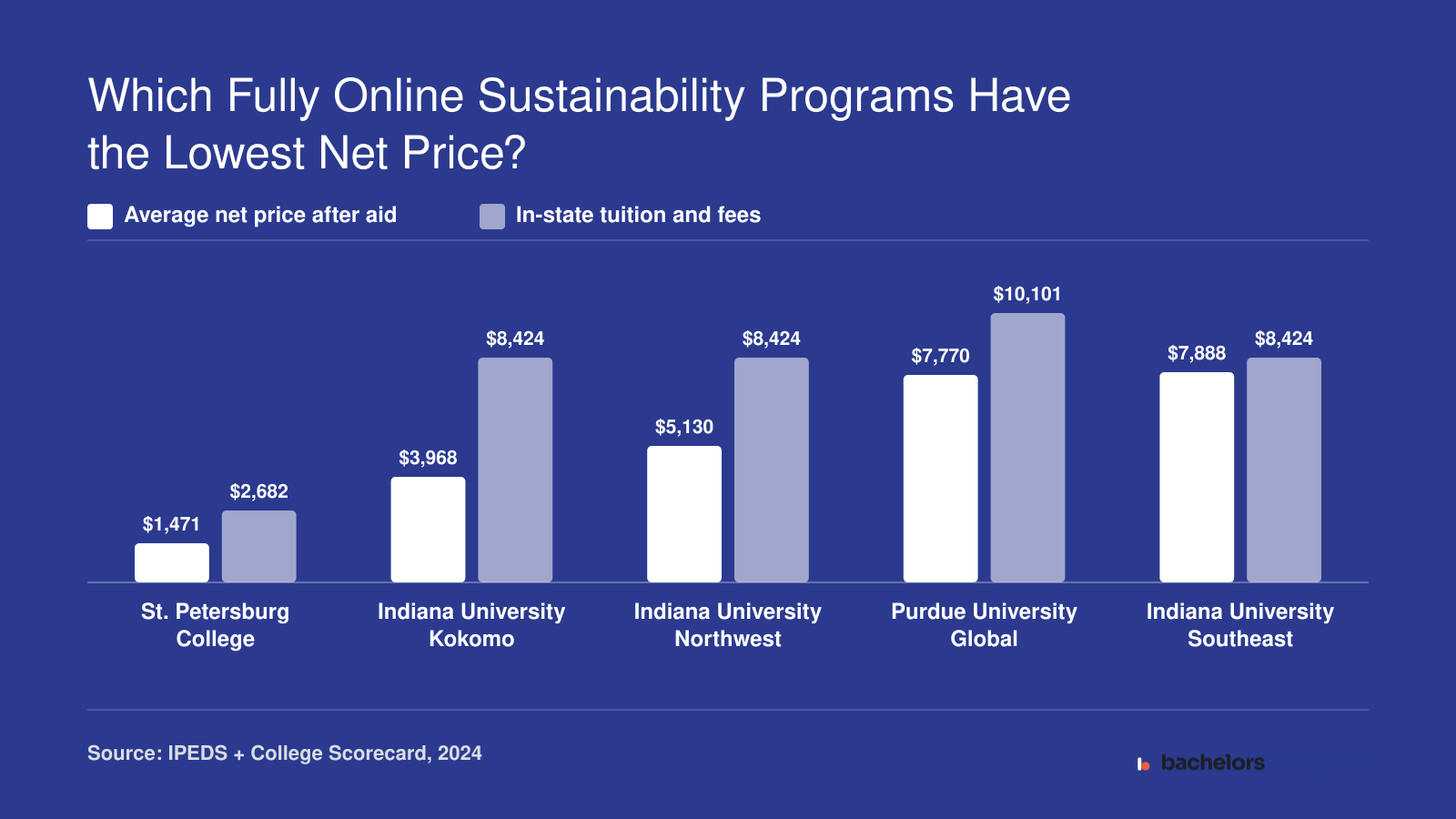
Which Fully Online Sustainability Programs Have the Lowest Net Price?
Net price is an institution-wide average of what students pay after grants and scholarships, so your own cost may land higher or lower. Among the lowest-cost fully online programs here, St. Petersburg College's average net price of $1,471 is $6,417 less than Indiana University Southeast's $7,888. In-state rates at public schools may not apply to online students outside the state. Indiana University's out-of-state tuition and fees run $22,811, compared with $8,424 in-state, though IU Southeast extends in-state tuition to Kentucky students.
Related Articles
Accreditation and Employer Recognition: What to Verify Before You Enroll
Accreditation is a college's seal of approval from an outside body that has reviewed its finances, faculty, and curriculum. For online sustainability degrees, the one that matters most is institutional accreditation from a regional agency such as the Higher Learning Commission (HLC), the Middle States Commission on Higher Education (MSCHE), or the New England Commission of Higher Education (NECHE). It is what makes you eligible for federal financial aid, lets credits transfer, and qualifies you for graduate school. Arizona State University's online sustainability BA and BS sit under HLC accreditation1, and Unity Environmental University is accredited by NECHE.2
There is no single mandatory programmatic accreditor for sustainability bachelor's degrees. Instead, look for a program that is clearly housed within an institutionally accredited school and that publishes its learning outcomes.
Two-Step Verification Tip
- Check the U.S. Department of Education's DAPIP database to confirm the institution's accreditation.
- Cross-check the CHEA directory for the accreditor's standing.
No 2026 survey quantifying how employers view accredited online degrees has been published, so treat anecdotes with caution. Diplomas typically do not state "online," and your transcript shows the same accredited institution either way.
BA vs. BS vs. Sustainability Studies: Which Online Degree Fits You?
Treat this as a checklist, not a ranking. Work through each step, then map what you find back to a BA, a BS, or a sustainability studies program. Check each source for current information instead of relying on generic rankings.
| Step | What to do | Where to look | What it tells you |
|---|---|---|---|
| 1. Compare occupations | Check typical entry-level education, median pay, projected growth, and state or industry filters for your target roles. | BLS.gov Occupational Outlook Handbook and O*NET | Environmental scientists and specialists typically need a bachelor's degree (2025 median pay $82,220). Environmental engineers earn a median of $107,110, and technicians typically need an associate's degree ($55,090). Note whether your role names a science major. |
| 2. Verify program facts | Confirm curriculum, credit requirements, transfer policy, capstone or internship options, tuition and fees, and outcome data. | School websites, official catalogs, accreditation pages, admissions advisors | Shows whether a BA, BS, or studies program has the science, policy, or business coursework your goal requires. |
| 3. Gauge employer perception | Look at hiring trends and how employers describe the degrees they want. | Professional associations, industry job boards, LinkedIn salary and job-posting insights, employer tuition-partnership pages, alumni and hiring manager interviews | Gallup reports 68% of U.S. employers prefer a candidate with at least a bachelor's degree. Interviews show how they view each degree label. |
| 4. Apply a decision framework | Match degree type to career goals, compare total cost and time to completion, and check any needed credentials or licensure. | Program pages, state licensing boards, BLS.gov | Favors accredited programs with transparent outcome data over the cheapest or most heavily marketed option. |
Salaries and Careers After an Online Sustainability Degree
Graduate earnings vary widely by program, and the schools ranked here report median earnings of $63,604 four years after completion at the University of Illinois Urbana-Champaign and $61,946 five years after completion at the University of Arizona Global Campus. Those are outcomes for graduates of the program itself, not institution-wide averages.
Nationally, environmental scientists and specialists earned a median $82,220 in May 2025, with 6% projected growth from 2025 to 2035 and roughly 7,300 openings a year.1 Urban and regional planners earned $89,320, growing 4% over the same period.2 Sustainability specialists, tracked as their own federal occupation, reported a median of $83,050, with wages running from $47,880 at the 10th percentile to $150,010 at the 90th.3
Typical job titles include sustainability coordinator, ESG analyst, energy analyst, conservation program specialist and policy associate. ESG analyst has no dedicated federal occupation code, so its pay sits inside broader sustainability categories.
Most graduates start as coordinators or analysts. A master's degree, or a credential such as LEED Green Associate, supports the move into manager and director roles.
Transfer Credits, Completion Time and Online Format
Transfer credit is often the deciding factor in how long an online sustainability degree takes and what it costs.
Unity Environmental University states the ceiling plainly: its BS in Environmental Studies accepts up to 90 transfer credits toward 1201, and the Applied Bachelor's in Sustainable Business Management caps transfers at 75 percent of its 90 credits2. Oregon State Ecampus requires 45 of your final 75 credits completed there, so plan which courses you leave for last. ASU Online runs 120 credits in 7.5-week classes, which is how students arriving with an associate degree finish in about two years rather than four.
Unity's online courses are asynchronous4, with weekly assignment deadlines rather than live class times, and its applied bachelor's terms run five weeks3. Ask where internships or capstones require scheduled hours.
Before applying, ask which credits will transfer.
Sustainability programs by state
Online Sustainability Degree FAQs
How much does an online sustainability degree cost?
How long does it take to earn an online sustainability degree?
Can I earn a sustainability degree online without a strong science background?
Do I need a master's degree to work in ESG or corporate sustainability?
Compare Sustainability programs on the data that matters
Explore more Business & Management majors or browse every field of study.
All Business & Management programs Browse every field of study