Best Criminology Degree Programs
Compare 330+ accredited Criminology programs, with net price after aid, graduation rates, earnings and debt from IPEDS and the U.S. College Scorecard.

Choosing a bachelor's degree in criminology looks like an academic decision and behaves like a financial one. Some schools confer a Bachelor of Science (B.S.), others a Bachelor of Arts (B.A.), and the two differ in how much statistics and research methods students take.
Net price after aid among the ranked programs runs from about $3,200 to $28,700. That spread is the difference between affording an internship-heavy senior year and working nights instead.
Criminal justice employers screen for clean background checks, physical standards and civil service exam scores. Debt taken on for a familiar name buys very little in that hiring market.
Key Points
- Programs are ranked on cost, completion and earnings, not reputation.
- Criminology majors earn a B.S. or B.A.; compare curricula, not titles.
- Fully online options exist, though internships usually happen in person or locally.
Top 10 Criminology Bachelor's Programs Ranked for 2027
These ten programs span fully online, on-campus and mixed formats, and each was chosen from cost, completion and outcome data rather than name recognition alone. Below you will find what each program requires, what it emphasizes, and which students it tends to suit.
University of California-Irvine
#1Irvine, CA · $14,000/yr (est. net price)
Best for: Aspiring law students wanting research depth
UC Irvine is a public research university in Irvine, California, where criminology sits inside the School of Social Ecology, so majors study crime alongside legal institutions and social policy. The department also runs a graduate program in criminology, law and society, which gives undergraduates a visible research pathway. About 87% of students graduate within six years, and the law and society framing appeals to readers aiming at law school.
- 11 courses totaling 44 units across three required course groups
- Seven upper-division electives worth 28 units
- Core coursework includes Criminological Theory and Juvenile Delinquency
- Electives include American Law and Race, Ethnicity, and Social Control
- Median earnings of $34,522 one year after finishing
- Prepares students for law school and graduate study in criminology
University of Maryland-College Park
#2College Park, MD · $16,000/yr (est. net price)
Best for: Transfer students entering a limited-enrollment major
The University of Maryland, College Park is a large public research university a few miles from Washington, D.C., which puts federal agencies, courts and policy organizations within reach for internships and fieldwork. The criminology and criminal justice department runs its own limited-enrollment admission process, so interested students apply to the major rather than sliding into it. Roughly 89% of students graduate within six years.
- 39 credits, 36 of them in criminology and criminal justice coursework
- Limited Enrollment Program with a 2.00 GPA and C- gateway grades
- Degree also available at the Shady Grove site
- Independent study and internships each earn up to 3 credits
- Two 400-level courses required among the four electives
- Core includes Criminal Law in Action and research methods
- Median earnings of $43,698 one year after finishing
University of South Florida
#3Tampa, FL · ~$10,000/yr (est.)
Best for: Working adults balancing jobs and coursework
The University of South Florida is a large public research university in Tampa with a criminology department that runs multiple research labs, an honor society and a dedicated criminal justice career fair. Its roughly 77% six-year graduation rate and comparatively low in-state tuition make it a common choice for Florida students who want a research-active department without a private-college price. The university is also launching a B.S. in Computer Science and Criminology in 2026 for students drawn to digital forensics and crime analysis.
- Internships earn up to 9 elective credits at close to 100 agencies
- Two-year and four-year plans of study available
- Criminology Club, Alpha Phi Sigma honor society and annual career fair
- Research centers include the Center for Justice Research & Policy
- Highlights cite pay rising from about $42,900 to $90,800 over ten years
- Median earnings of $37,108 one year after finishing
University of Florida
#4Gainesville, FL · ~$4,800/yr (est.)
The University of Florida is the state's flagship public research university in Gainesville, and it runs its criminology major through the College of Liberal Arts and Sciences. Unusually for a flagship, the same major is available fully online, so students who cannot relocate can earn the same degree at a distance. About 85% of students graduate within six years.
- 120 credits, including 34 in criminology and 3 in statistics
- At least 22 of the 34 criminology credits must be taken at the university
- Up to 12 transfer credits accepted in the major
- Up to 9 interdisciplinary elective credits outside the department
- A department exit exam is required to graduate
- 2.8 GPA minimum for the major
- Median earnings of $35,096 one year after finishing
Ohio State University
#5Columbus, OH · $17,000/yr (est. net price)
Ohio State University is a large public research university in Columbus with a criminology and criminal justice program spread across three campuses. The department leans on Columbus institutions for internships, placing students with the city prosecutor's office, the city police division and the inspector general, and it offers education abroad and an honors thesis for students who want research experience. About 88% of students graduate within six years.
- Offered on the Columbus, Marion and Mansfield campuses
- Sociology 1101 must be completed before declaring the major
- 24 additional credit hours, including 12 at the 4000 or 5000 level
- Internships with the Columbus City Prosecutor's Office and city police
- Education abroad options in Rwanda and Warsaw
- Senior honors thesis available with a faculty advisor
- Median earnings of $39,396 one year after finishing
CUNY John Jay College of Criminal Justice
#6New York, NY · ~$3,200/yr (est.)
John Jay College of Criminal Justice is a senior college of the City University of New York, devoted entirely to justice-related fields and located in Manhattan. That focus means criminology majors study alongside forensic science, forensic psychology and criminal justice students, and the college draws many people already working in justice and public service. About 56% of students graduate within six years, which reflects a large commuter and transfer population.
- One of 31 undergraduate majors, housed in the Sociology department
- Covers crimes, criminals, victims and the social reaction to crime
- Draws on sociology, other social sciences and the humanities
- Built for future graduate students and working justice professionals
- Median earnings of $33,798 one year after finishing
- Median federal debt of $11,000 for program graduates
University of Minnesota-Twin Cities
#7Minneapolis, MN · ~$17,000/yr (est.)
The University of Minnesota, Twin Cities is a large public research university where criminology sits inside a sociology department rather than a standalone criminal justice school. That placement suits students who want theory, research methods and a social-science lens on policing, courts and prisons. Roughly 85% of students graduate within six years.
- Both a BA and a BS are offered in this major
- Renamed in 2021 from Law, Criminology and Deviance
- More tightly focused than the generalist Sociology major
- Examines courts, prisons and human rights commissions
- Methods include interviews, surveys, ethnography and statistics
- Median earnings of $41,780 one year after finishing
California State University-Fresno
#8Fresno, CA · ~$7,000/yr (est.)
California State University, Fresno is a regional public university in the Central Valley with a criminology department built around required academic specializations. Students pick a track rather than a general degree, and the department also offers a separate B.S. in Forensic Behavioral Sciences for students drawn to lab and behavioral work. About 57% of students graduate within six years.
- Prepares students for work with offenders in institutions and community agencies
- Leads to roles in probation, parole, jails and prisons
- Coordinated by Dr. Monica Summers
- One of three required academic specializations in the major
- Built for federal, state and local agency careers
- Also prepares students for private-sector law enforcement roles
- Interdisciplinary theory and applied coursework throughout
- Pairs with a separate B.S. in Forensic Behavioral Sciences
- Focuses on victim and witness programs
- Prepares students for domestic violence and rape counseling work
- Coordinated by Dr. Tinneke Van Camp
- Prepares students for justice system careers and graduate study
North Carolina State University at Raleigh
#9Raleigh, NC · $9,000 – $33,000/yr (est.)
North Carolina State University is a large public research university in Raleigh where criminology is housed in sociology and anthropology. The major closes with a field placement, and Raleigh's role as the state capital puts students near the agencies and courts that hire criminology graduates. About 85% of students graduate within six years.
- 120 credits with a 120-hour senior internship at a justice agency
- Required courses include Criminal Justice Field Work and Criminology
- At least 15 sociology hours at NC State, 9 at the 300 level or above
- 2.0 overall and 2.0 major GPA required to graduate
- Electives include Juvenile Delinquency and Environmental Criminology
- Criminal Justice Club open to undergraduates
- Median earnings of $35,076 one year after finishing
University of Pennsylvania
#10Philadelphia, PA · $29,000/yr (est. net price)
The University of Pennsylvania is a private Ivy League university in Philadelphia with a criminology major that draws on statistics, neuroscience and sociology. The program is small and research-heavy, with a required seminar in experiments in crime and justice and an honors thesis option for students heading to graduate study. Its roughly 97% six-year graduation rate reflects a highly selective student body.
- 34 course units spanning statistics through neuroscience
- Core seminar in experiments in crime and justice
- Three socio-political context and three bio-psychological-social courses
- Two criminal justice research courses plus three criminology electives
- Honors thesis track requires a 3.4 GPA in the major
- Double majors may need additional units to finish
Cost & outcomes by school
Federal data for the highest-earning Criminology programs, independent of the ranking above. Earnings are this field's bachelor's graduates four years after completing where the Scorecard reports them, else the school's undergraduate median.
| School | Net price / yr | Grad rate | Earnings | Debt | Grads/yr | Format |
|---|---|---|---|---|---|---|
| University of Pennsylvania PA | $28,699 | 97% | $111,371 | $15,715 | 19 | Campus |
| Boston College MA | $41,704 | 91% | $103,937 | $19,000 | — | Campus |
| Villanova University PA | $43,756 | 92% | $100,423 | $25,874 | 40 | Campus |
| Northeastern University MA | $30,915 | 91% | $92,538 | $24,250 | — | Campus |
| University of San Francisco CA | $41,431 | 70% | $89,812 | $23,000 | — | Campus |
| University of Portland OR | $28,210 | 80% | $82,804 | $21,370 | — | Campus |
| Virginia Polytechnic Institute and State University VA | $24,953 | 86% | $81,698 | $21,500 | — | Campus |
| San Jose State University CA | $13,760 | 69% | $78,988 | $15,000 | — | Campus |
| Wake Forest University NC | $28,719 | 89% | $78,158 | $21,500 | — | Campus |
| George Mason University VA | $17,915 | 68% | $76,343 | $19,500 | — | Online or campus |
| Immaculata University PA | $24,258 | 71% | $75,701 | $27,000 | — | Campus |
| Seattle University WA | $34,662 | 76% | $75,272 | $19,883 | — | Campus |
Sources: U.S. Department of Education. Net price, graduation rate, earnings and debt: College Scorecard (earnings and debt for this field's bachelor's graduates where reported, else school-wide); graduates: IPEDS. A dash means no figure is reported.
Cost, debt & payoff
Median earnings of this field's bachelor's graduates (4 yrs after completing, else the school's undergraduate median) vs. their median federal loan debt · U.S. College Scorecard
Across these programs the median graduate earns about $56,201 and finishes with roughly $23,000 in debt — a ratio that clears a common rule of thumb (keep debt below first-year salary). Net price and debt vary widely school to school, so check the per-school figures in the table above before you shortlist.
How We Ranked Criminology Bachelor's Degree Programs
A familiar university name is easy to compare. Whether the degree leaves you with manageable debt and a salary that covers it is harder to answer, so this ranking puts cost, completion and earnings ahead of reputation.
The Five Inputs
- Net price after aid: what a typical student pays after grants and scholarships, not the published sticker tuition.
- Completion: graduation and retention rates that show how many students stay enrolled and finish.
- Program debt: the median amount borrowed by graduates of the criminology program itself.
- Earnings after completion: median pay for graduates in the years following the degree.
- Format: whether the program runs on campus, online, or both, which matters if you work while you study.
Where the Numbers Come From
Cost, debt, completion and earnings figures come from federal sources: the U.S. Department of Education College Scorecard, using both its program-level and institution-level files, plus IPEDS. The Scorecard snapshot used here is from 2024, so figures reflect that reporting cycle rather than the current academic year.
What the Ranking Cannot Tell You
Graduation rates and ten-year earnings cover the whole school rather than criminology majors alone, so read them as a signal about the institution, not just the department. Because that net price averages all aid recipients, it is not a personal quote. Confirm your own numbers with the department and the financial aid office before you commit.
Why Outcomes Beat Prestige
Prestige-only lists tend to reward names that were already famous. Ranking on outcomes asks a more useful question: after the loans come due, did this program pay off?
What a Bachelor's Degree in Criminology Involves: B.S. vs. B.A.
Does a criminology major have to earn a B.A., or is a B.S. the better choice?
Read the definitions first
Criminology is generally the social-science study of crime: its causes, patterns, consequences and prevention. Criminal justice examines the institutions that respond to crime, including policing, courts, corrections, investigations and law. The two overlap heavily, and a degree title alone does not establish what you will actually study. Pull up the program pages for 5 to 10 universities and see how each one defines the two terms. Note whether criminology sits in its own department, is combined with criminal justice, or is housed inside sociology, because that structure shapes the faculty you will learn from and the electives on offer.
For career outlook and the education employers expect, read the Occupational Outlook Handbook at BLS.gov. For how the discipline defines itself and what it recommends for curriculum, check the American Society of Criminology and the Academy of Criminal Justice Sciences.
A comparison checklist
- Core courses: whether theory, research methods and a capstone are all required.
- Statistics and research methods: both, one, or neither as separate courses.
- Concentrations: forensic science, cybercrime or justice policy, and whether they appear on the transcript.
- Policy electives: courts, corrections, juvenile justice, victimology.
- Internships: required or optional, and whether they earn credit.
- Credit totals: major credits plus general education. Around 120 semester credits is typical, but Florida Southern lists 124.1
The B.A./B.S. split is institution-specific. At Stockton, the B.A. pairs 64 major credits with 64 general education credits; the B.S. lists 80 and 48.2 Fort Hays adds 10 language credits to its B.A. only.3
Verify with the school
Catalogs change, so confirm credit totals, concentration requirements and your catalog year on the school's website, then ask admissions or a faculty member directly about the specifics that matter to your plans.
Related Articles
Online vs. Campus Criminology Programs: How the Formats Compare
Yes, you can get a criminology degree online. Several accredited universities offer the bachelor's degree fully online, and the internship is usually the main piece that still happens in person or locally. Check the Format column in the ranking above to see which top programs are offered online, on campus or both, then use the comparison below to weigh the tradeoffs.
| Factor | Online programs | Campus programs |
|---|---|---|
| Flexibility and pacing | Coursework can fit around work and family, and students can often pursue the degree while staying in their current job | Fixed class meeting times and a set weekly schedule, with a more structured pace |
| Internship requirement | Required; the internship may be completed virtually or in person | Required; students complete an internship with an approved criminal justice organization |
| Internship workload | One online program includes a 10-week supervised practicum and 120 hours of fieldwork | One campus program requires 400 hours, essentially 40 hours per week for 12 weeks; another offers 15 credit hours full-time or 8 part-time |
| Placement sites and local arrangements | Students can complete internships locally, or at their current workplace if it meets program director requirements; sites include probation and parole, corrections, juvenile agencies and victim-service organizations | Established agency partnerships, such as a program that has placed 327 majors with more than 30 agencies, including probation departments, state courts and police departments |
| Supervision | Direction from faculty and an on-site supervisor, plus a weekly seminar through an internship course | Faculty oversight and agency supervisors, often supported by a program internship office |
| Networking with local agencies | Built through your own placement site, so contacts are concentrated in the community where you live | Built through campus career events, faculty ties and partner agencies near the school |
| Cost considerations | Savings on commuting and relocation; compare per-credit tuition and fees directly | On-campus costs such as housing and transportation may add to the total price |
| Transfer-friendliness | Often geared toward working adults and students bringing prior college credit | Transfer policies vary by school, so confirm how credits apply before enrolling |
Best-Value Criminology Schools: Cost, Debt and Return on Investment
Based on 2024 IPEDS and College Scorecard data from the U.S. Department of Education, the ROI ratio divides each school's median earnings 10 years after enrollment (all majors, not just criminology) by its median graduate debt. Treat it as a proxy for overall value rather than a criminology-specific payoff. The University of Pennsylvania leads at 7.1, followed by UC Irvine at 5.4 and San Jose State at 5.3. For what you will actually owe, the program-level figure matters most: UC Irvine's Criminology, Law and Society graduates finish with a median of $15,383 in debt, about $163 a month on a 10-year plan, while school-wide medians of $15,000 to $15,715 serve as context where program debt is not reported. To keep borrowing low, start with in-state public options, where the tuition gap is large: San Jose State charges $8,410 in-state versus $21,010 out-of-state, and UC Irvine charges $15,722 versus $49,922. Completing general education credits at a community college before transferring to an in-state public university can cut costs further.
| School | Annual Net Price | In-State Tuition | Out-of-State Tuition | Median Criminology Program Debt | Est. Monthly Payment (10-Year Plan) | School-Wide Median Graduate Debt | ROI Ratio |
|---|---|---|---|---|---|---|---|
| University of Pennsylvania | $28,699 | $68,686 | $68,686 | N/A | N/A | $15,715 | 7.1 |
| University of California-Irvine | $14,251 | $15,722 | $49,922 | $15,383 | $163 | $15,000 | 5.4 |
| San Jose State University | $13,760 | $8,410 | $21,010 | N/A | N/A | $15,000 | 5.3 |
Highest First-Year Earnings Among Ranked Criminology Programs
Among the schools ranked here, one criminology program leads the way for early-career pay.
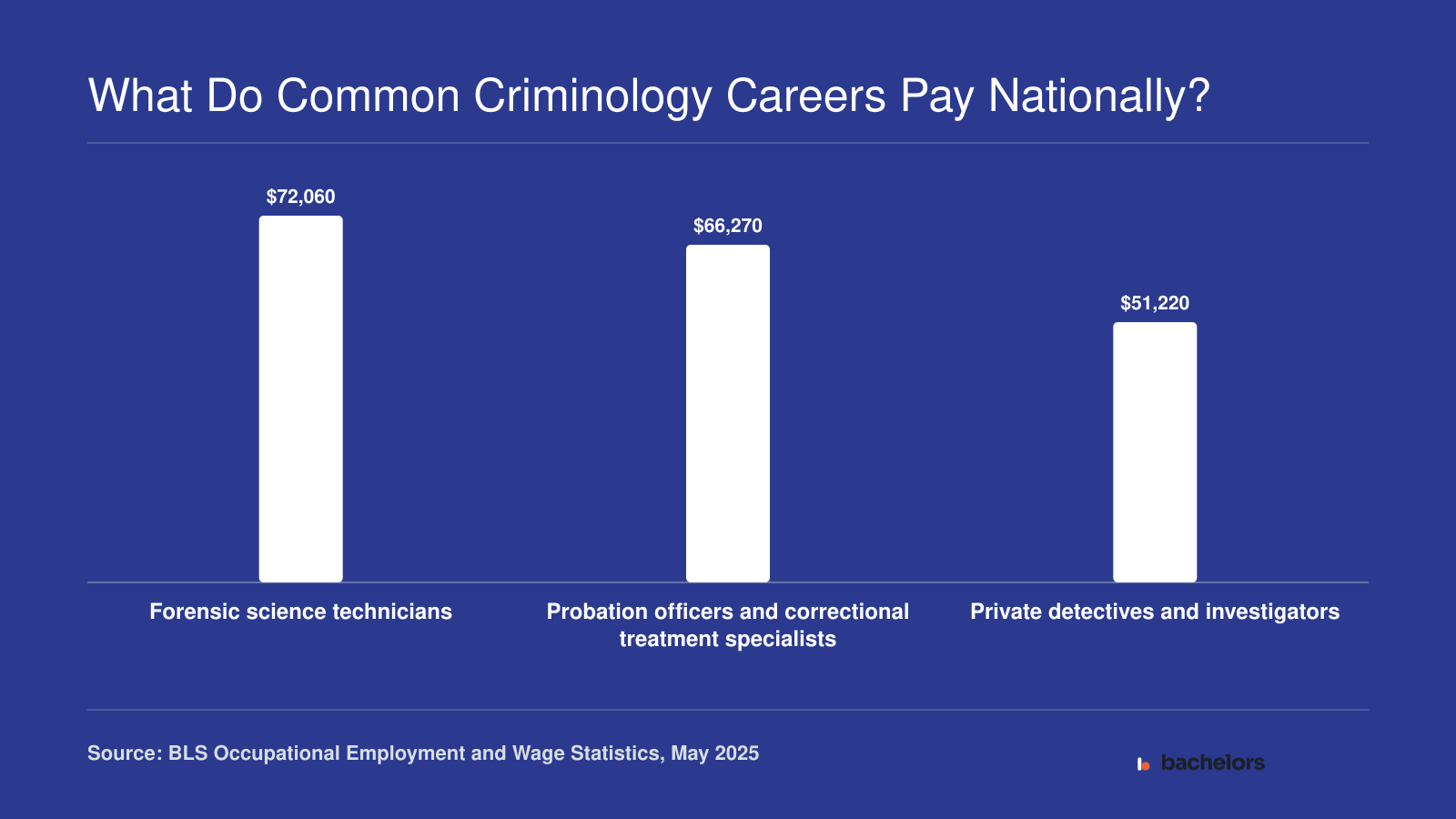
What Do Common Criminology Careers Pay Nationally?
A bachelor's degree in criminology prepares graduates for roles in corrections, investigations and forensic support. The chart compares national median annual wages for three of these fields, using the Bureau of Labor Statistics' May 2025 figures. These are wages for each occupation overall, not the earnings of graduates from any program ranked on this page. Pay also varies by state, employer and experience, so treat these medians as a starting benchmark rather than a guaranteed salary.
Admission Requirements, Transfer Credits and Time to Degree
Requirements for a bachelor's degree in criminology differ by school and applicant type. Use these typical benchmarks to check where you stand, then confirm the details with each program.
- High school diploma or GED with a minimum GPAMinimums typically fall between 2.0 and 3.0. Northwest Missouri State, Southern Illinois and Carlow list 2.0, while Arkansas State lists 3.0.
- Test scores, often optionalPolicies vary. Northwest Missouri State lists tests as optional, while Arkansas State lists the ACT or SAT.
- Transfer credit capCaps typically reach about 90 credits, as at Arkansas State, Southern Illinois, Carlow and Campbellsville. Residency rules still apply: William Paterson requires 30 credits completed at the university.
- Associate degree or 2+2 pathwayThese typically pair about two years at a community college with two at the university. An associate degree may not satisfy every major requirement.
- Credit for prior learning or police academy trainingAwards depend on approval and documentation. Campbellsville lists 12 credits, and William Paterson allows up to 30 for approved training.
- Time to degreeA 120-credit degree typically takes four years full time. East Carolina reports transfer students average 3.5 years, and accelerated online plans can shorten that for students with substantial transfer credit.
Questions to Ask Yourself
Do you want a law enforcement or probation job right after graduation, or are you headed to law school?
Will a concentration like cybercrime or forensic science help you stand out to the employers you are targeting?
Would a lower-net-price in-state public school keep your monthly loan payment within a starting probation officer's salary?
Criminology programs by state
Criminology Degree FAQs
These answers cover the questions prospective students ask most often about a bachelor's degree in criminology. Program titles vary by school, so check the curriculum and not just the degree name.
What is the difference between criminology and criminal justice?
Is a criminology degree worth it?
What is the best degree for criminology?
Do you need a graduate degree to work as a criminologist?
Compare Criminology programs on the data that matters
Explore more Criminal Justice & Law majors or browse every field of study.
All Criminal Justice & Law programs Browse every field of study