Best Artificial Intelligence Degree Programs
Compare 420+ accredited Artificial Intelligence programs at 410+ colleges, with net price after aid, graduation rates, earnings and debt from IPEDS and the U.S. College Scorecard.

The decision is rarely whether to earn a bachelor's degree in artificial intelligence, but where: a dedicated AI major, most often the Bachelor of Science (B.S.) in Artificial Intelligence, or a computer science degree with an AI concentration. Price separates them before coursework does.
Net price after aid among the schools ranked here runs from roughly $6,600 to just over $20,000, and one private university lists tuition near $64,000. Employers rarely sort candidates by the degree title; they screen for calculus, linear algebra, and working machine learning code. Accreditation is a separate question: ABET reviews AI programs one at a time, not by category.
Key Points
- Penn posts the highest program-level median earnings among ranked AI programs.
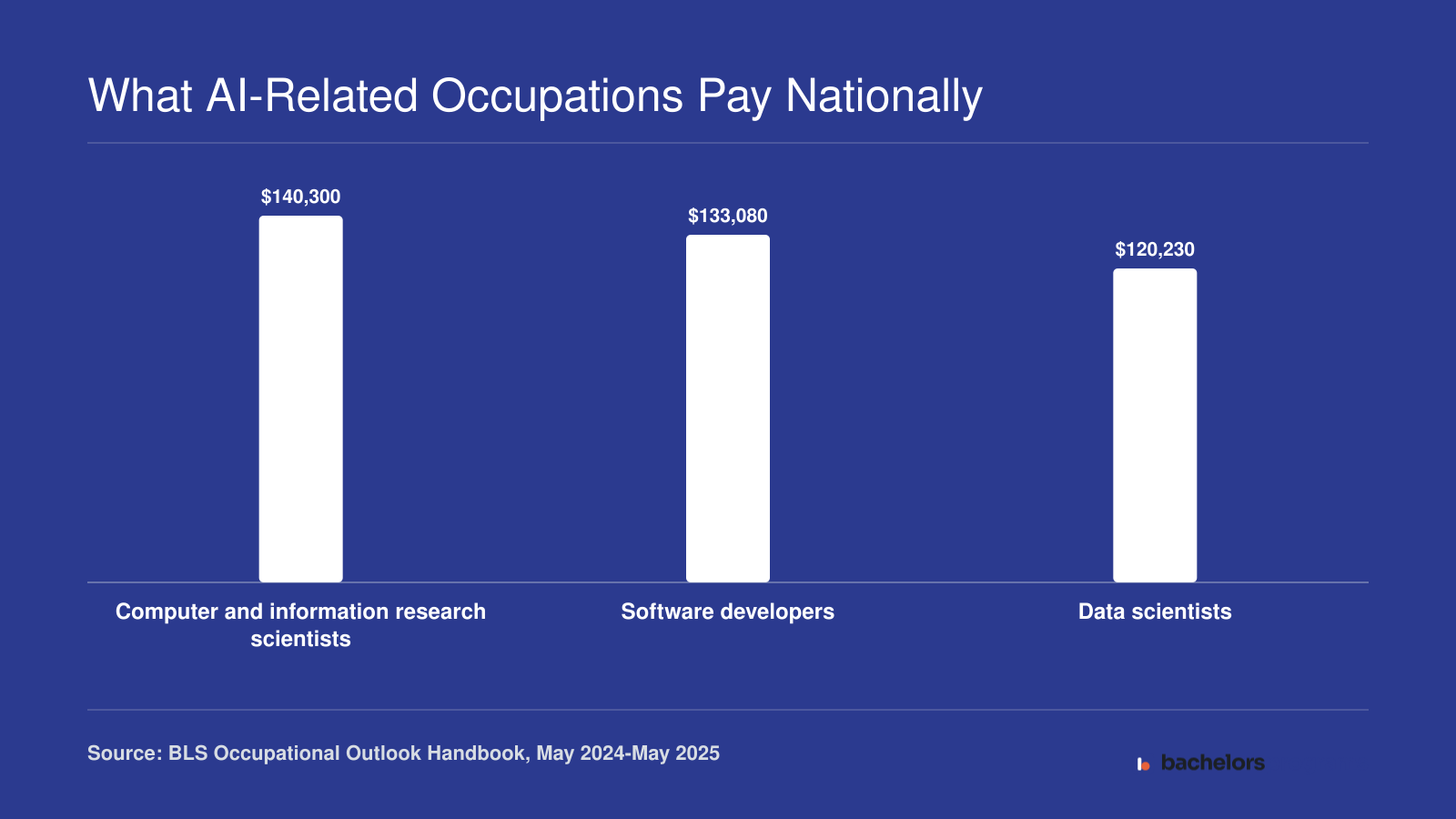
- Computer and information research scientists earned a $140,300 median in May 2025.
- Calculus is the most consistent admission requirement across AI bachelor's programs.
The 10 Best Artificial Intelligence Degree Programs for 2027
Every program in this year's top 10 is taught on campus, so the real spread shows up in price and structure. Net price after aid across the ten runs from roughly $6,600 to just over $20,000, and some schools award a standalone bachelor's degree in artificial intelligence while others fold AI into a computer science major.
Georgia Institute of Technology
#1Atlanta, GA · ~$12,000/yr (est.)
Best for: Students who want AI inside a CS degree
Georgia Tech is a public research university in Atlanta with one of the largest engineering and computing footprints in the country. Its AI track lives inside the Bachelor of Science in Computer Science, where students pair the Artificial Intelligence thread with Information Internetworks and finish with a Junior Design capstone. The school graduates 94% of students, and graduates of the AI program reported median earnings of $150,628 four years after finishing.
- 126 total credit hours, including 10 free electives
- Minimum grade of C required in many major courses
- Junior Design capstone chosen from five options
- Approaches to Intelligence: machine learning, deep learning, computer vision, NLP
- Embodied intelligence course in perception and robotics or cognitive science
- AI, Ethics, and Society satisfies the professionalism and ethics requirement
- Information management options across security, networking and databases
Rice University
#2Houston, TX · ~$13,000/yr (est.)
Best for: Small-cohort learners wanting a dedicated AI major
Rice University is a private research university in Houston with a small undergraduate population and a six-to-one student-to-faculty ratio. It awards a standalone Bachelor of Science with a major in Artificial Intelligence, so AI coursework is the degree rather than an add-on to a computer science major. The school graduates 95% of students, and program graduates had median earnings of $182,443 four years after finishing.
- 120 total credit hours, with 67 to 69 in the major
- At least 10 courses at the 300 level or above
- Choose three of five AI elective areas, from theory to robotics
- AI core includes deep learning, systems for AI, and AI ethics
- Two-semester AI Senior Design sequence
- Minimum 2.00 major GPA; up to five transfer courses allowed
- Fifth-year master's option for Rice undergraduates
Massachusetts Institute of Technology
#3Cambridge, MA · ~$20,000/yr (est.)
Best for: Future researchers seeking a math-heavy AI foundation
MIT is a private research university in Cambridge, Massachusetts, and its Department of Electrical Engineering and Computer Science awards the Bachelor of Science in Artificial Intelligence and Decision Making, known on campus as Course 6-4. The degree requires 168 to 177 units in the major, with electives spanning data-centric, model-centric, decision-centric, computation-centric and human-centric areas, plus a subject in the social and ethical responsibilities of computing. The school graduates 96% of students.
- Course 6-4 in Electrical Engineering and Computer Science
- 17 General Institute Requirements, six of them in science
- 168 to 177 units in the major plus 48 units of unrestricted electives
- Electives must span data, model, decision, computation and human-centric areas
- Social and Ethical Responsibilities of Computing subject required
- Two communication-intensive subjects in the major
- Swimming plus four physical education courses required
University of California-San Diego
#4La Jolla, CA · $10,000 – $15,000/yr (est.)
UC San Diego is a public research university in La Jolla, California, with a computer science and engineering department that runs its own AI major. The Bachelor of Science in Artificial Intelligence mixes core AI classes with electives drawn from data science, cognitive science, mathematics and philosophy. For 2026-2027, admission is direct only, and the department is not accepting internal major switches while the program ramps up. The school graduates 86% of students.
- Direct admission only for 2026-2027; no internal major switches
- Core topics: programming, data structures, algorithms, machine learning, data ethics
- Electives from CSE, Data Science, Cognitive Science, Mathematics and Philosophy
- AI electives include computer vision, natural language processing and robotics
- Major courses need C- or better; up to 12 units may be taken P/NP
- Sample four-year plan and transfer plan published
University of California-Irvine
#5Irvine, CA · $14,000/yr (est. net price)
UC Irvine is a public research university in Irvine, California, where AI is an undergraduate specialization inside the Bachelor of Science in Information and Computer Science. Students pick from six specializations and can pair the degree with a minor in digital art, mathematics or management, and an honors program adds small classes and individual study projects. The school graduates 87% of students, and program graduates had median earnings of $96,347 four years after finishing.
- Six undergraduate specializations, including Artificial Intelligence
- Combine the degree with a minor in digital art, mathematics or management
- Undergraduate honors program with small classes and individual study projects
- Advanced topics include intelligent agents and knowledge discovery in databases
- Apply through the UC Pathways system; deadline is November 30
- Research topics span embedded systems and hardware-software co-design
Florida State University
#6Tallahassee, FL · ~$11,000/yr (est.)
Florida State University is a public research university in Tallahassee with a broad computer science department and a published course flowchart for sequencing the AI track. The concentration sits inside the Bachelor of Science in Computer Science and runs from an introduction to AI and a deep learning course through electives on large language model agentic systems and applied data science projects. The school graduates 86% of students, and graduates of the AI program had median earnings of $93,727 four years after finishing.
- Required: CAP 4601 Intro to AI and CAP 4613 Deep Learning
- Next choose LLM Agentic Systems or Projects in Data Science
- Computing electives include full-stack C# development and advanced Python
- One database course from Databases or Non-Traditional Databases
- Concentration flowchart published for course sequencing
- Covers machine learning, data management and computing infrastructure
Florida International University
#7Miami, FL · ~$9,000/yr (est.)
Florida International University is a public research university in Miami and one of the largest Hispanic-serving institutions in the country. It awards a Bachelor of Science in Data Science and Artificial Intelligence through the College of Engineering and Computing, with concentrations that let students lean toward robotics, big data analytics or statistical modeling. The school graduates 74% of students, and program graduates had median earnings of $90,397 four years after finishing.
University of South Florida
#8Tampa, FL · ~$10,000/yr (est.)
The University of South Florida is a public research university in Tampa that built a dedicated college for AI, cybersecurity and computing. Its Bachelor of Science in Artificial Intelligence pairs core machine learning and ethics courses with electives in natural language processing and computer vision, and students can start internships as early as sophomore year, with paid co-op work available part- or full-time. Faculty-led undergraduate research can appear on the official transcript. The school graduates 77% of students, and program graduates had median earnings of $90,953 four years after finishing.
- Housed in the Bellini College of Artificial Intelligence, Cybersecurity and Computing
- Core machine learning and ethics courses
- Electives in natural language processing and computer vision
- Internships as early as sophomore year; some earn course credit
- Paid co-op work, part- or full-time, through the career center
- Faculty-led undergraduate research can appear on the transcript
- Target roles include machine learning engineer and computer vision engineer
California State University-Fullerton
#9Fullerton, CA · $7,000 – $20,000/yr (est.)
Cal State Fullerton is a public university in Orange County, California, with a large, access-focused computer science department. AI is a 15-unit concentration inside the Bachelor of Science in Computer Science rather than a separate degree, built on a 48-unit computer science core and 18 units of required mathematics. A placement exam can waive introductory programming courses for students who arrive with prior experience. The school graduates 70% of students.
- 15-unit AI and machine learning concentration
- Required: CPSC 375 Data Science and Big Data and CPSC 483 Machine Learning
- 3 units of AI electives plus 6 units of computer science electives
- 120 units total, including a 48-unit computer science core
- 18 units of required mathematics
- Placement exam can waive introductory programming courses
- Concentration sits inside the B.S. in Computer Science, not a separate degree
Ohio State University
#10Columbus, OH · $17,000/yr (est. net price)
Ohio State University is a large public research university in Columbus that has pushed AI across the whole campus, including a Google Cloud partnership and an AI fluency initiative for incoming classes. Its AI specialization is available inside both the Bachelor of Science in Computer Science and Engineering and the Bachelor of Science in Computer and Information Science. After a required survey course, students choose two of six electives covering machine learning, computer vision, speech and language processing, neural networks and data mining. The school graduates 88% of students, and program graduates had median earnings of $118,833 four years after finishing.
- AI specialization within the BSCSE and BSCIS majors
- Required: CSE 3521 Survey of Artificial Intelligence I
- Choose two of six AI electives worth 3 or 4 credits each
- Electives cover machine learning, computer vision, NLP and neural networks
- CSE 3521 requires CSE 2331 or 5221, a math course and a statistics course
- Specialization is normally chosen when applying to the major
Cost & outcomes by school
Federal data for the highest-earning Artificial Intelligence programs, independent of the ranking above. Earnings are this field's bachelor's graduates four years after completing where the Scorecard reports them, else the school's undergraduate median.
| School | Net price / yr | Grad rate | Earnings | Debt | Grads/yr | Format |
|---|---|---|---|---|---|---|
| University of Pennsylvania PA | $28,699 | 97% | $241,380 | $15,000 | 209 | Campus |
| Carnegie Mellon University PA | $31,944 | 94% | $187,437 | $21,750 | 143 | Campus |
| Rice University TX | $13,370 | 95% | $182,443 | $12,373 | 203 | Campus |
| University of Michigan MI | $13,138 | 93% | $172,904 | $19,475 | 1,323 | Campus |
| Northeastern University MA | $30,915 | 91% | $163,708 | $22,583 | 748 | Campus |
| The University of Texas at Austin TX | $19,857 | 89% | $155,168 | $20,500 | 562 | Campus |
| Georgia Institute of Technology GA | $12,116 | 94% | $150,628 | $20,500 | 1,470 | Campus |
| Stony Brook University NY | $18,784 | 76% | $147,064 | $16,250 | — | Campus |
| University of Maryland-College Park MD | $15,678 | 89% | $144,501 | $19,000 | — | Campus |
| Massachusetts Institute of Technology MA | $20,111 | 96% | $143,372 | $14,768 | 109 | Campus |
| University of Notre Dame IN | $26,780 | 95% | $142,970 | $19,000 | 142 | Campus |
| California Institute of Technology CA | $16,075 | 94% | $128,566 | — | — | Campus |
Sources: U.S. Department of Education. Net price, graduation rate, earnings and debt: College Scorecard (earnings and debt for this field's bachelor's graduates where reported, else school-wide); graduates: IPEDS. A dash means no figure is reported.
Cost, debt & payoff
Median earnings of this field's bachelor's graduates (4 yrs after completing, else the school's undergraduate median) vs. their median federal loan debt · U.S. College Scorecard
Across these programs the median graduate earns about $71,902 and finishes with roughly $23,250 in debt — a ratio that clears a common rule of thumb (keep debt below first-year salary). Net price and debt vary widely school to school, so check the per-school figures in the table above before you shortlist.
How We Ranked Bachelor's Degree in Artificial Intelligence Programs
The Five Factors
Every school on this list was compared on the same five measures, each chosen to answer a question families actually ask before enrolling:
- Average net price: What students pay after grants and scholarships are subtracted from the sticker price.
- Graduation rate: The share of students who finish their degree at the institution.
- Program earnings: How much graduates of the AI program typically earn early in their careers.
- Program debt: The median federal loan balance that graduates of the program carry when they leave.
- Admissions selectivity: How competitive it is to get in, based on the school's acceptance rate.
Where the Earnings and Debt Figures Come From
Earnings and debt are program-level figures from the U.S. Department of Education's College Scorecard. They are tied to the federal classification for artificial intelligence programs wherever Scorecard publishes data for that field at a given school. Earnings reflect the median for graduates who received federal aid, measured one year after completion. That makes them a snapshot of early-career pay, not lifetime income. Many AI majors are new, so these figures tend to be most reliable at schools that have been graduating AI students for several years.
What These Numbers Can't Tell You
The net price figure is an average across aided students, not a personal quote. Your cost depends on your family's income and the aid package you receive. Graduation rates cover the whole school, not the AI major specifically.
Why We Show Our Work
Most "best AI degree" lists never explain how schools were chosen. Here, every factor is a public federal figure, so you can check the reasoning yourself and decide which measures matter most to you.
AI Degree Cost: Tuition, Net Price, and Debt Compared
CUNY Baruch College lists in-state tuition and fees of $7,464 a year, but its average net price after aid is just $3,033, the lowest on this list. That gap between sticker price and what families actually pay shows up across every program on this list.
Published Tuition vs. Net Price
Public universities keep in-state tuition low, but out-of-state rates climb quickly. Net price averages for public schools reflect in-state students receiving aid, so they are the better guide for residents.
- CUNY Baruch College: $7,464 in-state, $15,414 out-of-state, $3,033 average net price
- Cal State Fullerton: $7,470 in-state, $20,070 out-of-state, $6,555 average net price
- Florida International University: $6,565 in-state, $18,964 out-of-state, $9,288 average net price
- University of South Florida: $6,410 in-state, $17,324 out-of-state, $9,812 average net price
At the higher end, the University of Michigan charges $17,736 in-state and $60,946 out-of-state, with an average net price of $13,138. Georgia Tech lists $12,058 in-state and $34,484 out-of-state, with a $12,116 net price. If you are crossing state lines, the published out-of-state rate matters far more than these averages.
Where a Private School Closes the Gap
College of the Ozarks, a private school on this list, posts $22,320 in tuition and fees for every student. Its average net price, though, is $6,100. That is lower than the net price at Cal State Fullerton and well under every Florida public here. Don't rule out a private college on sticker price alone.
Translating Debt Into a Monthly Payment
Where program-level figures are available, median federal debt for AI and related bachelor's graduates runs from $18,896 at FIU to $22,500 at USF. On a standard 10-year plan, that works out to a median monthly payment of $200 to $239. Florida State ($19,182, $203 a month), Michigan ($19,475, $206 a month), and Georgia Tech ($20,500, $217 a month) fall in between. Budget roughly $200 to $240 a month for loans after graduation.
The Practical Takeaway
The figures above are averages; your own cost will depend on income, residency, and scholarships. Before you compare schools seriously, run each one's net price calculator with your own financial details. It's the fastest way to see which AI program is actually affordable for you.
Top Early-Career Earnings Among Ranked AI Programs
The University of Pennsylvania has the highest program-level median earnings among the ranked programs.
AI Graduate Salary and Career Outcomes
Early earnings for AI bachelor's graduates are strong across these programs, but the spread is wide, and the window you measure matters.
Program-Level Earnings by Window
Median earnings one year after completion run from $53,517 at the University of California-Irvine to $146,204 at the University of Pennsylvania. Rice University sits at $131,154 and Georgia Tech at $105,137 in the same one-year window. Four years out, medians range from $96,347 (UC Irvine) to $241,380 (Penn), with Carnegie Mellon at $187,437. Five years out, they run from $122,422 (UC Irvine) to $298,016 (Penn), with Rice at $213,603 and Georgia Tech at $155,126. Two-year medians are not reported for these programs.
The employment picture holds up. One year after completion, the share of graduates working runs from 89.9% at UC Irvine to 100% at Penn. The share earning above the poverty threshold runs from 94.8% at Notre Dame to 100% at Rice and UConn.
What Employers Want From New Hires
Demand for AI skills is broad, though not all of it is aimed at new graduates. CompTIA counted more than 275,000 active U.S. postings referencing AI skills in January 2026.1 NACE found that AI-skill requirements in entry-level hiring nearly tripled between Fall 2025 and its Spring 2026 update, reaching 10.5% of entry-level postings.2 NACE's spring update also projected 5.6% more hiring for the Class of 2026, up from 1.6% in its earlier outlook.2
Python remains the most frequently requested specialized skill in AI-related postings, according to Stanford's AI Index.3 Employers also stress teamwork, problem-solving, and communication; about 70% use skills-based hiring.2 Portfolios, internships, and project work count.
The market is uneven. Stanford reports employment for software developers aged 22 to 25 fell nearly 20% from 2024, so early-career pipelines are tighter even where AI demand is rising.3 LinkedIn still listed AI engineer among the fastest-growing titles for recent graduates.4
Common First Jobs
- Machine learning engineer: building and deploying models in production.
- Data scientist: analysis, modeling, and reporting for business teams.
- Software developer: application and systems work with AI components.
- AI/ML research assistant: lab or industry research roles, often a path toward graduate study.
- AI engineer: integrating AI tools and services into products.
What AI-Related Occupations Pay Nationally
The occupations AI graduates most often target all carry six-figure national medians: $140,300 for computer and information research scientists and $120,230 for data scientists (May 2025), and $133,080 for software developers (May 2024). These medians cover everyone in each occupation, including workers with many years of experience, so they run well above the early-career Scorecard earnings shown above. Research scientist roles typically call for a master's degree, so most bachelor's graduates enter through software development or data science, where the Bureau of Labor Statistics projects data scientist employment to grow 35% from 2025 to 2035.
Related Articles
Are There Accredited Artificial Intelligence Degree Programs?
Does ABET accredit bachelor's programs in artificial intelligence? In principle, yes, but only program by program, and institutional accreditation matters first.
Institutional Accreditation Comes First
Regional and national accreditors recognized by the U.S. Department of Education and CHEA evaluate whole institutions. That status affects federal financial aid eligibility, and it strongly influences whether another school will accept your credits if you transfer.
What ABET Adds
ABET accredits individual programs, not schools.3 Its Computing Accreditation Commission (CAC) covers associate, bachelor's, and master's programs.1 Its Engineering Accreditation Commission requires "engineering" in the program name. Under the 2026-2027 criteria, a bachelor's titled "Artificial Intelligence" generally falls under CAC and must meet the eight general criteria plus AI-specific ones.2 Those include at least 42 semester credit hours, at least 9 in mathematics, coverage of ethics and responsible AI, at least one application area, and a major integrating project.2 A title alone does not prove accreditation, and online programs are held to the same criteria.3
Verify It in Three Steps
- Step 1: Search the Department of Education's DAPIP database to confirm the institution, its accreditor, and its current status, including any branch or online locations.1
- Step 2: Check CHEA to confirm the same campus and accreditor. A CHEA listing does not replace the accreditor's own directory.
- Step 3: Use ABET's Accredited Program Search and Accreditation Status Lookup to match the exact degree title, commission, level, and location against your catalog.
What a New AI Major Means
A new AI major at an accredited university may not yet hold ABET accreditation. The degree is still legitimate, and aid and transfer rules depend on the institution's status. What you lose is the program-level quality signal that some employers and graduate schools value. Ask the department whether it plans to seek ABET review and which commission would apply, and treat any claim you cannot find in ABET's listings as unconfirmed.
Admission Requirements and Math Prerequisites for AI Majors
Admission standards vary by school, but calculus is the most consistent requirement across AI bachelor's programs. Use this checklist to plan your coursework before you apply.
- High school math through precalculus, calculus recommendedPurdue expects four years of high school math, and UT Austin requires Algebra II or higher plus calculus readiness for its listed computer science majors. Purdue notes that calculus proficiency helps applicants.
- College calculus and linear algebra in the majorCarnegie Mellon requires differential and integral calculus plus calculus in three dimensions. Purdue's curriculum adds multivariate calculus and linear algebra, with a C or better in every major course.
- Introductory programmingNeither Purdue nor UT Austin requires a high school programming course. Carnegie Mellon places students in Fundamentals of Programming and Computer Science unless they earn credit or a waiver. Purdue starts with Problem Solving and Object-Oriented Programming.
- Discrete math, probability, and statisticsCoverage varies by school. Carnegie Mellon builds proof-based foundations through Mathematical Foundations for Computer Science. Other programs may fold this material into required or elective courses, so check each curriculum.
- GPA and test scoresThese schools do not publish a minimum GPA for their AI majors. At UT Austin, an SAT Math score of 620 or higher or an ACT Math score of 26 or higher is one way to show calculus readiness. AP or IB scores and calculus credit also qualify.
- Transfer prerequisitesFinish calculus and introductory programming before transferring. Purdue's College of Science requires two semesters of college calculus and two computer science courses at a B or higher. Carnegie Mellon admits AI students through its School of Computer Science, and students from other colleges at the university may apply to transfer later.
AI vs. Computer Science, Data Science, and Robotics Degrees
A bachelor's degree in artificial intelligence trains you to build software that learns, reasons, and perceives, while neighboring majors point the same math and coding skills at different problems. The differences are real, but they are program-specific, so check each school's course list before you decide.
How the Four Majors Compare
- Artificial intelligence: Front-loads machine learning, deep learning, natural language processing, vision, and AI ethics on a base of computer science, math, and statistics. Math intensity is high. Typical first jobs involve intelligent software systems.
- Computer science with an AI concentration: Keeps broad programming, algorithms, and systems coursework, then adds AI electives. Math is solid but usually less AI-specific. It suits a wide range of software careers.
- Data science: Centers on statistics, data analysis, and visualization. First jobs tend to be analytics roles.
- Robotics: Centers on embedded systems, machine vision, and physical machines. Some AI programs, such as Idaho's, offer robotics only as a specialized track.
All four can lead to graduate study, and a heavy math sequence (calculus, linear algebra, probability) keeps the most options open. Availability differs sharply: a 2026 report puts AI majors within CS departments at more than 100 U.S. universities, while stand-alone AI bachelor's degrees remain a smaller, growing group. Carnegie Mellon launched its B.S. in 2018, and Michigan Tech's begins in Fall 2026.
The CS Concentration Route
Many schools, including Arizona State and UMass Dartmouth, offer AI as a concentration inside computer science rather than a separate degree. Drake offers both a dedicated AI degree and a CS concentration. Employers generally read the two similarly, since the skills they screen for are the ML projects, coding ability, and math you can show.
Is an AI Degree Better Than a CS Degree?
Not automatically. Choose a dedicated AI degree if you already know you want to work on machine learning or intelligent systems and the program's math and electives fit that goal. Choose CS with an AI concentration if you want a broader safety net across software roles, or if the schools you prefer don't offer a stand-alone AI major.
Artificial Intelligence programs by state
Compare Artificial Intelligence programs on the data that matters
Explore more Computers & IT majors or browse every field of study.
All Computers & IT programs Browse every field of study