Best Business Degree Programs in Minnesota
Compare 59 accredited Business programs in Minnesota at 31 colleges, with net price after aid, graduation rates, earnings and debt from IPEDS and the U.S. College Scorecard.

A business bachelor's in Minnesota can mean a 4-year degree at a flagship-system campus in Duluth or Morris, a regional public like Winona State or Minnesota State University-Mankato, or a Twin Cities private such as the University of St Thomas. Concordia University-Saint Paul and Metropolitan State University add online or adult-degree formats.
The real tension is price versus label. Sticker tuition at private schools can run well above public rates, yet aid often narrows the gap sharply, and AACSB accreditation separates programs more than the degree title does.
For most students, the choice comes down to net cost, format and how close the school sits to the employers they want.
Key Points
- University of Minnesota-Morris pairs the lowest net price here with 63% completion.
- Saint Mary's lists $45,080 tuition, but average net price is $11,704.
- Minnesota State University-Mankato's stated admission standard is a 3.0 high school GPA.
10 Best Bachelor's in Business Programs in Minnesota
On this list, the best business school in Minnesota for a bachelor's degree is the University of Minnesota, Morris, which pairs the lowest average net price here with a 63% completion rate. The ten programs below run from small public liberal arts campuses to AACSB-accredited private business schools and online completion degrees. Each entry gives the tuition, the approximate school-wide average net price and the approximate school-wide graduation rate so the comparison stays apples to apples.
University of Minnesota-Morris
#1Morris, MN · ~$9,000/yr (est.)
Best for: Budget-focused liberal arts business students
Minnesota residents pay about $14,500 in tuition and fees, and the average net price near $8,800 is the lowest on this list. Business and Management majors pair accounting, finance, business law and ethics with a senior research seminar and credit-waiver pathways into Carlson School master's programs. School-wide, about 63% of students graduate within six years.
- Coursework in accounting, finance, business law and management of organizations
- Credit-waiver pathways to Carlson School master's programs in accountancy, finance and HR
- Paid McNair scholar research program open to undergraduates
- Faculty-led Truckers and Turnover study of long-haul driver turnover
- Senior research seminar required in the final year
- Four-year and three-year sample degree plans available
- Graduates hired at IBM, Merrill Lynch and Mayo Clinic
- Business and management minor with separate requirements
Saint Mary's University of Minnesota
#2Winona, MN · $12,000/yr (est. net price)
Best for: Working adults finishing an online degree
An online Bachelor of Science in Business Administration built for adult learners, with up to 90 transfer credits accepted and completion possible in about a year. Tuition is about $45,100, while the average net price after aid is roughly $11,700. Institution-wide, about 66% of students graduate within six years.
- Online BS for adult learners; up to 90 transfer credits accepted
- Can be completed in as little as one year with prior credit
- Tracks: Business Intelligence and Data Analytics, Marketing
- Specializations add six credits beyond the core
- Accredited by the International Accreditation Council for Business Education
- Covers management, finance, marketing and business law
- Fast track option for students planning graduate study
- Grounded in Lasallian Catholic values and ethical leadership
University of St Thomas
#3Saint Paul, MN · ~$29,000/yr (est.)
Best for: Twin Cities students wanting a metro business network
The largest private option on this list, with an AACSB-accredited Opus College of Business and a core-then-major structure that lets students choose general business management, marketing or finance after their first two years. Tuition runs about $54,400 and the average net price is near $29,200. School-wide, about 76% of students graduate within six years.
- AACSB-accredited Opus College of Business curriculum
- Core business foundation in the first two years, major chosen sophomore year
- Majors include general business management, marketing and finance
- London Business Semester and other study abroad options
- Service learning requirement and company site visits
- Double majors and minors available alongside the BS
- Ethics and experiential learning emphasized throughout
University of Minnesota-Duluth
#4Duluth, MN · $15,000 – $20,000/yr (est.)
A 120-credit Bachelor of Business Administration from the Labovitz School of Business and Economics, with an international perspective requirement and a professional development sequence that includes internships. Minnesota residents pay about $14,600 in tuition and fees and an average net price near $18,700. About 65% of students graduate within six years.
- 120-credit BBA through the Labovitz School of Business and Economics
- Core covering accounting, finance, marketing and operations
- Professional development course and internship opportunities
- International perspective requirement built into the degree
- At least 30 credits must be completed at UMD
- Double majors and minors possible
Bethel University
#5Saint Paul, MN · $29,000/yr (est. net price)
A 122-credit B.A. in Business with a 36-credit core and a 28-credit emphasis, including an accounting route whose internship can be designated to meet Minnesota Board of Accountancy rules for the CPA exam. Tuition is about $44,200 and the average net price around $28,600. Roughly 71% of students graduate within six years.
- 36 to 37 credit business core plus one 28-credit emphasis
- Emphases include accounting, finance, marketing, entrepreneurship and HR
- Analytics and Artificial Intelligence for Business emphasis offered
- 3 to 4 credit internship required in business
- Accounting internship can be designated to meet CPA exam rules
- Minimum grade of C required in each core course
- 122 credits total to graduate
- Cannot be combined with a business minor
Winona State University
#6Winona, MN · ~$18,000/yr (est.)
One of the lowest sticker prices among four-year options here: about $10,600 in tuition and fees for Minnesota residents, with an average net price near $17,500. Business Administration runs 66 program credits on campus, and a separate online completion version requires 33 major credits. School-wide, about 57% of students graduate within six years.
- 66 program credits within a 120-credit bachelor's degree
- Campus program with fall and spring start terms
- General education requirements completed alongside the major
- Prepares students to manage daily business operations
University of Northwestern-St Paul
#7Saint Paul, MN · ~$28,000/yr (est.)
A 126-credit Bachelor of Science in Business Administration with 13 concentration options, from analytics and healthcare management to sports management and nonprofit leadership. Tuition is about $37,900 and the average net price near $27,700. About 68% of students graduate within six years.
- 126 credit hours with 13 concentration options
- Concentrations include analytics, healthcare management and sports management
- Also entrepreneurship and family business, nonprofit leadership, strategic management
- Case studies and guest speakers from Fortune 500 companies
- Internships with Twin Cities organizations
- Bachelor's to accelerated master's plan available
- Part of the Stoltz School of Business
North Central University
#8Minneapolis, MN · ~$26,000/yr (est.)
A 124-credit Bachelor of Science in Business Administration taught in small classes, with faculty career mentoring and internships the school reports at employers such as 3M and Target. Tuition is about $32,200 and the average net price near $25,800. Roughly 66% of students graduate within six years.
- 124 credit hours
- Offered in person and online
- Small classes taught by industry-expert professors
- Experiential learning and real-world professional projects
- Career mentoring from faculty
- Internships completed at employers such as 3M and Target
Minnesota State University Moorhead
#9Moorhead, MN · ~$18,000/yr (est.)
An AACSB-accredited program that runs face-to-face, hybrid or fully online, with emphases in international business, management and marketing plus nine certificates. Minnesota residents pay about $10,400 in tuition and fees, and the average net price is near $18,000. About 57% of students graduate within six years.
- AACSB-accredited business program
- Tracks: International Business, Management, Marketing
- Face-to-face, hybrid and online class formats
- Online completer degree finishable in two years
- Nine certificates, including human resources and business analytics
- 4+1 MBA pathway available
- Transfer credits accepted from AAS, AS and diploma programs
- Faculty advisor assigned to each student
St Catherine University
#10Saint Paul, MN · $15,000 – $20,000/yr (est.)
A 46- to 48-credit major with a business portfolio requirement and a strategic management capstone built on a business simulation, offered through the College for Women. The average net price is roughly $19,800. School-wide, about 61% of students graduate within six years.
- 46 to 48 major credits plus 12 supporting credits
- Coursework spans accounting, finance, analytics, global business and law
- Business portfolio presented to an advisor before graduation
- Strategic management capstone runs a business simulation
- Offered in the College for Women only
- Seniors may take MBA courses if admitted to the accelerated track
- Financial economics minor option available
Cost & outcomes by school
Federal data for the highest-earning Business programs, independent of the ranking above. Earnings are this field's bachelor's graduates four years after completing where the Scorecard reports them, else the school's undergraduate median.
| School | Net price / yr | Grad rate | Earnings | Debt | Grads/yr | Format |
|---|---|---|---|---|---|---|
| University of St Thomas MN | $29,155 | 76% | $73,739 | $23,250 | 2,860 | Campus |
| The College of Saint Scholastica MN | $27,846 | 71% | $65,934 | $20,000 | 1,196 | Hybrid |
| Gustavus Adolphus College MN | $22,900 | 77% | $65,607 | $26,774 | 1,320 | Campus |
| Metropolitan State University MN | $16,863 | 44% | $64,705 | $17,100 | 2,800 | Hybrid |
| Bethel University MN | $28,556 | 71% | $63,764 | $21,500 | 1,244 | Campus |
| University of Minnesota-Duluth MN | $18,743 | 65% | $62,616 | $22,024 | 3,922 | Campus |
| Dunwoody College of Technology MN | $26,939 | 66% | $61,511 | $16,000 | 228 | Online |
| Hamline University MN | $20,744 | 61% | $61,106 | $23,770 | 918 | Campus |
| Concordia University-Saint Paul MN | $18,462 | 46% | $59,871 | $17,832 | 1,832 | Campus |
| Concordia College at Moorhead MN | $24,902 | 61% | $59,317 | $26,847 | 1,064 | Campus |
| St Catherine University MN | $19,764 | 61% | $59,282 | $24,181 | 1,070 | Campus |
| Augsburg University MN | $23,873 | 52% | $58,829 | $25,347 | 980 | Campus |
Sources: U.S. Department of Education. Net price, graduation rate, earnings and debt: College Scorecard (earnings and debt for this field's bachelor's graduates where reported, else school-wide); graduates: IPEDS. A dash means no figure is reported.
Cost, debt & payoff
Median earnings of this field's bachelor's graduates (4 yrs after completing, else the school's undergraduate median) vs. their median federal loan debt · U.S. College Scorecard
Across these programs the median graduate earns about $58,170 and finishes with roughly $21,325 in debt — a ratio that clears a common rule of thumb (keep debt below first-year salary). Net price and debt vary widely school to school, so check the per-school figures in the table above before you shortlist.
Most Affordable Bachelor's in Business Programs in Minnesota
These business bachelor's programs carry the lowest average net prices after aid among the schools on this page, based on 2024 IPEDS and College Scorecard data from the U.S. Department of Education. Net price is an average for students who receive aid, reported separately for public and private schools, so your own cost will depend on family income and the aid package you receive. Public universities post the lowest figures, led by University of Minnesota-Morris at $8,837. Saint Mary's University of Minnesota shows how far aid can move a private sticker price: its $45,080 in tuition and fees drops to an average net price of $11,704, below the other public schools in the table.
| School | City | Sector | Format | In-State Tuition and Fees | Average Net Price After Aid | Median Earnings 1 Year After Graduation |
|---|---|---|---|---|---|---|
| University of Minnesota-Morris | Morris | Public | Campus | $14,526 | $8,837 | $43,230 |
| Saint Mary's University of Minnesota | Winona | Private nonprofit | Online | $45,080 | $11,704 | $56,290 |
| Bemidji State University | Bemidji | Public | Campus | $10,237 | $15,261 | $47,396 |
| Metropolitan State University | Saint Paul | Public | Online or campus | $9,840 | $16,863 | $56,314 |
| Winona State University | Winona | Public | Campus | $10,576 | $17,503 | $47,097 |
Online and Hybrid Business Bachelor's Options at Minnesota Schools
Most online business bachelor's programs in Minnesota are built for students who arrive with college credits, not for first-year starters.
How the Formats Split
- Campus-based: University of Minnesota-Morris, University of St Thomas, University of Minnesota-Duluth, Bethel University, Winona State University, University of Northwestern-St Paul and St Catherine University.
- Online: Saint Mary's University of Minnesota offers a Bachelor of Science in Business Administration online, and its materials describe a path for adult learners with transfer credit. North Central University lists both in-person and online delivery.
- Hybrid or mixed: Minnesota State University Moorhead combines face-to-face, hybrid and online classes, plus an online completer track. Concordia University-Saint Paul offers an online-only adult business degree.
For Bemidji State University and Metropolitan State University, confirm delivery format with the schools directly.
Minnesota State Mankato's Degree-Completion Path
Minnesota State University-Mankato runs a fully online, asynchronous BBA in five-week sessions, often taken one course at a time. The sources reviewed describe no routine campus attendance requirement, but students must finish lower-division College of Business requirements first. An Associate of Science in Business from a Minnesota State two-year college is the most direct route, using the Business or Management Transfer Pathway. Sixty credits is the recommended starting point. Expect at least 30 resident upper-division credits and at least half of major coursework at Mankato.
Completing the Minnesota Transfer Curriculum alone does not guarantee junior standing, and an associate degree outside business may add prerequisites. Request a transcript evaluation early.
Who Each Format Suits
Working adults and transfer students tend to fit asynchronous completion programs. Career changers with prior credits can use the accelerated online tracks. Students wanting a traditional residential experience should look at the campus programs.
What It Takes to Get Into Minnesota's Business Bachelor's Programs
Minnesota State University-Mankato publishes a 3.0 high school GPA as its stated standard for admission, with a 2.7 accepted alongside an ACT composite of 21 and a class rank in the top half of the graduating class. Mankato is also test-optional, so an absent SAT or ACT score does not sink an otherwise solid application.
Where the Numbers Aren't Published
The University of St. Thomas Opus College of Business publishes no first-year minimum GPA. Admission rests on high school GPA, class rank where the school uses it, and the strength of your college-prep schedule, and SAT or ACT scores may be submitted but are not required. St. Thomas also publishes no transfer-admission GPA floor; the 2.00 GPA in its catalog governs credits counted toward graduation, which is a degree-completion rule rather than an entry bar. At schools with a policy like this, ask an admissions counselor to put the working threshold in writing before you apply.
For Transfer Students
Mankato admits transfer applicants holding 24 semester (or 36 quarter) transferable credits at a 2.00 cumulative GPA; below that line, your final high school transcript joins the file and the decision draws on both records. Build your community college schedule around the Minnesota Transfer Curriculum so general education credits clear as a package, and confirm that microeconomics and financial accounting transferred at a grade the business school will accept.
Questions to Ask Yourself
Do you need a fully online path, or can you get to a campus?
Do you already have an associate degree or transferable college credits?
Will your employer care about AACSB accreditation, or does net price matter more?
Business Bachelor's Tuition and Net Price in Minnesota, Plus State Aid
Sticker price has become a weak guide to what a business bachelor's actually costs in Minnesota. Saint Mary's University of Minnesota lists tuition of $45,080, yet students pay an average net price of $11,704 after aid, lower than several public campuses.
Tuition vs. Net Price at Public and Private Schools
- University of Minnesota-Morris: $14,526 in-state tuition; $8,837 net price
- Saint Mary's University of Minnesota: $45,080 tuition; $11,704 net price
- Winona State University: $10,576 in-state tuition; $17,503 net price
- Minnesota State University Moorhead: $10,428 in-state tuition; $17,997 net price
- University of Minnesota-Duluth: $14,608 in-state tuition; $18,743 net price
- St Catherine University: $38,428 tuition; $19,764 net price
In our directory, Minnesota State University-Mankato ($9,572) and Metropolitan State University ($9,840) post the lowest in-state tuition, with net prices of $19,139 and $16,863. For context, institution-wide median graduate debt among the schools above runs from $18,995 at Morris to $24,181 at St Catherine.
Minnesota State Grant and North Star Promise
To be considered for the Minnesota State Grant, list at least one eligible Minnesota college on your FAFSA. For 2026-27, the application deadline is the 30th day of the term.1 The North Star Promise program carries a June 1, 2026 FAFSA priority deadline.1 Award sizes and income limits are set by the state, so confirm current figures with the Minnesota Office of Higher Education and each school's aid office. Private scholarships set their own rules and deadlines, according to Federal Student Aid.2
Reciprocity for Neighboring-State Residents
Minnesota has tuition reciprocity arrangements with some neighboring states. Terms, eligible schools and application steps vary, so check with your home state's higher education agency before counting on a reduced rate.
Practical Tip
Run every school's net price calculator and compare net price, not sticker price. A private school's discount can beat a public campus's lower tuition.
BBA vs. BS vs. BA in Business and Why AACSB Accreditation Matters
AACSB accreditation carries more weight with employers and graduate admissions than the degree title does. It signals that the business curriculum itself was reviewed against an outside standard, not just the university around it.
BBA, BS or BA: What Actually Changes
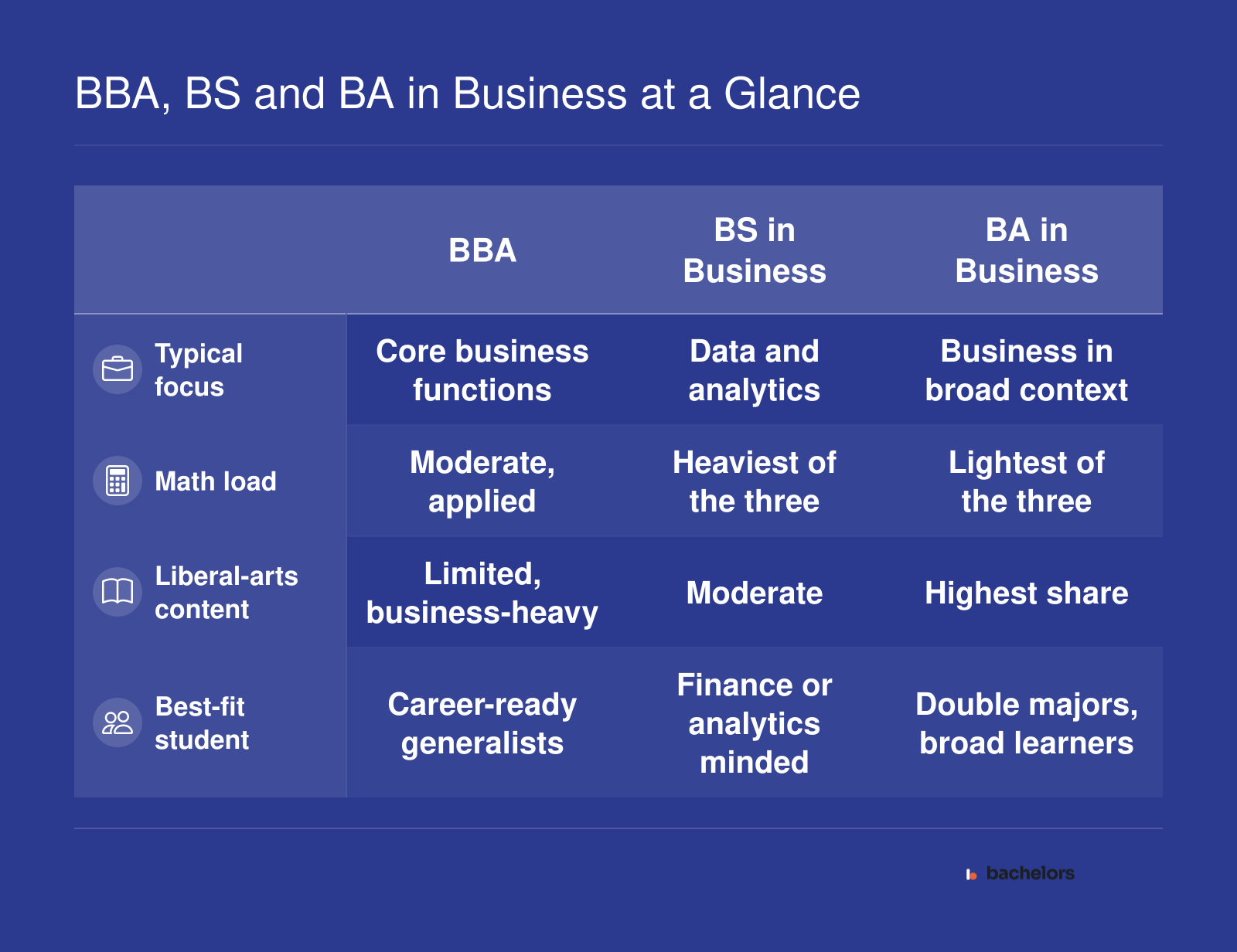
The label matters less than the credit mix. A BBA puts the largest share of credits into a business core (accounting, finance, marketing, management, business law) plus a functional major. A BS usually adds quantitative work such as statistics, analytics, or economics, which suits finance, supply chain, and data-heavy roles. A BA keeps a substantial liberal arts component, making it the easier one to pair with a second major or a language. Any of the three can lead to the same jobs; the real question is how much math and how many free electives you want.
Who Holds AACSB Accreditation Here
AACSB accreditation covers the business programs at the University of St. Thomas, the University of Minnesota-Duluth, Winona State University, Minnesota State University Moorhead, and Minnesota State University-Mankato. Saint Mary's University of Minnesota lists IACBE accreditation for its online business administration bachelor's. The remaining schools carry institutional accreditation, which covers the university overall rather than the business curriculum specifically.
Verify Before You Apply
Open the AACSB accredited-schools directory, search the institution by name, and confirm the business school or program appears. If it does not, ask an admissions counselor which body accredits the program.
BBA, BS and BA in Business at a Glance
Minnesota schools award business bachelor's degrees under different names, and the label usually signals how a program balances business coursework, math and general education. Use this comparison as a general guide, then check each school's curriculum, because requirements vary by institution.
Related Articles
Median Pay for Business and Financial Occupations in Minnesota
Business careers pay well in Minnesota.
Quick Answers on Minnesota Business Bachelor's Programs
These answers cover the questions students ask most when comparing business bachelor's programs in Minnesota. Costs, online formats and transfer rules change, so confirm details with each school before you apply.
What is the best business school in Minnesota?
Which Minnesota business programs offer the lowest net cost after financial aid?
Is it possible to finish a business bachelor's mostly online at a Minnesota-based school?
What is the difference between a BA, BS and BBA in business?
How do I check whether a Minnesota business program holds AACSB accreditation?
Can Minnesota community college credits transfer toward a business bachelor's?
Does Minnesota tuition reciprocity let out-of-state students pay less?
Compare Business programs on the data that matters
Explore more Business & Management majors or browse every field of study.
All Business & Management programs Browse every field of study