Best Accounting Schools in Minnesota
Compare 32 accredited Accounting programs in Minnesota at 28 colleges, with net price after aid, graduation rates, earnings and debt from IPEDS and the U.S. College Scorecard.

Minnesota CPA candidates must reach 150 semester hours before licensure, and a bachelor's degree in accounting typically covers about 120 of them, leaving the final stretch to plan deliberately. Most graduates earn a Bachelor of Science in Accounting, and several Minnesota programs build those remaining credits into the degree plan so students do not lose a year after commencement.
Cost is harder to pin down. Winona State lists in-state tuition and fees of $10,576. Private colleges in the state post rates four to five times higher before any aid is applied.
Key Points
- Saint Mary's University of Minnesota ranks first and runs fully online.
- Winona State University lists in-state tuition and fees of $10,576.
- A bachelor's in accounting alone won't earn a Minnesota CPA license.
Best Bachelor's in Accounting Schools in Minnesota: Our Top 10
Saint Mary's University of Minnesota takes the top spot: its accounting bachelor's runs entirely online, accepts up to 90 transfer credits, and starts six times a year, which makes it the most flexible route here for working adults. The ten programs below were compared using the factors set out in our methodology section, with completion and cost after aid carrying the most weight.
Saint Mary's University of Minnesota
#1Winona, MN · $12,000/yr (est. net price)
Best for: Working adults transferring prior college credit
Saint Mary's runs its accounting bachelor's entirely online through the School of Advancing Studies, with six start dates a year and admission decisions that usually arrive in one to two weeks. Prior credits never expire and up to 90 transfer, including military training and technical college coursework, so adults who already hold an associate degree can finish without starting over. The program is IACBE accredited and coursework in financial accounting, auditing, tax and GAAP points toward the CPA and CMA credentials. Median earnings four years after finishing were about $73,900.
- Fully online, IACBE accredited, 120 total credits
- $440 per credit; $0 application fee
- Six start dates a year with rolling admissions
- Transfer up to 90 credits, including military training
- Prior credits never expire; decision in one to two weeks
- Prepares for CPA and CMA credentials
- Employer tuition reimbursement and partner scholarships supported
University of Minnesota-Duluth
#2Duluth, MN · $15,000 – $20,000/yr (est.)
Best for: Internship-seekers aiming at public accounting firms
UMD awards a Bachelor of Accounting through the Labovitz School of Business and Economics, and its in-house internship office oversees more than 200 placements a year with employers such as 3M, Google, Hormel and Target. Students also staff a Volunteer Income Tax Assistance site, preparing real returns for clients at no cost, and the Accounting Club brings firms to campus for networking. The major prepares students for the CPA exam plus the CMA and CIA credentials, and the career center cites an average starting salary of $63,000 or more. Median earnings four years after completion were about $74,400.
- Bachelor of Accounting in the Labovitz School of Business and Economics
- More than 200 internships a year, including 3M, Google and Target
- Volunteer Income Tax Assistance: students prepare client returns
- Prepares for CPA, CMA and CIA credentials
- Accounting Club and LSBE Company Days networking
- Career center cites average starting salary of $63K or more
Gustavus Adolphus College
#3Saint Peter, MN · $20,000 – $25,000/yr (est.)
Best for: CPA exam-focused students wanting liberal arts
Gustavus offers three routes: a general accounting major, a public accounting track built to the 150-credit CPA standard, and an accounting major with a finance concentration. Classes are small at an 11-to-1 student-faculty ratio and every course is taught by faculty rather than graduate assistants, and recent alumni have landed at Deloitte, Cargill and the Minnesota Department of Revenue. Median earnings four years after finishing were about $95,200, the highest figure among the ten schools on this list.
- 52 credit hours; prepares for the CPA exam
- College reports a #16 national standing for CPA exam success
- Alumni hired at Deloitte, Cargill and the Minnesota Department of Revenue
- Student-faculty ratio of 11:1; all courses taught by faculty
- 150 credit hours, meets Minnesota CPA education requirements
- College places the program in the national top 20 for CPA exam success
- Only Minnesota private liberal arts college in the national top 40
- Paid internships available while enrolled
- 52 credit hours integrating accounting, business and finance
- Designed for private-business and corporate finance careers
- Additional credits required to reach CPA exam eligibility
University of St Thomas
#4Saint Paul, MN · ~$29,000/yr (est.)
St. Thomas delivers accounting as a Bachelor of Science in Business Administration major inside the Opus College of Business, following a structured four-year plan with a faculty advisor assigned to every accounting student. The program meets Minnesota Board of Accountancy education requirements for the CPA exam, and declared majors can apply for departmental scholarships funded by corporations, firms and the Minnesota Society of CPAs, with more than $55,000 awarded. The department reports a $70,000 median starting salary and full employment within six months among surveyed majors, and median earnings four years out were about $91,600.
- Meets Minnesota Board of Accountancy requirements for the CPA exam
- Faculty advisor assigned to every accounting student
- $55,000+ in department scholarships from firms and the MN Society of CPAs
- Accounting Club hosts employers weekly; free one-on-one tutoring
- Reported $70,000 median starting salary; 100% placement within six months
- 40 hours of required community service
Rasmussen University-Minnesota
#5St. Cloud, MN · ~$18,000/yr (est.)
Rasmussen's accounting bachelor's is fully online and built for speed, with a finish possible in about 18 months and a self-paced Empowered Learning option that lets working adults move faster or slower while staying connected to faculty. Coursework trains students in QuickBooks and Excel, covers managerial accounting and financial reporting, prepares them for the CMA exam, and lets associate-degree credits carry forward through credential laddering. An accelerated pathway also lets students take an MBA course inside the bachelor's. Median earnings four years after finishing were about $62,600.
- Fully online; finish in as few as 18 months
- Hands-on training in QuickBooks and Excel
- Self-paced Empowered Learning option for working adults
- Credential laddering carries associate-degree credits forward
- Prepares for the CMA exam; capstone required
- MBA course available through an accelerated pathway
- Employer tuition reimbursement supported
Saint Johns University
#6Collegeville, MN · ~$26,000/yr (est.)
Saint John's shares one accounting department with the College of Saint Benedict and offers two concentrations: Traditional Accounting, which lets students sit for the CPA exam with no extra coursework, and Public Accounting, which adds exam preparatory courses. Minnesota, like every state, requires 150 credit hours for licensure, and many students pursue internships during junior year. Classes run 16 weeks and the department counts 10 faculty. Median earnings four years after completion were about $80,900.
- Two concentrations: Traditional Accounting and Public Accounting
- Public Accounting track includes CPA exam preparatory courses
- 150 credit hours required for CPA licensure in Minnesota
- Traditional track suits double majors and study abroad
- Junior-year accounting internships available
- 16-week classes with 10 faculty in the department
The College of Saint Scholastica
#7Duluth, MN · $28,000/yr (est. net price)
St. Scholastica's accounting major is 76 credits inside a 120-credit bachelor's, with required work in intermediate accounting, accounting information systems, income tax, auditing and advanced accounting. The curriculum supplies 120 of the 150 credit hours Minnesota CPA candidates need, and the department lays out several options for the remaining 22 credits. A 2.0 GPA keeps students in the major, and graduates move into public accounting, healthcare, banking, manufacturing and nonprofit roles. Median earnings four years after completion were about $69,800.
- 76-credit major inside a 120-credit bachelor's degree
- 2.0 GPA required to stay in the major
- Curriculum covers 120 of the 150 credits Minnesota CPAs need
- Remaining 22 credits can be met through several options
- Prepares for CPA or CMA exams
- Degree requires 30 residency and 40 upper-division credits
College of Saint Benedict
#8Saint Joseph, MN · $27,000/yr (est. net price)
The College of Saint Benedict and Saint John's University run a single accounting department, so students here choose between Traditional Accounting, which suits double majors and study abroad, and Public Accounting with CPA exam preparation. Average class size is 18 with 10 faculty in the department, and juniors commonly take internships, many of them paid, that let students test a career path before graduating. A minor in accounting is also available. Median earnings four years after finishing were about $87,200.
- Two concentrations: Traditional Accounting and Public Accounting
- Traditional track allows CPA exam eligibility without extra coursework
- Average class size of 18 with 10 faculty
- Junior-year internships, many of them paid
- Accounting minor also available
- CPA licensure in Minnesota requires 150 credit hours
Bethel University
#9Saint Paul, MN · $29,000/yr (est. net price)
Bethel's accounting emphasis sits inside a B.A. in Business and pairs the accounting core in financial, managerial, tax and auditing work with data analysis, ethical decision-making and a Microsoft Office Specialist certification in Word, PowerPoint and Excel. Every student completes an internship and a capstone, and the program is built to meet Minnesota's CPA credit-hour requirements. Study abroad and student-led business organizations add options, with career coaching built into the degree. Median earnings four years out were about $85,000.
- Accounting emphasis inside the B.A. in Business
- Built to meet Minnesota CPA credit-hour requirements
- Microsoft Office Specialist certification in Word, PowerPoint and Excel
- Internship and capstone project required
- Coursework adds data analysis and ethical decision-making
- $0 application fee
Winona State University
#10Winona, MN · ~$18,000/yr (est.)
Winona State's accounting bachelor's is AACSB accredited and offered on campus or as an asynchronous online degree-completion program for students who already hold college credit. Coursework uses industry software alongside real audits, tax returns and case studies with local companies, and students get paid internships plus a dedicated business career services advisor. Graduates work at firms including Deloitte and KPMG or step into financial analyst, budget analyst and IRS roles. Median earnings four years after finishing were about $72,800.
- AACSB accredited; 120 total credit hours
- Starts in fall, spring or summer
- Hands-on audits and tax returns with local companies
- Paid internships and a dedicated business career services advisor
- Financial Markets Lab and Business Engagement Center
- Prepares for CPA and CMA exams
- Asynchronous online classes for students with prior college credit
- AACSB accredited; 120 total credit hours, fall and spring starts
- Paid internships and post-graduate job placement support
- $22,000+ in scholarships awarded annually
- Not eligible for F-1 visas
Cost & outcomes by school
Federal data for the highest-earning Accounting programs, independent of the ranking above. Earnings are this field's bachelor's graduates four years after completing where the Scorecard reports them, else the school's undergraduate median.
| School | Net price / yr | Grad rate | Earnings | Debt | Grads/yr | Format |
|---|---|---|---|---|---|---|
| Gustavus Adolphus College MN | $22,900 | 77% | $95,200 | $26,500 | 30 | Campus |
| University of St Thomas MN | $29,155 | 76% | $91,587 | $22,750 | 52 | Campus |
| College of Saint Benedict MN | $26,640 | 77% | $87,159 | $26,323 | 15 | Campus |
| Bethel University MN | $28,556 | 71% | $85,036 | $21,500 | 9 | Campus |
| Concordia College at Moorhead MN | $24,902 | 61% | $82,771 | $24,193 | 12 | Campus |
| Saint Johns University MN | $25,672 | 75% | $80,872 | $27,000 | 44 | Campus |
| University of Northwestern-St Paul MN | $27,705 | 68% | $77,128 | $25,038 | 17 | Campus |
| Saint Cloud State University MN | $13,529 | 40% | $76,080 | $23,051 | 32 | Campus |
| St Catherine University MN | $19,764 | 61% | $75,526 | $24,181 | 7 | Hybrid |
| University of Minnesota-Duluth MN | $18,743 | 65% | $74,360 | $25,000 | 35 | Campus |
| Saint Mary's University of Minnesota MN | $11,704 | 66% | $73,887 | $24,332 | 15 | Online |
| Minnesota State University-Mankato MN | $19,139 | 54% | $73,726 | $21,505 | 75 | Campus |
Sources: U.S. Department of Education. Net price, graduation rate, earnings and debt: College Scorecard (earnings and debt for this field's bachelor's graduates where reported, else school-wide); graduates: IPEDS. A dash means no figure is reported.
Cost, debt & payoff
Median earnings of this field's bachelor's graduates (4 yrs after completing, else the school's undergraduate median) vs. their median federal loan debt · U.S. College Scorecard
Across these programs the median graduate earns about $72,613 and finishes with roughly $23,026 in debt — a ratio that clears a common rule of thumb (keep debt below first-year salary). Net price and debt vary widely school to school, so check the per-school figures in the table above before you shortlist.
How We Ranked Minnesota Accounting Schools
The ranking compares bachelor's programs in accounting at Minnesota schools, using internal rankings data drawn from federal College Scorecard and IPEDS figures. Only bachelor's programs based in Minnesota are included, on campus or online.
What the Data Covers
We relied on the factors the federal data supports: cost, student outcomes, completion, and program format. We do not publish a formula or weights, so treat the order as a starting point and compare the schools that interest you on the details that matter most to you.
Two figures carry a caveat. Net price and graduation rate are institution-wide, so they describe the whole school, not the accounting program alone. Accounting students may see different costs or completion rates than the school average.
Business Accreditation
Accreditation is a separate quality check from the federal data. Three bodies accredit business programs, including accounting:
- AACSB: often regarded as the most rigorous business accreditor, reviewing a school's whole business unit.
- ACBSP: focuses on teaching quality and learning outcomes in business education.
- IACBE: emphasizes outcomes assessment and continuous improvement.
Status can change, so confirm each school's current accreditation on its own website before you apply.
Cheapest Minnesota Schools for a Bachelor's Degree in Accounting
The schools below are ordered by average net price, the amount students pay after grants and scholarships, based on 2024 U.S. Department of Education data from IPEDS and the College Scorecard. Saint Mary's University of Minnesota, one of the schools ranked here, shows how aid changes the picture: its $45,080 sticker price drops to an average net price of $11,704, the lowest in this table. The University of Minnesota-Crookston, Saint Cloud State University, Bemidji State University and Southwest Minnesota State University, all public schools in our directory, pair in-state tuition near $10,200 to $13,300 with net prices between $12,212 and $15,291.
| School | City | Format | In-State Tuition and Fees | Average Net Price | Graduation Rate | Median Earnings 1 Year After Graduation (Accounting) |
|---|---|---|---|---|---|---|
| Saint Mary's University of Minnesota | Winona | Online | $45,080 | $11,704 | 66% | $54,833 |
| University of Minnesota-Crookston | Crookston | Hybrid | $13,288 | $12,212 | 50% | $56,627 |
| Saint Cloud State University | Saint Cloud | Campus | $10,245 | $13,529 | 40% | $58,497 |
| Bemidji State University | Bemidji | Campus | $10,237 | $15,261 | 48% | $58,446 |
| Southwest Minnesota State University | Marshall | Online | $10,361 | $15,291 | 45% | N/A |
Cost of a Bachelor's Degree in Accounting in Minnesota
How much does a bachelor's degree in accounting cost in Minnesota once financial aid is counted? It depends heavily on the sector.
Public vs. Private Costs
Winona State University lists in-state tuition and fees of $10,576, and two other schools in our directory sit in the same range: Metropolitan State University at $9,840 and Saint Cloud State University at $10,245. Saint Mary's University of Minnesota, a private school, lists $45,080. Net price narrows that gap: the average is $17,503 at Winona State and $11,704 at Saint Mary's. Rasmussen University-Minnesota, also private, averages $17,962. Net price is an average across students, not a quote, so your own aid offer is what counts.
State Aid: State Grant and North Star Promise
The Minnesota State Grant is need-based.1 You must be a Minnesota resident enrolled in at least 3 credits at an eligible school.1 For 2026-27 the four-year cap is $18,071, with a $100 yearly minimum.2 The latest average figures are from 2023-24: $3,406 overall.1 Grants cover up to 8 full-time semesters, and the aid application is due by the 30th day of the term.1
North Star Promise is a last-dollar award at Minnesota public and Tribal colleges.4 It covers remaining tuition and fees (not housing, books, or food) after other gift aid. Eligibility requires:
- Income: Family AGI under $80,000.3
- Residency: Minnesota resident.
- Degree history: No prior bachelor's degree.
- Enrollment: At least 1 credit, with coverage up to 8 full-time semesters at a four-year school.
The 2026-27 filing date was June 1, 2026.3 The NSP Plus match is currently 0%.5
Tuition Reciprocity
The arrangement lets Wisconsin and North Dakota residents attend Minnesota public institutions, and Minnesota residents attend public schools in those states in return. Manitoba has a similar arrangement. No FAFSA is required, but you apply to the college first, and the program lists a December 31 deadline.6 South Dakota's agreement ended after 2023-24.6
A Practical Way to Cut Costs
File the FAFSA (or the Minnesota Alternative Application) early, since state grants depend on it. An in-state public school such as Winona State also keeps the sticker price low.
Online and Hybrid Bachelor's in Accounting Options at Minnesota Schools
A flexible format does not reliably bring a lower bill, and Minnesota's online accounting programs show it. Format matters less to your bill than whether a school is public or private.
Fully Online, Hybrid, and Campus-Only
Saint Mary's University of Minnesota (Bachelor of Science in Accounting) and Rasmussen University-Minnesota (Accounting Bachelor of Science) are the fully online programs among the top-ranked schools. Saint Mary's lists six start dates a year, $440 per credit, and up to 90 transfer credits. Rasmussen advertises an 18-month program with a self-paced option. Our data labels no program here as hybrid, so ask any school directly about blended scheduling. University of Minnesota-Duluth, Gustavus Adolphus College, University of St Thomas, Saint Johns University, The College of Saint Scholastica, College of Saint Benedict, Bethel University, and Winona State University are campus-based.
How Format Relates to Cost
Saint Mary's has the lowest average net price of the schools ranked here, at $11,704. Rasmussen averages $17,962, close to Winona State at $17,503 and University of Minnesota-Duluth at $18,743. Campus-based private schools run higher: $22,900 at Gustavus and $29,155 at St Thomas. Online is not automatically cheaper, but it can match public campus costs without relocation.
CPA Coursework Check
Before enrolling, confirm in writing that the online program's coursework is accepted for CPA purposes. Our licensure section covers the Minnesota Board's rules.
Who Each Format Fits
- Online: Working adults and transfer students who need rolling starts and credit for prior coursework.
- Campus: Traditional students who want internships, accounting clubs, and employer events nearby.
- Hybrid: Ask schools whether it exists if you want occasional in-person time.
Related Articles
Minnesota CPA Licensure: Does a Bachelor's Degree in Accounting Meet the Requirements?
The Minnesota Board of Accountancy issues the CPA license, the state credential that lets an accountant sign audits and represent clients.1 A bachelor's degree in accounting does not qualify you for that license on its own.2 The degree is only the starting point; the Board expects coursework and work experience on top of it.
The 150-Hour Rule and Course Requirements
Minnesota statutes call for at least 150 semester hours (or 225 quarter hours) from an accredited institution.3 Most bachelor's degrees run about 120 credits, so students close the gap with extra courses, a fifth year, or a graduate program. The Board's standard education route also requires 24 semester hours of accounting, including financial accounting, auditing, taxation, and management accounting.4 Under Rule 1105.1500, the alternative route asks for 24 hours of intermediate and advanced accounting, meaning courses beyond the introductory level. The route tied to an AACSB- or ACBSP-accredited bachelor's adds 24 semester hours of business-related or accounting courses.
Pathways and Experience
The Board's 2026 update describes two pathways: a bachelor's degree plus 2 years of qualifying experience, or a master's degree plus 1 year. The older route of a bachelor's plus 150 semester hours and 1 year of experience continues transitionally and is scheduled to sunset on June 30, 2030. Minnesota's experience guidance describes 2,000 hours for the 1-year pathway, and the experience must span at least 1 year and no more than 3 years.5 The excerpts reviewed do not spell out every rule on employers, supervisors, or documentation, so check Minnesota Rules 1105.2900 and the Board's current application instructions before you plan.
CMA and CIA as Alternatives
Two other credentials skip the state license. The Certified Management Accountant (CMA) suits people headed for corporate finance, budgeting, and internal reporting. The Certified Internal Auditor (CIA) fits those drawn to internal audit and risk work. Neither lets you sign public audit opinions, so choose the CPA if public accounting is the goal.
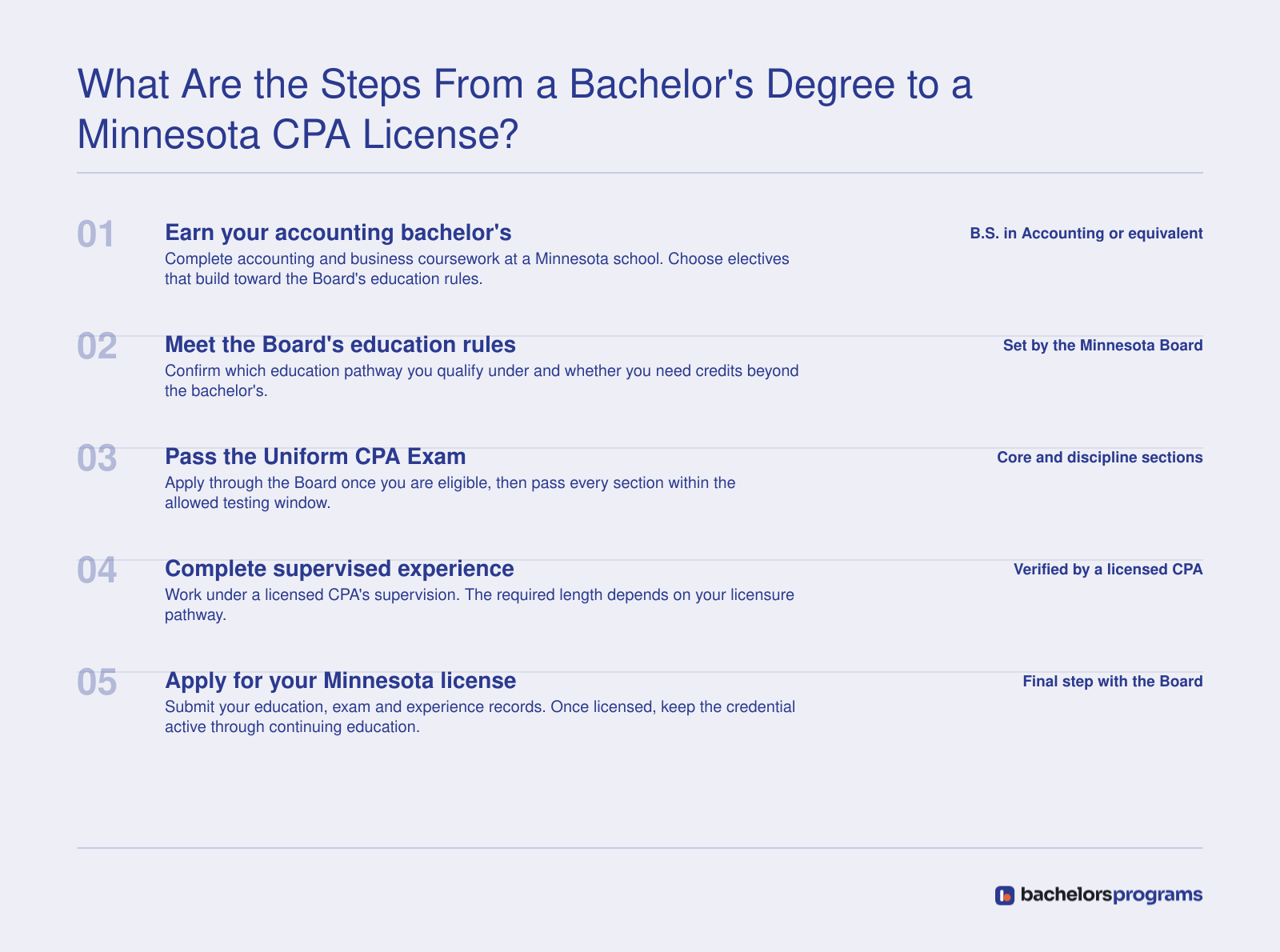
What Are the Steps From a Bachelor's Degree to a Minnesota CPA License?
A bachelor's degree in accounting is the starting point, not the finish line. Use this sequence with the requirements in the licensure section above, and confirm current rules with the Minnesota State Board of Accountancy before you plan your coursework.
CPA Exam Pass Rates for Minnesota Accounting Programs
A CPA Exam pass rate is the share of exam sections candidates pass. For a college, it signals how well its accounting graduates handle the licensing test. Program-level figures are not posted for every Minnesota school, so the most reliable approach is to track them down yourself.
Where to Find the Numbers
NASBA's 2025 Edition, covering all four 2025 testing quarters, reports university-level results alongside jurisdiction totals1. Its School Performance Book is narrower: it counts first-time sections taken within 365 days of graduation, grouped by the state where the school is located. For statewide context, the Minnesota Society of CPAs breaks down Minnesota pass rates by section and quarter. In the first quarter of 2026, Minnesota candidates passed AUD at 56.7%, FAR at 50.3% and REG at 66.6%, compared with national 2026 rates of 50%, 44% and 66%2. Those are statewide figures, not college results.
Your Source Checklist
- NASBA reports: Search the university statistics for each Minnesota school you are considering.
- Minnesota Society of CPAs and AICPA: Use them for exam structure, section content and study resources.
- BLS Occupational Outlook Handbook: Review the accountant and auditor profile for career outlook and pay.
- School accounting pages: Look for outcome disclosures, CPA results or graduate reports.
- Admissions or department contacts: Ask directly when nothing is posted.
What to Ask Programs
Contact each accounting department and request its first-time CPA Exam pass rate plus the number of candidates behind it. A high rate from a handful of test takers means less than a steady rate across a larger group, so ask for both figures and the years they cover.
Accounting Careers and Salaries in Minnesota
What an accounting degree earns in Minnesota depends as much on where you work as on what you studied, and the difference appears early in a career, not only at the top.
Statewide Pay and Employment
In the first quarter of 2026, Minnesota employed 30,530 accountants and auditors, according to state wage data.1 The median wage was $39.89 an hour, which works out to roughly $83,000 a year on a full-time, year-round schedule. Pay spreads widely at both ends: the lowest 10% earned $28.49 an hour and the top 10% $67.93, with a mean of $45.98.1
Twin Cities vs. Statewide
The Minneapolis-St. Paul metro accounts for 21,820 of those jobs, and it pays a premium. The metro median was $42.29 an hour, about $2.40 above the statewide figure, and the seven-county definition comes in at $42.50.2 Average pay across all metro occupations was $35.86 an hour as of May 2025, well below what accountants typically earn there.3
Entry-Level Roles and Outlook
New bachelor's graduates usually enter as staff accountants, auditors, or tax associates, with public accounting firms hiring the largest share straight out of school. State projections point to steady demand rather than a boom. Minnesota publishes ten-year occupational projections refreshed every other year, along with a shorter 2025-2027 outlook, so the forecast is updated regularly.4
One distinction matters when you compare numbers on this page: the figures above are occupational wages for everyone working in the job across Minnesota, while the graduate earnings reported for individual schools track alumni of specific programs. They answer different questions, and neither one predicts your own starting offer.
Compare Accounting programs on the data that matters
Explore more Business & Management majors or browse every field of study.
All Business & Management programs Browse every field of study