Best Accounting Schools in Wisconsin
Compare 33 accredited Accounting programs in Wisconsin at 30 colleges, with net price after aid, graduation rates, earnings and debt from IPEDS and the U.S. College Scorecard.

A bachelor's degree in accounting, most often a Bachelor of Science (B.S.) in Accounting, is the entry credential for Wisconsin's public and private accounting careers, yet it falls short of CPA licensure on its own. The CPA path requires 150 semester credits, so students weigh programs by how they close that 30-credit gap, not only by tuition.
The schools ranked here are Wisconsin-based and offer campus and online bachelor's options. Shortlists of the cheapest and highest-earning programs sit alongside the main ranking.
The real difference between programs often shows up after graduation, in first-job placement and the time it takes to reach 150 credits.
Key Points
- University of Wisconsin-Madison ranks first, offering a 4+1 path to CPA eligibility.
- Public Universities of Wisconsin campuses post the lowest average net prices here.
- Wisconsin CPA licenses come through the state Accounting Examining Board.
Best Accounting Schools in Wisconsin: Our Top 10 Ranked
The University of Wisconsin-Madison takes the top spot for accounting in Wisconsin, pairing a flagship business school with a 4+1 pathway that carries students straight through to CPA eligibility. The ten bachelor's programs below follow in ranked order, each with a note on what it does best and which students tend to thrive there. Every one of them awards a bachelor's degree in accounting, and several build in accelerated routes to the extra credits CPA licensure requires.
University of Wisconsin-Madison
#1Madison, WI · ~$17,000/yr (est.)
Best for: High achievers wanting a research flagship
Wisconsin's flagship public university pairs a large research campus with a Big Ten business school in Madison. Accounting students start with a broad business core and finish with a capstone, and the school runs an integrated 4+1 pathway that lets them add a master's in accounting on the way to CPA eligibility. Advising is assigned from day one, and organizations such as Beta Alpha Psi add networking and leadership.
- Four-year BBA carrying 120 total credit hours
- 3.0 GPA minimum with prerequisite courses required
- Capstone required; coursework in tax, audit and advisory services
- Integrated 4+1 MSABA pathway toward CPA exam eligibility
- Assigned academic advisor and career coach
- Beta Alpha Psi chapter for networking and leadership
- Emphasis on emerging technologies and global business
University of Wisconsin-La Crosse
#2La Crosse, WI · $15,000 – $20,000/yr (est.)
Best for: Hands-on learners seeking paid internships
A mid-size public campus in western Wisconsin known for the practicality of its business programs. Accountancy majors here are the most heavily recruited on campus for internships, which the school describes as among the best paid open to undergraduates. Students can finish at 120 credits or continue to 150, and the program maps requirements for licensure in both Wisconsin and Minnesota.
- Complete in four to five years; 120 total credit hours
- 2.5 GPA minimum; capstone in applied business strategy
- Most active internship program at UWL, with paid placements
- Choose a 120- or 150-credit path for Wisconsin or Minnesota
- Scholarships available; close work with alumni and firms
- Coursework spans taxation, auditing, cost accounting and business law
Marquette University
#3Milwaukee, WI · ~$31,000/yr (est.)
Best for: Milwaukee-bound students wanting firm connections
A private Jesuit university in downtown Milwaukee whose business school draws recruiters from national and regional firms. Accounting majors take semester-long internships, some placed in Chicago, Boston, Los Angeles or New York, and can roll the degree into a master's that satisfies the 150-hour requirement. Alumni go on to senior finance roles at large corporations.
- Semester-long internships with national and local firms
- Placements in Milwaukee, Chicago, Boston, Los Angeles and New York
- Combined bachelor's and master's option meets 150-hour CPA rules
- Coursework builds an ethical decision-making framework
- Located minutes from downtown Milwaukee accounting firms
- Builds analytical, communication and client advisory skills
University of Wisconsin-Eau Claire
#4Eau Claire, WI · ~$17,000/yr (est.)
A public regional campus whose business college treats internships as part of the curriculum rather than an extra. Accounting is a comprehensive major, and more than 90% of graduates complete paid internships, often with Big Four firms that extend full-time offers. Double majors in finance or information systems and study abroad options fit into a four-year advising plan.
- 120-credit BBA with a capstone in strategic management
- Over 90% of graduates complete paid internships
- Many interns land full-time offers, including with Big Four firms
- 2.0 GPA minimum; prerequisite courses required
- Prepares for CPA, CMA and CIA credentials
- Study abroad in Australia, Ireland, New Zealand and South Korea
- Double majors available in finance or information systems
- Coursework emphasizes GAAP, data analytics and internal controls
Maranatha Baptist University
#5Watertown, WI · ~$26,000/yr (est.)
A small private Christian university in Watertown, between Madison and Milwaukee, where accounting sits inside a business administration degree. Faculty hold CPA and CGMA credentials, and the curriculum pairs standard financial reporting and tax coursework with ethical and biblical framing. A longer CPA-track option serves students who want licensure as the goal from the start.
- Capstone plus an entrepreneurship project
- Coursework in auditing, federal taxation, business law and finance
- Faculty credentials include CPA and CGMA designations
- Integrates Christian character and biblical principles
- Prepares students to build and analyze financial reports
Carroll University
#6Waukesha, WI · $15,000 – $20,000/yr (est.)
A private university in Waukesha, in the Milwaukee suburbs, with accounting housed in its Sullivan School of Business. A required internship places students with firms such as Baker Tilly, Baird, Grant Thornton and Wipfli, and night classes serve working adults. An accounting and MBA path lets students finish both degrees in four years.
- Required internship with area CPA firms
- Recent placements include Baker Tilly, Baird, Grant Thornton and Wipfli
- Night classes for working students; most finish within two years
- Accounting and MBA path completable in four years
- Coursework in business law, taxes and auditing
- Pairs with minors in finance, actuarial science, IT or Spanish
- Accounting minor also available
University of Wisconsin-River Falls
#7River Falls, WI · $10,000 – $15,000/yr (est.)
A public campus near the Minnesota border, within reach of the Twin Cities corporate corridor. Accounting majors take auditing, tax and accounting systems coursework plus a paid internship, and the school reports that 99% of graduates are employed or in graduate school. Sixteen Fortune 500 employers sit close to campus.
- Meets CPA exam requirements; also prepares for CMA
- Paid accounting internship built into the major
- Coursework in auditing, federal income tax and accounting systems
- 16 Fortune 500 companies located near campus
- Reports 99% of graduates employed or in graduate school
- 18:1 student-to-faculty ratio
Milwaukee School of Engineering
#8Milwaukee, WI · ~$22,000/yr (est.)
A private engineering and business university in downtown Milwaukee with a technology-first approach. The accounting curriculum folds data analytics and artificial intelligence applications in alongside tax and audit, and the business school holds ACBSP accreditation. A one-year master's in analytics follows the bachelor's and covers the coursework CPA eligibility requires.
- Four-year Bachelor of Science in accounting
- Business programs accredited by ACBSP
- Coursework in tax, auditing, accounting research and data analytics
- Data analytics and AI applications built into the curriculum
- One-year master's in analytics meets CPA course requirements
- Work-ready technical and analytic focus
University of Wisconsin-Platteville
#9Platteville, WI · $9,000 – $18,000/yr (est.)
A public campus in southwest Wisconsin whose business college requires an internship of every major. Accounting students work through the full intermediate, tax, cost and auditing sequence and choose upper-division electives, with faculty helping plan a 150-credit licensure route. Up to six graduate credits can be earned while still an undergraduate.
- Approved business internship required of every major
- 2.50 GPA required in required major courses
- Coursework from Intermediate Accounting through Auditing and Federal Income Tax
- Six upper-division accounting elective credits required
- Prepares for CPA, CMA, CFE, CIA and EA credentials
- Up to six graduate credits can count toward the bachelor's
- Accelerated bachelor's-to-master's option available
- Faculty help plan the CPA licensure path
Viterbo University
#10La Crosse, WI · ~$21,000/yr (est.)
A private university in La Crosse that runs its accounting offerings online, including a completion track for students who already hold an associate degree. The BBA includes a guaranteed paid internship and a finance simulation lab, plus embedded certificates in servant leadership and wealth management. Eight-week terms let students move through quickly.
- Guaranteed paid internship, often leading to a job offer before graduation
- Gelatt Finance Simulation Lab for hands-on practice
- Embedded certificates in Servant Leadership and Wealth Management
- Coursework in auditing, federal taxation and financial reporting
- Faculty with real-world accounting experience
- Fully online eight-week terms
- Builds on an associate degree in accounting
- Generally completed in about two years
- Full-time and part-time options available
- Tutoring and academic advisors provided
Cost & outcomes by school
Federal data for the highest-earning Accounting programs, independent of the ranking above. Earnings are this field's bachelor's graduates four years after completing where the Scorecard reports them, else the school's undergraduate median.
| School | Net price / yr | Grad rate | Earnings | Debt | Grads/yr | Format |
|---|---|---|---|---|---|---|
| University of Wisconsin-Madison WI | $17,354 | 90% | $101,390 | $20,277 | 116 | Campus |
| Marquette University WI | $31,487 | 83% | $99,086 | $25,000 | 79 | Campus |
| Milwaukee School of Engineering WI | $22,453 | 67% | $89,070 | $27,000 | 1 | Campus |
| Carroll University WI | $15,193 | 71% | $87,085 | $25,434 | 11 | Campus |
| Carthage College WI | $26,565 | 64% | $86,561 | $22,250 | 18 | Campus |
| University of Wisconsin-Eau Claire WI | $16,550 | 64% | $83,018 | $22,437 | 63 | Campus |
| University of Wisconsin-Oshkosh WI | $14,305 | 46% | $79,217 | $18,645 | 29 | Campus |
| University of Wisconsin-La Crosse WI | $16,210 | 71% | $78,296 | $20,518 | 75 | Campus |
| University of Wisconsin-Milwaukee WI | $15,014 | 49% | $78,127 | $23,000 | 87 | Campus |
| University of Wisconsin-Green Bay WI | $13,369 | 48% | $77,802 | $23,288 | 50 | Campus |
| Saint Norbert College WI | $26,172 | 71% | $76,669 | $27,000 | 27 | Campus |
| University of Wisconsin-River Falls WI | $14,054 | 57% | $73,583 | $15,200 | 18 | Campus |
Sources: U.S. Department of Education. Net price, graduation rate, earnings and debt: College Scorecard (earnings and debt for this field's bachelor's graduates where reported, else school-wide); graduates: IPEDS. A dash means no figure is reported.
Cost, debt & payoff
Median earnings of this field's bachelor's graduates (4 yrs after completing, else the school's undergraduate median) vs. their median federal loan debt · U.S. College Scorecard
Across these programs the median graduate earns about $64,810 and finishes with roughly $22,500 in debt — a ratio that clears a common rule of thumb (keep debt below first-year salary). Net price and debt vary widely school to school, so check the per-school figures in the table above before you shortlist.
How We Ranked Wisconsin Bachelor's Degree in Accounting Programs
How do you tell a genuinely strong Wisconsin accounting program from one with a good marketing page?
The comparison here rests on published federal data rather than slogans. Most figures come from the U.S. Department of Education's College Scorecard and IPEDS.
What goes into the comparison
- Net price: average yearly cost after grants and scholarships, not sticker tuition.
- Graduation rate: the share of first-time, full-time students who finish their degree.
- Outcomes: reported earnings for graduates a few years into the workforce.
- Format: whether the accounting bachelor's runs on campus, online, or both.
Each program is checked against its own catalog page so the degree type and delivery format are accurate.
Two limits worth knowing
Neither measure is specific to the accounting department; both describe the whole institution. Net price is also an average across students in a sector, never a personal quote, so your aid package, income and housing choices will move the real figure. Where a federal figure is not reported, it is left out rather than estimated.
Why not the "top-ranked" banners
Many school pages claim to be "best" or "top-ranked" without naming who decided or how. The schools ranked here are measured on federal numbers you can verify yourself.
Who is covered
Bachelor's programs only, on campus and online, at schools based in Wisconsin. Graduate programs and institutions based elsewhere are outside the scope.
AACSB-Accredited Accounting Programs in Wisconsin
Two Wisconsin programs can both advertise AACSB accreditation and still hold very different seals. Which seal a school carries tells you how closely its accounting department itself has been reviewed.
The Two AACSB Seals
AACSB business accreditation covers the college as a whole. Accounting accreditation is supplemental: a school must hold or pursue the business seal first, then clear six additional standards aimed specifically at accounting faculty, curriculum and student outcomes. In Wisconsin, UW-Madison, UW-Milwaukee and Marquette hold both. UW-La Crosse (accredited since 1982), UW-Eau Claire and UW-Oshkosh hold business accreditation only, with no separate accounting seal identified in the AACSB directory.
ACBSP Is a Different Body
The Accreditation Council for Business Schools and Programs is a separate accreditor with its own standards and a teaching-centered approach. Milwaukee School of Engineering's accounting bachelor's lists ACBSP accreditation. That is a different claim rather than a lesser one, and employers who ask about accreditation generally recognize either.
Unconfirmed in Our Review
We could not confirm AACSB status for Maranatha Baptist, Carroll, UW-River Falls, UW-Platteville or Viterbo in the directory listings reviewed here, so we make no claim either way.
What It Signals to Employers
Accreditation is a quality floor, not a ranking. Large firms often screen for it, some employers prefer it for tuition support, and it keeps options open later, since many graduate business programs expect an accredited undergraduate business school behind your application.
Most Affordable Bachelor's in Accounting Programs in Wisconsin
These five public Universities of Wisconsin campuses post the lowest average net price for an accounting bachelor's in our data. Net price is a federal average of what students paid per year after grants and scholarships, and it includes living costs, so it runs higher than tuition and your own figure will vary with aid. Private schools carry far higher sticker prices (Marquette University's 2026-27 tuition is $53,890 before fees), but institutional aid can narrow that gap, so compare net price rather than tuition alone.
| School | City | Format | In-State Tuition and Fees (per year) | Average Net Price After Aid (per year) | Median Debt at Completion (accounting program) |
|---|---|---|---|---|---|
| University of Wisconsin-Parkside | Kenosha | Online | $8,270 | $11,772 | $14,915 |
| University of Wisconsin-Superior | Superior | Campus | $8,812 | $12,220 | Not reported |
| University of Wisconsin-Green Bay | Green Bay | Campus | $8,700 | $13,369 | $23,288 |
| University of Wisconsin-River Falls | River Falls | Campus | $9,008 | $14,054 | $15,200 |
| University of Wisconsin-Oshkosh | Oshkosh | Campus | $8,532 | $14,305 | $18,645 |
Related Articles
Questions to Ask Yourself
Do you need to keep working while you study, and do the program's start dates fit your schedule?
How many credits from a Wisconsin technical college could you transfer, and does the school cap them?
Will you pursue the 150-credit CPA path, and does the course plan support extra credits?
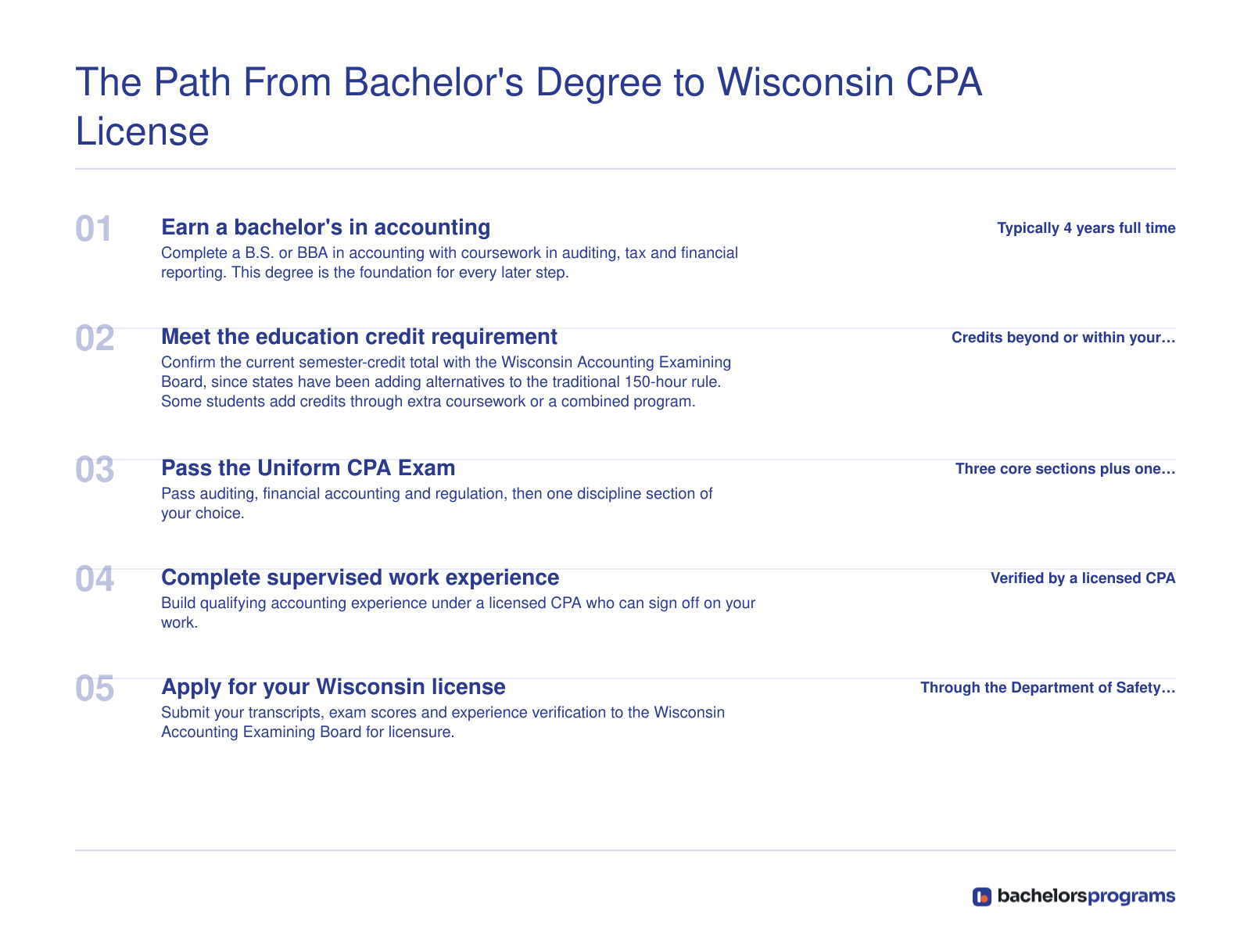
The Path From Bachelor's Degree to Wisconsin CPA License
A bachelor's degree in accounting is the first step toward a CPA license, not the last. In Wisconsin the license comes through the Accounting Examining Board, and each stage builds on the one before it.
Accounting Careers and Pay in Wisconsin: Milwaukee, Madison and Green Bay
The salary quoted for Wisconsin accountants is not the salary you will start on, and where you take your first job can matter as much as which degree you finish.
Statewide and Milwaukee Pay
Federal wage estimates put the median annual pay for Wisconsin accountants and auditors at $82,630 as of May 2023, or $39.73 an hour, across roughly 26,530 jobs in the state.1 In the Milwaukee metro area, the median was $80,780 ($38.84 an hour) across about 8,040 jobs, based on the May 2022 estimates.2 The estimates reviewed included no comparable Madison or Green Bay figures, so the statewide number is the better anchor for those markets. A median is a midpoint: half of accountants earn more, half less, and new graduates typically land below it.
Job Outlook
Nationally, the occupation is projected to grow about 5% between 2025 and 2035, with roughly 115,300 openings a year4 across about 1.6 million jobs.3 Most of those openings come from retirements and turnover rather than rapid expansion, which means steady rather than boom-time hiring in Wisconsin's metro areas.
What This Means for Your Decision
- Keep the two measures apart: The earnings figures shown earlier reflect what graduates of specific programs reported earning. The numbers above describe everyone working in the occupation, including CPAs with twenty years of experience.
- Compare cost against metro: Milwaukee's median sits close to the statewide figure, so a lower-cost program feeding into the Milwaukee market can beat a pricier degree aimed at the same jobs.
- Think about the license: The top of the pay range usually follows CPA licensure, so confirm a bachelor's degree in accounting covers Wisconsin's credit requirements before you enroll.
Ask programs for first-year placement rates and starting salary ranges by city. Those tell you more about your first five years than any statewide median.
Wisconsin Accounting Degree FAQs
These answers cover the questions Wisconsin students ask most about timelines, online study, CPA credit requirements and transfer. Details vary by school, so confirm specifics with each admissions office.
How long does it take to get an accounting degree in Wisconsin?
Can you get a bachelor's degree in accounting online in Wisconsin?
How many credits do you need to become a CPA in Wisconsin?
Do Wisconsin technical college credits transfer toward a bachelor's degree in accounting?
Compare Accounting programs on the data that matters
Explore more Business & Management majors or browse every field of study.
All Business & Management programs Browse every field of study