Best Communications Degree Programs in California
Compare 71 accredited Communications programs in California at 47 colleges, with net price after aid, graduation rates, earnings and debt from IPEDS and the U.S. College Scorecard.

A California State University communication studies department and a UCLA or Stanford major lead to the same bachelor's degree in communications, yet UCLA admits about 9% of applicants and Stanford about 4%. Whatever the campus, the credential is the Bachelor of Arts (B.A.) in Communications.
Every program ranked here is a bachelor's program at a California school, offered on campus or online. They compare cost, net price and graduate earnings alongside admissions rules and accreditation. San Jose State and Cal State Bakersfield offer online degree-completion paths.
No state license applies. Public relations, marketing and media employers weigh portfolios and internships instead, so access to Los Angeles and Bay Area employers can shape early opportunities.
Key Points
- UCLA admits about 9% of applicants, while Stanford admits about 4%.
- San Jose State and CSU Bakersfield offer fully online degree-completion paths.
- California communications careers in PR, marketing and media require no state license.
Best Communications Degree Schools in California: Our Ranked List
The ten programs below are the strongest places in California to earn a bachelor's degree in communications, ranging from large public communication studies departments to small, research-intensive majors. Each entry covers every program a school actually enrolls students in, so you can compare concentrations, transfer pathways, and delivery formats side by side.
University of California-Los Angeles
#1Los Angeles, CA · $13,000/yr (est. net price)
Best for: Pre-law and media strategy students
UCLA's communication department sits inside a large public research university in Los Angeles, and its bachelor's program draws students who want communication theory backed by serious analytical and legal framing. Coursework runs through mass communication, interpersonal dynamics, communication technology, and political and legal communication, capped by a required practicum. Enrollment in the major is limited and application-based, so students typically declare after finishing prerequisites.
- At least 45 units, including lower-division prerequisites
- Four core areas: mass, interpersonal, technology, political and legal
- Required practicum course adds hands-on experience
- Selective major with limited enrollment by application
- AP credit accepted for certain prerequisites
- Seven lower-division courses required before upper-division work
- Transfer students follow specified pathway requirements
Stanford University
#2Stanford, CA · $10,000 – $15,000/yr (est.)
Best for: Quantitative social-science media researchers
Stanford's Department of Communication treats the field as a social science, asking how media technologies and journalism shape political life and the human psyche. The major moves from a core curriculum through intermediate and advanced courses, with optional internships and advanced research projects along the way. It is a small program inside the School of Humanities and Sciences, and it suits students who want research training as much as professional preparation.
- Core, intermediate, and advanced coursework sequence
- Optional internships available
- Advanced research projects offered
- Honors program available
- Housed in the School of Humanities and Sciences
- Prepares students for graduate and professional school
- Quantitative and qualitative methods training
California State University-Fullerton
#3Fullerton, CA · $7,000 – $20,000/yr (est.)
Best for: PR and advertising portfolio builders
Cal State Fullerton runs one of the largest communications programs in the state, built on 120 units and four concentration options inside a single major. The department pairs a mass communication core with an internship requirement and a capstone, and its Orange County location puts students within reach of media outlets and agencies across Orange and Los Angeles counties. Community college students often arrive through the CSU's Associate Degree for Transfer in Communication Studies.
- Public relations concentration, 120 total units
- Four concentration options inside the major
- Required internship plus a capstone
- Capstone option: run campaigns in the student-run agency
- Coursework in crisis communications and entertainment PR
- Emphasis on ethics, strategic messaging, and research methods
- Blends creative strategy with market research
- Capstone: Advertising Campaigns or the AAF competition
- Internship required in the field
- 72 units must be completed outside Communications
- Prepares students for account executive and brand manager roles
- Upper-division writing requirement
- Hands-on multimedia skills training
- Required internship course
- Capstone required to finish the concentration
- Prepares students for anchor, journalist, and producer roles
- Emphasis on ethical practice and a global media perspective
California Polytechnic State University-San Luis Obispo
#4San Luis Obispo, CA · ~$17,000/yr (est.)
Cal Poly's communication studies department teaches the field as a practical liberal art, with five focus areas running from media and technology to politics and civic engagement. The Learn by Doing ethos shows up in internships, a competitive debate program, and a senior project capstone. Undergraduates can also seek funded research support through the department's Media and Communication Research Initiative, which recruited a 2026-27 cohort.
- Five focus areas, including media and technology and social influence
- 120 units with a senior project capstone
- Learn by Doing projects and broad internship opportunities
- Competitive debate program on campus
- Prepares students for business, advertising, public relations, law
- Interdisciplinary curriculum across rhetoric and media
San Diego State University
#5San Diego, CA · $15,000/yr (est. net price)
San Diego State offers communications in several shapes: an on-campus B.A. with general and health communication majors, plus a fully online degree completion program in communication. The health communication major is a distinctive option for students aiming at healthcare, public health, and patient-facing roles. The online route is built for transfer students who already hold at least 60 units and want to finish without coming to campus.
- 100% online, taught by the same SDSU faculty
- Designed for students with at least 60 transferable units
- Two-year completion program at $519 per credit
- Capstone project required
- Public Administration minor available
- Minimum 2.8 GPA for admission
- Transfer credits accepted; no on-campus attendance required
- On-campus B.A. with 36 upper-division units
- Minimum 2.75 GPA required
- Foundations courses serve as prerequisites
- Two strands: conceptualizing and investigating communication
- Capstone project required
- Impacted major; preparation courses needed
- Bachelor of Science, described as the first program of its kind in California
- 120 units to graduate, 42 of them upper division
- Focus on doctor-patient communication and health campaigns
- Minimum 2.75 GPA with a C or better in preparation courses
- Minor recommended but not required
- Communication capstone course required
California State University-Long Beach
#6Long Beach, CA · $7,000 – $20,000/yr (est.)
Cal State Long Beach's communication studies department is built around rhetoric, public address, and the study of communication inside organizations and across cultures. Students take a 27-unit core and then shape 21 units of electives toward interests such as media effects, conflict resolution, or gender and communication. It is a campus program in a large public university, and it suits students who want strong speaking and writing skills with flexible career applications.
- 120 units: a 27-unit core plus 21 units of electives
- Emphasis on rhetorical theory and criticism
- Coursework in interpersonal, intercultural, and organizational communication
- Public speaking and argumentation skills
- Electives include media effects and conflict resolution
- Prepares students for business, media, HR, and public relations
San Jose State University
#7San Jose, CA · ~$14,000/yr (est.)
San Jose State's communication studies program sits in the middle of Silicon Valley, and its curriculum is organized into foundations, inquiry, and practice rather than a single track. Students complete at least 42 units, take 4-unit upper-division courses, and finish with a senior seminar that ties theory to application. The department strongly encourages a minor, which pairs well with technology, business, or public health coursework.
- At least 42 units in the major
- Foundations, Inquiry, and Practice curriculum
- Senior Seminar: Synthesis and Application
- Up to 8 transfer units accepted toward the major
- Students strongly encouraged to complete a minor
- 4-unit upper-division courses for scheduling flexibility
- Credit/No Credit limit of 6 units
California State Polytechnic University-Pomona
#8Pomona, CA · $10,000 – $15,000/yr (est.)
Cal Poly Pomona awards a Bachelor of Science in Communication, a degree that leans more applied and research-based than a traditional B.A. Three concentrations let students choose among communication studies, multimedia journalism, and public relations, all with hands-on projects. The department also awards the Frank A. Tennant Endowed Scholarship, about $7,780 a year, to students active in communication clubs and media.
- Bachelor of Science with a Communication Studies concentration
- Research projects and communication simulations
- Coursework in interpersonal, organizational, and intercultural communication
- Frank A. Tennant Endowed Scholarship worth $7,780 annually
- Prepares students for social media, PR, and training manager roles
- Digital storytelling and reporting coursework
- Video production and multimedia training
- Builds a digital portfolio for multiple platforms
- Hands-on internship opportunities
- Blends theory and practice
California State University-Northridge
#9Northridge, CA · ~$7,000/yr (est.)
CSUN's communication studies department blends humanistic, aesthetic, and social scientific approaches, from performance studies to rhetorical and communication theory. A community involvement requirement and an internship course push students into applied work around Los Angeles. Electives range from health communication to organizational communication and digital culture, and the degree feeds into business, law, government, and teaching paths.
- 120 units blending humanistic, aesthetic, and social scientific methods
- Community Involvement Requirement
- Internship in Communication Studies available
- Required course in intercultural communication
- Electives include health communication and digital culture
- Prepares students for business, law, government, and teaching
California State University-Los Angeles
#10Los Angeles, CA · ~$4,000/yr (est.)
Cal State LA offers a communication B.A. with four concentrations, including a health communication option and an organizational communication option aimed at management and leadership roles. The degree requires 120 units with 45 in the major, and classes run on the main campus as well as the downtown Los Angeles and Lancaster sites. Journalism students also take part in the California Community News initiative, which links CSU journalism programs with local news outlets.
- Health Communication concentration, 120 units (45 in the major)
- Courses in health communication and narrative health communication
- Capstone project required
- Prepares students for population health, health education, and patient navigation
- Offered on the main campus, plus downtown Los Angeles and Lancaster sites
- 24-unit core, 12 units of electives, and a 9-unit option requirement
- Prepares students for advertising, public relations, and new media careers
- Emphasis on communication ethics and research methods
- Capstone course available
- Focus on business communication and organizational dynamics
- Includes internship opportunities and a capstone project
- Builds leadership and analytical skills
- Core courses in communication theory plus specialized option courses
- Designed for students aiming at management careers
Cost & outcomes by school
Federal data for the highest-earning Communications programs, independent of the ranking above. Earnings are this field's bachelor's graduates four years after completing where the Scorecard reports them, else the school's undergraduate median.
| School | Net price / yr | Grad rate | Earnings | Debt | Grads/yr | Format |
|---|---|---|---|---|---|---|
| Stanford University CA | $13,807 | 92% | $124,080 | $12,000 | 22 | Campus |
| Santa Clara University CA | $50,062 | 88% | $84,206 | $17,832 | 115 | Campus |
| Pepperdine University CA | $58,098 | 83% | $82,939 | $19,500 | 21 | Campus |
| University of California-Los Angeles CA | $12,548 | 93% | $82,511 | $14,000 | 251 | Campus |
| San Jose State University CA | $13,760 | 69% | $78,988 | $15,000 | 181 | Campus |
| University of Southern California CA | $32,740 | 92% | $75,864 | $15,875 | 242 | Campus |
| California Polytechnic State University-San Luis Obispo CA | $16,665 | 86% | $75,223 | $14,857 | 105 | Campus |
| Chapman University CA | $46,555 | 82% | $73,461 | $18,777 | 102 | Campus |
| University of California-Davis CA | $14,741 | 86% | $72,778 | $13,000 | 299 | Campus |
| Pacific Union College CA | $41,008 | 58% | $70,484 | $27,500 | 1 | Campus |
| Loyola Marymount University CA | $48,381 | 79% | $69,144 | $17,750 | 115 | Campus |
| University of San Diego CA | $30,365 | 84% | $68,913 | $24,000 | 85 | Campus |
Sources: U.S. Department of Education. Net price, graduation rate, earnings and debt: College Scorecard (earnings and debt for this field's bachelor's graduates where reported, else school-wide); graduates: IPEDS. A dash means no figure is reported.
Cost, debt & payoff
Median earnings of this field's bachelor's graduates (4 yrs after completing, else the school's undergraduate median) vs. their median federal loan debt · U.S. College Scorecard
Across these programs the median graduate earns about $61,389 and finishes with roughly $17,832 in debt — a ratio that clears a common rule of thumb (keep debt below first-year salary). Net price and debt vary widely school to school, so check the per-school figures in the table above before you shortlist.
How We Ranked California Bachelor's in Communications Programs
Prospective students now expect proof that a major pays off, and federal program-level data lets them check. The rankings here rest on College Scorecard outcomes for bachelor's programs only, so graduate credentials never enter the comparison.
What We Weighed
- Net price: what students actually pay once grants and scholarships are applied, not the sticker price.
- Completion: the share of students who finish their degree.
- Earnings: median pay for graduates of the specific communications program, where reported.
- Debt: typical borrowing for students who complete that program.
- Program availability: a verified bachelor's communications program, whether on campus, online, or hybrid.
Why Reputation Is Not Enough
A famous name tells you about an institution as a whole, not about what happens to its communications majors. Two schools with similar prestige can differ sharply in cost, borrowing, and graduate pay, so program-level results carry more weight here than brand recognition.
Limits to Keep in Mind
Both the graduation rate and the net price are institution-wide averages. They describe the whole school, not communications majors alone. Scorecard figures are also published on a lag, so earnings and debt reflect graduates from earlier years rather than today's cohort. We used the most recent release available as of November 2026. When a school's number is missing or suppressed, we leave it out instead of estimating. Treat the order as a starting point, then confirm current costs and requirements with each school.
Most Affordable Bachelor's in Communications Programs in California
Sticker price is the published tuition and fees. Net price is what an average student actually pays for a year after grants and scholarships are subtracted, so it is the better number for comparing cost. At Cal State LA, for example, in-state tuition and fees run $7,160, but the average net price drops to $3,967. The table below sorts the most affordable programs by net price, using 2024 IPEDS and College Scorecard data from the U.S. Department of Education. Median debt and first-year earnings refer to graduates of each school's communications bachelor's program.
| School | Program | Format | In-State Tuition and Fees | Average Net Price After Aid | Median Debt at Graduation | Median Earnings 1 Year After Graduation |
|---|---|---|---|---|---|---|
| California State University-Los Angeles | Communication (Health Communication) | Campus | $7,160 | $3,967 | N/A | N/A |
| California State University-Bakersfield | Online B.A. in Communications | Online | $8,090 | $5,652 | N/A | N/A |
| California State University-Fullerton | Communications, Public Relations Concentration, B.A. | Campus | $7,470 | $6,555 | $13,000 | $34,120 |
| California State University-Fresno | Communication | Campus | $7,350 | $7,000 | $14,915 | $33,050 |
| California State University-Northridge | Communication Studies | Campus | $7,458 | $7,021 | $13,999 | $30,794 |
Related Articles
Online and Hybrid Communications Bachelor's Options at California Schools
San José State University and California State University-Bakersfield both offer fully online communication degree-completion paths, and both are built for students who already hold about 60 transferable semester units. Most other schools here teach on campus.
Where Online Study Is Offered
- San José State: The B.A. is upper-division only, fully online and asynchronous, with no set class days or times. Applicants need 60 transferable semester units (90 quarter units) plus specified lower-division general education.1
- CSU Bakersfield: The B.A. in Communications is 100% online for transfer students. Admission calls for 60 completed semester units, certified general education, and a minimum 2.3 GPA.2
- San Diego State: The online degree-completion program runs through its Global Campus, is listed as 100% online and lists a 2.8 GPA minimum and $519 per credit.
- Cal State LA: The online completion option is 20 courses (60 semester units) delivered in 8-week sessions.3
UCLA, Stanford, Cal State Fullerton, Cal Poly San Luis Obispo, Cal State Long Beach, Cal Poly Pomona and CSUN list campus-based programs. Fresno State's Communication B.A. is listed as on-site.5 For Pepperdine, Santa Clara, Chapman, Loyola Marymount and the other private schools, we did not find online availability stated, so ask admissions directly.
Residency and In-Person Requirements
The sources we reviewed do not establish a California residency requirement or mandatory campus visits for the online programs above. Some online programs elsewhere in the state system include required live online sessions, so confirm whether yours does. Statewide concurrent enrollment lets you take one online course at another campus,4 but it is not a route to finish a whole major.
Who Benefits Most
- Working adults who need asynchronous coursework around a job.
- Community college transfers with an associate degree or 60 units in hand.
- Students who can meet GPA and general education certification rules before applying.
- Learners who want a fixed pace, such as Cal State LA's 8-week sessions.
- Students who prefer internships and campus networks should favor on-site programs.
Admissions: GPA, Test Policy, and Transfer Credit for Communications Majors
Admission to a communications major in California depends far more on which system you apply to than on the field itself.
Selectivity Across UC, CSU, and Private Schools
UCLA admits about 9% of applicants, and Stanford about 4%. Among the CSU campuses here, Cal Poly San Luis Obispo (about 31%) and San Diego State (about 36%) are the most selective. Long Beach admits roughly 46%, while Cal Poly Pomona (75%), San Jose State (85%), Fullerton (91%), Cal State LA (91%), and CSUN (93%) are far more open.
GPA and Test Policy
UC sets a minimum weighted GPA of 3.0 for California residents and 3.4 for nonresidents, but those are floors.1 A UC quick reference lists 3.7 for UCLA Communication,1 though it does not say whether that is a first-year or transfer figure. The UC pages we reviewed state no ACT/SAT policy, so check UCLA's admissions page directly. We found no published GPA or test policy for Stanford.
CSU requires a 15-unit college-prep pattern with grades of C- or better.2 It no longer uses ACT or SAT scores for freshman eligibility.2 There is no single statewide communications GPA, and impacted campuses or programs may require more than the baseline.
Community College Transfer Pathways
The Associate Degree for Transfer (ADT) takes 60 semester units and a 2.0 GPA.3 It guarantees admission to the CSU system, not to a particular campus or major, and impacted programs can ask for higher GPAs. Finished without a break, a communication ADT can let you complete the bachelor's in 60 more units at a similar CSU major.
UC offers a Communication Transfer Pathway, a set of courses that includes statistics, introductory communication studies, and electives in speech, linguistics, psychology, or sociology.4 It applies at UCLA and several other UC campuses. The Transfer Admission Guarantee (TAG) requires a 2.0 GPA in UC-transferable coursework,5 but UCLA is not among its participating campuses. ADT coursework overlaps heavily with the pathway, yet the pathway page does not say an ADT guarantees UC admission.
Three Quick Tips
- Match the pathway: Pick the ADT or UC pathway your target campus accepts before you enroll in community college courses.
- Aim above the floor: Treat 3.0 and 2.0 as eligibility minimums, not admission targets for selective or impacted majors.
- Verify each school: Read the admissions page for test policy and GPA, since several schools here publish nothing specific for communications.
What a Bachelor's Degree in Communications Costs in California
Tuition at California's public systems has stayed predictable even as state aid has grown more complicated, so what you pay depends more on your aid package than on the sticker price.
Tuition and Net Price Compared
For 2026-27, University of California systemwide tuition is $15,588, with campus fees on top that vary by campus.1 California State University tuition is $6,838 for students taking more than 6 units and $3,962 for 6 or fewer.2 CSU campus fees averaged $2,194 in 2025-26, so a full-time CSU student should expect roughly $9,000 before aid, an approximation rather than an exact 2026-27 figure.3
Net price, the average cost after grants, is lower. Among CSU communications schools here, Cal State LA averages $3,967, Cal State Fullerton $6,555, CSUN $7,021, Cal State Long Beach $10,440 and Cal Poly Pomona $11,531. Private schools such as Pepperdine, Santa Clara and Chapman publish their own sticker prices and net price calculators, so compare those directly.
State Aid That Offsets the Bill
- Cal Grant A: The maximum tuition award matches UC ($15,588) or CSU ($6,838) tuition for new full-time undergraduates who qualify.4
- Cal Grant B: The access award is $1,648 for most recipients and $6,000 for students with dependent children and foster youth.5
- Middle Class Scholarship: There is no fixed amount. Awards are calculated from your cost of attendance and other gift aid, after an $8,616 student self-help contribution. Dependent students with household income over $100,000 also see a parental contribution deducted.6
Middle Class Scholarship eligibility requires enrollment at a UC, CSU or California Community College campus, California residency or AB540 status, and at least 6 degree-required units.7 Household income and assets must fall under $250,000 for dependent students, with lower ceilings for independent students.6 Cal Grant rules on GPA, income and renewal vary by award type, so confirm them with the California Student Aid Commission.
Those figures are averages, so your own cost will shift with family income.
Ways to Lower the Bill
- File the FAFSA or California Dream Act application by the priority deadline, since both state programs depend on it.
- Run each school's net price calculator rather than relying on averages.
- Apply for campus scholarships. Cal Poly Pomona's communication department lists a $7,780 annual award.
- Consider a degree-completion route. CSU Bakersfield's online B.A. in Communications lists $18,850 total program tuition for students who bring 60 transferable units.
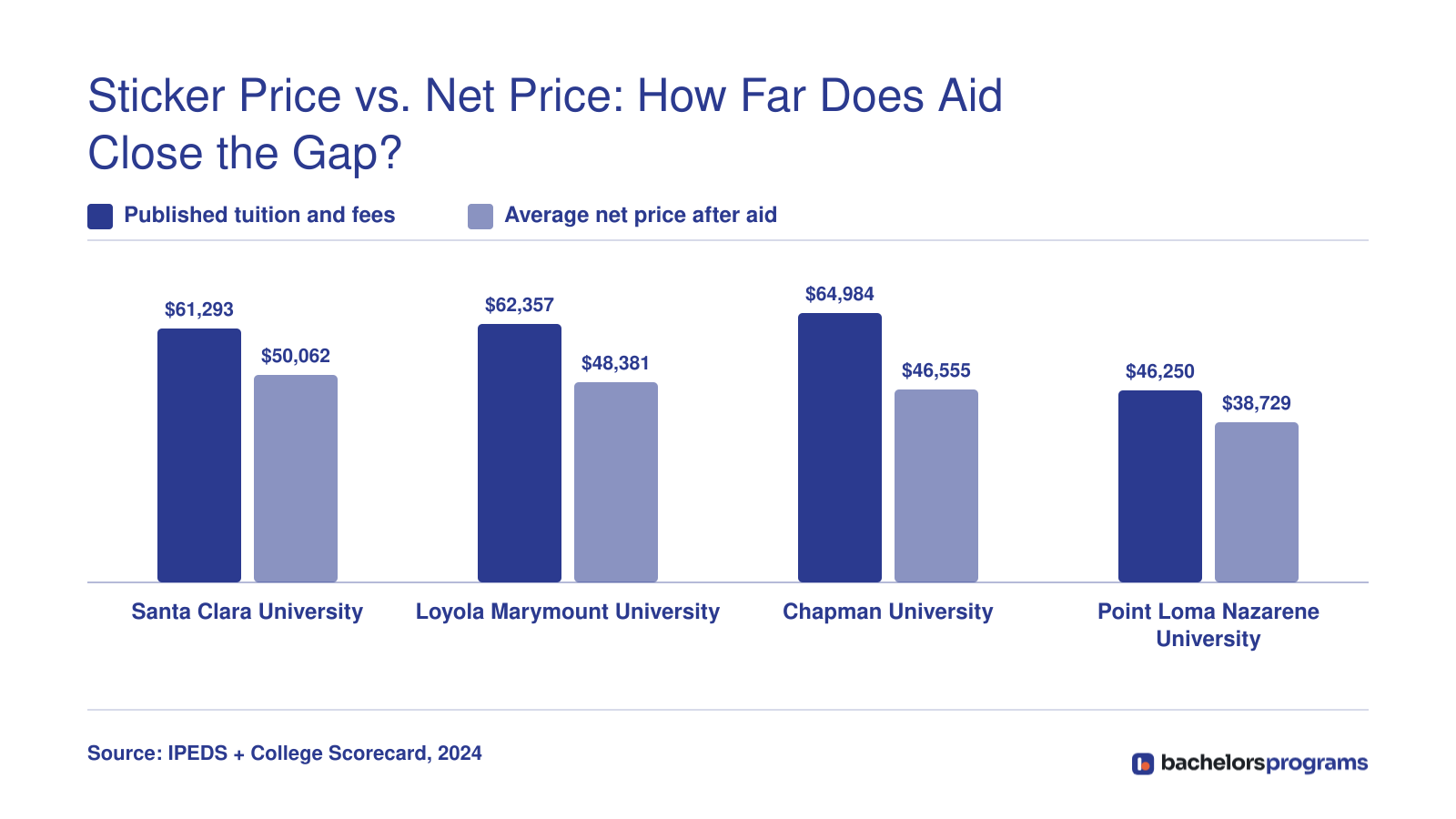
Sticker Price vs. Net Price: How Far Does Aid Close the Gap?
Published tuition is where the bill starts, not what most families pay. This chart compares in-state tuition and fees with the average net price after grants and scholarships at Santa Clara University, Loyola Marymount University, Chapman University and Point Loma Nazarene University. Aid lowers the price by $7,521 at Point Loma Nazarene and by $18,429 at Chapman. Net price is an average for students receiving aid, calculated within the private nonprofit sector, so your own figure will depend on family income. Private schools usually see the steepest drop from sticker price once aid is applied, so the published price alone can overstate your cost.
Accreditation and Program Quality: What to Check
Start With WSCUC Accreditation
WSCUC is the regional accreditor for California colleges and the baseline institutional check. Federal financial aid and most credit transfers depend on it. Cal Poly San Luis Obispo is fully accredited.1 Cal State Fresno is listed as accredited, with its latest Commission action on Feb. 13, 2026.2 Fullerton and Long Beach are also listed as accredited.3
ACEJMC for Journalism Tracks
ACEJMC accredits journalism and mass communication programs, and it lists only the degrees a school submitted for review.4 A school's presence on the list does not mean every media degree it offers is covered.
- Cal Poly San Luis Obispo: its Journalism B.S. is listed as accredited in the 2026-2028 catalog.1
- Northridge, San Diego State, San Francisco State: each has an accredited unit (Journalism, Journalism & Media Studies, and Journalism, respectively).
- Fullerton and Long Beach: both appear on ACEJMC's California list, but the specific accredited degree was not identified.
- San Jose State: it states its journalism program is accredited, but the 2022 review gave provisional status, with a revisit in February 2024. Confirm the current outcome.5
Communications has no licensure requirement, so accreditation and curriculum fit carry more weight than they would for a licensed field.
A Three-Step Checklist
- Institution: look the school up in the WSCUC accredited institutions directory.
- Program: if you want journalism, search the ACEJMC accredited programs list for the exact degree name.
- Curriculum: read the catalog page for your major and check that the courses match the career you want.
Some gaps are worth stating plainly. ACEJMC accreditation of Fresno's communication degrees could not be confirmed, since Fresno does not appear in the ACEJMC results. Current WSCUC status for Northridge, San Diego State and San Francisco State also could not be verified, so check those directly.
Careers and Salaries for Communications Graduates in California
A communications bachelor's degree in California leads to paid work in public relations, marketing, media and corporate communication, and none of those paths requires a state license.
Five Paths, One Degree
California employers hire communications graduates into five broad lanes: public relations agency and in-house teams, marketing and brand management, media and journalism, corporate and internal communications, and social and digital content. Los Angeles and the Bay Area concentrate the media, entertainment, and technology roles, and public relations management jobs cluster in the same places. The Los Angeles metro alone accounts for 3,610 of the 9,400 public relations manager positions counted across California in May 2025.4
What the Pay Looks Like
Bureau of Labor Statistics wage data for May 2025 put the median annual wage for public relations specialists at $85,030 statewide, with metro medians of $79,860 in Los Angeles-Long Beach-Anaheim, $102,520 in San Francisco-Oakland-Fremont, and $117,620 in San Jose-Sunnyvale-Santa Clara.1 Management pay runs higher. Marketing managers earn a national median of $166,7902, and in the San Francisco-Oakland-Fremont area they average $235,920, an average rather than a median.5 Public relations managers post a national median of $146,9103 and a San Francisco-area average of $207,600.5
Early Earnings From These Programs
Federal outcome data show what graduates of these programs earn early in their careers. Cal Poly communication studies graduates report median earnings of $62,183 one year after finishing and $75,223 four years out. San Diego State graduates report $37,773 at the one-year mark and $61,389 at four years.
No License, So Portfolio Wins
California does not license communications professionals, so hiring turns on internships, published clips, campaign results, and the alumni network a program puts within reach. That is why the internship requirements and campus media outlets built into these majors carry as much weight as the degree itself.
Common Questions About Communications Degrees in California
These answers draw on the rankings and program details covered above. Confirm requirements, tuition and program formats on each school's official pages before you apply.
What is the best college for communications in California?
Are there online communications bachelor's degrees from California schools?
Do you need a license to work in communications in California?
Can I transfer from a California community college into a communications bachelor's program?
Is a communications degree worth the cost in California?
Compare Communications programs on the data that matters
Explore more Communications & Media majors or browse every field of study.
All Communications & Media programs Browse every field of study