Best Communications Degree Programs in Florida
Compare 55 accredited Communications programs in Florida at 31 colleges, with net price after aid, graduation rates, earnings and debt from IPEDS and the U.S. College Scorecard.
A bachelor's degree in communications is one of the most common majors at Florida's public universities, and the usual credential is the Bachelor of Arts (B.A.) in Communications. The label hides real differences. Florida State, UCF and FIU run large programs inside major research universities, while Rollins, Stetson and Eckerd teach in small liberal arts classrooms, and the price gap between them is wide.
Florida's communications bachelor's programs run both on campus and online, so you can weigh cost, concentrations and format side by side.
Florida's tourism, healthcare, sports and media employers hire heavily in Miami, Orlando and Tampa, but internships often count for more than the school name.
Key Points
- UCF and Ana G. Mendez University offer fully online communications bachelor's options.
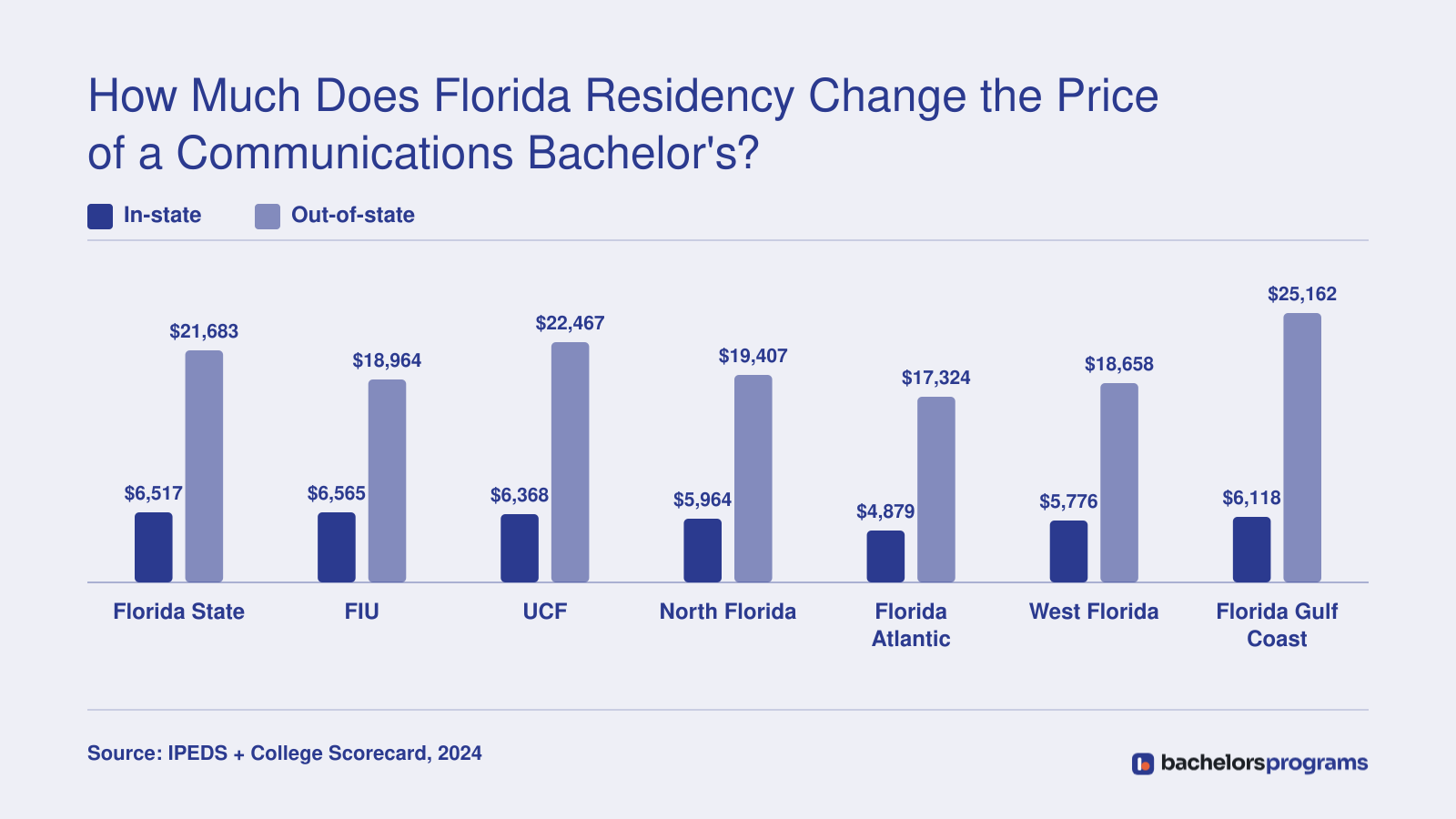
- At public universities, nonresidents pay roughly three to four times in-state tuition.
- Florida's tourism, healthcare, sports and entertainment sectors hire communications graduates.
Best Bachelor's Degree in Communications Schools in Florida: Ranked
Ten Florida schools anchor this ranking of bachelor's degree programs in communications, from flagship public universities to private liberal arts colleges and one fully online option. Each entry notes the credential offered, the tracks inside it, and the kind of student the school tends to fit.
Florida State University
#1Tallahassee, FL · ~$11,000/yr (est.)
Best for: Traditional-age students wanting a full campus experience
Florida State University runs its communication program through the College of Communication and Information on the Tallahassee campus, where students earn a Bachelor of Arts or Bachelor of Science in Communication and Digital Media Studies. The 120-credit degree pairs 30 hours in the major with a required minor outside Communication and foreign language through the 2200 level. Instruction is entirely in person, and the university reports an 86 percent graduation rate.
- 120 total credit hours, with 30 hours in the major
- Minor outside Communication required for graduation
- Foreign language through the 2200 level
- Four core courses plus 9 to 18 hours of advanced electives
- 2.00 GPA and 52 credit hours needed to progress
- In-person instruction in Tallahassee, no online option
- No specialized admission beyond university admission
Florida International University
#2Miami, FL · ~$9,000/yr (est.)
Best for: Working adults wanting online track options
Florida International University's Communication Arts degree sits in the School of Communication on the Miami campus and draws on more than 70 courses across the curriculum. Students choose among three tracks and can also complete the major online, which suits working students across South Florida. Admission to the upper division is handled separately from university admission and requires a 2.0 GPA.
- Tracks: Organizational Communication, Art + Performance, Design Studies
- Upper-division admission requires a 2.0 GPA across all coursework
- More than 70 courses offered across the communication curriculum
- Blends traditional communication theory with project-based digital work
- Tracks available on campus and fully online
University of Central Florida
#3Orlando, FL · ~$10,000/yr (est.)
Best for: Orlando creatives pursuing digital media careers
The University of Central Florida teaches communication through the Nicholson School, with a general communication track built on interpersonal, digital media, visual, and organizational coursework. The 120-credit degree includes 39 credits in the major and lets students count up to six internship or co-op credits. Orlando gives students a large local media market for internships and part-time work.
- 120 credits total, with 39 in the major
- 15 advanced core credits plus 18 restricted elective credits
- Up to six internship, co-op, or independent study credits may count
- 24 upper-division residency hours in Nicholson School courses
- 2.0 GPA in major courses and two semesters of foreign language
University of North Florida
#4Jacksonville, FL · $10,000 – $15,000/yr (est.)
The University of North Florida in Jacksonville offers a Bachelor of Science in Communication with four professional concentrations, including advertising and multimedia journalism. Advertising students build full campaigns for area nonprofits each semester, and the program places close to 100 communication majors in internships each term. The school is phasing out its older general communication degree while keeping the specialized tracks.
- Four concentrations: Advertising, Digital Video Production, Multimedia Journalism, Public Relations
- Advertising students build campaigns for First Coast nonprofits
- Nearly 100 communication majors placed in internships each term
- General communication track being phased out; specialized degrees continue
Florida Atlantic University
#5Boca Raton, FL · $4,900 – $17,000/yr (est.)
Florida Atlantic University's communication programs run through the School of Communication and Multimedia Studies in the Dorothy F. Schmidt College of Arts and Letters, based on the Boca Raton campus. The communication studies major is a 36-credit degree with a liberal arts base and coursework in rhetoric, intercultural communication, and media and cultural studies. A separate multimedia studies sequence covers journalism, video, and interactive media.
- 36 credit hours in the major
- Coursework in rhetoric, intercultural communication, and media studies
- Civic engagement and community-based projects emphasized
- Honors research and internship opportunities available
- Prepares students for law and politics careers as well as public relations
- Concentration in multimedia journalism
- Coursework in video production and interactive media
- Computer animation and new technology courses
- Sequence worksheets and academic advising provided
University of West Florida
#6Pensacola, FL · $5,000 – $10,000/yr (est.)
The University of West Florida delivers its communication degree at the Emerald Coast campus in Pensacola in a mix of face-to-face, online, and videoconferencing formats. That flexibility is aimed at working professionals, military members, and transfer students, who can finish the degree in about two years. Coursework runs from writing for public relations to crisis communication and social media strategy.
- Tracks: Advertising and PR, Communication Studies, Digital Storytelling
- Blends face-to-face, online, and videoconferencing instruction
- Transfer students can complete the degree in about two years
- Client-based projects and internships built into coursework
- Courses in crisis communication, social media strategy, and PR campaigns
University of Miami
#7Coral Gables, FL · $37,000/yr (est. net price)
The University of Miami is a private university in Coral Gables whose communication studies major sits inside a Bachelor of Science in Communication. Students choose among four tracks and must add a minor or second major, and all majors complete a capstone. Admission to the major requires a 2.5 GPA and 45 credit hours.
- Tracks: Communication Studies, Intercultural, Organizational, Public Advocacy
- 2.5 GPA and 45 credit hours required for admission to the major
- Minor or second major required alongside communication studies
- Capstone project plus practicum and internship options
- Health communication minor available
Florida Gulf Coast University
#8Fort Myers, FL · ~$13,000/yr (est.)
Florida Gulf Coast University in Fort Myers structures its Bachelor of Arts in Communication around 15 required major credits plus a 15-credit concentration. Students choose communication studies, which ends in a senior seminar, or public relations, which ends in a campaigns capstone. Both include a three-credit internship, and the degree carries service-learning and sustainability requirements.
- 120 credits: 15 required major credits plus a 15-credit concentration
- Concentrations in Communication Studies or Public Relations
- Three-credit internship required in the major
- Senior seminar or public relations campaigns capstone
- 42 upper-division credits and 30 residency credits at FGCU
- Service-learning and sustainability coursework required for graduation
Rollins College
#9Winter Park, FL · ~$35,000/yr (est.)
Rollins College is a private liberal arts college in Winter Park whose communication studies major centers on listening, intercultural communication, and organizational dynamics. Students specialize in public relations, health communication, or organizational communication and leadership, with internships at local and global organizations. The campus also fields an award-winning forensics team and supports study abroad.
- Tracks: Organizational Communication and Leadership, Public Relations, Health Communication
- Internships with local and global organizations
- Study abroad and faculty-student research opportunities
- Award-winning forensics team on campus
- Test-optional admission and a four-year graduation guarantee
Ana G. Mendez University
#10Orlando, FL · ~$20,000/yr (est.)
Ana G. Mendez University is a private institution whose Orlando location offers a fully online Bachelor of Arts in Communications. The curriculum spans print, radio, television, and digital journalism alongside public relations and advertising strategy. Delivery is built for working adults, and the program is approved for VA and military benefits.
- Fully online program with flexibility for working adults
- Covers print, radio, television, and digital journalism
- Coursework in public relations and advertising strategy
- Approved for VA and military benefits
- Part of the Liberal Arts Division
Cost & outcomes by school
Federal data for the highest-earning Communications programs, independent of the ranking above. Earnings are this field's bachelor's graduates four years after completing where the Scorecard reports them, else the school's undergraduate median.
| School | Net price / yr | Grad rate | Earnings | Debt | Grads/yr | Format |
|---|---|---|---|---|---|---|
| Embry-Riddle Aeronautical University-Daytona Beach FL | $41,272 | 67% | $84,131 | $23,666 | 11 | Campus |
| Embry-Riddle Aeronautical University-Worldwide FL | $18,725 | 21% | $84,131 | $23,666 | 4 | Online |
| University of Miami FL | $37,244 | 84% | $75,328 | $17,500 | 45 | Campus |
| Jacksonville University FL | $25,180 | 51% | $68,010 | $22,000 | 7 | Campus |
| Rollins College FL | $34,732 | 75% | $62,086 | $25,200 | 76 | Campus |
| Florida State University FL | $11,297 | 86% | $61,675 | $18,000 | — | Campus |
| Eckerd College FL | $38,071 | 66% | $60,969 | $20,500 | 9 | Campus |
| Nova Southeastern University FL | $30,371 | 63% | $59,209 | $24,250 | 15 | Campus |
| University of Central Florida FL | $10,411 | 78% | $58,783 | $17,148 | 420 | Campus |
| Stetson University FL | $19,372 | 62% | $58,071 | $27,000 | 18 | Campus |
| Florida International University FL | $9,288 | 74% | $57,376 | $17,234 | 245 | Campus |
| Florida Gulf Coast University FL | $12,568 | 57% | $56,455 | $17,479 | 121 | Campus |
Sources: U.S. Department of Education. Net price, graduation rate, earnings and debt: College Scorecard (earnings and debt for this field's bachelor's graduates where reported, else school-wide); graduates: IPEDS. A dash means no figure is reported.
Cost, debt & payoff
Median earnings of this field's bachelor's graduates (4 yrs after completing, else the school's undergraduate median) vs. their median federal loan debt · U.S. College Scorecard
Across these programs the median graduate earns about $55,403 and finishes with roughly $20,638 in debt — a ratio that clears a common rule of thumb (keep debt below first-year salary). Net price and debt vary widely school to school, so check the per-school figures in the table above before you shortlist.
Most Affordable Communications Bachelor's Programs in Florida
These Florida programs have the lowest average net price after aid in our data, based on 2024 IPEDS and College Scorecard figures from the U.S. Department of Education. Net price and graduation rate are institution-wide averages for each school. They are not exact quotes for any one student or figures for the communications program alone. Florida State College at Jacksonville, which appears in our directory, averages $4,128, roughly $4,600 below Florida Atlantic University, the most affordable of the ranked schools, while the ranked public universities in this table fall within about $1,400 of one another.
| School | City | Program | Average Net Price After Aid | Delivery Format | Graduation Rate (Institution-Wide) |
|---|---|---|---|---|---|
| Florida State College at Jacksonville | Jacksonville | Communication and Media | $4,128 | Campus | 36.8% |
| Florida Atlantic University | Boca Raton | Communication Studies | $8,752 | Campus | 62.6% |
| Florida International University | Miami | Bachelor of Arts in Communication Arts | $9,288 | Campus | 74.4% |
| University of West Florida | Pensacola | Bachelor of Arts in Communication | $9,364 | Campus and online | 58.8% |
| University of North Florida | Jacksonville | Bachelor of Science in Communication | $10,154 | Campus | 69.2% |
Related Articles
Online and Hybrid Communications Bachelor's Options at Florida Schools
Florida's communications bachelor's programs come in fully online, hybrid and campus-only formats. The program data points to the University of Central Florida and Ana G. Mendez University as the clearest fully online options, with the University of West Florida offering hybrid delivery.
Fully Online Programs
UCF lists two online bachelor's programs: Communication and Conflict, B.A., and English, Technical Communication, B.A. (an English degree with a technical communication focus). Each requires 120 credit hours. UCF's online tuition and fees are $179.19 per credit hour for Florida residents and $857.98 for nonresidents. A separate UCF page cites $715.80 for out-of-state students, so confirm the current rate with the school before budgeting.
By comparison, UCF's on-campus General Communication track lists $212 per credit for in-state students and $891 for out-of-state students. The online rate is modestly cheaper, and students taking only online classes may see campus-based fees reduced. Ana G. Mendez University in Orlando also delivers its B.A. in Communications online and accepts military benefits.
Hybrid and Campus-Only Formats
The University of West Florida's B.A. in Communication lists hybrid delivery, flexible schedules and a transfer-friendly two-year completion path. Florida State, FIU, UNF, FAU, Miami, FGCU and Rollins list campus-based programs, and FSU specifies in-person instruction in Tallahassee.
Who Benefits From Each Format
- Working adults: Fully online programs at UCF or Ana G. Mendez remove commuting and let you study around a job.
- Transfer students: UWF's hybrid, two-year completion structure suits students arriving with an associate degree.
- Career changers: UCF's technical communication degree builds writing skills that apply across industries.
- Recent high school graduates: Campus programs offer in-person networking, student media and organizations.
In-Person Requirements
UCF notes that not all electives or program prerequisites may be offered online, so check your course plan early. Internships are a feature of many campus programs, such as UNF's internships each term, FGCU's internship course and Miami's practicum. Ask any online program whether an internship is required and whether you can complete it near home.
Communications Concentrations Offered in Florida
A general communication degree preserves flexibility, while a named concentration signals a specific job path to employers. Florida schools split on this, so check the track list before you compare programs.
Common Tracks and the Work They Lead To
- Public relations and advertising: Campaign, social media and client work. The University of West Florida lists Advertising, Public Relations, and Social Media as one concentration with client-based projects, and the University of North Florida lists an Advertising concentration.
- Media production and journalism: Reporting, video and multimedia. Florida International University's digital media tracks are Digital Broadcasting, Digital and Interactive Media, Digital Journalism, and Digital TV and Multimedia Production.
- Organizational and interpersonal communication: Training, internal communication and leadership roles. The University of Central Florida's General Communication Track covers interpersonal and digital media.
- Communication studies: Rhetoric, intercultural and civic communication, as at Florida Atlantic University, or the four tracks at the University of Miami.
How the Degree Labels Differ
"Communication" is the broadest label; it covers how people and groups exchange messages. "Media" degrees lean toward producing and analyzing content. Public relations is narrower still, focused on managing an organization's message and reputation. Many programs blend these, so read the course list, not just the title.
Accreditation and Practical Requirements
Regional accreditation is the baseline for any Florida school. For journalism and mass communication, ACEJMC is the specialized accreditor, and it lists six Florida units in 2026. Its listing covers only the degrees a unit submits, not every bachelor's there. Florida International University's School of Communication was reaccredited in 2022. The University of North Florida is also listed, but the data does not specify which concentrations are covered or the exact internship rules, though the school describes professional internships each term.
Florida Southern College is not on the ACEJMC list. Its communication majors complete a semester-long internship or a senior project, usually in senior year, with a 2.0 GPA and permission from the coordinator. The University of Central Florida's Journalism B.A. is also not on the list. It requires a 2.5 GPA in major courses for internship credit, caps that credit at three hours, and requires a portfolio reviewed by faculty at least a semester before graduation. At least 75% of that work must be produced at UCF.
How Much Does Florida Residency Change the Price of a Communications Bachelor's?
At Florida's public universities, residency is the biggest single factor in the sticker price of a bachelor's degree in communications. Out-of-state students at the public schools shown here pay roughly three to four times what Florida residents pay in annual tuition and fees, a gap of about $12,400 at Florida International University and Florida Atlantic University and about $19,000 at Florida Gulf Coast University. Private schools such as the University of Miami ($62,616), Rollins College ($60,580) and Ana G. Mendez University ($13,575) charge one rate regardless of residency, so for out-of-state students the cost gap between public and private narrows.
Communications Careers and Salaries in Florida
A communications degree leads to jobs built around shaping and delivering messages: public relations, advertising, media production, and internal or corporate communication. Florida's tourism, healthcare, sports and entertainment sectors, plus the Miami, Orlando, Tampa and Jacksonville markets, give graduates of the schools ranked here a wide range of employers to approach.
Common Florida Job Paths
- Public relations: Specialists write press materials, manage media relations, and handle reputation for companies, agencies, and nonprofits.
- Advertising and marketing: Roles include account coordination, copywriting, and promotions work, with managers leading campaigns.
- Media: Writers, editors, and content producers work in broadcast, digital publishing, and social platforms.
- Corporate communication: Internal messaging, executive communication, and investor or community relations.
What the Pay Looks Like
Florida-specific wage and employment figures for these occupations are not available, so the national Bureau of Labor Statistics numbers are the safest benchmark. Florida pay can differ by metro area and employer, so check state and local listings before setting salary expectations.
- Public relations specialists: The national median was $74,750 in May 2025, across about 314,500 jobs. Employment is projected to grow 2% from 2025 to 2035.1
- Public relations and fundraising managers: The national median was $136,470, with projected growth of 6% from 2025 to 2035.2
- Advertising and promotions managers: The national median was $133,660. The 6% growth projection from 2025 to 2035 covers the broader advertising, promotions, and marketing managers group.3
For context, the median across all U.S. occupations was $50,980.2 Manager roles typically require experience beyond a bachelor's degree, so entry-level pay will sit closer to the specialist range.
Licensure and Program Earnings
Communications is not a licensed field in Florida, so there is no state licensure exam to pass after graduation. Earnings figures reported for individual programs describe graduates of those specific schools, while the occupational wages above describe all workers in a job nationally. They measure different groups, so compare them as separate reference points rather than combining them.
Common Questions About Communications Degrees in Florida
These answers draw on the tuition, program and career details covered earlier on this page. Costs and concentrations vary by school, so confirm current figures with each program before you apply.
What are the best communications degree programs in Florida online?
How much does a communications degree cost in Florida?
What can you do with a bachelor's degree in communications in Florida?
What concentrations are available in Florida communications programs?
Compare Communications programs on the data that matters
Explore more Communications & Media majors or browse every field of study.
All Communications & Media programs Browse every field of study