Best Communications Degree Programs in Georgia
Compare 51 accredited Communications programs in Georgia at 25 colleges, with net price after aid, graduation rates, earnings and debt from IPEDS and the U.S. College Scorecard.

What does a bachelor's degree in communications cost in Georgia, and does the price match the payoff? It varies by school. The degree usually carries the Bachelor of Arts (B.A.) in Communications title, though it also appears as Communication Studies at the University of Georgia and Mass Communication at Savannah State University.
The ranking weighs net price, graduation rate, and earnings across Georgia bachelor's programs, campus and online. What follows compares cost and earnings, online options, how the majors differ, and Atlanta salaries.
Atlanta anchors much of the state's media and PR hiring, so a campus's distance from the city shapes internship access.
Key Points
- UGA Communication Studies graduates earn a $44,283 median one year out.
- Clayton State University offers the lowest net price among these schools.
- Most programs stay campus-based, while Brenau University offers an online pathway.
Best Bachelor's Degree in Communications Schools in Georgia, Ranked
Ten Georgia colleges make this list, from the state's flagship in Athens to private colleges inside the Atlanta media market and regional publics across middle and south Georgia. Every entry is a bachelor's degree in communications, whether the school calls it communication studies, mass communication, or communication and media studies, and every one is offered by a school based in Georgia.
University of Georgia
#1Athens, GA · ~$14,000/yr (est.)
Best for: Students seeking a flagship research campus
The state's flagship public university, based in Athens, and the largest and most selective campus on this list, with an admit rate near 38 percent and a six-year graduation rate near 90 percent. Communication Studies here is a liberal arts major that examines settings from political campaigns and doctor-patient talk to advertising and family communication. Students build skills in argument, persuasive messaging, and publicity campaigns, and can add a Double Dawgs path that folds a master's degree into five years.
- Major and minor in Communication Studies
- Double Dawgs path to a master's in five years
- Coursework spans political campaigns, health talk, and advertising
- Department reports job placement above the university average
- Study abroad and undergraduate research opportunities
- Scholarships and other funding available to majors
Mercer University
#2Macon, GA · ~$24,000/yr (est.)
Best for: Private-college seekers wanting an honors track
A private university in Macon with small classes, about 11 students per faculty member, and a six-year graduation rate near 70 percent. The Communication Studies major is compact at 27 credit hours, leaving room for coursework in public speaking, intercultural and organizational communication, game studies, and intercollegiate debate. A departmental honors track is open to students who hold a 3.50 GPA overall and in the major.
- 27 credit hours minimum in the major
- Three named core courses: COM 200, COM 400, COM 420
- Nine of the 18 elective credits must be at 300 level or above
- Departmental Honors requires a 3.50 GPA overall and in the major
- Internship and directed independent study credit offered
- Taught at the Macon Campus
University of West Georgia
#3Carrollton, GA · $13,000/yr (est. net price)
Best for: Hands-on film and video learners
A public university in Carrollton with an admit rate above 50 percent and one of the lower in-state price tags among the ranked programs. Mass Communications is the school's hands-on media degree, with concentrations in journalism, digital media and entertainment, film and video production, and public relations, plus a student-run PR firm where students take on client work. Instruction is face-to-face on the Carrollton campus.
- Tracks: Journalism, Digital Media & Entertainment, Film & Video Production, Public Relations
- 120 total credit hours required
- Face-to-face instruction on the Carrollton campus
- Hands-on workshops, seminars, and collaborative projects from day one
- Multiple start terms each year
- Financial aid and scholarships available
- Client work through the student-run bluestone PR firm
- Courses in media relations, crisis management, PR writing, and campaigns
- Curriculum covers ethics and media law
- Optional online course components for some classes
- Internship opportunities built into the program
- $40 application fee for undergraduate admission
Georgia Southern University
#4Statesboro, GA · $15,000 – $20,000/yr (est.)
A public university with campuses in Statesboro and Savannah and a six-year graduation rate near 55 percent. Communication Studies blends theory with practice through public speaking, conflict resolution, intercultural communication, and leadership, with electives in health communication or persuasion and an immersive internship course. Alumni have landed at CNN, Delta Air Lines, and State Farm.
- 124 total credit hours, with a 2.5 GPA minimum
- Offered on the Statesboro and Armstrong campuses
- Immersive internship course (COMS 4791)
- Electives in health communication or persuasion
- Student organization: Society of Communications Scholars
- Alumni at CNN, Delta Air Lines, and State Farm
- $30 application fee
Georgia Southwestern State University
#5Americus, GA · $10,000 – $15,000/yr (est.)
A small public university in Americus with an admit rate near 75 percent and classes kept small. Its Communication and Emerging Media degree pairs traditional communication coursework with digital media, video production, and sports communication, and students can pull electives from business, IT, or nursing. A newly built media lab and internships with local businesses, the university marketing team, and athletics give students portfolio material before they graduate.
- Newly built media lab for hands-on production work
- Internships with local businesses, university marketing, and athletics
- Electives can be drawn from business, IT, and nursing
- Coursework in digital media, video production, and sports communication
- Small classes with dedicated faculty
University of North Georgia
#6Dahlonega, GA · ~$10,000/yr (est.)
A public university with its main campus in Dahlonega and the communication program based in Gainesville, north of Atlanta. The B.A. in Communication offers a multimedia journalism concentration built on newswriting, media production, and professional ethics, and a public relations concentration shaped by PRSA guidelines. Internship placements have included Public Broadcasting Atlanta and Jacobs Media.
- Hands-on newswriting and media production coursework
- Emphasis on professional ethics and responsible journalism
- Internships with Public Broadcasting Atlanta and Jacobs Media
- Prepares students to work across digital and broadcast platforms
- Based on the Gainesville Campus
- Career insights tool for exploring roles and salaries
- Curriculum follows PRSA guidelines for public relations education
- Available on campus and online
- Strategic communication focus with applied coursework
- Internships and hands-on practice built in
- Balances liberal arts study with career-building skills
Valdosta State University
#7Valdosta, GA · $10,000 – $15,000/yr (est.)
A public university in south Georgia with a six-year graduation rate near 42 percent and a 17-to-1 student-faculty ratio. The B.A. in Communication runs several tracks, including interpersonal, organizational, and public relations, and every student finishes with a capstone or internship plus foreign language credit. Coursework reaches into persuasion, data analytics, social media strategy, and crisis communication.
- Tracks: Interpersonal, Organizational, Public Relations, General
- 120 total credit hours, closing with a capstone or internship
- Six credits of modern or classical language required
- 2.3 GPA minimum for the major
- Courses in persuasion, data analytics, social media strategy, and crisis communication
- Study abroad options within Communication Arts
Clayton State University
#8Morrow, GA · $5,000 – $10,000/yr (est.)
A public university in Morrow, south of Atlanta, where most communication courses can be completed fully online. Communication and Media Studies combines theory, media studies, and production, and graduates have gone on to the New York Times and Sports Illustrated as well as local agencies and production companies. The flexible format suits transfer students and adults balancing work with school.
- Most courses available fully online
- Coursework in communication theory, media studies, and production
- Prepares students for PR, advertising, social media, and web design roles
- Graduates have worked at the New York Times and Sports Illustrated
- Emphasis on critical analysis, research, and ethical decision making
- Flexible pacing for transfer and adult students
Oglethorpe University
#9Atlanta, GA · ~$20,000/yr (est.)
A small private liberal arts university in Atlanta with a six-year graduation rate near 54 percent and a 13-to-1 student-faculty ratio. Communication Studies students take core work in public speaking, journalism, persuasive writing, and broadcast media, then specialize in media studies, public relations, or rhetoric and public discourse. The Atlanta location supports internships at CNN, CBS, and FOX Sports, and alumni work at ABC News, NBA TV, and the CDC.
- Core courses in public speaking, journalism, persuasive writing, and broadcast media
- Electives include digital storytelling, web design, and social media strategy
- Internships at CNN, CBS, and FOX Sports
- Alumni work at ABC News, NBA TV, and the CDC
- Requires a minor in a related field
- Independent study and research projects available
- Focus on media theory and critical analysis of media
- Global media perspectives in the curriculum
- Research methods training included
- Internship experience built into the track
- Capstone experience to close out the track
- Real-world client projects in PR coursework
- Crisis communication and social media integration
- Digital storytelling and writing-intensive assignments
- Strategic communication training for agency and corporate roles
- Prepares students for law, politics, and advocacy work
- Covers persuasion and social movements
- Writing-intensive coursework with a public speaking core
- Capstone or thesis options
- Study abroad encouraged
Columbus State University
#10Columbus, GA · ~$13,000/yr (est.)
A public university in Columbus with a hybrid communication degree that mixes campus and online coursework. Students choose among four focus areas, including media and film and strategic communication, and work with a campus television partnership with WRBL News, the WCUG 88.5 FM station, and 180,000 square feet of production space. Georgia Film Academy fast-track training and a PRSSA chapter add direct industry contact.
- Hybrid format mixing campus and online coursework
- Four focus areas, including Media and Film and Strategic Communication
- Partnership with WRBL News and the WCUG 88.5 FM station
- 180,000 square feet of production space
- Georgia Film Academy fast-track training available
- PRSSA chapter and NPACE Center for professional experience
- 120 credit hours across four years
Cost & outcomes by school
Federal data for the highest-earning Communications programs, independent of the ranking above. Earnings are this field's bachelor's graduates four years after completing where the Scorecard reports them, else the school's undergraduate median.
| School | Net price / yr | Grad rate | Earnings | Debt | Grads/yr | Format |
|---|---|---|---|---|---|---|
| University of Georgia GA | $13,936 | 90% | $68,319 | $17,250 | 131 | Campus |
| Kennesaw State University GA | $15,048 | 52% | $59,675 | $26,988 | — | Campus |
| Georgia College & State University GA | $20,686 | 64% | $58,140 | $22,250 | — | Campus |
| Oglethorpe University GA | $19,509 | 54% | $55,232 | $25,000 | 19 | Campus |
| Brenau University GA | $18,924 | 33% | $54,003 | $27,000 | 4 | Campus |
| Berry College GA | $22,320 | 70% | $53,800 | $23,250 | — | Campus |
| Georgia Southern University GA | $15,267 | 55% | $53,236 | $23,250 | 30 | Campus |
| Mercer University GA | $23,847 | 70% | $52,530 | $24,990 | 37 | Campus |
| University of North Georgia GA | $9,823 | 37% | $51,131 | $16,002 | 50 | Campus |
| University of West Georgia GA | $12,786 | 44% | $49,587 | $23,970 | — | Campus |
| Piedmont University GA | $20,599 | 47% | $49,130 | $25,000 | 10 | Campus |
| Georgia Southwestern State University GA | $12,019 | 41% | $48,757 | $18,851 | 6 | Campus |
Sources: U.S. Department of Education. Net price, graduation rate, earnings and debt: College Scorecard (earnings and debt for this field's bachelor's graduates where reported, else school-wide); graduates: IPEDS. A dash means no figure is reported.
Cost, debt & payoff
Median earnings of this field's bachelor's graduates (4 yrs after completing, else the school's undergraduate median) vs. their median federal loan debt · U.S. College Scorecard
Across these programs the median graduate earns about $48,757 and finishes with roughly $25,000 in debt — a ratio that clears a common rule of thumb (keep debt below first-year salary). Net price and debt vary widely school to school, so check the per-school figures in the table above before you shortlist.
Cheapest Communications Bachelor's Programs in Georgia
These Georgia public universities offer a bachelor's degree in communications at the lowest average net price, based on 2024 IPEDS and College Scorecard data from the U.S. Department of Education. Clayton State University has the lowest net price among the schools ranked here, at $8,365 per year. Savannah State University and Albany State University, both in our directory, also come in under $12,000, and every school below charges Georgia residents less than $6,200 a year in tuition and fees.
| School | City | Program | In-State Tuition and Fees | Average Net Price (per year) | Graduation Rate |
|---|---|---|---|---|---|
| Savannah State University | Savannah | BA in Mass Communications | $5,750 | $8,172 | 28% |
| Clayton State University | Morrow | Communication and Media Studies | $5,180 | $8,365 | 40% |
| University of North Georgia | Dahlonega | Communication Major with Multimedia Journalism Concentration | $5,285 | $9,823 | 37% |
| Valdosta State University | Valdosta | Communication | $6,124 | $10,945 | 42% |
| Albany State University | Albany | Mass Communication, Bachelor of Arts | $5,656 | $11,898 | 31% |
How We Ranked Georgia Communications Programs
What the Numbers Mean
The order leans on federal College Scorecard and IPEDS figures: net price after aid, graduation rate, earnings for graduates, and format, whether a bachelor's degree in communications can be finished online or on a hybrid schedule. Those signals answer what families actually ask: what it costs, whether students finish, what graduates earn, and whether the schedule fits.
One caution before you compare. Net price and graduation rate are school-wide numbers, not program-specific; a university's completion rate covers nursing and business majors along with communications students. Read them as a measure of the institution, then check each program's own page for curriculum detail.
Institutional vs. Program Accreditation
Every school ranked here should hold institutional accreditation from SACSCOC, the regional body that accredits degree-granting colleges in Georgia. That is the baseline: it keeps federal aid and transfer credit workable.
Program-level accreditation is separate. ACEJMC reviews journalism and mass communication curricula specifically, and in 2026 three Georgia bachelor's programs hold it1: Savannah State University's B.A. in Mass Communications (reaccredited in 2026)2, the University of Georgia's Grady College programs in Advertising, Entertainment and Media Studies, Journalism, and Public Relations (reaccredited in 2025)3, and the University of West Georgia's B.S. in Mass Communications (accredited in 2020)4. ACEJMC status signals a curriculum built around internships, professional faculty, and hands-on training.
Accreditation Is Not a License
Communications carries no state licensure in Georgia, so nothing gates you out of public relations, media, or corporate communication work. Accreditation is a quality signal, not a permit to practice. If you want newsrooms or agencies that recruit from accredited programs, ACEJMC matters. If you are aiming at marketing, social media, or graduate study, SACSCOC institutional accreditation is the one that protects your degree and your aid.
Related Articles
Online and Hybrid Communications Bachelor's Options at Georgia Schools
Most communications programs in Georgia still center on a campus newsroom or production facility; a small number are built for fully online study.
Fully Online and Hybrid Options
Brenau University's B.A. in Communication and Media Studies is the clearest online route: 120 credits across eight semesters, with fall, spring and summer starts. Brenau's own pages disagree on the label, though. One describes the degree as fully online, while a separate online-program listing calls it hybrid, so ask an admissions counselor which courses meet in person.
Columbus State University's Communication B.A. is listed as hybrid, a 120-credit, four-year program. The available page does not state specific start terms.
Clayton State University's Communication and Media Studies program is cataloged as campus-based, though its program page notes that most courses are offered fully online, which makes it worth a call if you need remote coursework.
Campus-First Programs With Online Courses
The University of West Georgia's mass communications degrees, including the Digital Media & Entertainment and Journalism tracks, are face-to-face at Carrollton. Students may take some courses partially or fully online, but the degree itself is not built as fully online. Digital Media applicants face deadlines of June 1 for fall, Nov. 15 for spring and May 15 for summer.
Brenau's separate B.A. in Mass Communication is on-ground in Gainesville with fall and spring starts. Georgia College & State University requires an internship and two on-campus practicums, so budget time in Milledgeville.
Choosing Between Them
A campus program puts you near Atlanta agencies and broadcasters for internships; an online track with multiple start terms keeps working students on schedule. The program pages do not list a separate online rate, so confirm whether online students pay the same in-state tuition before enrolling.
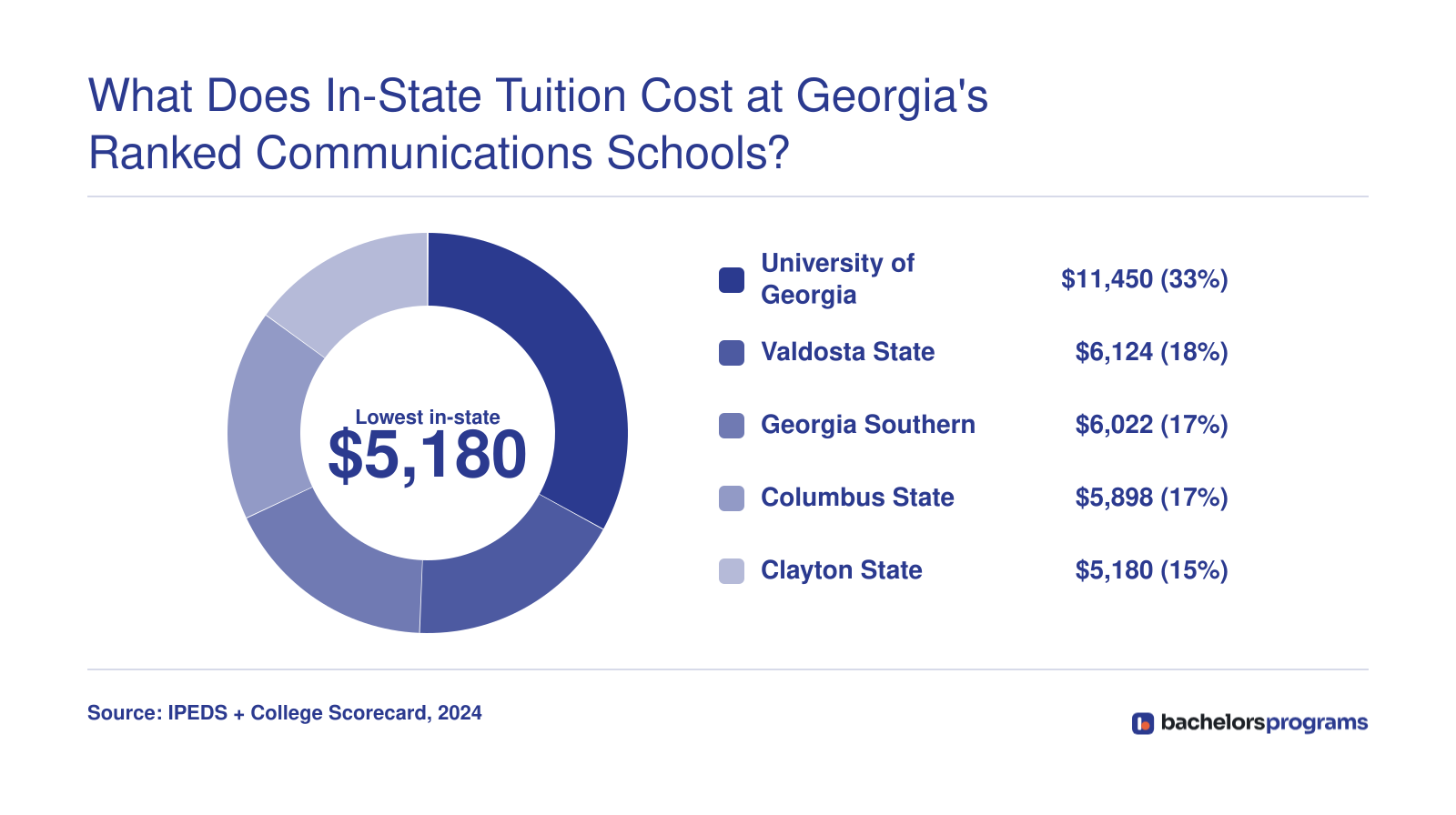
What Does In-State Tuition Cost at Georgia's Ranked Communications Schools?
Most programs ranked here are taught on campus. Columbus State University's Communication B.A. runs in a hybrid format, and Clayton State University notes that most of its communication courses are offered fully online, which gives working adults the most schedule flexibility. Traditional students tend to get more from campus media labs, student radio and in-person internships. In-state tuition and fees at the ranked public universities run from $5,180 to $11,450 a year.
Communications Majors Compared: Mass Communication, Communication Studies, PR, and Media
Communication studies graduates reported a median salary of $56,359 four years after graduation, with a middle range of $39,575 to $76,115. At the occupation level, communication studies and public relations roles paid nearly the same median wage in May 2025, $74,250 and $74,750. The labels overlap heavily, so course requirements and portfolio work separate these majors more than salary data does.
Communication Studies
This is the broadest option. Coursework leans on rhetoric, interpersonal and organizational communication, research methods, and argument. Georgia examples include the University of Georgia, Mercer University, Georgia Southern University, Oglethorpe University, and Morehouse College. Graduates move into sales, human resources, nonprofit work, event planning, and media roles, and the degree leaves room for graduate study.
Mass Communication and Media
These programs are more industry-facing. Mass communication typically adds journalism, broadcasting, advertising, and media law, while media and emerging media degrees emphasize production and digital platforms. The University of West Georgia, Albany State University, Georgia College & State University, and Savannah State University use the mass communication label; Georgia Southwestern State University and Brenau University frame the degree around media.
Public Relations
PR focuses on reputation, campaigns, media relations, and persuasive writing. The University of North Georgia offers a public relations concentration. Among the four, PR has the clearest documented direct occupational pathway: a historical survey found 46.5% of the Class of 1987 were employed in PR or a related field six months after graduation. Treat that as a snapshot of one old cohort, not a current placement rate.
Choosing Between Them
Compare required courses, not just names. A media degree suits production portfolios, PR suits campaign and writing samples, and communication studies preserves the most flexibility. Salary differences among the four are difficult to defend because job classifications overlap so much.
Atlanta Wages for PR, Media, and Marketing Roles
The best-paying communications jobs are rarely the ones new graduates land first. The real question is how quickly an entry role can lead to a management title. Federal wage data from May 2025 shows how wide that gap can be.
National Medians for Core Communications Roles
- Public relations specialists: $84,120 median annual wage nationally1
- News analysts, reporters, and journalists: $102,460 median annual wage nationally1
- Public relations and fundraising managers: $156,310 median annual wage nationally1
Medians reflect workers at every career stage, so a first-year salary will usually sit below these figures. Marketing managers belong in the same high-earning tier as PR managers because both roles oversee budgets, campaigns, and staff. Market research analyst positions offer a data-focused path for graduates who are comfortable with surveys and analytics.
How Atlanta Compares
The Bureau of Labor Statistics groups the region as the Atlanta-Sandy Springs-Roswell metro. Its May 2025 release puts the average hourly wage across all occupations at $34.57, roughly 3 percent above the national average of $33.54.2 Atlanta medians for these specific roles were not reported in the figures available here. Treat that metro-wide edge as a general signal, not a promise for any single job.
Where New Graduates Usually Start
Public relations specialist is a common first stop for someone with a bachelor's degree in communications. Reporting, social media, and junior marketing roles are other typical entry points. Manager titles in PR, fundraising, and marketing generally come after several years of experience. For students at Georgia schools, internships with Atlanta agencies, newsrooms, and corporate communications teams are the practical bridge from an entry-level paycheck to those higher earnings.
What Georgia Communications Graduates Earn One Year After Finishing
Among the schools ranked here, University of Georgia's Communication Studies bachelor's graduates post the highest median earnings one year after finishing: $44,283.
Georgia Communications Degree FAQs
These answers draw on the program details and findings covered earlier on this page. Program titles, formats, and requirements vary by school, so confirm specifics on each school's own program page before you apply.
Does Georgia offer online bachelor's degrees in communications?
What is the difference between communication studies and mass communication?
Which Georgia colleges have accredited communications programs?
What is the starting salary for a communications graduate in Georgia?
Compare Communications programs on the data that matters
Explore more Communications & Media majors or browse every field of study.
All Communications & Media programs Browse every field of study