Best Communications Degree Programs in Mississippi
Compare 12 accredited Communications programs in Mississippi at 7 colleges, with net price after aid, graduation rates, earnings and debt from IPEDS and the U.S. College Scorecard.
Tuition for a bachelor's degree in communications in Mississippi runs from $7,692 a year at Mississippi Valley State University to $23,500 at Mississippi Christian University, and the cheaper campus is not always the one with the broader program. Schools here typically award a Bachelor of Arts (B.A.) in Communications, though titles vary: mass communication, communication studies, speech communication.
Cost, outcomes and program breadth drive the order; each entry then covers concentrations, online options, admissions standards and career outcomes.
Mississippi's media market is small, so campus newsrooms, radio stations and internships function as core training rather than extras.
Key Points
- Mississippi State University leads, with the state's widest concentration lineup.
- Mississippi State freshmen average a 3.7 GPA, with test scores optional.
- Mississippi public relations specialists earned a $64,830 mean wage in May 2025.
Best Schools for a Bachelor's Degree in Communications in Mississippi
Mississippi State University is the strongest overall choice for a bachelor's degree in communications in Mississippi, pairing the state's widest concentration lineup with the deepest campus media operation. The other six schools on this list make sense in narrower situations: a smaller class setting, a faith-based campus, a lower sticker price, or a specific production niche. Tuition, net price after aid and graduation rates shown on each card are school-wide figures for the institution, not figures for the communications program alone.
Mississippi State University
#1Mississippi State, MS · ~$18,000/yr (est.)
Best for: Students wanting the widest concentration choice
The state's largest public university, with a Department of Communication, Media and Theatre built on a shared 12-hour core and five distinct concentrations. Freshmen enter with an ACT Enhanced English sub-score of 20, transfers with a 2.0 GPA, and every concentration finishes with a capstone. A Lambda Pi Eta chapter and departmental scholarships round out the support.
- Concentrations: broadcast, print, media studies, public relations, theatre
- 48 to 49 communication hours inside a 124-credit degree
- 12-hour departmental core plus 36 to 37 concentration hours
- ACT Enhanced English sub-score of 20 or higher for freshmen
- Transfer applicants admitted with a 2.0 GPA
- Capstone required in every concentration
- Minimum grade of C in all communication courses
- Lambda Pi Eta chapter, departmental scholarships, lab fees for production courses
William Carey University
#2Hattiesburg, MS · ~$14,000/yr (est.)
Best for: Faith-based learners preferring small production classes
A faith-based university in Hattiesburg where mass communication is taught in small classes and paired with a required field internship; the department reports that nearly all interns receive job offers. Students can earn either a B.A. or a B.S., add a second major, and use a two-year class cycle that suits transfer students.
- 128 total credit hours
- Capstone required
- Minor or second major required
- Writing intensive requirement
- Hattiesburg campus location
- Classes run on a two-year cycle for transfer students
- Coursework in news writing, television and film production, radio and digital media
- Required field internship; nearly all interns receive job offers
- Small classes with an interactive format
- Double majors permitted
- ACT or SAT scores required for admission
- B.A. or B.S. pathways for public relations study
- High school GPA of 2.0, ACT 20 or SAT 1030 for entry
- Prepares for PR specialist, communications officer and media planner roles
- Coursework in social media management
Alcorn State University
#3Alcorn State, MS · ~$13,000/yr (est.)
Best for: Hands-on radio and television learners
A public HBCU where mass communication students run real outlets: a bi-monthly online newspaper, a newscast on the campus cable channel and a one-hour show on a 3,000-watt FM station. Classroom work is reinforced through the state's professional media network, and the university's marketing and communication division won awards in 13 categories at the 2026 College Public Relations Association of Mississippi conference.
- Student-run online newspaper, The Campus Chronicle, published bi-monthly
- Television newscast roles as producers, reporters, videographers and anchors
- One-hour radio show on 3,000-watt WPRL 91.7 FM
- Cable television center ASU TV-13
- Prepares for public relations, reporting, editing and government service
- Annual Media Day connects students with Mississippi broadcast professionals
Mississippi University for Women
#4Columbus, MS · ~$12,000/yr (est.)
A public university in Columbus built around a convergence model, so students practice video, audio, writing and design rather than committing to a single medium. The 124-credit degree includes an internship, and classes are led by faculty with industry experience.
- Convergence-based: video, audio, writing, visual design and layout
- 124 total credit hours, about four years full time
- Internship component built into the degree
- Courses in media law and ethics and advanced media writing
- Faculty with industry experience
- Portfolio-building across TV, radio and branding work
Mississippi Christian University
#5Clinton, MS · $28,000/yr (est. net price)
A private Clinton university where communication students choose from seven concentrations and can pursue either a B.A. with foreign language coursework or a B.S. with free electives. The student-run Blue and Gold Media outlet produces broadcasts, podcasts and live sports coverage, and internships place students with media companies, agencies and PR firms.
- Seven concentration options
- 132 total credit hours, including a 30-credit communication core
- B.A. adds 12 hours of foreign language; B.S. adds 12 electives
- Blue and Gold Media student-run news outlet
- Internships with media companies, government agencies and PR firms
- Senior portfolio required
- 18 credit hours in digital media production
- Studio facilities and industry-standard video equipment
- Preparation for on-air and behind-the-camera roles
- Digital storytelling, social media and multimedia journalism courses
- Graphic design fundamentals
- 18 credit hours in interpersonal and public communication
- Courses in persuasion, argumentation, negotiation and nonverbal communication
- Team-based communication and professional communication courses
- Intercultural communication coursework
- Prepares for public relations and political campaign work
- 18-hour minor required
University of Southern Mississippi
#6Hattiesburg, MS · ~$22,000/yr (est.)
A public research university in Hattiesburg whose communication studies program leans on speaking, persuasion and human interaction rather than production alone, supported by a nationally competitive Speech and Debate Team and a campus Speaking Center. Students choose a B.A. or B.S., take courses in health, legal, organizational and social communication, and can intern as far away as Washington, D.C.
- B.A. and B.S. options at the Hattiesburg campus
- Nationally competitive Speech and Debate Team
- Campus Speaking Center for public speaking coaching
- Internships, including placements in Washington, D.C.
- Courses in health, legal, organizational and social communication
- Crisis communication, persuasion and interpersonal conflict courses
- Undergraduates join faculty research
- Two active student organizations
Mississippi Valley State University
#7Itta Bena, MS · ~$10,000/yr (est.)
An HBCU in Itta Bena that offers the only communication bachelor's in the Mississippi Delta, with hands-on work at the student-run Delta Devils Gazette and internships that have included a congressional office. Broadcasting, journalism, public relations and speech communication all sit inside the department, alongside a Lambda Pi Eta chapter and an honors program.
- Only communication bachelor's degree offered in the Mississippi Delta
- Curricular areas: broadcasting, journalism, public relations and speech
- Student-run Delta Devils Gazette newspaper
- Internships including work with U.S. Congressman Bennie Thompson
- Lambda Pi Eta honor society chapter
- Honors program available
- Separate B.A. focused on speech communication
- Theater minor available
- Hands-on student media experience
- Internship opportunities
- Prepares students for graduate study in communication
Cost & outcomes by school
Federal data for the highest-earning Communications programs, independent of the ranking above. Earnings are this field's bachelor's graduates four years after completing where the Scorecard reports them, else the school's undergraduate median.
| School | Net price / yr | Grad rate | Earnings | Debt | Grads/yr | Format |
|---|---|---|---|---|---|---|
| Mississippi State University MS | $17,595 | 67% | $48,493 | $23,250 | 119 | Campus |
| University of Southern Mississippi MS | $21,708 | 49% | $45,161 | $22,500 | 20 | Campus |
| Mississippi Christian University MS | $27,712 | 59% | $44,779 | $23,870 | 20 | Campus |
| William Carey University MS | $14,258 | 60% | $43,087 | $20,832 | 2 | Campus |
| Mississippi University for Women MS | $12,411 | 47% | $41,632 | $15,000 | 6 | Campus |
| Alcorn State University MS | $13,265 | 57% | $36,421 | $28,000 | 12 | Campus |
| Mississippi Valley State University MS | $9,686 | 27% | $31,919 | $28,413 | — | Campus |
Sources: U.S. Department of Education. Net price, graduation rate, earnings and debt: College Scorecard (earnings and debt for this field's bachelor's graduates where reported, else school-wide); graduates: IPEDS. A dash means no figure is reported.
Cost, debt & payoff
Median earnings of this field's bachelor's graduates (4 yrs after completing, else the school's undergraduate median) vs. their median federal loan debt · U.S. College Scorecard
Across these programs the median graduate earns about $43,087 and finishes with roughly $23,560 in debt — a ratio that clears a common rule of thumb (keep debt below first-year salary). Net price and debt vary widely school to school, so check the per-school figures in the table above before you shortlist.
How We Ranked Mississippi Communications Schools
Every school here was measured against the same public federal data, so the order reflects comparable figures rather than marketing claims. The ranking weighs these factors:
- Cost and net price: Sticker tuition matters less than what students pay after grants and scholarships, so we weighed average net price alongside in-state tuition.
- Completion: The share of students who finish a bachelor's degree within six years.
- Earnings and debt: Median earnings and typical debt for graduates of the communications program itself, where the data reports them.
- Selectivity: Admission rate and the academic profile of entering students.
- Program breadth: Concentrations and formats, such as mass communication, speech communication, communication studies and online options, taken from each school's program pages.
Where the numbers come from
Cost, completion and selectivity describe the whole university. Earnings and debt are program-level when reported, which makes them the closest look at what communications graduates actually experience.
Limits to keep in mind
Only schools with a Scorecard-listed bachelor's program in communications are ranked, so a strong program outside that data will not appear. The published net price averages what aided students pay, and your own bill will depend on family income, scholarships and housing. Program-level earnings can also be withheld when a graduating class is small. Treat the ranking as a starting point, then confirm costs with each school's financial aid office.
Communications Concentrations: Journalism, Public Relations, Media and Strategic Communication
At the University of Southern Mississippi, every program in the School of Mass Communication and Journalism ends with a capstone, and two are named in the catalog: MCJ 406, Multimedia Capstone, for journalism majors, and MCJ 428, PR and Advertising Campaigns, for public relations and advertising majors.
Where Journalism and PR Sit
Southern Miss is the clearest answer for both. Journalism seniors build a multimedia website in MCJ 406 from broadcast, photo, print and multimedia work, add a resume and an essay on media history, law, ethics or theory, and working media professionals judge the result. PR and advertising seniors assemble a portfolio in MCJ 428 with a resume, writing and graphic samples, a piece demonstrating an appreciation of human diversity, and the campaign book from the campaigns course, reviewed by industry professionals.
The other programs are broader in scope. Alcorn State's mass communications department operates an FM station and a cable television center and produces a television newscast. Mississippi Valley State lists broadcasting, journalism, public relations and speech as curricular areas and publishes the Delta Devils Gazette. Mississippi State pairs a 12-hour departmental core with 36 to 37 hours inside one of five concentrations, capstone included. Mississippi Christian University's communication department reports seven undergraduate degree programs and runs the student-run Blue & Gold Media. Mississippi University for Women runs a convergence-based program with an internship. William Carey's mass communication degree carries two concentrations, one in Electronic Media and News Production, and requires a field-specific internship.
Internship Paperwork
USM's internship course, MCJ 429 or FLM 429, needs an application before the midpoint of the semester preceding the placement, then closes with a work-sample portfolio, a report and a supervisor evaluation.
Takeaways
- Journalism portfolio review: Southern Miss, MCJ 406, evaluated by working media professionals.
- PR campaign book: Southern Miss, MCJ 428.
- Broadcast facilities: Alcorn State and Mississippi Valley State.
- Required internship: William Carey.
- Widest in-house menu: Mississippi Christian University, with seven undergraduate degree programs.
Accreditation: SACSCOC, ACEJMC and Why There's No Mississippi License
Communications accreditation comes in two kinds, and only one is non-negotiable when you pick a school.
Institutional accreditation is the one that matters most
The Southern Association of Colleges and Schools Commission on Colleges (SACSCOC) is the regional accreditor for Mississippi institutions, including Mississippi State University1 and Mississippi Valley State University2. SACSCOC accredits the institution rather than individual majors, and its recognition covers every degree level the school awards, on campus or online. That matters in two practical ways: federal financial aid flows only to students at accredited institutions, and credits transfer far more reliably between accredited schools. Before you apply anywhere, confirm the school's current SACSCOC status directly on the accreditor's public listing, since status can change.
Program-level accreditation in journalism
The Accrediting Council on Education in Journalism and Mass Communications (ACEJMC) reviews journalism and mass communication units specifically, and it is voluntary. We could not verify current ACEJMC accreditation for any of the Mississippi programs ranked here, so treat it as unconfirmed rather than absent, and ask each department directly. Also ask about student chapters of the Public Relations Student Society of America or faculty involvement in AEJMC. These affiliations are not accreditation, but they signal a department connected to its professional field and are worth confirming with an admissions counselor.
No state license, but optional credentials exist
Communications is not a licensed profession the way nursing or accounting is, so no Mississippi board gates entry to the work. Career-stage credentials are optional and employer-driven. The Accreditation in Public Relations (APR) from the Public Relations Society of America is the best known; verify current eligibility and exam details with PRSA before planning around it.
Related Articles
Admissions Requirements for Mississippi Communications Bachelor's Programs
Admitted freshmen at Mississippi State University carry an average high school GPA of 3.7, and the university does not require an ACT or SAT score to apply.1 That combination, a competitive academic profile paired with a test-optional review, sets the tone for how most communications applicants in the state are evaluated: transcript first, scores second, and no hard cutoff advertised at every school.
What the admissions pages publish
- Mississippi State University: Average admitted GPA of 3.7, test-optional admissions, rolling application deadline.1
- University of Southern Mississippi: No minimum GPA published. Admitted students' ACT scores typically fall in the 20 to 29 range, and no explicit test-optional policy appears in the published admissions information.2 Applications are accepted on a rolling basis.
- William Carey University: No policy published.
- Alcorn State University: No policy published.
- Mississippi University for Women: No policy published.
- Mississippi Christian University: No policy published.
- Mississippi Valley State University: No policy published.
A "No policy published" row means the school has not posted a stated GPA floor, score requirement or fixed deadline in the admissions material reviewed here. That is not the same as open admission. Call the admissions office and ask directly, because unpublished standards still exist and are often applied through holistic review.
How to read selectivity in Mississippi
Rolling admission at both Mississippi State and Southern Miss means there is no single cliff-edge date, but financial aid, scholarship consideration and housing assignments all move faster for early files. Apply in the fall of your senior year rather than the spring.
If you are transferring into a communications major from a community college, ask two questions before you commit: how many credits the university will accept toward the bachelor's degree in communications, and which lower-division media, writing or public speaking courses transfer as major credit rather than general electives. None of these schools publish a transfer articulation table in the admissions material surveyed here, so get the answer in writing from a department advisor.
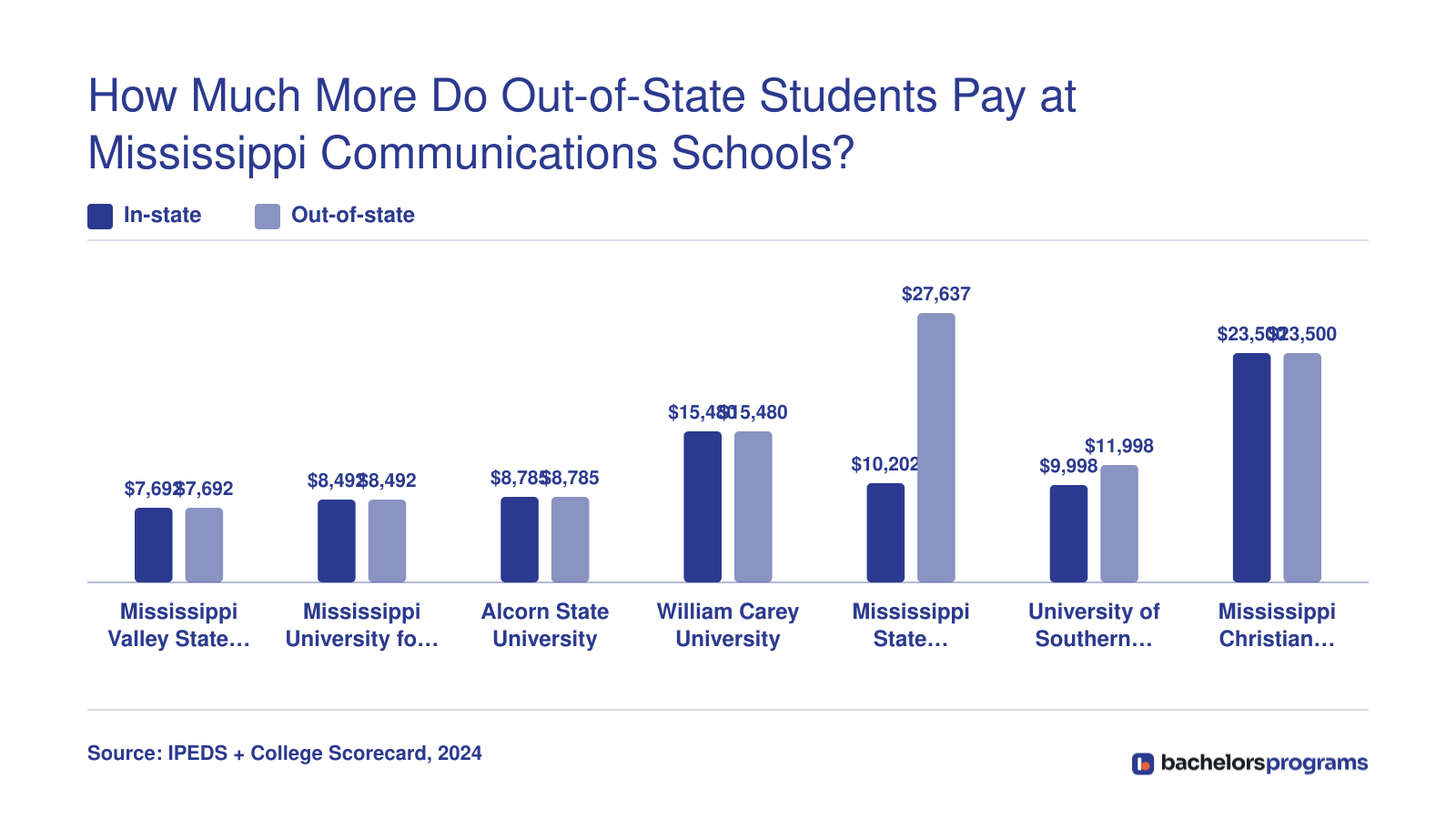
How Much More Do Out-of-State Students Pay at Mississippi Communications Schools?
Most of the schools ranked here charge the same undergraduate tuition and fees whether you live in Mississippi or not, so a nonresident pays nothing extra at Mississippi Valley State, Mississippi University for Women, Alcorn State, William Carey or Mississippi Christian. The gap shows up at two public universities: Mississippi State charges out-of-state students $27,637, which is $17,435 more than its $10,202 in-state rate, while Southern Mississippi's nonresident rate of $11,998 is only $2,000 above its $9,998 in-state figure. Some universities bill online courses at a separate per-credit rate, so if you plan to study online from outside Mississippi, ask the bursar which rate applies to you before you compare costs.
Communications Careers and Salaries in Mississippi
Mississippi had about 950 public relations specialists in May 2025, with a mean annual wage of $64,830.1 Nationally, the median for the same occupation was $74,750.2 The figures below come from the latest federal wage data, and the comparison needs one caution. Mississippi's state release reports mean, entry-level and experienced wages rather than medians, so the state and national numbers are not like-for-like. Read the gap as a general guide, not an exact one.
Wages by Occupation
- Public relations specialists: Mississippi employment was 950, with a $64,830 mean. Entry-level pay was $40,440 and experienced pay was $76,850. The national median was $74,750 across 283,380 jobs. This path fits public relations and strategic communication coursework.
- News analysts, reporters and journalists: Mississippi employment was 310, with a $49,700 mean.1 Entry-level pay was $31,630 and experienced pay was $58,600. The national median was $62,200 across 39,250 jobs.2 This is the destination for journalism-focused study.
- Media and communication workers, all other: Mississippi reports an entry-level wage of $26,970, but the state extract gives no employment or mean figure. Nationally, 19,590 people held these jobs at a $83,860 mean.2 The broader national media and communication group had a $74,250 median across 613,530 jobs. This catch-all category suits graduates of general media and mass communication tracks, such as those at William Carey University and Alcorn State University.
What the Numbers Suggest
Mississippi's job counts are small, especially in news. Reporting roles pay noticeably less than public relations in the state, and starting pay in both fields sits well below the national medians. Students who want the strongest earning prospects should look at public relations and strategic communication, and should be open to remote or out-of-state roles as experience builds. Internships and campus media work matter a great deal in a market this size.
Licensing
Mississippi does not require a state license to work in public relations, journalism or general media roles. A bachelor's degree in communications, plus a portfolio of clips, campaigns or production work, is what employers typically look for.
Compare Communications programs on the data that matters
Explore more Communications & Media majors or browse every field of study.
All Communications & Media programs Browse every field of study