Best Communications Degree Programs in Montana
Compare 7 accredited Communications programs in Montana at 4 colleges, with net price after aid, graduation rates, earnings and debt from IPEDS and the U.S. College Scorecard.

Earning a communications bachelor's degree in Montana means studying how messages work in media, public relations, organizational settings and public argument, often at a school small enough for direct faculty contact. The common credential is the Bachelor of Arts (B.A.) in Communications, offered under the communication studies label at most campuses here, including The University of Montana, Carroll College, Rocky Mountain College and Montana State University Billings.
Small classes, direct faculty access and ties to local newsrooms, nonprofits and state agencies are the draw. The tradeoff is a thinner employer base than larger states offer, so internships and in-state networking carry real weight.
Key Points
- Montana State University Billings delivers its Communication B.A. fully online.
- University of Montana graduates' $54,300 median earnings nearly triple their debt.
- Admission is accessible: The University of Montana admits about 95.9% of applicants.
Best Bachelor's Degree in Communications Programs in Montana, Ranked
Every Montana college below awards a Bachelor of Arts in Communications or communication studies, and each card carries the city, delivery format, in-state tuition, an average net price after aid and a graduation rate for the school that runs the program. Treat the net price as a sector-average estimate rather than a quote for what any one student will pay, and read the graduation rate as an institution-wide figure that describes the schools offering the program, not the major itself. Montana is a small market, so these four campuses differ more by program structure and access to internships than by size.
The University of Montana
#1Missoula, MT · ~$17,000/yr (est.)
Best for: Advocacy-focused students wanting internship depth
The University of Montana's communication studies department builds its 45-credit B.A. around an Advocacy and Social Movements concentration that leans into environmental and technology rhetoric, persuasion and public discourse. Students can take recurring internships each semester and through the summer, design community or organizational projects for credit, and pick up service-learning work such as the research methods course that creates messaging for the Humane Society of Western Montana. Study-abroad options in Central Europe center on propaganda and advocacy, and the department also runs in-state graduate and certificate pathways in health communication and public relations.
- 45 total credit hours, 36 of them in communication studies
- 18 credits must be numbered 300 or above
- 12 credits of concentration courses such as argumentation and rhetoric of women's activism
- 9 credits of allied coursework in history, sociology, environmental or gender studies
- 2.0 GPA and a C- or better in major courses to graduate
- Internships available every semester and over the summer
Carroll College
#2Helena, MT · ~$24,000/yr (est.)
Best for: Students choosing between interpersonal and PR tracks
Carroll College is a private Catholic liberal arts college in Helena where the communication studies major runs 40 to 51 credits on a 19-credit core before splitting into two tracks. Seniors sit a two-part comprehensive exam, and up to 6 forensics credits at the 200 level or above count toward the major. The Prospector student newspaper supplies practicum experience, and the department steers students on the public relations side toward a marketing minor.
- Two tracks: Interpersonal Communication (21 credits) and Public Relations and Social Media (32 credits)
- 40 to 51 total credits on a 19-credit core
- Senior comprehensive exam in two parts, with the written portion waived for thesis students
- Up to 6 forensics credits at the 200 level or above count toward the major
- Prospector student newspaper practicum available
- Marketing minor encouraged for the PR track
Rocky Mountain College
#3Billings, MT · $15,000 – $20,000/yr (est.)
Best for: Billings-area students seeking local internships
Rocky Mountain College in Billings runs communication studies as both a major and a minor, with classes on campus and projects that carry into the wider Billings community. Core work opens with an introduction to communication studies covering interpersonal dialogue, group dynamics, mass media and the digital world, then spreads into health, organizational, intercultural, rhetorical and political or environmental communication. Students finish with internships, practicums or a senior seminar, and the program reports that most of its students land internships and receive scholarships or grants.
- 88% of students placed in internships
- 99% receive scholarships or grants
- Double major option with Psychology or Business
- Coursework in health, organizational, intercultural and political communication
- Small classes held on campus and across Billings
- Finishes with an internship, practicum or senior seminar
Montana State University Billings
#4Billings, MT · $17,000/yr (est. net price)
Montana State University Billings offers the only fully online route to the degree in this group, a Bachelor of Arts in Communication backed by advisor support and transfer credit evaluation for prior coursework. On campus, the department splits the major into Media Studies, Organizational Communication and Public Relations emphases. The organizational track prepares managers, trainers and human resources staff, media studies covers message construction and effects, and the public relations emphasis follows the PRSA curriculum model.
- Fully online Bachelor of Arts in Communication
- Concentrations in Organizational Communication and Media Studies
- Previous credits evaluated for transferability
- Career paths in public relations, news reporting, fundraising and corporate communication
- 120 total credits including general education and a capstone
- Coursework in news reporting, public relations, video production and advertising
- Critical media analysis alongside theoretical and applied knowledge
- C or above required in major courses
- Focus on interaction in business and social service settings
- Prepares managers, trainers, human resource officers and corporate communication staff
- Emphasis on real-world organizational applications
- Internship opportunities included
- Follows the PRSA curriculum model
- Prepares for PR roles in corporate, nonprofit, government and health care settings
- Theoretical grounding in public relations with applied coursework
Cost & outcomes by school
Federal data for the highest-earning Communications programs, independent of the ranking above. Earnings are this field's bachelor's graduates four years after completing where the Scorecard reports them, else the school's undergraduate median.
| School | Net price / yr | Grad rate | Earnings | Debt | Grads/yr | Format |
|---|---|---|---|---|---|---|
| Carroll College MT | $23,960 | 69% | $61,772 | $25,757 | 5 | Campus |
| The University of Montana MT | $16,784 | 48% | $54,300 | $18,687 | 35 | Campus |
| Rocky Mountain College MT | $19,751 | 48% | $49,036 | $26,000 | 4 | Campus |
| Montana State University Billings MT | $16,524 | 30% | $44,296 | $18,209 | 4 | Online |
Sources: U.S. Department of Education. Net price, graduation rate, earnings and debt: College Scorecard (earnings and debt for this field's bachelor's graduates where reported, else school-wide); graduates: IPEDS. A dash means no figure is reported.
Cost, debt & payoff
Median earnings of this field's bachelor's graduates (4 yrs after completing, else the school's undergraduate median) vs. their median federal loan debt · U.S. College Scorecard
Across these programs the median graduate earns about $44,296 and finishes with roughly $18,209 in debt — a ratio that clears a common rule of thumb (keep debt below first-year salary). Net price and debt vary widely school to school, so check the per-school figures in the table above before you shortlist.
How We Ranked Montana Communications Programs
Comparing Montana communications programs fairly comes down to a few College Scorecard measures: cost, completion and payoff. Only bachelor's programs in Montana, whether on campus or online, are included.
Measures Tied to Cost and Progress
- Net price: What students pay after grants and scholarships, not the sticker tuition. It is the better guide to what your family will actually owe.
- Graduation rate: The share of students who finish. A higher rate suggests a school that keeps students on track.
- Program completions: How many students earn a communications bachelor's degree. Steady completions point to an established program with real classmates and course variety.
Measures Tied to Outcomes
- Program-level earnings: What communications graduates earn after finishing, where the federal data reports it.
- Program-level debt: What graduates in the field typically borrow, which lets you weigh pay against loan payments.
What the School-Wide Numbers Don't Show
Graduation rate, median debt and 10-year earnings for the institution describe the whole school, every major combined. They are not communications-specific. Treat them as context for a school's overall track record, then lean on the program-level figures and ask each department directly about its own graduates' results.
Communications Concentrations Compared: Media, PR, Organizational and Rhetoric
Montana communications programs differ most in how they let you specialize. Some split the major into named tracks for public relations, media or organizational work, while others offer one broad communication studies path you can shape with a minor, double major or internships. Use the table below to match a concentration to the career direction you have in mind.
| Concentration | School | Format | Focus and Career Direction | Credit Details |
|---|---|---|---|---|
| Public Relations and Social Media | Carroll College | Campus | PR and social media track; a marketing minor is encouraged | 32 credits |
| Interpersonal Communication | Carroll College | Campus | Interpersonal communication track within the Communication Studies BA | 21 credits |
| Media Studies | Montana State University Billings | Online | Message construction and effects; paths include PR, news and advertising | N/A |
| Organizational Communication | Montana State University Billings | Online | Prepares graduates for roles as managers, trainers and HR professionals | N/A |
| Advocacy and Social Movements | The University of Montana | Campus | Advocacy-focused concentration within the Communication Studies B.A. | 12 concentration credits within 36 communication studies credits; C- or better in major courses |
| Communication Studies (general) | Rocky Mountain College | Campus | Careers such as PR specialist, event planner and journalist; double major option with Psychology or Business | N/A |
Online and Hybrid Bachelor's in Communications Options at Montana Schools
Montana State University Billings lists a fully online B.A. in Communication with two concentrations, Organizational Communication and Media Studies. It is the clearest online route among the schools here, though confirm current delivery on the school's own page before you apply.
How the Montana Programs Sort by Format
- Online: MSU Billings, which publishes a dedicated online page for the degree. Its pages do not mention a residency or other in-person requirement, so ask an advisor whether any practicum or capstone must be done on site.
- Online-listed, delivery varies: The University of Montana lists its Communication Studies B.A. as available online. Its catalog warns that required courses may not be consistently offered online, so a full online path is not guaranteed. Confirm the course sequence with the department before you commit.
- Campus-based: Carroll College (Helena) and Rocky Mountain College (Billings) describe their programs as on-campus. Neither presents a fully online communications bachelor's. Carroll's newspaper practicum and Rocky Mountain's internships and senior seminars are built around being nearby.
UM also offers a separate Communicative Sciences and Disorders B.A. that is fully online and asynchronous with no face-to-face sessions. It is a different field from communication studies, so do not treat it as a substitute.
Which Format Fits Which Student
For working students, MSU Billings is the practical pick: a fully online degree lets you study around a job. Rural Montanans far from Billings, Helena or Missoula can start there too, or ask UM which required courses are offered online in a given term. Out-of-state students who want a Montana-based school will find MSU Billings the most straightforward fit. Carroll and Rocky Mountain suit students who can relocate and want small classes, internships and campus media experience.
Related Articles
Admission Requirements for Montana Communications Bachelor's Programs
Test-optional admission is now common at U.S. campuses, and Montana's communications programs follow that pattern. Policies still differ by school, so check each one before you apply.
School-by-School Policies
- The University of Montana: Admits about 95.9% of applicants, making it the most open option here. SAT or ACT scores are not required for general admission, though they are encouraged for course placement. Transfer applicants need a 2.0 cumulative GPA and at least 12 non-remedial college semester credits.
- Carroll College: Admits about 70.9% of applicants. The admissions material reviewed publishes no minimum GPA, test policy or transfer-credit rule, so confirm each with the admissions office.
- Rocky Mountain College: Admits about 69.6% of applicants. As with Carroll, no minimum GPA, test policy or transfer-credit rule appeared in the material reviewed.
- Montana State University Billings: Publishes no minimum freshman GPA. Admitted students average a 3.2 high school GPA, but that is an average, not a cutoff.1 A 2026 profile describes the school as test-optional, with a middle-half ACT range of 17 to 24 among admitted students.1 Because the official admissions page does not restate that policy, verify it, especially for your specific program.
Montana Transfer Pathways
Starting at a two-year college and finishing a communications bachelor's is a workable route, provided you plan the credits.
- Keep your cumulative GPA at 2.0 or higher. At MSU Billings, students arriving from public Montana two-year and tribal colleges through an approved general education program need a C- or better in each general education course.
- Take courses in the Montana University System Transferable Core where you can. MSU Billings accepts up to 30 semester credits of it across six areas.
- Know the candidacy rules. Students in candidacy status at UM or MSU Billings must complete 20 credits at the new school, at a 2.0 GPA, before earlier credits are reviewed.
- Send official final transcripts directly from each college.
- Ask each department how your credits apply to the communications major. UM sets no general transfer maximum and does not guarantee that credits will count toward a degree, so accepted credits may still land as electives.
Questions to Ask Yourself
Do you want to live in Montana, or would a Montana-based online program let you stay where you are?
Do you want a media-production or public relations focus, or an organizational or rhetoric emphasis?
Will a lower in-state net price outweigh a program with more internship or newsroom opportunities?
Cost of a Communications Bachelor's Degree in Montana
Montana's public campuses carry far lower sticker prices than its private colleges, but residency and aid can shrink or widen that gap quickly. The figures below show what that gap looks like.
Sticker Price vs. Net Price
At The University of Montana, in-state tuition and fees run $9,750 for 2026-27. Total cost of attendance is $34,086 for residents and $60,454 for out-of-state students. Montana State University Billings charges residents $5,285 in tuition plus $2,404 in mandatory fees (FY2026), while nonresidents pay $20,756 in tuition plus $2,554 in fees. The two private options, Carroll College ($41,484) and Rocky Mountain College ($35,582), charge the same rate regardless of residency.
After aid, the spread narrows: Montana State University Billings averages $16,524, The University of Montana $16,784, Rocky Mountain College $19,751 and Carroll College $23,960. Montana State University Billings is the most affordable option here on that measure.
Net price is an average, so your own bill depends on income and aid. Pell share hints at how common need-based aid is: about 62 percent of students at both Montana State University Billings and The University of Montana receive Pell Grants, compared with roughly 51 percent at Rocky Mountain College and 41 percent at Carroll College.
Montana Aid and Tuition Discounts
- Montana Higher Education Grant: Need-based aid for Montana-resident undergraduates that does not have to be repaid. Award amounts and deadlines change, so check current figures before you plan around it.
- Montana Promise: Pays $1,000 per semester for full-time students and $500 for those taking 6 to 11 credits. It applies to Montana residents enrolled at least half-time at a community college, tribal college or two-year campus in a program leading to transfer or an associate degree. You must file the FAFSA every year.
- Western Undergraduate Exchange (WUE): A tuition discount, not a cash award, for students from nearby western states. Participating schools charge no more than 150 percent of in-state tuition. At The University of Montana, WUE tuition and fees come to $6,887, and total WUE cost of attendance is $39,334. It is competitive, open to incoming students only, and excludes online-only enrollment. Apply by December 1, 2026 for automatic consideration.
One Way to Cut the Bill
Start at a two-year Montana campus with Montana Promise covering part of the cost, then transfer into a communications bachelor's program for your final two years. Out-of-state students should apply for WUE before the deadline.
How Do Communications Graduates' Earnings Compare With Their Debt in Montana?
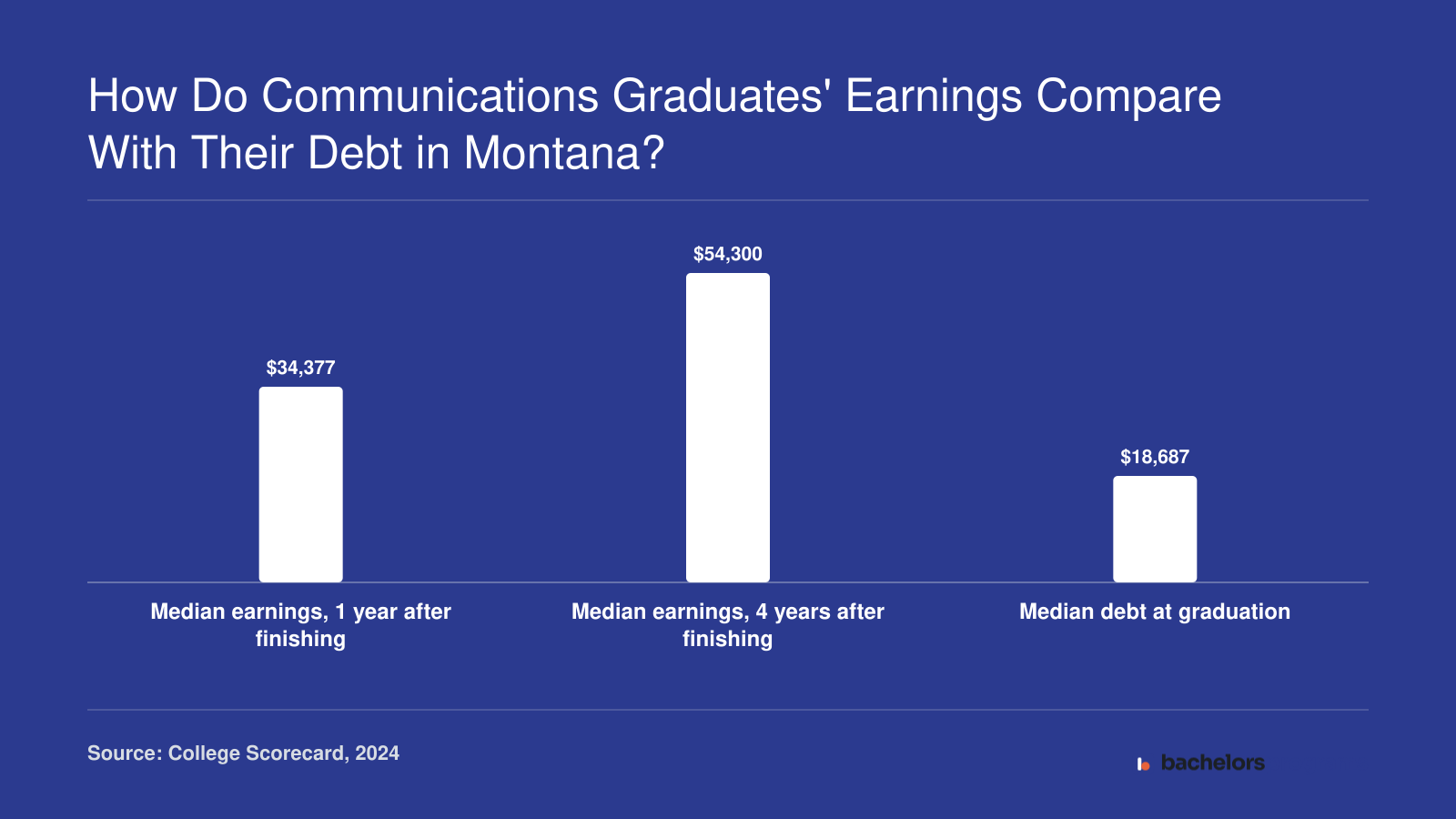
At The University of Montana, Communication Studies B.A. graduates earn a median $34,377 one year after finishing and $54,300 four years after finishing. That four-year figure is nearly three times their median debt of $18,687. Carroll College, Rocky Mountain College and Montana State University Billings graduate too few communications students for program-level earnings or debt to be reported, so they are not charted here.
What Communications Graduates Earn Early in Their Careers
Program-level earnings show how a bachelor's degree in communications in Montana can pay off in the first few years after graduation.
Montana Communications Degree FAQ
These answers draw on the figures and findings covered earlier on this page. Where a school has not published a comparable detail, the answer says so rather than guessing.
How do the University of Montana and Montana State University Billings compare for communications?
Which Montana school is the most affordable for a communications degree?
Are there online communications bachelor's programs in Montana?
What jobs can you get with a communications degree in Montana?
Compare Communications programs on the data that matters
Explore more Communications & Media majors or browse every field of study.
All Communications & Media programs Browse every field of study