Best Communications Degree Programs in Utah
Compare 19 accredited Communications programs in Utah at 9 colleges, with net price after aid, graduation rates, earnings and debt from IPEDS and the U.S. College Scorecard.
Median student debt for a communications graduate from a Utah school runs from roughly $12,450 to $17,500, and the credential behind those figures is nearly always the Bachelor of Arts (B.A.) in Communications. Utah schools offer it on campus, and several extend it online.
The harder decision is fit. An accredited journalism sequence at Brigham Young University is a different degree in practice from an applied communication track at Utah Valley University, even though both carry the same name on the transcript.
Employers in Salt Lake City and Provo hire from both. What separates graduates is the portfolio, not the diploma.
Key Points
- Brigham Young University ranks first, with ACEJMC accreditation since 1985.
- Utah Valley University has the lowest average net price here.
- In Utah, public relations and marketing management medians sit nearly $80,000 apart.
Best Bachelor's Degree in Communications Schools in Utah: Ranked List
Brigham Young University leads this list because its School of Communications has held ACEJMC accreditation since 1985, it runs four separate bachelor's sequences in Provo, and its communication graduates post the strongest four-year earnings mark among the Utah schools we examined. Each entry below shows what the degree covers, the net price students pay after aid, the school-wide graduation rate, and whether you can study on campus or online.
Brigham Young University
#1Provo, UT · $15,000 – $20,000/yr (est.)
Best for: Advertising and PR hopefuls
Brigham Young University's School of Communications has been ACEJMC accredited since 1985 and runs four bachelor's sequences from its Provo campus: Media & Society, Advertising, Journalism & Sports Media, and Public Relations. Net price after aid is about $15,564, and 81% of the school's students graduate. Communication graduates here report median earnings of $68,843 four years after finishing, with median debt of $19,680, the strongest four-year earnings figure among the Utah schools on this list.
- 40 credit hours, plus 1 credit of internship or mentored research
- Prerequisite writing course and two gateway courses at B or better
- AP English credit not accepted toward admission requirements
- Coursework in media law, ethics, history, research methods, media effects
- 2026-2027 academic plan published
- Application required for admission to the sequence
- Hands-on experiential learning with industry-expert faculty
- Internships and mentorships available to admitted students
- Housed in the George H. Brimhall Building
- Professional labs with student e-portfolios
- Internships in news and sports media
- Mentorship from faculty with industry experience
- Professionalism policy applies to admitted students
- Training in responsible advocacy and strategic persuasion
- Mass media and society coursework
- Professional labs and internship options
- Scholarships and awards available to majors
University of Utah
#2Salt Lake City, UT · $10,000 – $31,000/yr (est.)
Best for: Salt Lake City students eyeing sports media
The University of Utah runs one of the state's largest communication departments, awarding more than 300 bachelor's degrees in a recent year across four emphases that include Strategic Communication and Journalism. In August 2026 the department opened a sports-broadcast studio in the Language & Communication Building with Utah Athletics, giving students internships alongside professional ESPN+ production crews. Net price after aid is about $16,200, 65% of students graduate, and communication graduates report median earnings of $63,309 four years after finishing with median debt of $17,500.
- BA and BS options across four department emphases
- Coursework in ethical communication, persuasion, social influence
- Internship opportunities and an honors thesis option
- Popular as a double major with business or social science
- Department scholarships and academic advising available
- Newsroom-style technical training paired with theory
- Student media organizations open to majors
- Career coaching through the department
- Focus on health, environmental, and risk messaging
- Personalized curriculum built with an advisor
- Pairs well with a second major in a science field
Southern Utah University
#3Cedar City, UT · $7,000 – $21,000/yr (est.)
Best for: Rural learners needing a fully online emphasis
Southern Utah University offers a BA or BS in Communication with six emphases, and the New Media emphasis can be completed entirely online, making it the most flexible in-state option among Utah's public universities. Students produce work for the University Journal, SUTV television, and KSUU Thunder 91 radio, and the department uses virtual reality and eye-tracking equipment for nonverbal communication training. Net price after aid is about $10,462, 61% of students graduate, and communication graduates report median earnings of $44,461 four years after finishing.
- Six emphases, including Media Studies and Sports Communication
- New Media emphasis can be completed entirely online
- Student work for the University Journal, SUTV, and KSUU radio
- Virtual reality and eye-tracking tools for nonverbal training
- Certificates in speech writing, social media, and technical writing
- Teaching license option through the Department of Teacher Education
Utah State University
#4Logan, UT · $9,000 – $25,000/yr (est.)
Utah State University's Communication Studies degree is built around how messages work inside organizations and communities, with emphasis areas that include conflict management, leadership, health outreach, and intercultural communication. Students choose a BA path with foreign language proficiency or a BS with focused coursework, and admission to the major is reviewed on a rolling basis with a 2.5 GPA minimum. Net price after aid is about $14,936, 59% of students graduate, and communication graduates report median earnings of $58,672 four years after finishing, with median debt of $13,960.
- Tracks: Intercultural Communication, Organizational Communication
- 2.5 GPA minimum to enter the major
- BA requires foreign language proficiency; BS takes focused coursework
- Emphasis areas include conflict management and leadership
- Rolling admission review, with a pre-major option
- Prepares students for graduate study or law school
Utah Valley University
#5Orem, UT · $5,000 – $10,000/yr (est.)
Utah Valley University's Applied Communication degree is the skills-forward option on this list, built on 18 core credits and 18 elective credits covering public speaking, research methods, data literacy, and conflict negotiation. Students can finish on campus in Orem or through a fully online BS track that publishes an online graduation plan. Net price after aid is the lowest here at about $6,376, 45% of students graduate, and communication graduates report median earnings of $62,566 four years after finishing, with median debt of $13,942.
- 36 credits in the major: 18 core and 18 elective
- Public speaking, intercultural communication, and research methods
- Data literacy, conflict negotiation, and ethical decision-making
- Minor option available
- 120 total credit hours, including 40 upper-division
- Fully online option with an online graduation plan
- 2.0 GPA minimum for admission
- Capstone required
Weber State University
#6Ogden, UT · ~$10,000/yr (est.)
Weber State University's communication department leans on small classes and hands-on production, with six emphases and student work published and broadcast through The Signpost newspaper, Studio 76, and Wildcat Radio. The department fields an award-winning debate team and a PRSSA chapter, and counts a Pulitzer Prize winner among its alumni. Net price after aid is about $10,258, 46% of students graduate, and communication graduates report median earnings of $59,969 four years after finishing, with median debt of $16,749.
- Tracks: Civic Advocacy, Digital Media, Multimedia Journalism, PR
- Student work with The Signpost, Studio 76, and Wildcat Radio
- Award-winning debate team and PRSSA chapter
- Small classes with hands-on audio and video production
- Alumni include a Pulitzer Prize winner
Westminster University
#7Salt Lake City, UT · ~$27,000/yr (est.)
Westminster University is the small-private option here, with a 124-credit BA in Communication that pairs theory with a required internship and a senior portfolio workshop built around industry-standard design software. Classes are small, admission sits at a 2.3 GPA minimum, and the Salt Lake City location puts students near the state's largest media and public relations employers. The trade-off is price: net price after aid is about $27,094, the highest on this list, and 64% of students graduate. Communication graduates report median earnings of $59,676 four years after finishing, with median debt of $25,000.
- 124 total credit hours; 2.3 GPA minimum
- Required internship plus a senior portfolio workshop
- Layout and design training on industry-standard software
- Coursework on disinformation, media writing, and ethics
- Electives in video production, public relations, intercultural comm
Ensign College
#8Salt Lake City, UT · ~$11,000/yr (est.)
Ensign College is a private Salt Lake City institution whose Bachelor of Applied Science in Communication is built for workplace application: 120 credits on a block schedule, a required capstone and internship, and certificate add-ons in digital content creation and social media marketing. Religion cornerstone courses are part of the degree, and graduates move into human resources, public relations, and sports broadcasting roles. Net price after aid is about $10,824, and 43% of students graduate.
- 120 credit hours with a capstone and internship
- Block schedule; starts fall, winter, or spring
- Certificates in digital content creation and social media marketing
- Religion cornerstone courses required
- Prepares for HR, public relations, and sports broadcasting roles
Utah Tech University
#9Saint George, UT · $16,000/yr (est. net price)
Utah Tech University's BS in Communication Studies is a theory-plus-practice degree with a 120-credit core covering communication theory, public speaking, intercultural and gender communication, ethics, research methods, and a senior seminar capstone. Declaring the major takes an advisor consultation and departmental approval, and students complete at least 21 credits of communication electives plus 40 upper-division credits. Net price after aid is about $16,039, 38% of students graduate, and communication graduates report median earnings of $50,755 four years after finishing, with median debt of $19,555.
- 120 credits with a senior seminar capstone
- 21 credits of communication electives
- 2.0 GPA to enter; 2.5 GPA to graduate
- Advisor consultation and departmental approval to declare
- 40 upper-division credits, 30 completed at Utah Tech
- Lambda Pi Eta honor society chapter
Cost & outcomes by school
Federal data for the highest-earning Communications programs, independent of the ranking above. Earnings are this field's bachelor's graduates four years after completing where the Scorecard reports them, else the school's undergraduate median.
| School | Net price / yr | Grad rate | Earnings | Debt | Grads/yr | Format |
|---|---|---|---|---|---|---|
| Brigham Young University UT | $15,564 | 81% | $68,843 | $19,680 | 61 | Campus |
| University of Utah UT | $16,200 | 65% | $63,309 | $17,500 | 293 | Campus |
| Utah Valley University UT | $6,376 | 45% | $62,566 | $13,942 | 1 | Campus |
| Weber State University UT | $10,258 | 46% | $59,969 | $16,749 | 72 | Campus |
| Westminster University UT | $27,094 | 64% | $59,676 | $25,000 | 10 | Campus |
| Utah State University UT | $14,936 | 59% | $58,672 | $13,960 | 58 | Campus |
| Utah Tech University UT | $16,039 | 38% | $50,755 | $19,555 | 84 | Campus |
| Ensign College UT | $10,824 | 43% | $50,630 | — | 55 | Campus |
| Southern Utah University UT | $10,462 | 61% | $44,461 | $12,450 | 82 | Hybrid |
Sources: U.S. Department of Education. Net price, graduation rate, earnings and debt: College Scorecard (earnings and debt for this field's bachelor's graduates where reported, else school-wide); graduates: IPEDS. A dash means no figure is reported.
Cost, debt & payoff
Median earnings of this field's bachelor's graduates (4 yrs after completing, else the school's undergraduate median) vs. their median federal loan debt · U.S. College Scorecard
Across these programs the median graduate earns about $59,969 and finishes with roughly $17,125 in debt — a ratio that clears a common rule of thumb (keep debt below first-year salary). Net price and debt vary widely school to school, so check the per-school figures in the table above before you shortlist.
Most Affordable Bachelor's Degree in Communications Schools in Utah
These schools are sorted by average annual net price, the amount a typical student pays after grants and scholarships, using federal IPEDS and College Scorecard data. Utah Valley University has the lowest net price in this table, and Southern Utah University is the only one here that offers an online path alongside its campus program. Published in-state tuition and fees are shown for comparison, though your own net price will depend on the aid you receive.
| School | City | Program | Average Annual Net Price | In-State Tuition and Fees | Format |
|---|---|---|---|---|---|
| Utah Valley University | Orem | Applied Communication | $6,376 | $6,507 | On campus |
| Weber State University | Ogden | Communication | $10,258 | $6,557 | On campus |
| Southern Utah University | Cedar City | Communication (BA/BS) | $10,462 | $6,962 | On campus and online |
| Ensign College | Salt Lake City | Communication | $10,824 | $4,004 | On campus |
| Utah State University | Logan | Communication Studies | $14,936 | $9,228 | On campus |
How We Ranked These Schools and What Accreditation to Look For
A familiar campus name and a verified accreditation status are not the same thing, and only one of them affects your financial aid, your transfer credits, and whether a graduate school or employer takes your transcript seriously. Before you commit to any program here, spend twenty minutes confirming the paperwork yourself.
Institutional vs. Programmatic Accreditation
Institutional accreditation covers the whole university. In Utah, that is handled by the Northwest Commission on Colleges and Universities (NWCCU), and you can confirm any school's current standing by searching the institution directory at nwccu.org. This is the accreditation that matters most: it governs federal aid eligibility and how smoothly credits move between schools.
Programmatic accreditation is narrower. For communications and journalism, the relevant body is the Accrediting Council on Education in Journalism and Mass Communications (ACEJMC), which publishes its accredited programs list at acejmc.org. Most communications bachelor's degrees in the United States are not ACEJMC accredited, and that absence is not a red flag on its own. It is simply an extra credential some journalism-heavy programs pursue.
A Verification Checklist
- Start at the source: Open the department page or academic catalog on the school's official website and look for a written accreditation statement.
- Cross-check the claim: If a program advertises ACEJMC status, confirm it against the ACEJMC list rather than trusting a brochure or landing page.
- Re-check before you enroll: Accreditation is reviewed on a cycle and can change, so confirm status in the term you apply.
Where to Get Career Context
For realistic expectations about the work itself, read the Occupational Outlook Handbook entries at bls.gov for reporters, editors, and public relations specialists. Professional associations including SPJ, PRSA, and ONA publish industry standards, student chapters, and portfolio guidance worth reviewing while you compare programs.
What You Study in a Bachelor's Degree in Communications in Utah
A bachelor's degree in communications teaches you to build a message, choose the channel and measure the result. Most of the degree is practice: writing, speaking, producing media and researching audiences, alongside theory courses that explain why a campaign worked.
B.A. or B.S. tracks
Utah schools split on this. The B.A. usually carries a foreign language requirement; Utah State, for example, lists language proficiency for its B.A. and offers a B.S. alongside it. The University of Utah advertises both options, Southern Utah awards either a B.A. or a B.S., and Utah Tech's program is a B.S. Broadly, the B.S. trades language study for more quantitative and research-heavy work, a fit for analytics or graduate study.
Concentrations and where they lead
- Strategic communication and PR: the University of Utah's Strategic Communication emphasis covers public relations, advertising and marketing, and BYU offers Public Relations and Advertising emphases. These suit agency, corporate and nonprofit roles.
- Journalism and sports media: BYU's Journalism & Sports Media emphasis and Weber State's student newspaper, TV and radio operations point toward reporting and broadcast work.
- Digital media: Southern Utah's New Media emphasis runs fully online, and Ensign College pairs its major with certificates in digital content creation and social media marketing.
- Communication studies: BYU's Media & Society emphasis and Utah State's conflict management area suit law, policy or human resources paths.
Skills you leave with
- Writing and editing: press releases, scripts and campaign copy, with Westminster's senior portfolio workshop pulling the work together.
- Production: audio and video, layout and design, and industry-standard software at Weber State and Westminster.
- Research: Utah Valley builds research methods and data literacy into its core requirements.
Online and Hybrid Bachelor's in Communications Options at Utah Schools
Communications degrees come in plenty of flexible formats, but certainty that you can finish one from home is harder to come by. Among the Utah schools here, delivery varies more than the program names suggest, so check the details before you apply.
Fully Online Options
Southern Utah University offers its Communication bachelor's degree (B.A. or B.S.) on campus and online, and its New Media emphasis can be completed fully online. That makes it the clearest option for students who cannot relocate to Cedar City.
Utah Tech University offers a fully online, asynchronous Bachelor of Science in Communication Studies worth 120 credits. A Health Communication version follows the same format.1 One caveat applies: Utah Tech's program page says some electives are not yet offered online. Juniors and seniors are told to consult an advisor to confirm they can finish the degree without coming to campus, so ask about your elective path early.
Campus-Based Programs
Brigham Young University, the University of Utah, Utah State University, Utah Valley University, Weber State University, Westminster University and Ensign College deliver their communication bachelor's programs on campus. If you are weighing these schools, plan for in-person classes.
Utah Tech's Professional Communication degree-completion program is also in person, not online and not hybrid. Students meet one evening a week (Tuesday or Wednesday) and take one course per month over five semesters, after finishing general education or an associate degree.2
Which Format Fits You
- Working adults: Utah Tech's asynchronous online degree and Southern Utah's online option let you study around a job. The Professional Communication evening program suits local adults who want a fixed schedule and a defined finish line.
- Transfer students: Utah Tech's degree-completion track is built for students who already hold an associate degree or have completed general education. Online students elsewhere should ask each school how prior credits will apply.
Do not assume online tuition matches the on-campus rate. Ask each school for its online per-credit price and any distance-learning fees before you compare costs.
Related Articles
Admission Requirements: GPA, Test Policy and Transfer Credit
Admission requirements are the GPA, test-score and transfer-credit rules a school sets before it enrolls you in a bachelor's degree in communications. Here is what each school's official admissions pages state.
School-by-School Policies
- University of Utah: No minimum GPA for transfer admission, though the 75th-percentile GPA among recent transfer admits was 3.1.1 Applicants with 30 or more transferable credits must meet a cumulative GPA set by the admissions committee.1 ACT/SAT scores are optional for admission, merit scholarships and direct admission, but required for homeschooled, unaccredited-high-school and GED applicants.2 Credit from regionally accredited colleges is reviewed course by course, with grades of D- or better accepted and no cap on credits for admission.3
- Brigham Young University: No published policy.
- Utah State University: No published policy.
- Weber State University: No published policy.
- Utah Valley University: No published policy.
- Southern Utah University: No published policy.
- Utah Tech University: No published policy.
- Westminster University: No published policy.
- Ensign College: No published policy.
Open Admission Versus Selective Schools
Open-admission schools generally enroll applicants who meet a basic threshold, such as a diploma or equivalent. Selective schools weigh GPA, coursework and sometimes essays. Confirm which category a school falls into on its own admissions page before you apply.
Check the Major Requirements
Getting into a university does not guarantee entry to its communications major, so look at the department's own page too. At the University of Utah, the Office of Admissions decides whether a course transfers, and the Communication department decides how it applies.4 Students under the 2025 and later catalogs can count up to six Communication courses from another school toward the major, versus four for 2021 through 2024 catalog years.5
Utah State Grants and Scholarships That Can Lower the Bill
Utah's state aid once centered on merit scholarships earned in high school. For new students, the aid that matters is need-based and runs through the FAFSA. Knowing which programs still accept applicants keeps you from chasing awards that have closed.
Regents' and New Century: Closed to New Students
The Regents' Scholarship and the New Century Scholarship took their final applicants from the Utah high school class of 2021. Starting with the class of 2022, the state replaced both with the Opportunity Scholarship. Earlier recipients remain eligible for the award they qualified for, so confirm the amount and renewal terms with your school's aid office. Students finishing high school in 2026 should not plan around either program.
Utah Promise: Need-Based Help for Residents
The statewide Utah Promise grant serves recent Utah high school graduates and adult residents. You need Utah residency, a completed FAFSA and demonstrated financial need. It pays published tuition and fees left after other grants, waivers and scholarships, so there is no fixed dollar award.
The University of Utah runs a narrower version for first-time freshmen who graduate high school in 2026 or later. It requires a 3.5 unweighted GPA, Utah residency at application, and family income and assets within $100,000 limits. It covers tuition and mandatory fees for up to eight full-time semesters if you keep your GPA up and refile the FAFSA each year.
School Scholarships and Deadlines
Brigham Young University, Utah State University, Weber State University and the other schools ranked here also award their own scholarships. File the FAFSA, then contact each school's financial aid office for current options.
Aim for December 1 for admission and February 1 for the FAFSA. Those are the University of Utah's Promise dates, and applying that early rarely hurts at any school.
How Much Debt Do Communications Graduates Borrow in Utah?
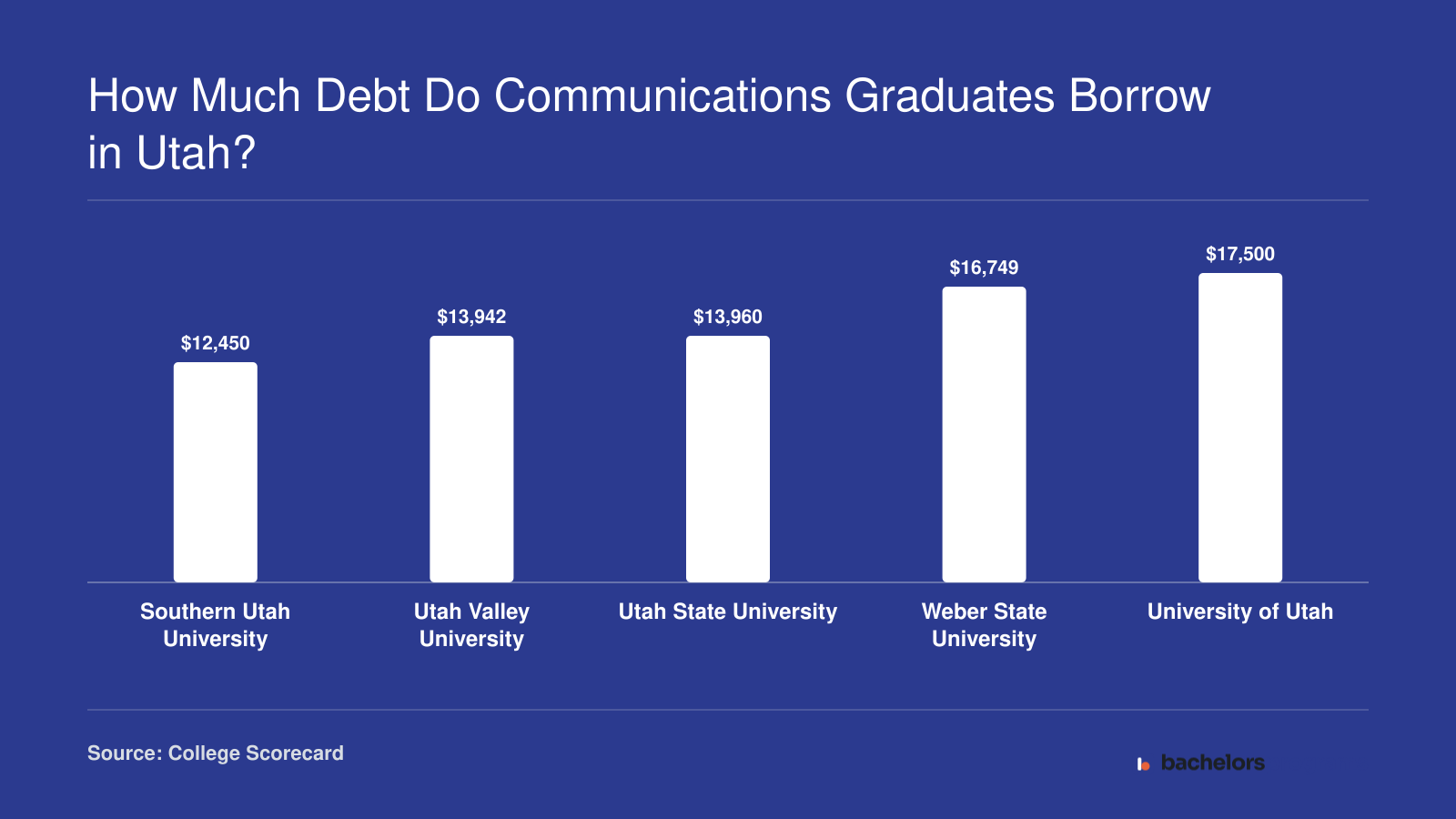
Bachelor's degree in communications graduates in Utah borrow modest amounts. The lowest median program-level debt is $12,450 at Southern Utah University, about $132 a month over 10 years, and the highest shown here is $17,500 at the University of Utah, about $186 a month. Utah Valley University ($13,942, $148 a month), Utah State University ($13,960, $148 a month) and Weber State University ($16,749, $178 a month) fall in between.
Communications Careers and Salaries in Utah
You will not pick communications for its starting salary. You pick it for range, and in Utah the range is wide: public relations work and marketing management sit on the same degree, nearly $80,000 apart at the median.
What Utah pays
- Public relations specialists: median $62,670 a year, with about 2,805 jobs statewide and roughly 280 openings a year, many concentrated in the Salt Lake City metro.1
- Technical writers: median $80,187, a strong fit for students who pair communication with software, medical devices or engineering.1
- Marketing managers: median about $139,840, with roughly 670 openings a year, though most of those go to people who already have experience.1
Growth in all three is steady rather than explosive, so much of the hiring comes from replacing workers who move up or leave.1
Where communicators work in Utah
Tech, healthcare, higher education and government all hire for public information, marketing and stakeholder communication, and the Salt Lake City area carries the densest public relations employment.3 Communications is not a licensed field in Utah, so no license or exam stands between you and a first job. Employers ask for a portfolio and an internship instead, which makes both part of the degree rather than extras.
Questions to Ask Yourself
Do you want a public relations, journalism or digital media focus, and does the school you are considering offer it?
Do you need a fully online or hybrid format while you keep working in Utah?
Is the net price after Utah aid realistic against the debt graduates of that program typically carry?
Are you transferring credits from a Utah community college or another school?
Compare Communications programs on the data that matters
Explore more Communications & Media majors or browse every field of study.
All Communications & Media programs Browse every field of study