Best Communications Degree Programs in Virginia
Compare 38 accredited Communications programs in Virginia at 23 colleges, with net price after aid, graduation rates, earnings and debt from IPEDS and the U.S. College Scorecard.

A bachelor's degree in communications has become a specialization decision as much as a school decision: the B.A. in Communications now splits into public relations, advertising, journalism, and digital media tracks, each feeding a different hiring market. Virginia Commonwealth University runs four concentrations inside its mass communications program; George Mason offers five. Cost spreads as widely, from roughly $14,600 to $29,400 in average net price after aid at the Virginia schools here. Every program discussed is an undergraduate one, offered on campus or online by a Virginia institution. What separates graduates in Richmond and Northern Virginia is usually the internship and the portfolio, not the diploma's wording.
Key Points
- VCU's Mass Communications major awards a Bachelor of Science, not a B.A.
- Virginia's 23 community colleges feed public universities through guaranteed-admission agreements.
- Public relations specialists in Virginia earn above the national rate.
Best Bachelor's Degree in Communications Programs in Virginia, Ranked
Read this list as a value-and-fit ranking rather than a prestige list. Each card names the degree, its concentration tracks, and the university's overall graduation rate, so you can compare outcomes at a glance. If net price after aid comes first, start with Old Dominion, Longwood, and Mary Washington; if selectivity and a Washington-area job market come first, start with Virginia Tech and George Mason.
Virginia Polytechnic Institute and State University
#1Blacksburg, VA · $25,000/yr (est. net price)
Best for: Students planning a double major or minor
Virginia Tech is the largest public option on this list and the most selective, with an overall graduation rate of 86%. Its Bachelor of Arts in Communication pairs a liberal arts core with visual media, persuasion, rhetoric, and professional communication, and the curriculum leaves room for a minor or double major. Students take internships, undergraduate research, or a study abroad term in Switzerland, and classes average 24 students.
- 120 total credit hours
- Average class size of 24
- Study abroad program in Switzerland
- Room to add a minor or a second major
- Undergraduate research and internship opportunities
- Prepares for roles in marketing, digital media, and politics
George Mason University
#2Fairfax, VA · $15,000 – $20,000/yr (est.)
Best for: Northern Virginia students targeting D.C. media jobs
George Mason sits in Fairfax, minutes from the Northern Virginia media, public relations, nonprofit, and government employers that hire communication graduates. The Communication, BA carries five concentration options, from journalism to public relations to advocacy, plus an accelerated path to a master's in as few as five years. An overall graduation rate of 68% reflects a large, access-minded public university.
- Five concentration options within the major
- Accelerated bachelor's to master's option in five years
- Internship program available
- Student media include WGMU radio and Fourth Estate newspaper
- Tracks include interpersonal and organizational communication
- 2.0 GPA required for admission
- Foreign language proficiency required
- Internship counts toward credit
- Located near Washington, D.C. media organizations
- Portfolio building and media relations training
- Social media campaign and video production skills
- Internship component included in the concentration
- Industry advisory committee input on the curriculum
Virginia Commonwealth University
#3Richmond, VA · ~$23,000/yr (est.)
Best for: Students focused on advertising or media production
VCU's Richard T. Robertson School of Media and Culture anchors one of the largest mass communications programs in the state. The Bachelor of Science in Mass Communications requires 45 credits at the 300 level or above and a 2.5 GPA, and its tracks run from advertising and public relations to journalism and media production. The university's overall graduation rate is 63%, and honors students can join the Mass Communications Scholars Program.
- Concentration tracks in advertising, journalism, media production, and public relations
- 2.5 GPA minimum plus prerequisite foundation courses
- 45 credits must be at the 300 level or above
- Mass Communications Scholars Program linked to VCU Honors College
- Honors scholars complete a capstone thesis and international component
- Advertising and creative track covers copywriting and art direction
- Portfolio compilation and hands-on production work
Christopher Newport University
#4Newport News, VA · $17,000 – $31,000/yr (est.)
Christopher Newport is a small public liberal arts university in Newport News, with an overall graduation rate of 72%. The Bachelor of Arts in Communication covers public speaking, interpersonal communication, media culture and technology, and rhetoric, closing with a senior research project. Concentrations include interpersonal studies, rhetoric, and critical media studies, and a minor in communication is available.
- Core courses in public speaking, interpersonal communication, and rhetoric
- Senior research project required
- Tracks in interpersonal studies, rhetoric, and critical media studies
- 15 credits must be at the 300 or 400 level
- Minor in communication available
- Liberal learning curriculum required alongside the major
University of Mary Washington
#5Fredericksburg, VA · $21,000/yr (est. net price)
Mary Washington pairs communication theory with digital production in a single interdisciplinary major. The Bachelor of Arts in Communication and Digital Studies requires 120 credits and a capstone seminar in digital rhetoric or digital studies, with electives drawn from art, computer science, and English. The university graduates 66% of its students overall, and small performance courses keep instruction personal.
- 120 total credit hours
- Capstone seminar in digital rhetoric or digital studies
- Internship for credit
- Academic credit available through the debate team
- Small performance courses for individual instruction
- Interdisciplinary electives in art, computer science, and English
Old Dominion University
#6Norfolk, VA · $13,000 – $34,000/yr (est.)
Old Dominion is the largest public university in Hampton Roads, and its communication program leans practical. The Bachelor of Arts in Communication Studies offers foundation courses across organizational, health, and digital communication, and every student completes a Senior Experience, whether a capstone, an internship, or study abroad. The university's overall graduation rate is 46%, which makes advising and credit momentum worth asking about on a visit.
- 120 total credit hours
- Senior Experience: capstone, internship, or study abroad
- Linked BA to MA pathway in Digital Communication
- Linked early-entry options with the MBA and MPA
- Foundation courses in organizational, health, and digital communication
- 2.0 GPA minimum
- Internship credit applies toward the major
Liberty University
#7Lynchburg, VA · ~$29,000/yr (est.)
Liberty is a private Christian university in Lynchburg and the largest residential option on this list, with an overall graduation rate of 65%. The Bachelor of Science in Communication is a residential program grounded in Christian values, with coursework in crisis communication, argumentation, event planning, and conflict resolution. Students build portfolios and professional networks through PRSSA and forensics.
- 120 total credit hours
- Residential, on-campus program
- Concentration options including integrated communication
- Coursework in crisis communication and argumentation
- Leadership and conflict resolution training
- PRSSA and forensics experiences
- Christian values integrated into the curriculum
Longwood University
#8Farmville, VA · ~$19,000/yr (est.)
Longwood is a small public university in Farmville with an overall graduation rate of 61%. Its Communication Studies degree runs 120 credits, with 51 in the major, and the Public Relations concentration adds PR writing, persuasion theory, research, and campaigns on top of a 30-credit core. An internship is required, and electives reach into crisis and intercultural communication.
- 120 total credit hours, 51 in the major
- 30-credit Communication Studies core plus 15-credit concentration
- Public Relations concentration
- Internship required for the concentration
- Coursework in PR writing, campaigns, and persuasion theory
- Electives in crisis and intercultural communication
- Study abroad opportunities
Randolph-Macon College
#9Ashland, VA · ~$28,000/yr (est.)
Randolph-Macon is a private liberal arts college in Ashland, north of Richmond, with an overall graduation rate of 70%. Communication Studies majors work with real clients in leadership communication courses, build a professional portfolio, and intern at places such as the U.S. House of Representatives and Circle S Studio. Campus media include The Yellow Jacket newspaper, Stinger Radio, and the Franklin Debating Society.
- Internships with the U.S. House of Representatives and Circle S Studio
- Work with real-world clients in leadership communication courses
- Campus media: The Yellow Jacket, Stinger Radio, Franklin Debating Society
- Faculty mentorship with original research presentations
- Professional portfolio built through coursework
- Alpha Beta Mu honor society
Roanoke College
#10Salem, VA · ~$25,000/yr (est.)
Roanoke College is a private liberal arts college in Salem with an overall graduation rate of 67%. Communication Studies mixes public speaking, environmental communication, and professional communication with research methods and rhetorical theory. Students get hands-on experience through the Brackety-Ack newspaper, WRKE-FM radio, the Roanoke Review, and a visiting writers series that has brought Pulitzer winners to campus.
- Student media: Brackety-Ack newspaper, WRKE-FM radio, Roanoke Review
- Coursework in public speaking, environmental communication, and professional communication
- Research methods and rhetorical theory built into the major
- Visiting Writers series with Pulitzer Prize winners
- Hands-on experiential learning emphasized
- Alumni working in public relations and media production
Cost & outcomes by school
Federal data for the highest-earning Communications programs, independent of the ranking above. Earnings are this field's bachelor's graduates four years after completing where the Scorecard reports them, else the school's undergraduate median.
| School | Net price / yr | Grad rate | Earnings | Debt | Grads/yr | Format |
|---|---|---|---|---|---|---|
| George Mason University VA | $17,915 | 68% | $76,343 | $19,500 | 120 | Campus |
| Roanoke College VA | $24,503 | 67% | $76,198 | $26,820 | 17 | Campus |
| Marymount University VA | $29,137 | 54% | $67,516 | $25,000 | 10 | Campus |
| Virginia Polytechnic Institute and State University VA | $24,953 | 86% | $66,106 | $20,500 | 293 | Campus |
| Randolph-Macon College VA | $27,866 | 71% | $61,867 | $27,000 | 24 | Campus |
| University of Mary Washington VA | $20,667 | 66% | $60,613 | $20,500 | 41 | Campus |
| Virginia Commonwealth University VA | $23,433 | 63% | $59,968 | $21,500 | 204 | Campus |
| Radford University VA | $14,578 | 49% | $59,932 | $25,000 | 19 | Campus |
| Hampton University VA | $25,319 | 57% | $59,159 | $25,442 | — | Campus |
| Shenandoah University VA | $30,298 | 67% | $58,433 | $25,000 | 11 | Campus |
| Christopher Newport University VA | $23,015 | 72% | $57,254 | $23,250 | 95 | Campus |
| Old Dominion University VA | $14,638 | 46% | $54,914 | $24,000 | — | Campus |
Sources: U.S. Department of Education. Net price, graduation rate, earnings and debt: College Scorecard (earnings and debt for this field's bachelor's graduates where reported, else school-wide); graduates: IPEDS. A dash means no figure is reported.
Cost, debt & payoff
Median earnings of this field's bachelor's graduates (4 yrs after completing, else the school's undergraduate median) vs. their median federal loan debt · U.S. College Scorecard
Across these programs the median graduate earns about $56,084 and finishes with roughly $25,000 in debt — a ratio that clears a common rule of thumb (keep debt below first-year salary). Net price and debt vary widely school to school, so check the per-school figures in the table above before you shortlist.
How We Ranked Virginia Communications Schools
A school-wide statistic and a program-level result are not the same thing, so we keep them apart. Each figure is used at the level it measures.
- Outcomes and cost: We drew on College Scorecard data for earnings, debt, net price after grant aid, and the number of communications degrees a school awards. Net price is what students actually pay after aid, so it is a better guide than the sticker price.
- Graduation rate: This figure covers the whole institution, not the communications major. A school with a strong overall rate may still have a smaller or newer communications program, so treat it as a signal of how well a school supports students in general.
- Accreditation: Regional accreditation from SACSCOC (the Southern Association of Colleges and Schools Commission on Colleges) is the baseline we look for1. ACEJMC accreditation is the national standard for journalism and mass communication programs. We note ACEJMC accreditation only where a school's status can be confirmed, and we never assume it. Many strong communications programs have no ACEJMC accreditation, which is common for programs outside journalism. Check the SACSCOC institution directory and the ACEJMC accredited-programs directory before you apply.
- Adjacent programs: Mass communications, media production, strategic communications, and journalism-leaning majors are included when they are the school's closest match to a communications degree. Speech-language pathology and communication sciences and disorders are not. They are health-science fields focused on diagnosing and treating speech and hearing disorders. They usually lead to graduate training and state licensure, and their coursework and career paths differ from those of a communications degree in public relations, media, or corporate communication.
The program names vary from school to school, so read each curriculum before you decide.
Communications Concentrations Compared: PR, Advertising, Journalism, and Digital Media
A concentration is the cluster of courses that turns a broad communications major into a specific skill set: reporting for a newsroom, pitching brands, producing digital content, or studying how media shapes audiences. The coursework matters more than the label, but the label is what appears on your transcript and in job filters.
The Four Tracks at a Glance
- Public relations: Suits students who like persuasion, relationships, and messaging under deadline. Coursework leans on writing, campaigns, crisis communication, and audience research. First jobs include public relations assistant, account coordinator, and media relations associate.
- Advertising: Suits idea-driven students who want brand work. Expect copywriting, art direction, account planning, and consumer behavior. Entry roles include junior copywriter, account coordinator, and social media associate.
- Journalism: Suits storytellers who want to report. Focus areas include reporting, editing, ethics, multimedia production, and beat coverage. First jobs include reporter, producer, news assistant, and digital editor.
- Digital media: Suits builders who like platforms and analytics. Coursework covers content creation, social strategy, video, user experience, and metrics. Entry roles include social media coordinator, content producer, and digital marketing assistant.
Four Labels, Four Emphases
Communication studies is the broad, theory-and-rhetoric option. Journalism is the reporting trade. Mass communication studies media industries and audiences. Strategic communication is the persuasion-and-brand umbrella that covers public relations and advertising.
Match the Goal, Then the School
Program names at the ranked schools show where the emphasis sits. Mary Washington's Communication and Digital Studies major signals a digital-first blend. Bridgewater and Hampton label their programs strategic communications. VCU, Virginia State, and Norfolk State organize around mass communications. Shenandoah, Emory & Henry, and Virginia Wesleyan put media and communication in the program name.
Match the goal, not the label: storytelling points to journalism or media production, persuasion points to public relations, brand work points to advertising or strategic communication, and platform work points to digital media.
The Undecided Student's Best Bet
If you are undecided, choose communication studies. It leaves the most options open: you can move into public relations, marketing, media operations, nonprofit communications, or graduate study without being typecast as a reporter or a copywriter. Pair it with a digital media or public relations minor, and you keep practical skills without narrowing the degree.
Related Articles
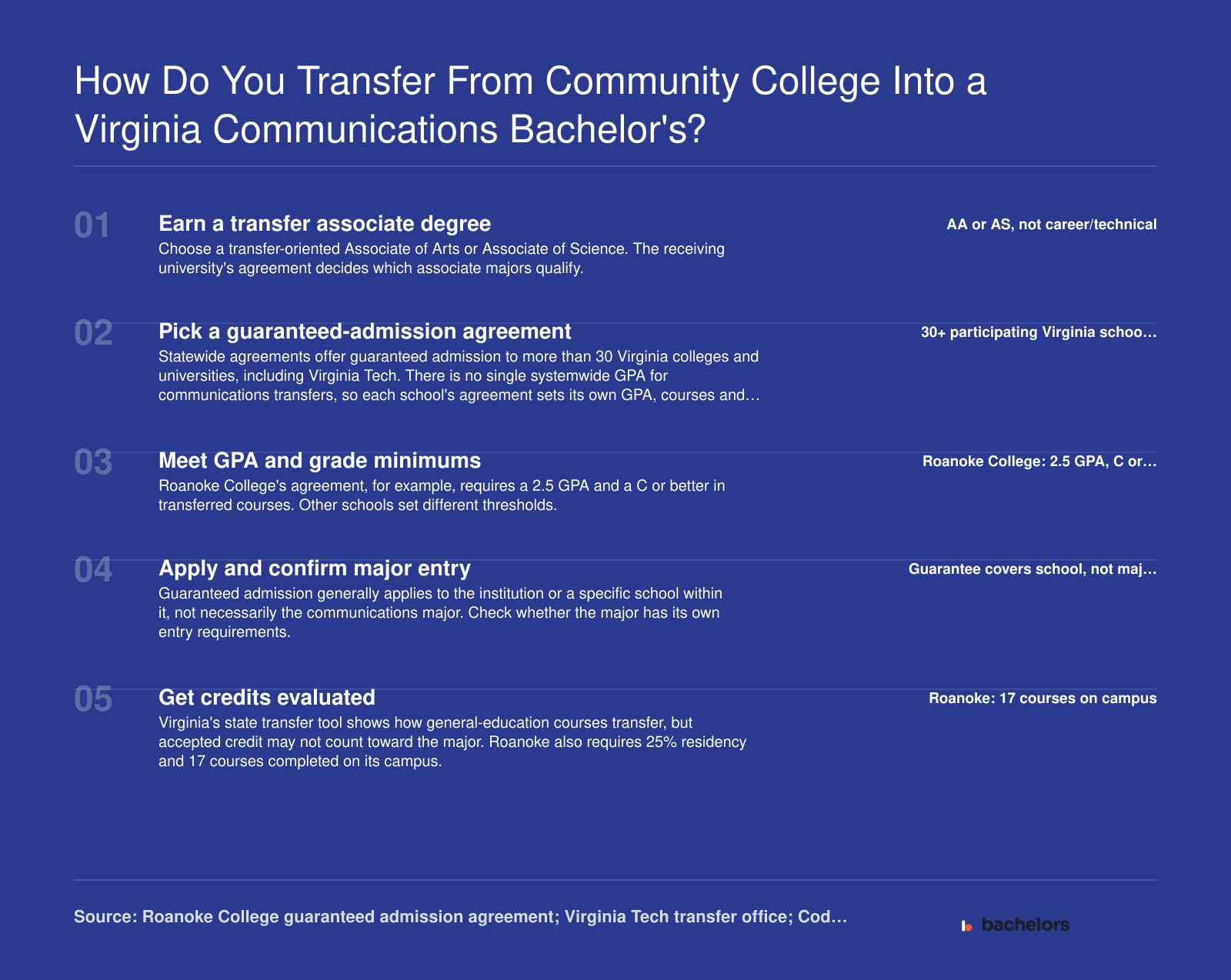
How Do You Transfer From Community College Into a Virginia Communications Bachelor's?
Many Virginia students start at one of the state's 23 community colleges and finish a communications bachelor's at a four-year school. Virginia law requires public universities to maintain articulation and guaranteed-admission agreements, but each school writes its own terms. Policies vary by school, so confirm every requirement with the transfer office of the university you plan to attend.
Cost of a Communications Degree in Virginia: Tuition, Net Price, and State Aid
The table lists the lowest average net prices we found among Virginia communications programs, drawn from federal College Scorecard data. Net price is an average for students who receive aid, not a quote for your family. For context, SCHEV puts the 2026-27 statewide average for in-state tuition and fees at Virginia public institutions at $15,356, up $510 (3.4%). Private colleges such as Virginia Union University charge one price to every student, yet Virginia Union's $17,450 sticker price falls to a $13,235 average net price. Virginia residents enrolled full time at eligible private nonprofit colleges can also claim the Virginia Tuition Assistance Grant. It is not need-based, and SCHEV sets a 2026-27 maximum of $5,250 ($12,750 at Hampton University and Virginia Union, $2,625 for online programs), though SCHEV notes amounts can be adjusted. Virginia Guaranteed Assistance Program awards vary by institution, and the neediest students receive at least tuition. Best value: Old Dominion University pairs a $12,750 in-state price with a $14,638 average net price, the lowest among the schools ranked here. Virginia Union offers the lowest net price we found for residents who qualify for the larger state grant.
| School | Sector | In-State Tuition and Fees | Out-of-State Tuition and Fees | Average Net Price After Aid |
|---|---|---|---|---|
| Virginia Union University | Private nonprofit | $17,450 | $17,450 | $13,235 |
| Radford University | Public | $12,548 | $25,633 | $14,578 |
| Old Dominion University | Public | $12,750 | $33,780 | $14,638 |
| Norfolk State University | Public | $10,180 | $21,682 | $15,282 |
| Virginia State University | Public | $10,043 | $22,650 | $15,840 |
Questions to Ask Yourself
Would a private school's aid package, including the Tuition Assistance Grant, bring its net price below in-state public tuition?
Does an online program's lower cost cost you internship and studio access you would otherwise get on campus?
Could two years at a community college with a guaranteed transfer agreement cut the total bill?
What Virginia Public Relations Specialists Earn
Public relations is one of the most common career paths for graduates with a bachelor's degree in communications, and Virginia pays above the national rate.
Virginia Communications Degree FAQs
These answers cover the questions readers ask most about bachelor's degree in communications options in Virginia. Each one points to the part of this page with the full detail.
What is the best communications college in Virginia?
Can you get an accredited bachelor's degree in communications online from a Virginia school?
Do you need a license to work in communications in Virginia?
Can I transfer from a Virginia community college into a communications major?
Compare Communications programs on the data that matters
Explore more Communications & Media majors or browse every field of study.
All Communications & Media programs Browse every field of study