Best Speech Pathology Schools in New Jersey
Compare 3 accredited Speech Pathology programs in New Jersey, with net price after aid, graduation rates, earnings and debt from IPEDS and the U.S. College Scorecard.
Students drawn to speech pathology meet an unusual split early: the credential that admits them to graduate study is not the one that lets them practice. A bachelor's degree in speech pathology, most often the Bachelor of Science (B.S.) in Speech Pathology, is the pre-professional step; New Jersey licensure as a speech-language pathologist requires a master's degree.
The major's name varies: Speech-Language Pathology and Audiology at The College of New Jersey, Speech-Language-Hearing Sciences at Kean University, Speech-Language Pathology at William Paterson University of New Jersey.
Graduate committees read those transcripts for phonetics, speech anatomy, and audiology coursework, so the catalog itself matters more than the label on the diploma.
Key Points
- The College of New Jersey ranks first, with the strongest graduation rate.
- Public tuition and fees run about $14,300 to $19,600 per year.
- New Jersey SLP licensure requires a master's, about 6 to 7 years total.
Best Bachelor's in Speech Pathology Schools in New Jersey
Two other New Jersey public universities, Kean and William Paterson, follow with bachelor's programs built squarely around preparation for graduate study. Every school here offers the pre-professional step toward practice, since becoming a licensed speech-language pathologist in New Jersey requires a master's degree.
The College of New Jersey
#1Ewing, NJ · $20,000 – $26,000/yr (est.)
Best for: Future clinicians wanting undergraduate research experience
Undergraduates complete the prerequisite sequence graduate programs expect, including biological science, statistics and psychology, while logging clinical observation hours and, if they choose, independent research. Interprofessional coursework with future educators and a student-run NSSLHA chapter give students early exposure to school-based practice and special education law.
- Curriculum covers special education law and policy
- Clinical observation hours built into the program
- Option to pursue independent research
- Interprofessional coursework alongside future educators
- Student-run NSSLHA chapter
- ASHA prerequisite coursework in biology, statistics and psychology
- Minor options include linguistics and deaf studies
Kean University
#2Union, NJ · $14,000 – $22,000/yr (est.)
Best for: Community college transfer students
Kean University in Union runs its speech-language-hearing sciences major through a dedicated Department of Communication Sciences and Disorders, and the bachelor's is designed as a launchpad rather than a terminal credential. Students interested in schools can move into special education, deaf education, or elementary and secondary teaching, and the department also supports minors in American Sign Language and in speech-language-hearing sciences. The campus sits in Union County, within reach of much of northern and central New Jersey.
- Housed in a dedicated Department of Communication Sciences and Disorders
- Master's degree required to practice as a speech-language pathologist
- Foundation for special education, deaf education and classroom teaching
- Prepares students for graduate work in psychology or social work
- Minor in American Sign Language available
- Minor in Speech-Language-Hearing Sciences available
William Paterson University of New Jersey
#3Wayne, NJ · $16,000 – $25,000/yr (est.)
Best for: Aspiring speech-language pathology assistants
A clinical observation and methods course gives students supervised early exposure to the field, and a senior seminar pulls the strands of the major together. Graduates leave prepared for graduate study in speech-language pathology as well as entry-level work as speech-language pathology assistants.
- 51 major credits required
- Clinical observation and methods course
- Coursework in phonetics and language development
- Anatomy and physiology of the speech mechanism
- Audiology and auditory rehabilitation
- Neurological bases of communication
- Senior seminar capstone; supporting courses in psychology and physics
Cost & outcomes by school
Federal data for the highest-earning Speech Pathology programs, independent of the ranking above. Earnings are this field's bachelor's graduates four years after completing where the Scorecard reports them, else the school's undergraduate median.
| School | Net price / yr | Grad rate | Earnings | Debt | Grads/yr | Format |
|---|---|---|---|---|---|---|
| The College of New Jersey NJ | $27,646 | 86% | $73,323 | $23,250 | 25 | Campus |
| William Paterson University of New Jersey NJ | $18,745 | 44% | $63,108 | $16,941 | 22 | Campus |
| Kean University NJ | $12,447 | 47% | $57,237 | $23,250 | 47 | Campus |
Sources: U.S. Department of Education. Net price, graduation rate, earnings and debt: College Scorecard (earnings and debt for this field's bachelor's graduates where reported, else school-wide); graduates: IPEDS. A dash means no figure is reported.
Cost, debt & payoff
Median earnings of this field's bachelor's graduates (4 yrs after completing, else the school's undergraduate median) vs. their median federal loan debt · U.S. College Scorecard
Across these programs the median graduate earns about $63,108 and finishes with roughly $23,250 in debt — a ratio that clears a common rule of thumb (keep debt below first-year salary). Net price and debt vary widely school to school, so check the per-school figures in the table above before you shortlist.
How We Ranked New Jersey Speech Pathology Bachelor's Programs
Federal outcome data now lets students compare bachelor's programs on cost and results, not just name recognition.
What We Measured
Each school was assessed on five measures. Some describe the speech pathology program itself, while others describe the whole institution.
- Net price: The average yearly cost after grants and scholarships. This is institution-wide.
- Graduation rate: The share of students who finish a bachelor's degree. This is institution-wide.
- Selectivity: The admission rate, a rough signal of how competitive entry is. This is institution-wide.
- Earnings: Median pay for graduates of the speech pathology or communication sciences program. This is program-level.
- Completions: How many students earn the degree in this field each year, a sign of program size and stability. This is program-level.
How to Read the Results
Treat these averages as approximations, not exact figures. A published net price blends every income bracket together, so your actual cost could land well above or below it. Each school's net price calculator will give you a figure tied to your family's finances.
Weight the measures to fit your situation. If cost is your main concern, lean on net price and graduation rate, since finishing on time avoids paying for extra semesters. If outcomes matter most, give more weight to graduation rate and completions. Early earnings in this field can understate long-term pay because many graduates continue their education before working as speech-language pathologists.
Compare New Jersey Bachelor's in Speech Pathology Schools Side by Side
This table compares cost, outcomes and admissions figures for the New Jersey schools ranked here, using IPEDS and College Scorecard data from the U.S. Department of Education. The College of New Jersey posts the highest graduation rate and median earnings, while Kean University has the lowest in-state tuition and net price. Earnings and debt figures cover each school's graduates as a whole, not speech pathology majors alone.
| School | City | Major Name | In-State Tuition and Fees | Out-of-State Tuition and Fees | Average Net Price | Graduation Rate | Retention Rate | Acceptance Rate | Student-Faculty Ratio | Median Earnings 10 Years After Entry (All Graduates) | Median Graduate Debt (All Graduates) |
|---|---|---|---|---|---|---|---|---|---|---|---|
| The College of New Jersey | Ewing | Speech-Language Pathology and Audiology | $19,632 | $25,752 | $27,646 | 86% | 91% | 62% | 14:1 | $73,323 | $23,250 |
| Kean University | Union | Speech-Language-Hearing Sciences | $14,299 | $22,446 | $12,447 | 47% | 76% | 76% | 17:1 | $57,237 | $23,250 |
| William Paterson University of New Jersey | Wayne | Speech-Language Pathology | $15,704 | $25,344 | $18,745 | 44% | 74% | 90% | 18:1 | $57,780 | $22,334 |
Related Articles
Admissions: GPA, Test Policy, and Transfer Credit
Overall admission rates for these schools run from 62.3 percent at The College of New Jersey to 90.1 percent at William Paterson University of New Jersey, with Kean University at 75.9 percent. Those are campus-wide figures, not rates for the speech pathology major. Still, they show how competitive each school is before you choose a program.
The College of New Jersey
TCNJ admits roughly 62 percent of applicants, which makes it the most selective of the schools here. Its Speech Pathology major sits within the Speech-Language Pathology and Audiology program. The program information we reviewed publishes no minimum GPA, no test-optional or test-required statement, and no transfer credit rule specific to the major. Treat general university admissions standards as the starting point and confirm details with the admissions office.
Kean University
Kean admits about 76 percent of applicants. Its bachelor's major is called Speech-Language-Hearing Sciences, and the program page does not publish a minimum GPA, a testing policy, or a transfer credit policy. If you are weighing Kean, ask directly whether the SAT or ACT is required, optional, or not considered.
William Paterson University of New Jersey
William Paterson has the highest admission rate of the group, at about 90 percent. The Speech-Language Pathology major lists its course requirements, including 51 major credits, but the program materials publish no minimum GPA, test policy, or transfer credit policy. A high overall admit rate does not tell you whether the major sets its own bar once you enroll.
At a Glance
- TCNJ: 62.3 percent admitted; no GPA, test, or transfer policy published for the major.
- Kean: 75.9 percent admitted; no GPA, test, or transfer policy published for the major.
- William Paterson: 90.1 percent admitted; no GPA, test, or transfer policy published for the major.
A Practical Tip
Before you apply, ask each school one question: does the speech pathology or communication sciences major require a separate internal admission step after you enroll, such as a minimum GPA in prerequisite courses? Many pre-professional majors screen students at the end of the first or second year, and a missing public policy does not mean there is no checkpoint. Transfer students should also request a written credit evaluation early, so you know which courses count toward the major's required coursework before committing.
Cost of a Bachelor's Degree in Speech Pathology in New Jersey
At the public four-year schools ranked here, the sticker price for a bachelor's in speech pathology runs about $14,300 to $19,600 a year in tuition and fees, but the average net price after grants ranges much more widely, from $12,447 at Kean University to $27,646 at The College of New Jersey. William Paterson University of New Jersey sits in the middle at $18,745. Those net figures are institution-wide averages, not speech pathology-specific, so treat them as a comparison tool rather than an exact bill.
Sticker Price Versus Net Price
Kean lists $14,299 in tuition and fees for New Jersey residents and $22,446 for out-of-state students. William Paterson lists $15,704 in-state and $25,344 out-of-state. TCNJ lists $19,632 in-state and $25,752 out-of-state. After grants and scholarships, the average net price is $12,447 at Kean, $18,745 at William Paterson and $27,646 at TCNJ. Median federal debt for graduates who borrowed is $22,334 at William Paterson and $23,250 at Kean and TCNJ. Pell Grant recipients make up 67% of undergraduates at Kean, 66% at William Paterson and 30% at TCNJ. Debt and Pell shares are institution-wide.
New Jersey Aid That Can Lower the Bill
TAG is the state's core need-based grant.1 For 2026-2027, maximum awards are $9,496 at state colleges and universities, $10,964 at public research universities, $14,404 at independent colleges and $3,098 at county colleges.1 Those are ceilings, not promises. Awards depend on need, enrollment status, institution type and program funding, and applicants need at least 12 months of New Jersey residency before enrolling, financial need, and a timely FAFSA or state alternative application.1
The Educational Opportunity Fund (EOF) serves students from disadvantaged backgrounds. File by the state deadline and contact the campus EOF director, because the institution sets the grant. NJ STARS is a separate state program; confirm its current eligibility rules and award levels with HESAA before counting on it. The Garden State Guarantee can bring net tuition and approved fees to $0 for New Jersey residents at public four-year colleges with family incomes from $0 to $65,000.2 It applies in the third and fourth years only, requires full-time enrollment at 12 or more credits, a first bachelor's degree and satisfactory academic progress, and is capped at four semesters or 128 credits.2
Stack Aid Before You Compare
File the FAFSA early, complete the NJ Alternative application if eligible, and apply for TAG, EOF and campus awards before comparing sticker prices. Judge each school by net price after all grants, not by tuition alone.
Online and Hybrid Bachelor's Options at New Jersey Schools
Online delivery is routine in many health-related majors, but speech pathology has lagged because supervised clinical observation is hard to run remotely.
What the New Jersey Schools Offer
Among the New Jersey schools ranked here, campus instruction remains the norm for the speech pathology major itself. The College of New Jersey runs its Speech-Language Pathology and Audiology pathway on the Ewing campus, with clinical observation built into the curriculum. Kean University's Speech-Language-Hearing Sciences BA in Union is also a campus program. William Paterson University advertises 100% online and hybrid formats on its university-wide online page, but that page does not connect the Speech-Language Pathology BS to online delivery, and the program is listed as campus-based with a clinical observation and methods course. Where these schools offer online or hybrid flexibility, it typically covers general education, prerequisites, or degree-completion coursework, not the full major.
The Clinical Piece Still Happens in Person
Guided observation is the obstacle. Professional preparation in the field calls for observation hours (commonly 25) before supervised practicum, and guidance for online SLP programs indicates those observation hours are generally completed in person or through live, supervised sessions rather than fully remotely. Local placements may also be required, so a fully remote bachelor's in this field is rare and should be confirmed in writing.
Which Format Fits Which Student
- Commuters and traditional-age students: Campus programs at TCNJ, Kean and William Paterson keep observation hours, faculty and study groups in one place.
- Working adults: Hybrid general coursework can help you clear prerequisites around a job, but plan on travel for observation and upper-level major classes.
- Transfers: Ask the department which major courses, if any, can be completed online before you enroll.
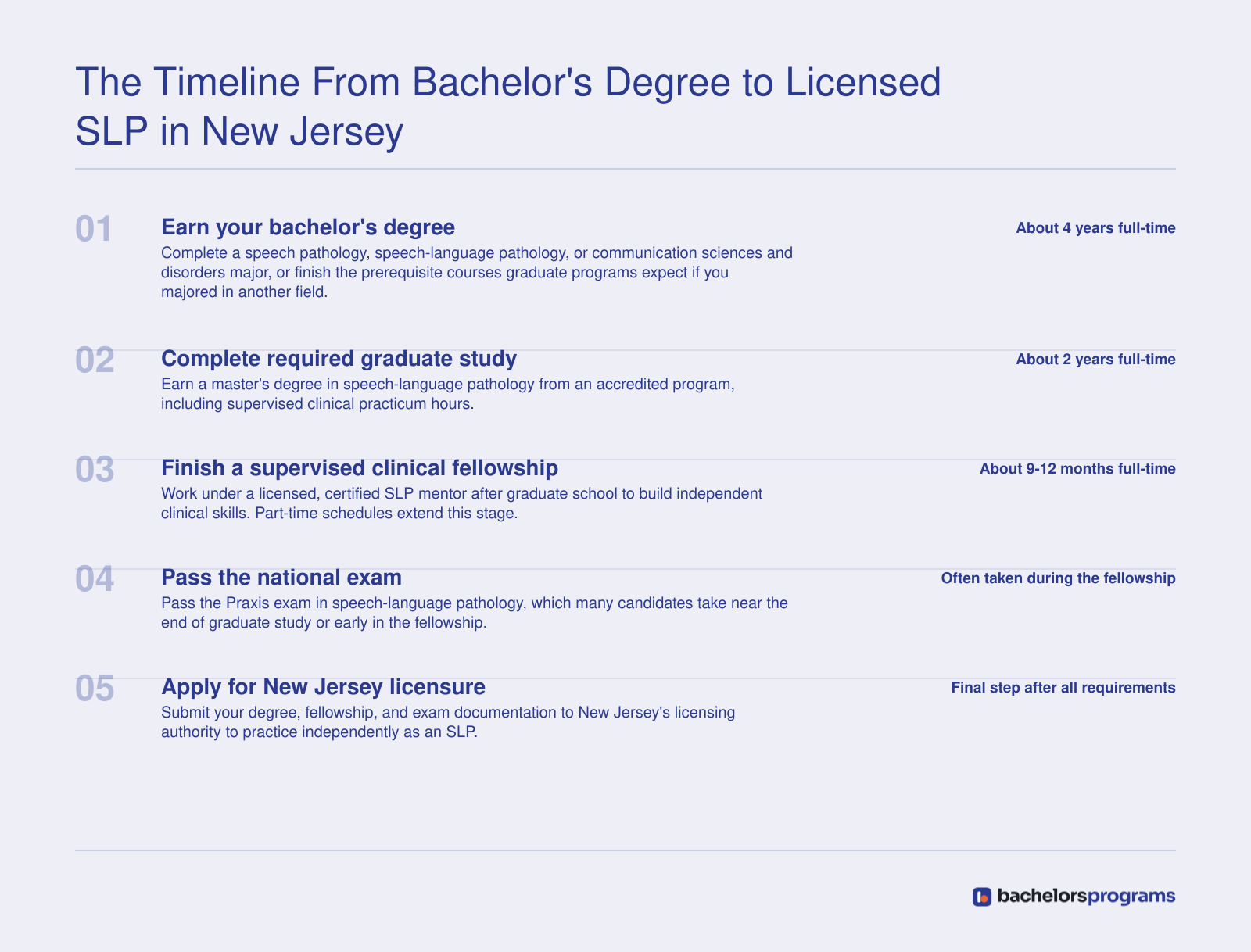
The Timeline From Bachelor's Degree to Licensed SLP in New Jersey
Licensure as a speech-language pathologist in New Jersey requires a master's degree, so the bachelor's degree in speech pathology is the pre-professional first step. Counting from the first semester of college, most students reach full licensure in about 6-7 years. The steps below show the order and the typical time for each stage.
Careers and Licensure: From a Bachelor's Degree to Working as an SLP in New Jersey
A New Jersey speech-language pathologist may hold a state clinical license, a school-issued educational services certificate, or both, and every route to any of them runs through graduate school. Licensure as a speech-language pathologist in New Jersey requires a master's degree; the bachelor's degree in speech pathology is the pre-professional step, not a license to practice independently.1
How Long the Path Takes
Plan on four years for the bachelor's, typically two years for the master's, then a clinical fellowship of at least 36 weeks and 1,260 hours under a qualified mentor, documented through the Clinical Fellowship Skills Inventory.4 The national exam sits in that stretch as well, and the ASHA Certificate of Clinical Competence arrives once the fellowship and exam are finished. Coursework and graduate practicum must be complete before the fellowship begins, and hours logged ahead of those prerequisites do not count.1
Exam logistics are shifting in this window. Candidates testing through December 31, 2026 register for the Praxis Speech-Language Pathology (5331) through ETS, while those testing from January 11, 2027 schedule the National SLP Exam through PSI.2 Allow roughly three years of graduate study plus fellowship on top of the bachelor's before a full license and CCC are in hand.
Two Credentials, Two Agencies
The NJ Audiology and Speech-Language Pathology Advisory Committee issues the state license, which turns on the graduate degree, the national exam, and the supervised fellowship.3 School-based clinicians need a second credential: the Speech Language Specialist certificate (endorsement 3462) from the New Jersey Department of Education, which authorizes services in all public schools. It advances through three stages, Certificate of Eligibility, provisional certificate, and standard certificate.6 The standard certificate requires a master's or equivalent and a passing score of 162 on Praxis 5331.7 No emergency certificate exists,6 and the Certificate of Eligibility expires every July 31.8
What the Bachelor's Degree Opens Now
The state's school route accepts a bachelor's in speech-language pathology or communication disorders with current master's enrollment and at least 18 graduate semester hours, including graduate clinical practicum; other majors need at least 24 graduate semester hours, all on an accredited four-year transcript. Until the graduate work and license are complete, bachelor's graduates typically move into support and human-services roles that do not require the SLP license, gaining exposure to clinics and schools while finishing prerequisites.
New Jersey Speech-Language Pathologist Job Outlook and Pay
What does a speech-language pathologist earn in New Jersey, and will jobs be there when you finish? Because national and state numbers are not interchangeable, the reliable answer comes from pulling current figures for each.
Start With BLS.gov
The Occupational Outlook Handbook entry for speech-language pathologists gives the national picture: 193,400 jobs in 2025, a projected 17% gain by 2035 ("much faster than average"), about 12,500 openings a year, and a May 2025 median wage of $97,870 ($47.05 an hour). Those are U.S. figures, not New Jersey ones. For the state, open the OEWS state data pages, select New Jersey, and search "speech-language pathologists" or occupation code 29-1127. The June 2026 New Jersey release reports 2025 wage data.1
Add State and Local Sources
The New Jersey Department of Labor and Workforce Development runs a labor market information site with state employment projections and wage estimates. Expect some lag, sometimes a year or more behind federal releases.
Then compare against what employers say. Check salary schedules and job postings on New Jersey school district and healthcare employer websites, the program pages at The College of New Jersey, Kean University, and William Paterson University of New Jersey, and professional associations such as ASHA and the New Jersey Speech-Language-Hearing Association.
A Quick Checklist
- Data year: Confirm which year each wage or employment figure covers before comparing sources.
- Median versus range: A median is the midpoint, not what a new graduate should expect. Look at the percentile range too.
- Geography: The 17% growth figure is national for 2025 to 2035. Look for the state projection separately.
- Combine sources: Use federal, state, and employer data together instead of leaning on one number.
Is a Bachelor's Degree in Speech Pathology Worth It in New Jersey?
A bachelor's degree in speech pathology can look expensive for a credential that does not, by itself, let you practice in New Jersey. The value case rests on what the degree makes possible: a pre-professional foundation for graduate study, not immediate licensure.
The Earnings and Debt Evidence
At William Paterson University of New Jersey, program-level data show that graduates of the Speech-Language Pathology program earned a median $63,108 four years after finishing. The same program data list median debt of $16,941 and a median 10-year monthly payment of $180. That is a manageable debt load against early earnings, but it describes one program, not a guarantee for every graduate. For The College of New Jersey and Kean University, compare published tuition and school-wide net price, and treat any school-wide earnings figure as context rather than the program's own result.
The Master's Step Changes the Math
New Jersey licensure as a speech-language pathologist requires a master's degree, so the bachelor's is a stepping stone, not the finish line. Budget for graduate tuition and living costs before you call the degree a bargain. The bachelor's still has value: it builds the prerequisite coursework and clinical observation that graduate programs expect, and it lets you test your interest before committing to graduate school.
Who Should Choose What
- Cost-focused in-state student: Kean University has the lowest in-state tuition here at $14,299 and a school-wide net price after aid of $12,447. It keeps undergraduate debt small before the master's.
- Career-changer or transfer student: Ask for a written transfer credit audit and confirm that speech pathology prerequisites will be accepted before you enroll.
- Unsure about graduate study: Choose the lowest-cost program that keeps graduate prerequisites open, and do not assume the bachelor's alone qualifies you to practice.
The Bottom Line
Published in-state tuition at the New Jersey schools profiled here runs from $14,299 to $19,632, with school-wide net prices from $12,447 to $27,646. Plan on four years for the bachelor's, then a master's for licensure. The New Jersey programs profiled here are campus-based, so confirm online or hybrid options directly with each school. If you accept the graduate step and keep undergraduate debt low, the degree is worth it; if you need a license quickly, it is not a shortcut.
Compare Speech Pathology programs on the data that matters
Explore more Communications & Media majors or browse every field of study.
All Communications & Media programs Browse every field of study