Best Speech Pathology Schools in West Virginia
Compare 3 accredited Speech Pathology programs in West Virginia, with net price after aid, graduation rates, earnings and debt from IPEDS and the U.S. College Scorecard.
A bachelor's degree in speech pathology and a West Virginia speech-language pathologist license are separate credentials, and practicing requires both. The Bachelor of Science (B.S.) is the pre-professional step. The license calls for a master's degree on top of it.
The major goes by several names. West Virginia University calls it Communication Sciences and Disorders, West Liberty University offers Speech Pathology and Audiology, and Marshall University lists Communication Disorders. All three are public universities, with in-state tuition and fees from $8,893 to $10,104 a year.
With prices that close, the sharper differences are clinic access, class size and how well each program prepares students for graduate admission.
Key Points
- West Liberty University charges the lowest in-state tuition here: $8,893.
- West Virginia University expects a 3.0 GPA for direct, test-optional admission.
- West Virginia speech-language pathologist licensure requires a master's degree beyond the bachelor's.
Best Schools for a Bachelor's Degree in Speech Pathology in West Virginia
Three West Virginia universities award a bachelor's degree in speech pathology or communication sciences and disorders, and each takes a different route to the same destination: graduate study. West Virginia University brings the largest health sciences infrastructure and an on-campus clinic, West Liberty University keeps the cohort small and personal, and Marshall University leans on simulations and a research-active faculty. The order below reflects how much each program hands an undergraduate who is building toward a graduate degree, not a claim that one campus fits every student.
West Virginia University
#1Morgantown, WV · ~$16,000/yr (est.)
Best for: Research-minded students at a flagship campus
West Virginia University runs its communication sciences and disorders program through the School of Medicine in Morgantown, so undergraduates study inside a health sciences environment rather than a stand-alone department. Students complete a senior capstone, log clinical hours on and off campus, and train at the university's own speech, language and hearing clinic that opened in 2022. An Early Assurance pathway lets qualified freshmen lock in a graduate seat, and graduates have been hired at WVU Medicine and UPMC.
- 2.5 high school GPA plus ACT 23 or SAT 1150 for freshmen
- Test-optional applicants need a 3.0 GPA instead
- Senior capstone required of every major
- Clinical hours on and off campus, including a clinic opened in 2022
- Early Assurance pathway guarantees a graduate seat for qualified freshmen
- Interprofessional coursework with other health sciences students
- Honors College adds two program options
- Core courses span both audiology and speech-language pathology
West Liberty University
#2West Liberty, WV · $15,000/yr (est. net price)
Best for: Pre-professional students preferring a small campus
West Liberty University is a small public campus in the Northern Panhandle, and its four-year Bachelor of Science in Speech Pathology and Audiology is built entirely as a pre-professional step toward graduate school. Classes stay modest in size, faculty hold national clinical certificates, and the on-campus Speech and Hearing Clinic provides early observation hours. The program reports that its graduates have been accepted at West Virginia University, the University of Pittsburgh and James Madison University.
- 3.0 cumulative GPA required for program admission
- Program application deadline of January 21
- Grades of C or better in required prerequisite courses
- Faculty hold national clinical certificates
- On-campus Speech and Hearing Clinic provides hands-on observation
- Program reports 100% acceptance into graduate programs
- Prepares students for speech-language pathology or audiology graduate study
- Electives in education, pediatrics, gerontology or psychology
Marshall University
#3Huntington, WV · $5,000 – $10,000/yr (est.)
Best for: Hands-on learners wanting simulation-based coursework
Marshall University's communication disorders department in Huntington pairs a traditional Bachelor of Science with unusually hands-on undergraduate training. Board-certified faculty, including swallowing and listening and spoken language specialists, build clinical simulations directly into courses, and an optional study abroad trip to the Caribbean adds supervised clinical hours. Marshall also partners with WVU's Center for Excellence in Disabilities on assistive technology access across West Virginia.
- 120 total credit hours including a capstone
- 2.5 GPA to enter, 3.0 GPA guarantees continuation
- Faculty approval required to continue in the program
- Clinical simulations embedded in required coursework
- Optional study abroad to the Caribbean for supervised clinical hours
- 9 hours of one foreign language required
- Faculty include swallowing and listening and spoken language specialists
- Assistive technology partnership with WVU's Center for Excellence in Disabilities
Cost & outcomes by school
Federal data for the highest-earning Speech Pathology programs, independent of the ranking above. Earnings are this field's bachelor's graduates four years after completing where the Scorecard reports them, else the school's undergraduate median.
| School | Net price / yr | Grad rate | Earnings | Debt | Grads/yr | Format |
|---|---|---|---|---|---|---|
| Marshall University WV | $7,502 | 51% | $55,037 | $25,500 | 13 | Campus |
| West Virginia University WV | $15,634 | 65% | $54,252 | $23,840 | 40 | Campus |
| West Liberty University WV | $15,366 | 60% | $47,212 | $23,250 | 8 | Campus |
Sources: U.S. Department of Education. Net price, graduation rate, earnings and debt: College Scorecard (earnings and debt for this field's bachelor's graduates where reported, else school-wide); graduates: IPEDS. A dash means no figure is reported.
Cost, debt & payoff
Median earnings of this field's bachelor's graduates (4 yrs after completing, else the school's undergraduate median) vs. their median federal loan debt · U.S. College Scorecard
Across these programs the median graduate earns about $54,252 and finishes with roughly $23,840 in debt — a ratio that clears a common rule of thumb (keep debt below first-year salary). Net price and debt vary widely school to school, so check the per-school figures in the table above before you shortlist.
Compare West Virginia Speech Pathology Schools Side by Side
Read each row as one university's bachelor's program. Graduation rate, average net price and Pell share describe the whole university, while completions, median earnings four years after graduation and median debt come from the speech pathology program itself, and "Not reported" means the federal IPEDS and College Scorecard data publish no program figure. The biggest differences are cost and scale. Marshall University's average net price of $7,502 is about half that of West Liberty University ($15,366) or West Virginia University ($15,634). West Virginia University awards the most degrees in the field and has the highest graduation rate, and its graduates and Marshall's report similar median earnings (about $54,000 to $55,000) and median debt ($23,840 and $25,500). All three admit most applicants, so the admission rate matters less than price and outcomes.
| School | Program name | Admission rate | In-state tuition and fees | Average net price (school-wide) | Graduation rate (school-wide) | Pell share (school-wide) | Program completions | Program median earnings, 4 years after graduation | Program median debt |
|---|---|---|---|---|---|---|---|---|---|
| West Virginia University (Morgantown) | Communication Sciences and Disorders | 89% | $10,104 | $15,634 | 64.7% | 51.5% | 73 | $54,252 | $23,840 |
| West Liberty University (West Liberty) | Speech Pathology and Audiology | 97.3% | $8,893 | $15,366 | 59.5% | 60.8% | 14 | $47,212 | Not reported |
| Marshall University (Huntington) | Communication Disorders, BS | 95.7% | $9,162 | $7,502 | 51.2% | 63.5% | 31 | $55,037 | $25,500 |
Online and Hybrid Bachelor's Options at West Virginia Schools
What These Schools Publish
West Virginia University lists its Bachelor of Science in Communication Sciences and Disorders as a Morgantown Campus program, and WVU Health describes the instruction as in-person. WVU does offer an online graduate degree in speech-language pathology, but that is a master's program, not the bachelor's. West Liberty University's Speech Pathology and Audiology program and Marshall University's Communication Disorders bachelor's are likewise published as campus programs. As published, none of the three advertises a fully online or hybrid bachelor's in the field, so none of these degrees can be completed entirely from another state.
Out-of-State Enrollment
WVU's program page does not state a separate residency restriction for the bachelor's. It sends first-time freshmen to WVU's general admission requirements and external transfer students to the program's transfer requirements, so out-of-state applicants should plan to meet those same standards. West Liberty and Marshall list their bachelor's as on-campus programs, and their published pages do not describe a separate online enrollment route. Apply through each school's regular admission process, then ask directly whether any online sections are open to nonresidents.
What Usually Stays on Campus
Clinical and lab-style coursework in this major is typically campus-based, because supervised observation and hands-on practice happen in person. Hybrid formats often pair online lecture with required on-campus labs or clinic hours. Even where a school offers online general education sections, confirm which courses can be completed remotely and which require attendance in Morgantown, West Liberty or Huntington.
Takeaway
If you are out of state or working full time, treat these bachelor's degrees as campus-first programs and ask each school which courses, if any, can be completed online before you commit.
Admissions: GPA, Test Policy and Transfer Credit
West Virginia University lists a 3.0 high-school GPA as the standard for test-optional direct admission to its Communication Sciences and Disorders major. Its published pages do not agree on every point, so treat what follows as a guide and confirm it with the school.
West Virginia University
The WVU Catalog says first-time freshmen need a 3.0 overall high-school GPA for direct admission, with case-by-case review for applicants below the GPA or test thresholds. A separate program page lists a 2.5 GPA plus a 23 ACT Composite or 1150 SAT (Evidence-Based Reading and Writing plus Math). Applicants who skip tests need the 3.0. WVU permits test-optional admission.
Once you are in, the catalog sets a 2.8 minimum GPA in all coursework applied to the degree. The pages reviewed list no program-specific undergraduate deadline. The dates on the department's admissions timeline apply to a different program, so use WVU's undergraduate admissions calendar instead.
Marshall University and West Liberty University
- Marshall University (Communication Disorders): The pages I reviewed do not publish a program-specific minimum GPA, test policy, deadline, or transfer-credit rule for this major. Marshall's general undergraduate admissions office is the place to get current numbers.
- West Liberty University (Speech Pathology and Audiology): The same applies. This school does not publish a policy for the major on the pages I reviewed, so ask admissions directly rather than assuming it matches another school's.
Entry and Progression Requirements
At WVU, the 2.8 GPA is the clearest major-specific gate. It applies to transfer students and to current WVU students switching into the major. I found no separate sophomore or junior application, prerequisite-grade rule, or observation-hour requirement for the bachelor's, but ask the department whether one exists. For Marshall and West Liberty, no major-specific entry or progression rules are published on the pages I reviewed.
Transfer Students
WVU requires at least a 2.0 GPA in all college work attempted for general transfer admission. Applicants with fewer than 24 transferable credit hours must also meet freshman standards, though they may apply test optional. For the CSD major, the overall GPA bar rises to 2.8.
Published pages do not state a cap on transferable credits or say whether every transferred CSD course counts toward the 120-credit degree. Before you enroll, get a written course-by-course evaluation. Ask specifically whether your anatomy, phonetics, and introductory communication disorders courses count toward the major or only as electives. That one step can save a semester.
Related Articles
Cost of a Speech Pathology Bachelor's in West Virginia
In West Virginia, the tuition line on a school's website is rarely the number a resident family ends up paying.
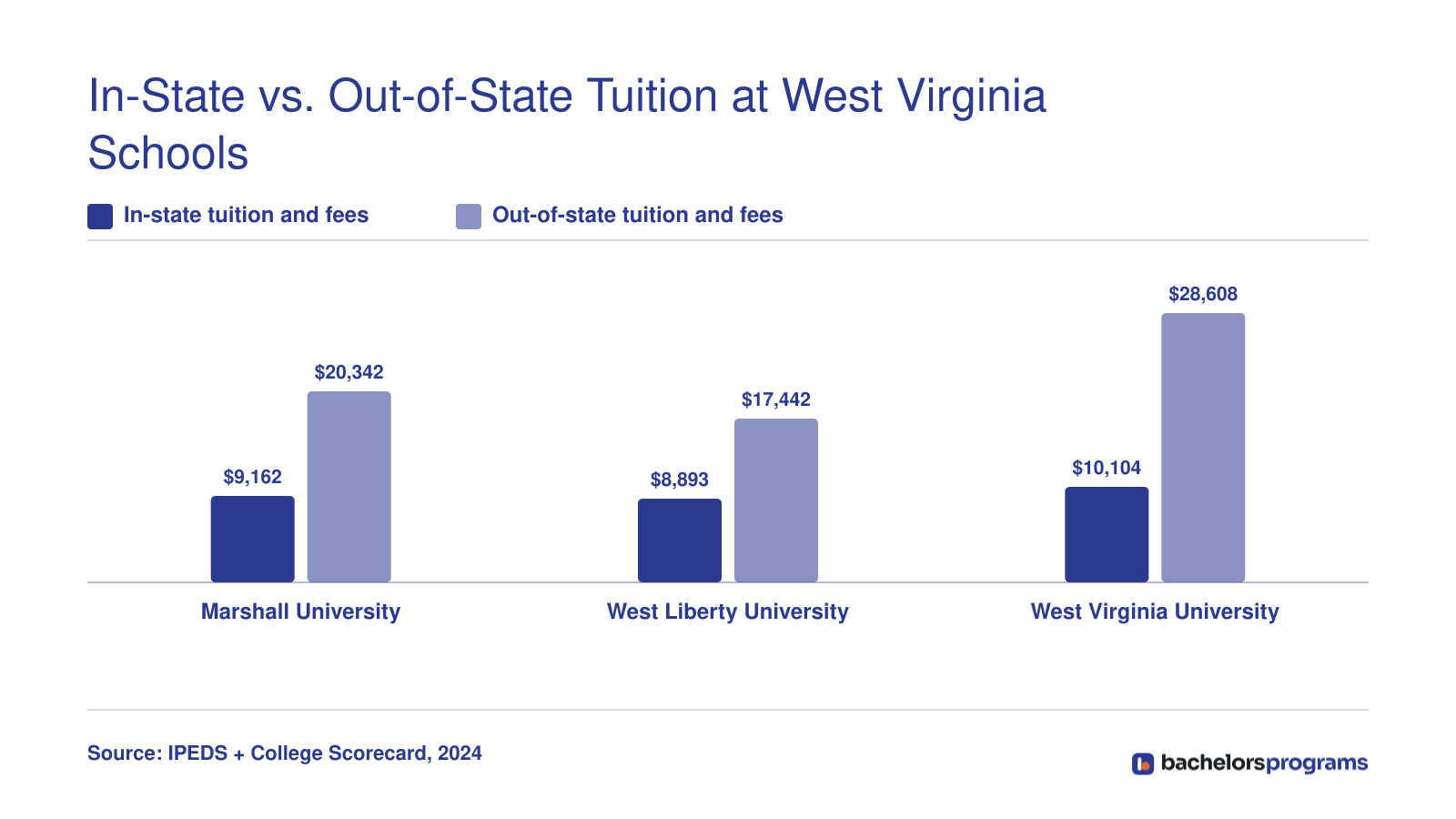
Among the schools ranked here, in-state tuition and fees run from $8,893 at West Liberty University to $10,104 at West Virginia University, with Marshall University in between at $9,162. Out-of-state students pay considerably more: $17,442 at West Liberty, $20,342 at Marshall, and $28,608 at WVU.
Net Price After Aid
Average net price, meaning what students pay after grants and scholarships are applied, tells a different story. Marshall's average net price is about $7,502. West Liberty's is $15,366 and WVU's is $15,634. These are averages across first-time, full-time students receiving aid, not a quoted price for any one family, and a student living at home will typically land below them.
Pell Grant share shows how many students at each campus receive need-based federal aid: about 64 percent at Marshall, 61 percent at West Liberty, and 52 percent at WVU.
State Aid That Cuts the Bill
The West Virginia PROMISE Scholarship is the state's main merit award. For 2026-27 it pays the lesser of tuition and mandatory fees or $5,500 a year.1 Qualify with a 3.00 high school GPA, a 21 ACT composite, or a 1,080 SAT, and file by March 1.2 Applicants must be full-time first-year students and must have lived in West Virginia for at least 12 consecutive months.
The West Virginia Higher Education Grant Program is need-based, worth up to $3,400 a year, and uses the FAFSA as its only application.3 The deadline is April 15, and the grant covers up to eight full-time semesters.3 The Higher Education Policy Commission also administers other state programs, distributing more than $100 million in aid each year.4
The Bottom Line
For an in-state student, Marshall carries the lowest average net price among the schools ranked here, while West Liberty posts the lowest sticker tuition. File the FAFSA and the PROMISE application by March 1, then compare aid offers side by side; that is the cheapest route through any of these schools.
In-State vs. Out-of-State Tuition at West Virginia Schools
Residency changes the price more than any other factor at these schools. West Liberty University has the smallest out-of-state premium, about $8,549 more per year, so nonresidents pay roughly twice the in-state rate. Marshall University adds about $11,180. West Virginia University adds about $18,504, close to three times its in-state rate. Over four years, that gap can exceed $70,000 at West Virginia University. If you live outside West Virginia, compare net price after aid, ask each school about scholarships for nonresidents, and check how it determines residency before you commit.
Questions to Ask Yourself
Do you need an online or hybrid option, or can you commit to a campus?
Will you stay in West Virginia for the next stage of training?
Do you want a larger program or a smaller campus with closer faculty contact?
West Virginia Speech-Language Pathologist Licensure at a Glance
Careers With a Bachelor's in Communication Sciences and Disorders
The degree that leads to the highest-paying speech pathology work is not the one that gets you hired soonest. A bachelor's in communication sciences and disorders (CSD) can lead to paid work right away, but the wages people usually quote belong to licensed speech-language pathologists, not to new bachelor's graduates.
What You Can Do With the Degree
Bachelor's-level roles tend to be supportive rather than independent clinical positions. Common paths include:
- SLP assistant: Works under a supervising speech-language pathologist in schools, clinics or health care settings. Credential rules vary by state, so confirm West Virginia's current requirements with the state licensing board before you plan around this job.
- Early intervention and rehabilitation support: Entry roles helping children or adults with communication, feeding or hearing needs.
- Education-adjacent jobs: Classroom and special education support, often with extra coursework or a state credential.
Many graduates also use the degree as a pre-professional step, which is how West Liberty University describes its Speech Pathology and Audiology program.
Occupation Wages and Demand
These figures describe speech-language pathologists as an occupation, not what bachelor's graduates earn. Nationally, the Bureau of Labor Statistics reports a May 2025 median wage of $97,870 a year ($47.05 an hour) across about 193,400 jobs.1 That sits below the $103,500 median for healthcare diagnosing and treating practitioners and well above the $50,980 median for all occupations. BLS projects 17% growth from 2025 to 2035, about 32,100 added jobs and roughly 12,500 openings a year.2 No West Virginia wage or job count for this occupation appears in the BLS data reviewed, so treat the national numbers as a general guide. BLS also does not list SLP assistants as a separate occupation, so there is no reliable federal wage figure for them.
What Completers Report
College Scorecard publishes earnings for people who finished each program, measured four years after completion:
- West Virginia University: $54,252 median earnings, with a five-year figure of $70,136 and median debt of $23,840.
- Marshall University: $55,037 median earnings and $25,500 median debt.
- West Liberty University: $47,212 median earnings. No debt figure is published for the program.
These cohorts are small, so a few graduates can move the medians noticeably. They also mix people who went straight to work with people who continued in school, so read them as rough benchmarks.
Accreditation Context
The Council on Academic Accreditation (CAA) of the American Speech-Language-Hearing Association accredits graduate-level education programs in the field. It does not accredit bachelor's programs, so a bachelor's in CSD will not carry CAA accreditation. Check each school's institutional accreditation instead, and look at how well the curriculum prepares you for the next step.
Compare Speech Pathology programs on the data that matters
Explore more Communications & Media majors or browse every field of study.
All Communications & Media programs Browse every field of study