Best Speech Pathology Schools in Wisconsin
Compare 7 accredited Speech Pathology programs in Wisconsin, with net price after aid, graduation rates, earnings and debt from IPEDS and the U.S. College Scorecard.
A bachelor's degree in speech pathology in Wisconsin, typically a Bachelor of Science, runs roughly $8,616 to $11,603 a year in tuition and fees at the state's public campuses, and considerably more at the private ones. Schools label the major Speech Pathology, Speech-Language Pathology or Communication Sciences and Disorders (CSD).
None of it licenses you on its own. Wisconsin requires a master's degree to practice as a speech-language pathologist, so the bachelor's is the pre-professional step: prerequisite coursework, observation hours and a GPA strong enough for graduate admission. The programs differ most in how early students reach the clinic.
Key Points
- UW-Whitewater offers a fully online Communication Sciences and Disorders bachelor's.
- Wisconsin licenses speech-language pathologists through DSPS, which requires a master's degree.
- Wisconsin speech-language pathologists earned an $80,340 median wage (BLS, May 2025).
Best Schools for a Bachelor's Degree in Speech Pathology in Wisconsin
Seven Wisconsin universities award a bachelor's degree in speech pathology or communication sciences and disorders, and each one leads somewhere slightly different: a large research campus, a Jesuit clinic with direct admission, or a regional public with unusually early clinical hours. The ordering below reflects program-level outcomes and cost as much as reputation, so a school that fits your budget and your goals can legitimately outrank a bigger name. Every entry is the pre-professional step; licensure as a speech-language pathologist in Wisconsin requires a master's degree.
University of Wisconsin-Madison
#1Madison, WI · ~$17,000/yr (est.)
Best for: Research-minded students near a teaching hospital
UW-Madison is the state's flagship research university, and its Communication Sciences and Disorders bachelor's sits inside a large academic health ecosystem. Students study anatomy and physiology of speech, hearing science, neural communication, and language development, and the major can be declared without a separate application.
- 120 total credit hours with a four-year sample plan
- No application required to declare the major
- Honors in the major available
- Study abroad options in more than 80 countries
- Career advising through SuccessWorks
Marquette University
#2Milwaukee, WI · ~$31,000/yr (est.)
Best for: Students wanting immediate clinical contact
Marquette is a private Jesuit university in Milwaukee where undergraduates in speech pathology and audiology are admitted directly into the major from their first semester. That access shows up in the clinic: undergraduates observe and work with real clients in the on-campus Speech and Hearing Clinic, and can take gross anatomy lab and conduct research with faculty. It is a compact, clinically oriented alternative to a large public campus.
- Direct admission to the major from the first semester
- On-campus clinicals in the Speech and Hearing Clinic
- Gross anatomy lab open to undergraduates
- Leadership concentration through the E-Lead program
- Undergraduate research with faculty
- Study abroad opportunities available
University of Wisconsin-Whitewater
#3Whitewater, WI · $10,000 – $15,000/yr (est.)
Best for: Hands-on learners seeking early observation hours
UW-Whitewater frames its Communication Sciences and Disorders degree around practice. Students log 25 observation hours before graduation, complete a capstone with a mock interview and portfolio, and take part in interprofessional simulations alongside social work students, working through realistic cases with simulated patients and caregivers. The campus Center for Communication Disorders and an active NSSLHA chapter give students a professional community close to home.
- 25 clinical observation hours built into the degree
- Required senior capstone with mock interview and portfolio
- Interprofessional simulation with social work students, about 30 students yearly
- Field study placements in local schools
- On-campus Center for Communication Disorders
- Minor options in Spanish or psychology
University of Wisconsin-River Falls
#4River Falls, WI · $10,000 – $15,000/yr (est.)
UW-River Falls offers a Bachelor of Science in Communication Sciences and Disorders through its College of Education, Business and Allied Health, with a curriculum built on the biological and neurological bases of communication. Students study assessment and intervention for articulation, hearing, voice, fluency, and language disorders, and assist with sessions in the University Speech-Language and Hearing Clinic. It is one of the smaller, more teaching-focused programs on this list.
- Bachelor of Science housed in the College of Education, Business and Allied Health
- Coursework in biological and neurological bases of communication
- Training in articulation and phonological disorders
- Assessment and intervention for voice, fluency, and hearing disorders
- Hands-on sessions in the University Speech-Language and Hearing Clinic
University of Wisconsin-Stevens Point
#5Stevens Point, WI · $15,000/yr (est. net price)
UW-Stevens Point has taught communication sciences and disorders for six decades and runs a campus Speech, Language and Hearing Clinic where undergraduates observe clients starting in their first two years, all under faculty holding the ASHA Certificate of Clinical Competency.
- Clinic observations beginning in the first two years
- Senior-year case management experience
- Faculty hold the ASHA Certificate of Clinical Competency
- Award-winning NSSLHA chapter and Student Academy of Audiology
- 60 years of teaching in the field
University of Wisconsin-Milwaukee
#6Milwaukee, WI · $10,000 – $22,000/yr (est.)
UWM's Bachelor of Science in Communication Sciences and Disorders is a pre-professional degree covering speech, language, communication, swallowing, hearing, and balance disorders. Admission to the major is selective and happens after prerequisite coursework, so students should plan for the GPA and credit thresholds early. The program encourages undergraduate research with faculty and connects students to professional organizations in the Milwaukee area.
- Minimum 2.750 cumulative UWM GPA to enter the major
- 3.00 GPA required across the three core COMSDIS courses
- 58 completed credits plus general education competencies
- Pre-professional foundation for SLP and audiology graduate study
- Undergraduate research with program faculty
- Requires coordinator endorsement for admission
Concordia University-Wisconsin
#7Mequon, WI · ~$36,000/yr (est.)
Concordia University Wisconsin is a private Lutheran university in Mequon offering a 120-credit Communication Sciences and Disorders degree with community service learning and clinical observation involving both children and adults. High-achieving students can apply to a 3+2 dual degree that finishes the bachelor's and a Master of Science in Speech-Language Pathology in five years rather than six. The on-campus Speech, Language, and Hearing Clinic supplies clinical exposure close to Milwaukee.
- 120 total credit hours over a standard four-year plan
- 3+2 dual degree completing bachelor's and master's in five years
- Clinical observation with both children and adults
- Community service learning built into coursework
- On-campus Speech, Language, and Hearing Clinic
Cost & outcomes by school
Federal data for the highest-earning Speech Pathology programs, independent of the ranking above. Earnings are this field's bachelor's graduates four years after completing where the Scorecard reports them, else the school's undergraduate median.
| School | Net price / yr | Grad rate | Earnings | Debt | Grads/yr | Format |
|---|---|---|---|---|---|---|
| Marquette University WI | $31,487 | 83% | $66,501 | $26,000 | 35 | Campus |
| University of Wisconsin-Madison WI | $17,354 | 90% | $61,737 | $25,247 | 91 | Campus |
| University of Wisconsin-Whitewater WI | $14,158 | 59% | $56,878 | $25,750 | 20 | Campus |
| Concordia University-Wisconsin WI | $36,201 | 68% | $56,075 | $25,750 | 5 | Campus |
| University of Wisconsin-River Falls WI | $14,054 | 57% | $54,963 | $19,500 | 25 | Campus |
| University of Wisconsin-Milwaukee WI | $15,014 | 49% | $53,793 | $21,500 | 18 | Campus |
| University of Wisconsin-Stevens Point WI | $14,559 | 51% | $51,497 | $19,000 | 27 | Campus |
Sources: U.S. Department of Education. Net price, graduation rate, earnings and debt: College Scorecard (earnings and debt for this field's bachelor's graduates where reported, else school-wide); graduates: IPEDS. A dash means no figure is reported.
Cost, debt & payoff
Median earnings of this field's bachelor's graduates (4 yrs after completing, else the school's undergraduate median) vs. their median federal loan debt · U.S. College Scorecard
Across these programs the median graduate earns about $56,075 and finishes with roughly $25,247 in debt — a ratio that clears a common rule of thumb (keep debt below first-year salary). Net price and debt vary widely school to school, so check the per-school figures in the table above before you shortlist.
Compare Wisconsin Speech Pathology Bachelor's Schools Side by Side
This table lines up the schools ranked here on cost, completion and borrowing, using institution-wide figures from IPEDS and the College Scorecard (2024). Average net price reflects the full cost of attendance (tuition, housing and other expenses) minus grants and scholarships, which is why it can run higher than tuition alone. UW-Whitewater posts the lowest in-state tuition, while UW-Madison has the highest graduation rate.
| School | Major Name | Location | Type | In-State Tuition and Fees | Average Net Price | Graduation Rate | Median Debt at Graduation |
|---|---|---|---|---|---|---|---|
| University of Wisconsin-Madison | Communication Sciences and Disorders | Madison | Public | $11,603 | $17,354 | 90% | $20,484 |
| Marquette University | Speech Pathology and Audiology | Milwaukee | Private | $51,170 | $31,487 | 83% | $23,940 |
| University of Wisconsin-Whitewater | Communication Sciences and Disorders | Whitewater | Public | $8,616 | $14,158 | 59% | $23,188 |
| University of Wisconsin-River Falls | Communication Sciences and Disorders | River Falls | Public | $9,008 | $14,054 | 57% | $20,500 |
| University of Wisconsin-Stevens Point | Communication Sciences and Disorders | Stevens Point | Public | $9,488 | $14,559 | 51% | $21,503 |
| University of Wisconsin-Milwaukee | Communication Sciences & Disorders | Milwaukee | Public | $10,398 | $15,014 | 49% | $23,000 |
| Concordia University-Wisconsin | Communication Sciences and Disorders | Mequon | Private | $35,470 | $36,201 | 68% | $25,750 |
Admissions: GPA, Test Policy and Transfer Credit
Do you need a high GPA or test scores to get into a speech pathology bachelor's program in Wisconsin? For most of these schools, the answer sits in general university admission, not in the department. Selectivity varies widely, and published program-level rules are thin.
Selectivity Versus What Schools Publish
University of Wisconsin-Madison is the most selective here, admitting about 45% of applicants. Concordia University-Wisconsin (78%), Marquette University (81%), University of Wisconsin-River Falls (82%), University of Wisconsin-Whitewater (86%), University of Wisconsin-Milwaukee (91%) and University of Wisconsin-Stevens Point (92%) admit far more. Yet a high admit rate does not mean an easy path into the major, as UWM shows below.
School by School
- Concordia: The application is online, and ACT scores are optional.1 No SAT policy, minimum GPA or transfer-credit rules are published, and there is no separate CSD admission step.
- Madison: Students can declare the major without a separate application. No GPA minimum, test policy or transfer rules turned up on the pages we read.
- Marquette: Admission to the major is direct from the first semester. No GPA minimum, test policy or transfer-credit policy for the program is published.
- Whitewater: The online bachelor's requires 38 major credits plus 31 to 33 in related coursework.4 No GPA minimum, test policy or transfer rules were published on the pages we read.
- River Falls: Nothing published covers a GPA minimum, test policy, transfer-credit rules or a declaration requirement.
Where the Major Has Its Own Gate
UWM is the clearest example of a secondary admission.3 After general admission, you must apply to the CSD major with 58 completed credits and a 2.75 cumulative UWM GPA.2 You also need a 3.0 in the prerequisite CSD courses, earned the first time you take them, plus coordinator endorsement. The catalog also lists a 3.5 high school GPA, but it is unclear which applicants that covers, so confirm it with an advisor. UWM publishes no test policy, and on transfer credit it notes only that some AP credits are recommended.
Stevens Point's standard bachelor's requires 42 CSD credits. Its separate 3+2 track is stricter: declare by summer of sophomore year and hold a 3.50 GPA. Students in the track keep a 2.75 overall and 3.0 major GPA, with C or better in required CSD courses. Whether those standards apply to the standard bachelor's is not published.
A Practical Tip
Transfer students should request a written credit evaluation before enrolling, since most schools here publish no transfer rules. Undeclared students should take the gateway CSD courses in the first year, especially at UWM, where a weak first attempt can block the major.
Related Articles
Cost in Wisconsin: In-State Tuition, Net Price and State Aid
Cost comes down to two numbers. The first is a year of in-state tuition and fees. The second is the average net price, what students pay for tuition, housing, books and living costs after grants and scholarships.
Tuition and Net Price by School
- UW-Whitewater: $8,616 tuition and fees; $14,158 net price; 44% receive Pell Grants
- UW-River Falls: $9,008 tuition; $14,054 net price; 45% Pell
- UW-Stevens Point: $9,488 tuition; $14,559 net price; 50% Pell
- UW-Milwaukee: $10,398 tuition; $15,014 net price; 53% Pell
- UW-Madison: $11,603 tuition; $17,354 net price; 33% Pell
- Concordia University-Wisconsin: $35,470 tuition; $36,201 net price; 50% Pell
- Marquette University: $51,170 tuition; $31,487 net price; 35% Pell
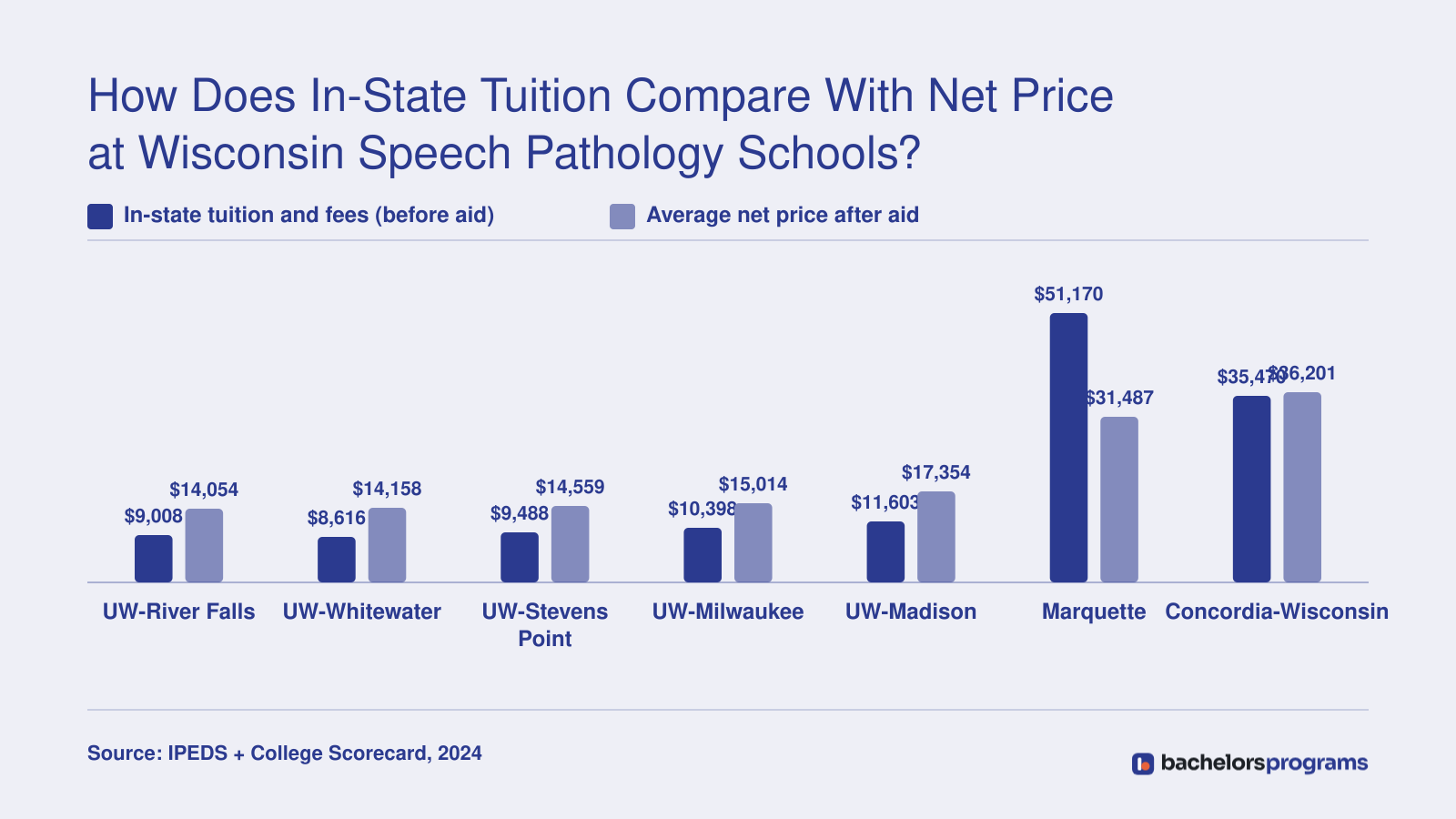
Whitewater has the lowest sticker price, and River Falls has the lowest net price. Marquette charges the most in tuition, but Concordia ends up with the highest net price. The public campuses land between $14,054 and $17,354 after aid, roughly half the private figures. Net price is a school-wide average for students who receive aid. It is not a quote for this major or for your family. A high Pell share, like UWM's, means many students there qualify for need-based aid.
Wisconsin Grants and Scholarships
Each of these starts with the FAFSA.
- Wisconsin Grant: For Wisconsin resident undergraduates with financial need, prorated by enrollment and capped at 10 semesters. The 2026-27 maximum is $3,700 at UW campuses. At private nonprofit colleges it is $4,850 for students with a Student Aid Index of $8,000 or less.1
- Talent Incentive Program: Up to $1,800 a year for first-time freshmen with financial need who enroll at least half-time and come from educationally disadvantaged or non-traditional backgrounds.2 Students are nominated by their aid office or a Wisconsin Educational Opportunities Program counselor.3
- School scholarships: Whitewater and Stevens Point advertise scholarships, and Concordia reports average undergraduate aid of $23,395.
A Practical Way to Cut Cost
Take general education courses at a lower-cost UW campus, then transfer. UWM expects 58 completed credits before admission to its major, so early coursework is where savings add up. Confirm that your credits will transfer with the receiving school before you enroll.
How Does In-State Tuition Compare With Net Price at Wisconsin Speech Pathology Schools?
Each bar pair puts a school's published in-state tuition and fees next to its average net price after grants and scholarships. Tuition is the sticker price before any aid, while net price is an institution-wide average for all undergraduates aided at that school, not a figure for the speech pathology major alone. At the UW campuses, net price runs higher than tuition because it also covers housing, food, books and other costs of attendance. At Marquette, aid brings the average well below the tuition sticker price.
Questions to Ask Yourself
Do you need an online or hybrid schedule, or can you attend on campus in Wisconsin?
Does the school offer a 3+2 or accelerated pathway, and do you need to commit as a first-year student?
Does the school require a separate application to the CSD major after you enroll?
Online and Hybrid Bachelor's Options at Wisconsin Schools
Fully online study is rare in this field, and the documentation is uneven. Only UW-Whitewater's Communication Sciences and Disorders program appears in the Universities of Wisconsin online-degree directory as fully online (120 credits, semester-based). That listing does not say whether clinical, observation or in-person components are exceptions, so confirm them with the department before you enroll.
For UW-Madison, UW-Milwaukee, UW-Stevens Point, Concordia University-Wisconsin, Marquette and UW-River Falls, the program pages describe on-campus study. None of them clearly advertises an online or hybrid bachelor's. UW-Madison accepts credits earned online or through study abroad, but that does not make its major a hybrid program.
Accelerated Bachelor's-to-Next-Step Pathways
Three schools describe five-year tracks. This covers structure only, not a recommendation.
- Concordia University-Wisconsin: A 3+2 Fast Track that combines the bachelor's and the next degree in five years.1 The published page does not give application timing, GPA cutoffs or the course sequence.
- UW-Stevens Point: A 3+2 dual-degree option starting Fall 2026, also five years. Application timing and GPA thresholds are not published in the sources reviewed.
- UW-Milwaukee: A BS/MS track with the clearest rules. Students apply in January of their third year and share 22 credits between the two degrees (20 backward, 2 forward).2 Advancing requires at least a 3.0 overall GPA, no retaking courses, and a B or better in every COMSDIS course. A 3.5 cumulative GPA guarantees admission to the professional phase. Students who miss the marks can return to the regular four-year major.
No 4+1 route turned up, and UW-Madison does not describe an accelerated option.3
Why Hands-On Requirements Limit Online Delivery
The major relies on supervised exposure to real clients. UW-Whitewater lists 25 clinical hours and an on-campus communication disorders center. UW-Stevens Point schedules clinic observations in the first two years. Concordia lists observation with children and adults, and Marquette lists an on-campus speech and hearing clinic and an undergraduate gross anatomy lab. Before you commit, ask any online or hybrid program how it places observation hours near you and who signs off on them.
Careers in Wisconsin and Wisconsin Speech Pathology Licensure
Wisconsin licenses speech-language pathologists through the state's Department of Safety and Professional Services (DSPS), and that license requires a master's degree. The bachelor's is the pre-professional step: the degree, plus the prerequisite courses and observation hours graduate programs expect, is what positions you to pursue a license later.
Start With the Licensing Board
Go to the DSPS credentialing pages for speech-language pathologists before you trust any summary, including this one. Read the education, supervised experience and fieldwork language as the board writes it, and note which requirements apply now and which apply only after graduate study. If a support-level role interests you, ask DSPS directly which credential covers it and what supervision it carries.
Confirm Prerequisites With ASHA and the Programs
The American Speech-Language-Hearing Association describes the bachelor's as the pre-professional stage nationally; its guidance frames the graduate step that follows. Then use the Wisconsin program pages on this list to confirm prerequisite courses, observation hours, and what graduate admissions committees expect. Course titles vary from campus to campus, so get each requirement in writing rather than inferring it from a similar-sounding course.
Map the Wisconsin Job Market
Use BLS.gov's occupational outlook for speech-language pathologists to understand the work and its demand picture, then read live postings to see where hiring happens: Wisconsin school districts, hospitals, outpatient clinics, skilled nursing facilities, early intervention agencies, and telehealth providers. The Wisconsin Speech-Language Pathology and Audiology Association is a useful state-level source on practice issues and professional development.
Your Checklist
- Licensure: Confirm current DSPS requirements for the credential you are aiming at, and ask specific questions in writing so you have answers on record.
- Programs: Compare prerequisite and observation-hour expectations across every program you are considering, and ask how each one supports students applying to graduate school.
- Employers: Track postings for a few weeks in the region where you want to live to see which settings hire most often.
What Speech-Language Pathologists Earn in Wisconsin
According to the U.S. Bureau of Labor Statistics May 2025 estimates, licensed speech-language pathologists in Wisconsin earn a median of $80,340 a year, against $97,870 nationally. These are wages for the whole profession, which requires a master's degree, so they show where a bachelor's degree in speech pathology can lead after graduate study, not what you will earn with the bachelor's alone. They also differ from College Scorecard figures for recent bachelor's graduates, which track early-career pay for people who may not yet be licensed. Separate wage estimates for the Milwaukee, Madison, Green Bay and Appleton metro areas were not reported in the data we reviewed.
| Area | Occupation | Median Annual Wage | Employment |
|---|---|---|---|
| Wisconsin (statewide, May 2025) | Speech-language pathologists | $80,340 | N/A |
| United States (national, 2025) | Speech-language pathologists | $97,870 | 193,400 |
Wisconsin Speech Pathology Bachelor's FAQ
These answers cover the questions students ask most often about a bachelor's degree in speech pathology in Wisconsin. Each one reflects the program details and cost facts covered earlier on this page.
Can you become a speech-language pathologist with just a bachelor's degree in Wisconsin?
Are there online speech pathology bachelor's programs in Wisconsin?
What can you do with a bachelor's degree in communication sciences and disorders?
How much does a speech pathology bachelor's degree cost in Wisconsin?
Compare Speech Pathology programs on the data that matters
Explore more Communications & Media majors or browse every field of study.
All Communications & Media programs Browse every field of study