Best Global Health Degree Programs
Compare 390+ accredited Global Health programs at 380+ colleges, with net price after aid, graduation rates, earnings and debt from IPEDS and the U.S. College Scorecard.

After grant aid, a year at these schools costs anywhere from about $6,500 to $21,700, and graduation rates span 70% to 96%. A bachelor's degree in global health sits inside that spread: same credential, sharply different price and completion odds. The standard credential is a Bachelor of Science (B.S.) in Global Health, though some programs award a B.A. or a B.S.P.H. instead.
Median first-year earnings reported by these schools range from roughly $28,000 to $56,000, and required field placements can add airfare, housing and program fees that no tuition line reflects.
Key Points
- CUNY Lehman College's average net price after aid is just $3,148.
- Cal Poly San Luis Obispo graduates report the highest first-year median earnings.
- Required study abroad can add travel costs missing from published prices.
Best Schools for a Bachelor's Degree in Global Health
These ten programs separate themselves on three things: what graduates actually pay after aid, whether students finish on time, and what the major is worth in the job market shortly after graduation. Every entry is a bachelor's degree in global health or a closely related public health major with a global health concentration, drawn from federal data and our own program records. Earnings figures below describe the major itself, not the whole institution.
University of California-San Diego
#1La Jolla, CA · $10,000 – $15,000/yr (est.)
Best for: Future field researchers wanting interdisciplinary breadth
UC San Diego runs one of the few dedicated global health majors in the country, and it is the rare one that splits into a Bachelor of Arts and a Bachelor of Science. The B.S. adds a year each of biology, chemistry and math plus pre-health coursework, while the B.A. leans on social science, policy and global processes. Faculty come from medicine, social sciences, arts and humanities, and the Rady School of Management, and both tracks end in a 100-hour field experience in the U.S. or abroad. The school's graduation rate is 86 percent, and graduates of the major reported a median $43,608 one year after finishing and $64,428 four years out.
- B.A. requires 17 courses (68 units); B.S. requires 24 courses (96 units)
- B.S. adds a year each of biology, chemistry and math plus pre-health coursework
- 100-hour field experience in the U.S. or abroad, at least 5 weeks long
- Four upper-division core courses, including GLBH 148, GLBH 181 and MGT 173
- Two-quarter honors thesis seminar open to majors with a 3.5 GPA
- Courses must be graded C- or better
- Faculty drawn from medicine, social sciences, humanities and Rady School of Management
University of Chicago
#2Chicago, IL · ~$15,000/yr (est.)
Best for: Pre-health students seeking research-intensive science training
Global health at the University of Chicago sits inside Biological Sciences, where Global Health Services is one of nine specializations available in both the B.A. and B.S. tracks. That placement suits students who want a science-heavy foundation, and the Center for Innovation in Global Health adds undergraduate courses, seminars, summer research, internships and supervised fieldwork at international sites. GlobeMed chapters maintain long-term partnerships with community organizations, and career partners include the United Nations Population Fund, Save the Children and Oxfam. The school's graduation rate is 96 percent.
- Global Health Services is one of nine specializations in Biological Sciences
- Offered as both a B.A. and a B.S. in the College
- Center for Innovation in Global Health funds summer research and fieldwork
- GlobeMed chapters run long-term community partnerships and on-site internships
- Supervised service learning available at international sites
University of California-Davis
#3Davis, CA · $10,000 – $15,000/yr (est.)
Best for: One Health advocates eyeing zoonotic disease work
Global Disease Biology at UC Davis is a joint venture of the Department of Plant Pathology, the School of Veterinary Medicine and the School of Medicine, built on the One Health model. Students study etiology, evolution, ecology and epidemiology alongside research methods, then complete a practicum in a research, clinical, laboratory or field setting. It is a strong fit for readers who want human health taught next to veterinary, plant and environmental health rather than on its own. The school's graduation rate is 86 percent, and graduates of the major reported a median $46,005 one year after finishing and $74,343 four years out.
- Jointly run by Plant Pathology, Veterinary Medicine and the School of Medicine
- One Health model links human, animal, plant and environmental health
- Practicum in research, clinical, laboratory or field settings
- Three competency sets: disease issues, disease knowledge, research methods
- Graduates move into epidemiology, public health analysis and food safety
University of Florida
#4Gainesville, FL · ~$7,000/yr (est.)
The University of Florida awards a Bachelor of Science in Health Education with two specializations, Community Health Promotion and Health Studies, and the Health Studies track is stacked with prerequisites for medical, dental, pharmacy, physician assistant and physical therapy programs. All students complete a 15-credit internship and graduate eligible to sit for the Certified Health Education Specialist exam. The department has been active in health promotion for more than 60 years. The school's graduation rate is 91 percent, and graduates of the major reported a median $27,994 one year after finishing and $64,285 four years out.
- 120 credits, including a 15-credit health education internship (HSC 4876)
- Two specializations: Community Health Promotion and Health Studies
- Eligible to sit for the Certified Health Education Specialist exam
- Health Studies track covers prerequisites for medical, dental and PA school
- Curriculum rests on social, behavioral, biological and health sciences
University of Virginia
#5Charlottesville, VA · $22,000/yr (est. net price)
Virginia's global health pathway is a Bachelor of Arts in Global Studies with a Global Public Health concentration, so the degree reads as policy and social science rather than bench science. Students begin with GSGS 2000 and add social science coursework in anthropology or economics, then examine how culture, politics, economics and environment shape access to care. It is a social-science route rather than a pre-health one, and study abroad scholarships are available. The school's graduation rate is 96 percent, and graduates of the major reported a median $42,197 one year after finishing and $76,044 four years out.
- B.A. in Global Studies with a Global Public Health concentration
- Starts with GSGS 2000, Introduction to Global Studies
- Adds a social science course such as anthropology or economics
- Covers cultural, social, political and environmental drivers of health
- Study abroad scholarships available
- Leads to policy analysis, consultancies and public health outreach roles
California Polytechnic State University-San Luis Obispo
#6San Luis Obispo, CA · ~$17,000/yr (est.)
Cal Poly's Bachelor of Science in Public Health carries a Health Equity and Global Health concentration of 12 units, and the whole degree reflects the university's learn-by-doing model. Concentration coursework includes Public Health and Mental Health and Comparative Health Care Systems, and students round it out with an elective in public health microbiology, international relations or the sociology of health. Every student completes a senior project, and admission needs a 2.0 GPA plus 40 upper-division units. The school's graduation rate is 86 percent, and graduates of the major reported a median $55,807 one year after finishing.
- 120 units, including 12 units of Health Equity and Global Health coursework
- Concentration covers comparative health systems and health promotion
- Elective drawn from public health microbiology, international relations or sociology
- Senior project required, plus 40 upper-division units and a 2.0 GPA
- Prepares graduates for the CHES exam and for MPH study
University of Michigan
#7Ann Arbor, MI · $18,000 – $61,000/yr (est.)
The University of Michigan houses its Bachelor of Arts in Community and Global Public Health inside the School of Public Health, one of two upper-level bachelor's degrees the school offers. Students take an integrated public health core plus a broad liberal education, and the coursework looks at the cultural, ethical, social, economic and political forces behind health outcomes. It suits readers who want a public health school's faculty and advising from day one but a liberal arts frame, with graduates heading into health education, policy, nonprofits and government. The school's graduation rate is 93 percent, and graduates of the major reported a median $32,022 one year after finishing and $57,890 four years out.
University of North Carolina at Chapel Hill
#8Chapel Hill, NC · ~$12,000/yr (est.)
Carolina's Community and Global Public Health major is a Bachelor of Science in Public Health at the Gillings School, and it is deliberately small. The 52-53 credit major includes HBEH 520 Introduction to Global Health, HBEH 571 Global Health and Human Rights, BIOS 600 and EPID 600, and seniors finish a 150-hour internship with a partner organization. Students apply as sophomores for a junior-year start, and the cohort holds about 40 people. The school's graduation rate is 91 percent.
- 52-53 credit hours, including HBEH 520 Introduction to Global Health
- 150-hour internship with a partner organization in HBEH 555
- Cohort of about 40 students; apply sophomore year to start junior year
- Prerequisites: BIOL 101 with lab, one math course, one social science course
- Coursework includes BIOS 600 and EPID 600
- Honors thesis needs a 3.3 cumulative and 3.5 major GPA
University of South Florida
#9Tampa, FL · ~$10,000/yr (est.)
South Florida's Bachelor of Science in Public Health was the first bachelor's in public health housed in an accredited College of Public Health in the state, and it can be completed entirely online. Global Health is one of four concentration options, sitting on a core that covers epidemiology, biostatistics, environmental health and health policy. Strong students can use a bachelor's-to-master's pathway, and the degree targets entry-level roles in government agencies, health corporations, community nonprofits and care facilities. The school's graduation rate is 77 percent, and graduates of the major reported a median $32,135 one year after finishing and $57,628 four years out.
- Global Health is one of four concentration options
- Entire degree can be completed online
- Housed in an accredited College of Public Health
- Bachelor's to master's pathway for high-achieving students
- Core covers epidemiology, biostatistics, environmental health and policy
California State University-Fullerton
#10Fullerton, CA · $7,000 – $20,000/yr (est.)
Cal State Fullerton's Bachelor of Science in Public Health pairs 28 units of core coursework with an 18-unit Global Health concentration. The concentration develops a global view of communicable and non-communicable disease, food security and development, and asks students to weigh competing economic, political and social interests when designing interventions. Core work covers environmental health, epidemiology, health systems, program planning and data analysis, and graduates move into health careers or advanced study. The school's graduation rate is 70 percent, and graduates of the major reported a median $34,909 one year after finishing.
- 28 units of core coursework plus an 18-unit Global Health concentration
- Core covers epidemiology, environmental health and program planning
- Concentration examines food security, development and burden of disease
- C- (1.7) or better required in every course counted toward the major
- Prepares graduates for health careers and advanced study
Cost & outcomes by school
Federal data for the highest-earning Global Health programs, independent of the ranking above. Earnings are this field's bachelor's graduates four years after completing where the Scorecard reports them, else the school's undergraduate median.
| School | Net price / yr | Grad rate | Earnings | Debt | Grads/yr | Format |
|---|---|---|---|---|---|---|
| Massachusetts College of Pharmacy and Health Sciences MA | $39,545 | 62% | $125,557 | $25,000 | — | Campus |
| University of Pennsylvania PA | $28,699 | 97% | $111,371 | $15,715 | — | Campus |
| Lehigh University PA | $36,931 | 88% | $105,584 | $21,960 | — | Campus |
| Cornell University NY | $28,690 | 95% | $104,043 | $14,000 | — | Campus |
| Boston College MA | $41,704 | 91% | $103,937 | $19,000 | — | Campus |
| Georgetown University DC | $40,815 | 95% | $103,494 | $15,500 | 1 | Campus |
| Duke University NC | $29,612 | 97% | $97,800 | $13,000 | — | Campus |
| Northeastern University MA | $30,915 | 91% | $92,538 | $24,250 | — | Campus |
| University of Southern California CA | $32,740 | 92% | $92,498 | $18,000 | — | Campus |
| University of Chicago IL | $14,860 | 96% | $91,885 | $15,000 | — | Campus |
| Vanderbilt University TN | $15,846 | 94% | $91,565 | $14,000 | — | Campus |
| California Polytechnic State University-San Luis Obispo CA | $16,665 | 86% | $90,768 | $21,744 | 9 | Campus |
Sources: U.S. Department of Education. Net price, graduation rate, earnings and debt: College Scorecard (earnings and debt for this field's bachelor's graduates where reported, else school-wide); graduates: IPEDS. A dash means no figure is reported.
Cost, debt & payoff
Median earnings of this field's bachelor's graduates (4 yrs after completing, else the school's undergraduate median) vs. their median federal loan debt · U.S. College Scorecard
Across these programs the median graduate earns about $57,259 and finishes with roughly $23,250 in debt — a ratio that clears a common rule of thumb (keep debt below first-year salary). Net price and debt vary widely school to school, so check the per-school figures in the table above before you shortlist.
How We Ranked Global Health Bachelor's Programs
Which numbers actually separate one bachelor's degree in global health from another? Four do most of the work: real cost after aid, whether students stay and finish, selectivity, and what graduates of the major itself earn and owe.
The Inputs
- Net price after aid: the average a first-year student pays after grant aid, not published tuition.
- Retention and completion: the share of first-years who return, and the share who finish within six years.
- Admission rate: how selective the campus is.
- Major-level earnings and debt: median pay and borrowing reported for the global health program's own graduates.
Why Major Earnings Outweigh School Averages
A campus-wide median blends English majors, nurses and engineers; it describes the institution, not your likely outcome. Where federal data reports earnings for the global health completions themselves, that figure carries the heavier weight. Some campuses have no published program earnings, since small graduating cohorts are often left out of the public release. Those schools are weighed on what is reported.
What the Averages Hide
Net price averages all aided students rather than quoting your bill; what you pay depends on income, assets and residency. Graduation rates cover the whole institution, so treat them as a signal about student support rather than a forecast for your own cohort.
The Data Snapshot
Institution-level figures come from the 2024 College Scorecard release; earnings and debt come from the 2022 outcomes release, so they describe graduates who finished a few years ahead of you.
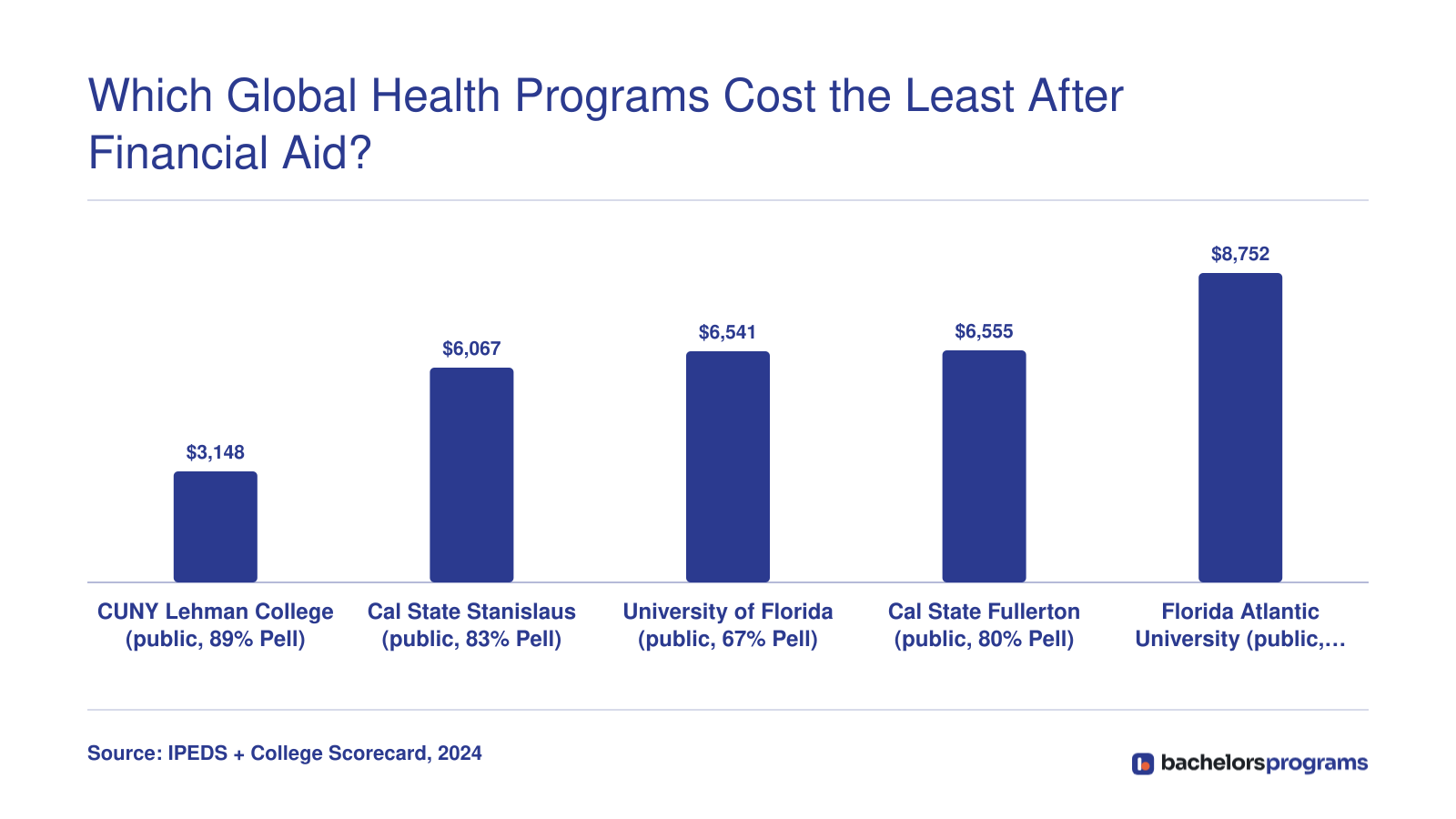
Which Global Health Programs Cost the Least After Financial Aid?
The most affordable global health programs here are all public universities. Average net price after aid runs from $3,148 at CUNY Lehman College to $8,752 at Florida Atlantic University, and Pell Grant shares of 67% to 89% show these schools enroll many lower-income students. Program-level median debt is $12,489 at Cal State Fullerton ($132 a month over 10 years), $13,936 at Lehman ($148 a month) and $14,942 at the University of Florida ($158 a month), while Stanislaus State and FAU report school-wide medians of $13,540 and $17,236. Net price is an average, so your own aid package may differ; run each school's net price calculator before you compare offers.
Online vs. On-Campus Global Health Degrees
An online bachelor's in global health is a four-year degree, usually 120 credits, completed mostly through virtual coursework instead of daily campus attendance. Most programs on this list are campus-only. University of South Florida stands out for offering both formats: its B.S. in Public Health with a Global Health concentration has a fully online option.
What Online Actually Looks Like
Arizona State University is the clearest fully online match, down to the exact title. It offers a B.S. and a B.A. in Global Health, each at 120 credits, delivered in 7.5-week classes. The diploma does not say online or in person. The online B.A. includes an approved global-health study-abroad program, though published material does not say whether it is required or can be done virtually.
Oral Roberts University offers an online B.S. in Global Health and Environmental Sustainability that mixes live scheduled classes with asynchronous coursework.1 The University of Cincinnati has a fully online B.S. in Public Health (120 semester credits) with a Global Health concentration. Its $100 application fee is waived through Spring 2027 for online programs.2
Published details on required synchronous attendance, in-person practicums and transfer-credit rules are thin for most online options. Working adults should ask admissions about all three before applying.
International Students: Campus Is Usually the Path
F-1 students generally cannot study fully online and keep their visa status. No online program reviewed here has confirmed F-1 eligibility, so international applicants should focus on campus programs and verify with the school's international office.
The Tradeoff
- Online: Flexible scheduling and no relocation cost, which suits people already working or raising a family.
- On campus: Easier access to field placements and study abroad. UC San Diego requires a field experience of at least five weeks in the U.S. or abroad, and UNC Chapel Hill pairs a 150-hour internship with study abroad options.
If you need to stay where you are, online is a workable route. If you want hands-on global fieldwork built into the degree, a campus program makes that easier.
Related Articles
What Can You Do With a Global Health Degree? Careers and Salaries
A global health bachelor's can put you in the field within months of graduation, but the pay ladder in this work climbs fastest after a master's. The real question is which side of the work you want: program delivery and community outreach, which a B.S. supports directly, or analytic and research roles that almost always ask for an MPH. Both paths start from the same degree, so the choice is easier to make before you enroll than after.
Where B.S. Global Health Graduates Work
Graduates move into international and domestic NGOs, state and local health departments, university research centers, and community health organizations. Typical first jobs include health education, program coordination, community outreach, and data collection for surveillance or program evaluation. Many of these positions depend on time-limited grants, so weigh job security alongside salary when you compare offers. Openings cluster in state capitals, large metro areas, and the university towns where research centers sit, so a willingness to relocate widens the entry-level pool.
Bachelor's-Level Roles and Pay
- Health education specialists: $64,070 median annual wage; 6% projected growth from 2025 to 2035; bachelor's degree typical.1
- Community health workers: $51,850 median annual wage; 13% projected growth from 2025 to 2035; high school diploma typical.2
- Social and community service managers: $80,390 median annual wage; 7% projected growth from 2025 to 2035; bachelor's degree typical.3
Community health workers earn the least of the three, and the job typically requires only a high school diploma, so a bachelor's degree puts you ahead of the minimum rather than at it. Health education specialists and social and community service managers are the roles where the degree is the entry ticket, and managers carry the highest median of the group.
When the Master's Changes the Math
- Epidemiologists (typically requires a master's): $87,220 median annual wage; 19% projected growth from 2025 to 2035; master's degree typical.4
Epidemiology is the clearest example of a role that rewards the graduate step: the strongest projected growth of any occupation here, with a master's as the typical entry requirement. Treat that as a map of where an MPH leads rather than a job to apply for at 22. If outbreak investigation or biostatistics is the goal, build research experience and quantitative coursework during the bachelor's, because MPH admissions weigh both.
How Much Do Global Health Majors Make?
Global health majors typically enter occupations with median annual wages between about $51,850 and $80,390, based on 2025 U.S. Bureau of Labor Statistics figures for community health workers, health education specialists, and social and community service managers.
Top Early-Career Earnings for Global Health Graduates
Among the ranked programs, Cal Poly San Luis Obispo graduates report the highest median earnings in their first year after finishing a bachelor's degree.
Global Health vs. Public Health and Related Bachelor's Majors
Global health, public health, and international development overlap, but each points you toward different first jobs. ASPPH says many undergraduate degrees can lead to public-health graduate study and careers, and it does not name any of these three as the preferred route to an MPH. Decision rule: choose global health for cross-border and development-focused work, and choose public health for domestic health departments and training built around CEPH-recognized standards. Treat the MPH as a later step, since admissions committees look at your whole application, not only your major.
| Factor | Global Health (B.S.) | Public Health (B.S.) | International Development (B.A.) |
|---|---|---|---|
| Main focus | Health problems and health equity across countries, with attention to low-resource settings | Population health, prevention, and health systems, usually with a U.S. emphasis | Economic, political, and social change in developing regions, with health as one topic |
| Typical core courses | Global health foundations, epidemiology, health policy, culture and health, often a language requirement | Epidemiology, biostatistics, health policy, environmental health, health behavior | Development theory, economics, policy, regional studies, research methods |
| International or field component | Often expected, such as study abroad, a global field experience, or an international internship | Community practicum or internship, usually domestic | Study abroad or overseas fieldwork is common |
| Accreditation path | Varies by school, so check whether the program sits within a CEPH-accredited school or program | CEPH recognizes undergraduate public-health programs, which gives this major the clearest accreditation path | No public-health accreditor, since this is a social science degree |
| Common first jobs | Nonprofit and NGO program support, research assistance, and global disease-prevention roles | Roles in hospitals, health-care providers, federal and local government, universities, nonprofits, and private employers; research, policy advocacy, and educational programming | Program or policy support at nonprofits, government agencies, and development organizations |
| Quantitative preparation | Varies by curriculum; ASPPH points to math or science as a strong base for epidemiology or biostatistics | Varies by curriculum; ASPPH says a math or science major can also work well | Often lighter; add statistics and science coursework if you want an MPH in epidemiology |
| Readiness for a later MPH | Applies through the same materials as any major, and ASPPH does not name it as preferred | Builds a direct foundation for public-health study, though ASPPH does not name it as preferred | Applies through the same materials as any major, and ASPPH does not name it as preferred |
| What strengthens an MPH application | Health-related work, volunteering, internships, strong writing and speaking skills | Health-related work, volunteering, internships, strong writing and speaking skills | Health-related work, volunteering, internships, strong writing and speaking skills |
Global Health programs by state
Frequently Asked Questions
These answers draw on Bureau of Labor Statistics occupation data and general degree-planning guidance. National wage figures describe occupations, not global health majors, so treat them as rough benchmarks rather than promises.
Is a bachelor's degree in global health worth it?
What is the best degree for global health?
Do you need a master's degree to work in global health?
Can international students earn a global health bachelor's degree in the U.S.?
Compare Global Health programs on the data that matters
Explore more Liberal Arts & Humanities majors or browse every field of study.
All Liberal Arts & Humanities programs Browse every field of study