Best Community Health Degree Programs
Compare 140+ accredited Community Health programs, with net price after aid, graduation rates, earnings and debt from IPEDS and the U.S. College Scorecard.

What separates community health programs is less the sticker price than what you pay after aid. A bachelor's degree in community health, most often a Bachelor of Science, leads to the same entry-level roles whether you study online from Gainesville or on a residential campus in Ann Arbor. Average net price across the programs ranked here runs from about $4,815 a year at the University of Florida to $19,857 at UT Austin.
Delivery format follows the same pattern. Several programs are campus-only and build fieldwork into the final year; a few run entirely online; others blend the two.
Employers hiring health education specialists rarely ask where the degree came from. They ask whether the internship hours are done and whether you can sit for the CHES exam.
Key Points
- Lehman College's average net price is about $3,148 a year.
- Median earnings one year after graduation range from $30,056 to $53,372.
- In 2027, bachelor's graduates have two routes to CHES eligibility.
The 10 Best Community Health Degree Programs for 2027
This ranking covers bachelor's programs in community health across every format we track: fully online, on-campus, and hybrid. Schools are listed in the order our data supports, with net price, graduation rate, and program details shown for each.
University of North Carolina at Chapel Hill
#1Chapel Hill, NC · ~$12,000/yr (est.)
Best for: High-achieving students seeking a small cohort
The University of North Carolina at Chapel Hill is a public flagship whose Gillings School of Global Public Health houses the Community and Global Public Health major, one of five undergraduate public health degrees on campus. Admission is competitive and limited-enrollment, with most students applying in sophomore year for junior entry and a small cohort of about 40. The university posts a 91% graduation rate, and the surrounding Research Triangle gives students access to health agencies, nonprofits, and hospital systems.
- Eight-semester plan with a roughly 40-student cohort
- 150-hour internship with a partner organization
- Apply sophomore year for junior fall start
- Assured Enrollment available to qualifying high school seniors
- Honors thesis option with 3.3 cumulative GPA
- Study abroad and community-engaged learning built in
University of Michigan
#2Ann Arbor, MI · $18,000 – $61,000/yr (est.)
Best for: Policy-minded students who want a liberal arts route
The University of Michigan is a public research university in Ann Arbor whose School of Public Health awards an upper-level Bachelor of Arts in Community and Global Public Health alongside one other bachelor's degree. Coursework takes a socio-ecological view of health determinants, health disparities, and the infrastructure agencies need to deliver essential services. The university reports a 93% graduation rate, and graduates move into health education, policy, nonprofit, and governmental roles.
- Integrated public health core plus breadth requirements
- Socio-ecological framework for health determinants
- Coursework on health disparities and interventions
- Prepares for health education and promotion roles
- Pathways into policy, nonprofit, and government work
- Cultural humility and resource-limited settings emphasized
California Polytechnic State University-San Luis Obispo
#3San Luis Obispo, CA · ~$17,000/yr (est.)
Best for: Hands-on learners who prefer project-based coursework
California Polytechnic State University in San Luis Obispo is a public polytechnic known for project-based learning and its learn-by-doing philosophy. Its Bachelor of Science in Public Health offers a Community Health Promotion concentration along with two other concentration options, and the university reports an 86% graduation rate. Cal Poly's central coast location and strong employer ties in state and county health agencies support internships and service-learning placements.
- 120 units with 40 upper-division units required
- 12-unit Community Health Promotion concentration
- Senior project and capstone required
- CHES exam eligibility upon completion
- Internships and service-learning with health agencies
- Preparation for MPH study and public health careers
The University of Texas at Austin
#4Austin, TX · ~$20,000/yr (est.)
The University of Texas at Austin is a large public research university whose Health Promotion and Behavioral Science degree sits in the Kinesiology and Health Education department. Students choose from six specializations, and the department maintains more than 20 research labs plus a study abroad program in Japan. The university reports an 89% graduation rate, and graduates move into public health, community health promotion, and corporate wellness work.
- 30 hours in Kinesiology and Health Education
- Six specialization options, including Community Health and Wellness
- Core work in epidemiology, planning, and evaluation
- CHES exam preparation built into the curriculum
- Study abroad in Japan and 20-plus research labs
- Health profession prerequisites finishable in four years
University of Maryland-College Park
#5College Park, MD · $16,000/yr (est. net price)
The University of Maryland in College Park offers a Bachelor of Science in Public Health Practice through its School of Public Health, built around a full-semester capstone internship. The university reports an 89% graduation rate, and students can take domestic or global placements with community and public health agencies. Departmental honors are available, and the program reports that 90% of graduates are employed in a related field within a year.
- 120 credits including a 12-credit capstone internship
- Full-time semester internship at about 36 hours weekly
- Domestic and global agency placements available
- Coursework in biostatistics, epidemiology, and grant writing
- Prepares students for the CHES exam
- Departmental honors option for high performers
University of Florida
#6Gainesville, FL · ~$4,800/yr (est.)
The University of Florida is a large public land-grant university in Gainesville that awards a Bachelor of Science in Health Education with a Community Health Promotion specialization. The degree follows an eight-semester critical-tracking plan and includes 18 credits of specialization coursework plus a full-time internship in the final term. UF Online offers the same community health promotion track, and the university reports an 85% graduation rate.
- 120 credits with 18 credits of HSC specialization courses
- Fully online option through UF Online
- 2.5 GPA required in critical-tracking courses
- Final-semester internship of 12 credits, full or part time
- CHES exam eligibility through NCHEC
- Graduates work in county and state health departments
San Jose State University
#7San Jose, CA · ~$14,000/yr (est.)
San Jose State University is a public university in the heart of Silicon Valley whose Department of Public Health offers a Bachelor of Science in Public Health with a Community Health Education concentration. The concentration applies community health promotion practice to population health outcomes, with fieldwork built into a leadership series. The university reports a 69% graduation rate, and the surrounding county and nonprofit health sector provides internship and job pipelines.
- 120 units total, with 54 in major requirements
- 36 units of core coursework and 18 in the concentration
- Concentration includes community mental health and social marketing
- Community health education capstone required
- C or better required in core and concentration courses
- Fieldwork embedded in the leadership series
Stony Brook University
#8Stony Brook, NY · ~$19,000/yr (est.)
Stony Brook University is a public research university on Long Island whose School of Health Professions awards a Bachelor of Science in Health Science with nine concentrations. The public health and community health education track covers epidemiology, biostatistics, program planning and evaluation, and health literacy across five courses. The university reports a 76% graduation rate, and seniors complete internships in health departments, public health agencies, HMOs, and hospitals.
- Nine concentration options within the Health Science major
- Five 3-credit community health education courses
- Epidemiology, biostatistics, planning, and health literacy
- Advance to senior curriculum at 91 credits with a 2.0 GPA
- Weekly three-hour in-person core classes in senior year
- Internships in health departments, HMOs, and hospitals
Indiana University-Bloomington
#9Bloomington, IN · $12,000 – $42,000/yr (est.)
Indiana University Bloomington is a public research university whose School of Public Health awards a Bachelor of Science in Public Health in Community Health. Students cover the five core public health disciplines and finish with an internship inside the day-to-day operations of a public health agency. The university reports an 80% graduation rate, and graduates work in government agencies, nonprofits, hospitals, schools, and corporations.
- Four-year degree through the Department of Applied Health Science
- Core work in epidemiology, biostatistics, and environmental health
- Internship in the operations of a public health agency
- Program planning, measurement, and evaluation coursework
- Curriculum aligns with CEPH competencies
- Graduates work in government, nonprofits, and hospitals
Texas A&M University-College Station
#10College Station, TX · ~$21,000/yr (est.)
Texas A&M University in College Station is a large public land-grant institution whose School of Public Health awards a Bachelor of Science in Health Education with a Community Health concentration. The school runs three undergraduate degree programs and offers three minors for students who want broader grounding in health issues. The university reports an 84% graduation rate, and students have access to the school's public health advising and financial aid guidance.
- Community Health concentration within the Health Education degree
- Two concentration options plus a Bachelor of Science in Public Health
- Three minors open to undergraduates
- Financial aid and cost guidance through the university
- Admissions advising through Undergraduate Student Services
Cost & outcomes by school
Federal data for the highest-earning Community Health programs, independent of the ranking above. Earnings are this field's bachelor's graduates four years after completing where the Scorecard reports them, else the school's undergraduate median.
| School | Net price / yr | Grad rate | Earnings | Debt | Grads/yr | Format |
|---|---|---|---|---|---|---|
| Lehigh University PA | $36,931 | 88% | $105,584 | $21,960 | 58 | Campus |
| California Polytechnic State University-San Luis Obispo CA | $16,665 | 86% | $90,768 | $18,500 | 55 | Campus |
| San Jose State University CA | $13,760 | 69% | $78,988 | $15,000 | 162 | Campus |
| University of Michigan MI | $13,138 | 93% | $78,928 | $16,787 | 111 | Campus |
| University of the Pacific CA | $25,447 | 69% | $78,445 | $19,500 | 9 | Campus |
| Commonwealth University of Pennsylvania PA | $15,699 | 55% | $75,679 | $26,000 | — | Online or campus |
| Tufts University MA | $39,998 | 94% | $75,448 | $18,250 | 60 | Campus |
| Stony Brook University NY | $18,784 | 76% | $74,502 | $18,228 | — | Campus |
| University of Maryland-College Park MD | $15,678 | 89% | $72,328 | $21,500 | 403 | Campus |
| University of North Carolina at Chapel Hill NC | $11,655 | 91% | $72,200 | $14,000 | 39 | Campus |
| DePaul University IL | $30,902 | 68% | $68,751 | $23,168 | — | Campus |
| University of Florida FL | $6,541 | 91% | $68,605 | $15,454 | 200 | Online |
Sources: U.S. Department of Education. Net price, graduation rate, earnings and debt: College Scorecard (earnings and debt for this field's bachelor's graduates where reported, else school-wide); graduates: IPEDS. A dash means no figure is reported.
Cost, debt & payoff
Median earnings of this field's bachelor's graduates (4 yrs after completing, else the school's undergraduate median) vs. their median federal loan debt · U.S. College Scorecard
Across these programs the median graduate earns about $56,318 and finishes with roughly $21,601 in debt — a ratio that clears a common rule of thumb (keep debt below first-year salary). Net price and debt vary widely school to school, so check the per-school figures in the table above before you shortlist.
How We Ranked Each Bachelor's Degree in Community Health
The cheapest program on paper is rarely the one that puts you in the fieldwork placement you actually want, and the figures that separate them are not always published. Our ranking weighs what can be counted without pretending the count is the whole picture.
Five Things We Look At
- Cost: average net price, what students pay once grants and scholarships are applied, not the sticker price on a brochure.
- Completion: school-wide graduation and retention rates.
- Earnings: median earnings for graduates of that specific program, a few years after finishing.
- Debt: the typical federal loan balance carried by the program's graduates.
- Flexibility: online, hybrid, evening, and part-time formats that let working adults finish.
No formula settles these. Cost and completion carry the most pull because they touch nearly every reader. Earnings and debt break ties between schools that otherwise look alike on paper. Flexibility decides placement for anyone balancing a job or family.
What the Federal Data Covers
Program-level outcomes come from the federal College Scorecard, paired with institution data from IPEDS and the Scorecard. Graduation rates are school-wide, not program-specific, so read them as context rather than proof of how a community health major fares. Some programs do not publish earnings or debt figures at all, usually because their graduating cohorts are small enough to fall below federal reporting thresholds. In those cases we leave the gap visible instead of substituting a flattering school average.
What Data Cannot Measure
Coursework alignment with CHES, internship placement, and the quality of faculty advising do not appear in any federal file. CHES eligibility and what health education specialists actually earn fall outside these files, and each gets its own section.
Community Health Degree Tuition and Total Cost Compared
Among the programs ranked here, the lowest average net prices belong to public universities that enroll many lower-income students. Lehman College (88.7% Pell share) and Cal State LA (86.9%) post average net prices of about $3,148 and $3,967 a year after aid, and these are approximate averages, not price quotes. The debt and monthly payment columns are program-level figures for community health graduates from IPEDS and College Scorecard (2024) data. Out-of-state tuition can erase a public school's cost advantage, as the University of Florida's $3,876 in-state versus $16,579 out-of-state rate shows, unless you study online at a school that charges every online student one rate or you qualify for a tuition reciprocity agreement.
| School | Sector and Location | In-State Tuition | Out-of-State Tuition | Average Net Price | Pell Share | Median Program Debt at Completion | 10-Year Monthly Payment |
|---|---|---|---|---|---|---|---|
| CUNY Lehman College | Public, Bronx, NY (Hispanic-Serving Institution) | $7,410 | $15,360 | $3,148 | 88.7% | $13,936 | $148 |
| California State University-Los Angeles | Public, Los Angeles, CA (Hispanic-Serving Institution) | $7,160 | $19,760 | $3,967 | 86.9% | $12,457 | $132 |
| University of Florida | Public, Gainesville, FL (fully online option) | $3,876 | $16,579 | $4,815 | 66.7% | $15,454 | $164 |
Related Articles
Can You Earn a Community Health Degree Online?
Yes. An online community health degree is the same bachelor's degree in community health taught remotely: the same coursework in epidemiology, health behavior, and program planning, delivered through a learning platform instead of a lecture hall. What changes is where the fieldwork happens and how much of the legwork is yours.
Where the Online Options Sit
Most of the programs ranked here are campus-based, and a few mix formats. The University of Florida is the clearest fully online route on this list, offering its Health Education and Behavior major with a community health promotion concentration through UF Online. If geography is your main constraint, that is the one to study first.
Fieldwork Is Local, Wherever You Study
Practicum hours swing widely between programs, so read the requirement before you apply. National University's practicum runs 8 weeks for 3 credits and documents at least 20 approved public health hours.1 Wayne State requires 120 hours inside a single semester, and 135 for honors students.2 The University of Pittsburgh asks for 140 hours at about 10 hours a week, on top of 120 service-learning hours across four years.3 Boston University places students in senior year for 120 hours over at least 8 weeks under a designated supervisor.4 Online students usually arrange a site near home, so ask who secures and approves that placement, the program or you.
Transfer Credits and Associate Pathways
Caps vary by institution. Texas State accepts up to 90 transfer credits but no more than 72 from accredited community colleges.5 Husson advertises up to 90.6 Clarkson College accepts an approved 60-credit associate degree as a block into its online BS in Community Health: 122 credits total, 27 of them in residency, finishable in as little as four semesters.7
Three Trade-offs to Weigh
- Flexibility: asynchronous courses suit working adults, but fieldwork still runs on a site's schedule.
- Networking: you lose the casual access to faculty, labs, and classmates that campus programs provide.
- Self-direction: nobody hands you a fieldwork site, so you need to be comfortable making calls and following up.
CHES Exam Eligibility Checklist for Community Health Graduates
The Certified Health Education Specialist (CHES) credential is issued by NCHEC. For 2026, bachelor's graduates qualify through one of two routes.
- Accredited degreeHold an accredited bachelor's, master's, or doctoral degree.
- Degree-major routeYour official transcript clearly shows a major in a health education discipline.
- Coursework routeComplete at least 25 semester (37 quarter) hours addressing the Areas of Responsibility, each with a C or better.
- Process coursesAt least 12 semester (18 quarter) of those hours must be process courses aligned to the Areas.
- Course limitsCount no more than 9 semester (14 quarter) topic-focused hours and 6 semester (8 quarter) hours of other courses.
- Framework match2026 exams follow the Eight Areas (HESPA II). The Nine Areas (HESPA III) begin in Spring 2027, so align coursework to your exam date.
- Official transcriptSubmit transcripts showing your degree, award date, and all course titles. NCHEC cannot process an application without one.
- Final-semester optionStudents may apply if all degree requirements finish within 90 days of the exam.
- Advisor letterOn school letterhead, it confirms your major, enrollment status, projected graduation, and 90-day completion, and it must arrive before the deadline.
- Program checkAsk each program whether its curriculum maps to CHES eligibility.
What Health Education Specialists Earn
A bachelor's degree in community health most directly prepares graduates for health education specialist roles, which pay well above the median for frontline community health work.
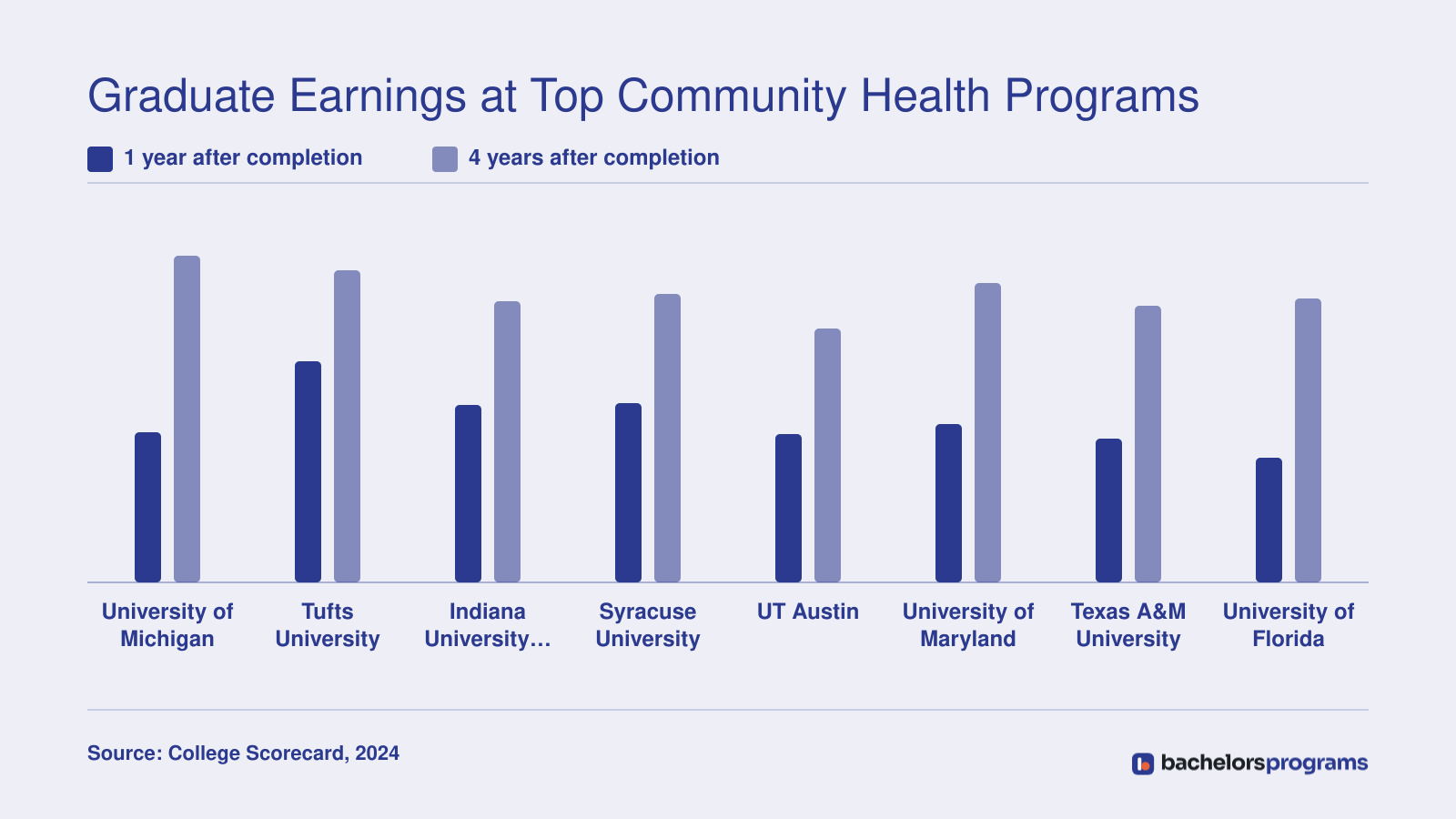
Graduate Earnings at Top Community Health Programs
This chart shows median earnings for bachelor's completers in each school's community health or closely related program, measured one year and four years after completion. One year out, medians range from $30,056 at the University of Florida to $53,372 at Tufts University. Four years out, they range from $61,390 at UT Austin to $78,928 at the University of Michigan. These College Scorecard figures track only each program's own graduates, so they differ from the BLS occupational wages for health education specialists shown above.
Community Health vs. Public Health vs. Health Education Degrees
The best degree for community health depends on how you want to work. If you want hands-on program work with individuals and groups, a bachelor's degree in community health or health education fits. If you want a population and data focus, choose public health. Many MPH programs accept applicants from any of the three, and the University at Buffalo's MPH in Community and Behavioral Health notes that applicants come from varied educational backgrounds.
| Feature | Community Health (B.S.) | Public Health (B.S. or B.A.) | Health Education |
|---|---|---|---|
| Core focus | Health care and health behavior, with concentrations in Health Education & Promotion, Health Planning & Administration, and Rehabilitation Studies | Population health, including biostatistics, epidemiology, health policy, and health communication | Health behavior and health-program practice, often a community health concentration |
| Typical coursework | Planning, implementation, and evaluation of health services and programs | Research methods, health psychology and human behavior, health policy and services, and program evaluation | Health promotion and disease prevention, intervention design, and evaluation |
| Applied learning | Required senior-year internship in a setting tied to your interests | Capstone course; field experience is built into the paired MPH | Designing and implementing interventions and applying evaluation methods |
| CHES alignment | Strong, especially in the Health Education & Promotion concentration | Possible if coursework covers health education responsibilities; check the course list | Most direct fit, since the curriculum centers on health education practice |
| Common entry-level roles | Health program coordinator, community outreach and health education roles | Public health program or research assistant, data and policy support roles | Health educator, wellness or health promotion program staff |
| Accreditation body to check | Varies by school; confirm whether the program holds CEPH accreditation or SABPAC approval | CEPH accredits many public health programs | SABPAC approval is the credential most associated with health education programs |
| Preparation for an MPH | Illinois offers a five-year BS/MPH for Community Health majors, with 12 senior-year credits counting toward both degrees | Sam Houston State's 4+1 pathway includes 12 graduate-level hours within the 120-hour BS, plus 30 more for the MPH | A social and behavioral sciences background is described as good preparation for an MPH in Community and Behavioral Health |
Questions to Ask Yourself
Do you want to sit for the CHES exam right after graduation, and does this program's coursework clearly qualify you?
Are you aiming for direct-service community health work, or for a later MPH and a policy or epidemiology role?
Will your existing credits transfer, and how many semesters will that actually save?
Does the program place interns with health departments or nonprofits in the region where you want to work?
Community Health programs by state
Compare Community Health programs on the data that matters
Explore more Healthcare majors or browse every field of study.
All Healthcare programs Browse every field of study