Best Health Sciences Degree Programs
Compare 680+ accredited Health Sciences programs at 620+ colleges, with net price after aid, graduation rates, earnings and debt from IPEDS and the U.S. College Scorecard.

A bachelor's degree in health sciences serves two ends. Some programs are pre-professional tracks built around the prerequisites for PA, PT, or OT school. Others are terminal degrees feeding health education, care coordination, and public health outreach. Most of these programs award the Bachelor of Science (B.S.) in Health Sciences.
The split shows up in cost. Anatomy and physiology labs, the kind physician assistant and physical therapy programs screen for, are the expensive part, and a program that skips them can mean a retake later.
Physical therapy and occupational therapy licensure now runs through doctoral programs, so the bachelor's degree's job is to prove you can handle a hard science load.
Key Points
- UNC Chapel Hill tops the 2027 ranking of health sciences bachelor's programs.
- University of Florida has the lowest net price among ranked schools.
- Confirm graduate programs accept online science labs before you enroll.
Best Schools for a Bachelor's Degree in Health Sciences
The strongest health sciences programs pair a science-heavy core with a clear route into clinical work, public health, or graduate study, and the ten schools below do it at very different price points. Some are limited-enrollment majors inside large public research universities, others are fully online degrees built for working adults, and a few are degree-completion formats for students who arrive with credit already earned. Format flexibility ranges from residential cohorts to fully online coursework, so the right fit depends as much on how you want to study as on what you want to study.
University of North Carolina at Chapel Hill
#1Chapel Hill, NC · ~$12,000/yr (est.)
Best for: Public health majors wanting research depth
A public research university in Chapel Hill, North Carolina, with a health sciences pathway built inside the Gillings School of Global Public Health. The environmental health sciences major is limited-enrollment and accredited by the Council on Education for Public Health, with small cohorts, a faculty mentor for every student, and a capstone or research experience at the end. It suits students who want a public health lens on human health and a degree that feeds medical, dental, veterinary, or law school plans.
- Accredited by the Council on Education for Public Health
- Four concentration paths, including environmental chemistry and health biology
- 68 credit hours, with cohorts of roughly 30 to 40 students
- 3.0 GPA, one calculus course and two qualifying science courses to apply
- Apply in sophomore year for junior-year entry
- Ends with a capstone, practicum, research project or honors thesis
- Each student is assigned a faculty mentor
American College of Healthcare Sciences
#2Portland, OR · ~$24,000/yr (est.)
Best for: Online learners drawn to holistic wellness
A private institution based in Portland, Oregon, that delivers its health sciences work entirely online and specializes in integrative and natural health fields. Coursework blends general education and science foundations with aromatherapy, herbal studies, holistic nutrition, and wellness coaching tracks. It is aimed at learners who want a wellness-oriented credential and do not need a campus commute.
- Fully online bachelor's with 30 credits each of general education and science core
- Major core covers aromatherapy and herbal studies
- Four tracks: aromatherapy, herbal studies, holistic nutrition, wellness coaching
- Accredited by the Distance Education Accrediting Commission
- Curriculum meets NAHA Level II aromatherapy standards and is NANP approved
- $52,200 in program tuition, about $71,513 total estimated cost
- Transfer credit and challenge exams can reduce the total
University of Florida
#3Gainesville, FL · ~$4,800/yr (est.)
Best for: Pre-health students targeting professional school
A large public research university in Gainesville, Florida, where the health sciences bachelor's is designed as a springboard into professional and graduate study. Core classes run in multiple sections and the program keeps a low faculty-to-student ratio. Combined pathways let students begin occupational therapy, public health, or biostatistics coursework before finishing the bachelor's.
- Three specializations: preprofessional, pre-rehabilitation and applied brain science
- Combined BHS/OTD begins occupational therapy coursework in the junior year
- Bachelor's/MPH counts 15 credits toward the public health master's
- Bachelor's/MS in biostatistics shares 12 credits
- Core covers the U.S. health care system, human disease and patient communication
- Core classes run in multiple sections with a low faculty-to-student ratio
- Prepares students for medicine, PA, physical therapy, dentistry and nursing
Brigham Young University
#4Provo, UT · $15,000 – $20,000/yr (est.)
A private university in Provo, Utah, with a public health program that emphasizes applied learning over lecture-only coursework. The health science emphasis requires a hands-on experience, whether a practicum, a global health placement, mentored research, or an internship. Broad electives let students shape a clinical or population health focus while staying inside a small, structured major.
- 58 credit hours, including 10 core public health courses
- Required applied learning experience, from practicum to mentored research
- Options include global health experience, academic internship and mentored teaching
- Core includes biostatistics plus health systems and policy
- Electives span epidemiology, aging, women's health and health behavior change
- Learning outcomes emphasize cultural humility and an upstream approach to health
St Luke's College
#5Sioux City, IA · ~$20,000/yr (est.)
A small private college in Sioux City, Iowa, focused on health care careers and built around a degree-completion model. Its health science bachelor's is fully online and designed for students who already hold college credit and want to finish without relocating. Core coursework covers the business and systems side of health care as well as its clinical and ethical dimensions.
- 100% online degree-completion format for students with prior college credit
- 120 credit hours combining transfer credit with upper-division core courses
- Full-time and part-time schedules available
- Accredited by the Higher Learning Commission
- Core covers health care finance, informatics, law and ethics, and leadership
- Includes an independent research project and statistics coursework
- Electives include quality management, health promotion and pathophysiology
Ohio State University
#6Columbus, OH · $17,000/yr (est. net price)
A large public research university in Columbus, Ohio, with health sciences coursework available on the Columbus and Lima campuses. Students enter as pre-health sciences majors, finish prerequisites, and then move into a core that covers epidemiology, ethics, health care systems, and health care law. A minor, or a previously earned associate degree, is required to graduate, which gives the degree an interdisciplinary shape.
- Classes offered on the Columbus and Lima campuses
- Students enter as pre-health sciences and complete prerequisites first
- Prerequisites must be finished with a C- or higher
- A minor, or a previously earned associate degree, is required to graduate
- Optional internship course and study abroad in health care
- Eligible students can sit for the Certified Health Education Specialist exam
- Prepares students for medicine, dentistry, physical therapy and dietetics
University of Central Florida
#7Orlando, FL · ~$10,000/yr (est.)
A large public university in Orlando, Florida, where health sciences is one of the biggest majors on campus. Two tracks let students aim at clinical careers or at health promotion and population health, with research, internship, and study abroad options alongside the coursework. Three start dates a year give applicants scheduling flexibility.
- Two tracks: Pre-clinical and Health Promotion
- Four-year program with fall, spring and summer start dates
- $212.28 per credit for Florida residents, $891.07 out of state
- Second-largest major at UCF
- Research, internship and study abroad opportunities
- Pre-clinical track covers pathophysiology, pharmacology and clinical nutrition
- Health Promotion track covers preventive care and chronic disease epidemiology
Northwestern University
#8Evanston, IL · $29,000/yr (est. net price)
A private research university in Evanston, Illinois, that offers its health sciences bachelor's through the School of Professional Studies with online sections available. The degree pairs eight core courses with a concentration and an elective certificate taken outside the major, so students can combine health care management with data science, law, or leadership. A capstone and substantial upper-level coursework complete the program.
- 45 units total, delivered through the School of Professional Studies
- Eight core courses, including data management and research methods
- Concentrations in strategic management, public health or biology for health sciences
- Add a four-course certificate in areas such as data science or law and policy
- Capstone required, with at least 14 courses at the 300 level
- Online sections are marked -DL in the catalog
- Requires a philosophy course in professional ethics
University of Illinois Urbana-Champaign
#9Champaign, IL · ~$14,000/yr (est.)
A large public research university in Champaign, Illinois, with an interdisciplinary health sciences major in the College of Applied Health Sciences. The degree requires a health internship and early field work, and students pick a concentration rather than a single fixed track. Joint bachelor's to master of public health options pair the major with public health or epidemiology.
- 120 credit hours, including at least 40 upper-division hours
- Concentrations such as Health Across the Lifespan, Health & Aging, and Health Behavior Change and Rehabilitation
- Required four-credit health internship plus early field work
- Third-semester language requirement
- Joint BS/MPH options in public health or epidemiology
- Core includes biostatistics, medical ethics, health equity and health care organization
- Prepares students for physical therapy, occupational therapy, medicine and nursing
University of South Florida
#10Tampa, FL · ~$10,000/yr (est.)
A large public research university in Tampa, Florida, with health sciences based in the College of Public Health on the St. Petersburg campus. Four concentrations cover biological health sciences, health information technology, healthcare administration, and social and behavioral health. Instruction mixes classroom and distance courses, and the campus sits in an innovation district close to major hospital partners.
- Four concentrations, including biological health sciences, health IT and healthcare administration
- Eight foundational courses before concentration coursework
- Classroom and distance instruction, with many courses online or in person
- Campus located in the St. Petersburg Innovation District
- Hospital partners include Johns Hopkins All Children's, Bayfront and BayCare
- Faculty expertise spans public health and medicine
- Leads to roles such as health policy analyst, informatics analyst and research coordinator
Cost & outcomes by school
Federal data for the highest-earning Health Sciences programs, independent of the ranking above. Earnings are this field's bachelor's graduates four years after completing where the Scorecard reports them, else the school's undergraduate median.
| School | Net price / yr | Grad rate | Earnings | Debt | Grads/yr | Format |
|---|---|---|---|---|---|---|
| Samuel Merritt University CA | — | — | $143,238 | $20,825 | — | Online or campus |
| Albany College of Pharmacy and Health Sciences NY | $29,882 | 68% | $131,426 | $25,500 | — | Campus |
| Massachusetts College of Pharmacy and Health Sciences MA | $39,545 | 62% | $125,557 | $25,000 | — | Campus |
| SUNY Downstate Health Sciences University NY | — | — | $109,601 | $12,500 | — | Campus |
| Santa Clara University CA | $50,062 | 88% | $109,183 | $19,162 | — | Campus |
| Northeastern University MA | $30,915 | 91% | $92,538 | $24,250 | — | Campus |
| University of Southern California CA | $32,740 | 92% | $92,498 | $18,000 | — | Campus |
| George Washington University DC | $36,586 | 84% | $90,873 | $20,449 | — | Hybrid |
| Northwestern University IL | $29,167 | 95% | $89,363 | $15,000 | — | Online |
| Washington University in St Louis MO | $21,786 | 94% | $86,182 | $17,500 | — | Campus |
| Boston University MA | $24,402 | 89% | $83,238 | $23,250 | — | Campus |
| University of Illinois Urbana-Champaign IL | $14,355 | 85% | $81,054 | $19,500 | — | Campus |
Sources: U.S. Department of Education. Net price, graduation rate, earnings and debt: College Scorecard (earnings and debt for this field's bachelor's graduates where reported, else school-wide); graduates: IPEDS. A dash means no figure is reported.
Cost, debt & payoff
Median earnings of this field's bachelor's graduates (4 yrs after completing, else the school's undergraduate median) vs. their median federal loan debt · U.S. College Scorecard
Across these programs the median graduate earns about $53,739 and finishes with roughly $23,000 in debt — a ratio that clears a common rule of thumb (keep debt below first-year salary). Net price and debt vary widely school to school, so check the per-school figures in the table above before you shortlist.
How We Ranked Health Sciences Bachelor's Programs
Federal program-level earnings data has turned the health sciences bachelor's degree from a school-level guess into a program-by-program comparison.
What We Measured
Every program was assessed on five published measures: - Average net price: what students pay after grant and scholarship aid, from federal IPEDS cost data. - Institution-wide graduation rate: completion across the entire college. - Program-level median earnings: what graduates of that specific health sciences program earn after finishing. - Program-level median federal debt: what borrowers owe at completion. - Earnings-to-debt return: early earnings measured against the debt taken on.
Earnings, debt, and completion figures come from the U.S. Department of Education's College Scorecard, which reports results by field of study and credential level. Cost data comes from IPEDS. Both online and campus programs were eligible, and only bachelor's-level health sciences programs were ranked, so a graduate certificate or a master's housed in the same department does not enter the comparison.
Why Program Earnings Matter More
A college-wide average blends nursing, business, and engineering graduates together. A health sciences program's own median reflects the students who enrolled in it, which is the comparison a prospective student is really making.
Where the Numbers Stop
Net price averages what students pay after aid; it is not a quote for your situation. Graduation rates describe the whole institution. And some programs do not publish earnings at all, usually because a cohort was too small to report without identifying individuals.
Online vs. Campus Health Sciences Degrees
Online and campus programs can lead to the same bachelor's degree in health sciences, but they differ in who can enroll, what you pay, and how much hands-on access you get. Many online B.S. programs are built as degree-completion pathways for students who already hold an associate degree or roughly 60 transfer credits, though a few, such as Texas State's online program, also admit first-time freshmen. Online programs at regionally accredited schools carry the same institutional accreditation as their campus counterparts, so confirm accreditation before comparing anything else. If you plan to apply to PA, PT, or OT graduate programs, check whether your target programs accept online lab sciences before you enroll.
| Factor | Online Programs | Campus Programs |
|---|---|---|
| Eligibility | Varies by school. Some are degree-completion only, such as SCUHS. Others, such as Texas State, also accept entering freshmen. | Typically open to first-time freshmen as well as transfer students. |
| Cost per credit | SCUHS charges $484 per credit. Total cost depends on how many credits transfer in. | Often billed as a flat annual rate. Quinnipiac's 2026-2027 tuition is $56,430 for 12 to 16 credits per semester, plus $1,300 per credit above 16. |
| Credits you must complete | Transfer students may finish far fewer credits. Mizzou estimates 64 credits for a typical transfer student versus 120 for a part-time freshman. Texas State allows up to 90 transfer credits toward 120. | Freshmen generally complete the full 120 credits on a set sequence. |
| Lab and science prerequisites | Lab sciences may be limited, completed elsewhere, or arranged locally. Acceptance varies by graduate program. | On-site labs are usually built into the curriculum and are widely recognized by graduate programs. |
| Clinical or practicum access | Often arranged by the student near home, which can require extra coordination. | Typically supported through campus affiliations and partner sites. |
| Pre-professional advising | Available at many schools, but may be remote and less tailored to PA, PT, or OT tracks. | Often includes in-person advisors and pre-health committees. |
| Schedule flexibility | High. Asynchronous or part-time options suit working adults. | Lower. Fixed class times and on-campus attendance are common. |
Related Articles
How Much Does a Health Sciences Degree Cost?
Public four-year colleges charge an average of $12,290 a year in tuition and fees for in-state students in 2026-27, according to the College Board.1 Out-of-state students at public schools pay $32,730, and private nonprofit four-year colleges charge $46,350. Those prices rose 2.9%, 3.5% and 3.7% respectively this year.2
Sticker Price vs. Net Price
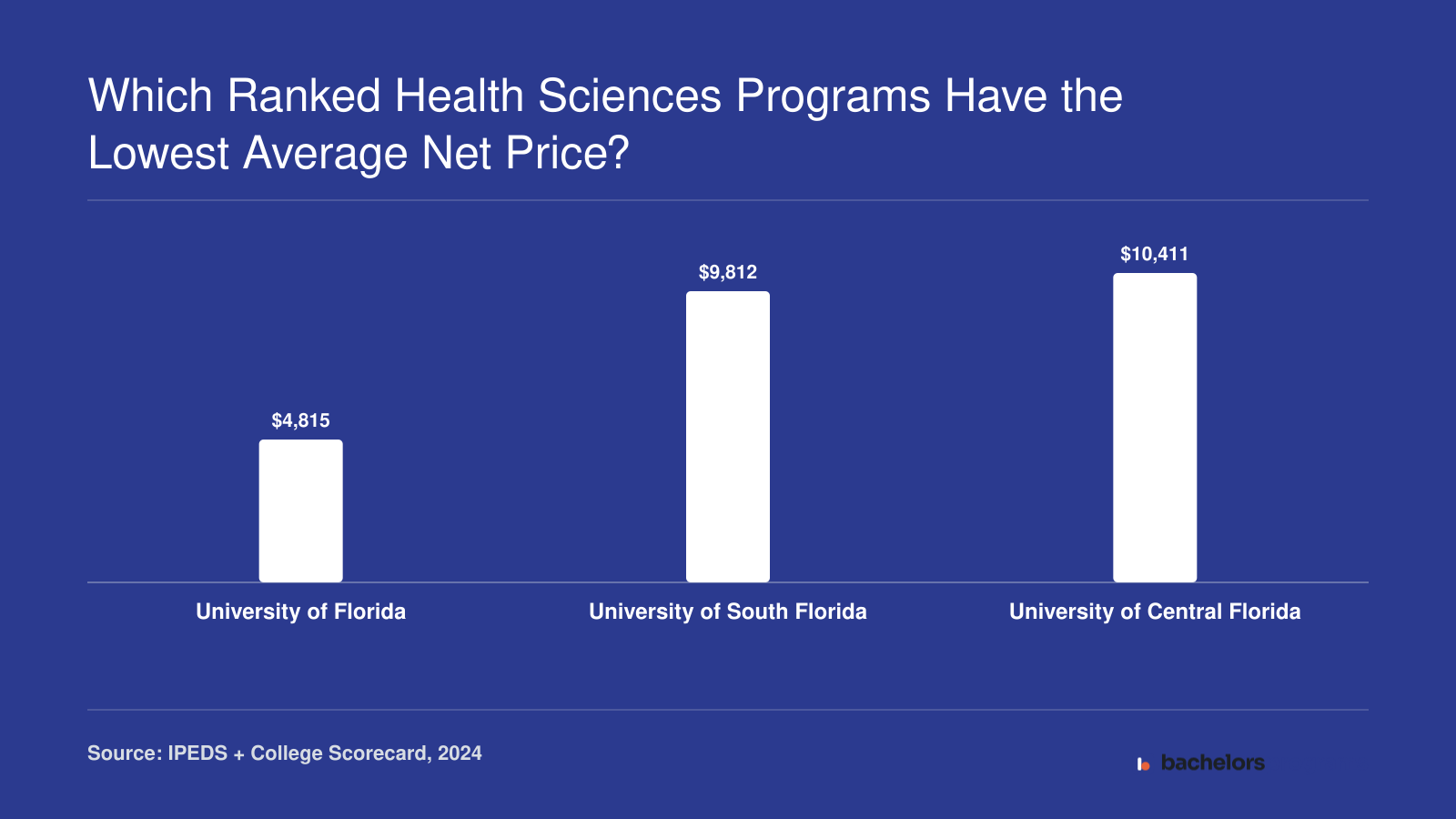
Published tuition is rarely what students pay. Among the ranked schools with cost data, average net price after grants and scholarships runs from $4,815 at the University of Florida to $14,355 at the University of Illinois Urbana-Champaign. The University of South Florida ($9,812), the University of Central Florida ($10,411) and UNC Chapel Hill ($11,655) fall in between.
Compare that with sticker tuition. Florida lists $3,876 in-state and $16,579 out-of-state for its health science program. UNC Chapel Hill lists $8,994 in-state and $41,203 out-of-state, so residency changes the bill more than almost any other factor.
Debt and Payoff
Median federal debt for graduates at these schools runs from $14,000 at UNC Chapel Hill to $19,500 at Illinois. Florida sits at $15,000, South Florida at $17,988 and Central Florida at $18,190. Program-level monthly payment figures are not published for these schools. Debt in that range is modest next to the net prices above, and it makes the lower-cost public options the safest bets for a degree that often leads to further study.
Cheapest Online Option
The University of South Florida offers the cheapest online health science degree among the ranked schools. It is the lowest-net-price ranked school offering a program in both online and in-person formats, at $9,812 a year on average. Many courses are available in either format. Online per-credit rates vary by school and by residency, so confirm the current rate on each program's tuition page before you compare.
Net Price Is an Average
Those figures are averages across students who receive aid, not quotes. Your own figure depends on family income, residency and the aid you qualify for. Run each school's net price calculator before you rule a program in or out.
Which Ranked Health Sciences Programs Have the Lowest Average Net Price?
Among the schools ranked on this page, the University of Florida has the lowest average net price, at $4,815 per year after grants and scholarships. These figures come from College Scorecard and are institution-wide averages for aided undergraduates, not prices for the health sciences major alone. Program formats: University of Florida (Campus), University of South Florida (Both), and University of Central Florida (Campus).
Bachelor in Health Science Jobs and Salaries
These U.S. Bureau of Labor Statistics figures reflect median pay for everyone working in each occupation nationwide, not what new health sciences graduates earn in their first years. To judge whether a health sciences degree is worth it, compare them with the program-level graduate earnings and student debt from the College Scorecard in the earnings section above. Medical and health services management offers the highest median pay at $123,860, but employers usually expect related work experience first, so a health education specialist role ($64,070, with 6% projected growth from 2025 to 2035) is a more realistic first job, while medical records work, which requires only a postsecondary nondegree award, often serves as a stepping stone toward health information management or a graduate program in public health or health administration.
| Occupation | Median Annual Pay (BLS) | Projected Job Growth | Typical Entry-Level Education |
|---|---|---|---|
| Medical and health services managers | $123,860 | N/A | Bachelor's degree |
| Health education specialists | $64,070 | 6% (2025-2035) | Bachelor's degree |
| Medical records specialists | $51,140 | 8% (2025-2035) | Postsecondary nondegree award |
Health Sciences programs by state
Frequently Asked Questions About Health Sciences Degrees
These answers cover the questions prospective students ask most often about a bachelor's degree in health sciences. Costs and earnings vary by school and program, so use the figures as starting points and confirm them with each school.
Is a health sciences degree worth it?
Which is the cheapest online health science degree?
Can you get into PA or physical therapy school with a health sciences degree?
What is the difference between a health sciences degree and a public health or nursing degree?
Compare Health Sciences programs on the data that matters
Explore more Healthcare majors or browse every field of study.
All Healthcare programs Browse every field of study