Best General Studies Degree Programs
Compare 320+ accredited General Studies programs at 310+ colleges, with net price after aid, graduation rates, earnings and debt from IPEDS and the U.S. College Scorecard.

A bachelor's degree in general studies exists to finish what a scattered transcript started. Working adults and transfer students arrive with 60 or 90 credits, no declared major, and a hard stop on promotion without the credential. Schools award it as a Bachelor of Arts (B.A.), a Bachelor of Science (B.S.), or a Bachelor of General Studies (B.G.S.), usually at the standard 120 credits.
Cost separates these programs more than prestige does: annual tuition at the schools ranked here runs from $6,389 to $71,845, and reported first-year earnings from about $25,000 to nearly $67,000.
What decides the outcome is the credit audit, not the major label. Prior coursework gets evaluated and applied before registration, or the degree runs past its promised calendar.
Key Points
- UMGC's online B.S. in General Studies costs $337 per credit in-state.
- Among schools here, Georgetown's Liberal Studies B.A. posts top first-year earnings.
- Document prior credits before registering, since they shorten a 120-credit degree.
Best General Studies Schools Ranked for 2027
The programs below earn their place on a mix of three things: a net price after aid that working adults can carry, completion rates that suggest students actually finish, and delivery formats that fit a life already in progress. Each entry below shows what the degree looks like in practice, including how much prior credit transfers in, what the capstone or concentration demands, and what graduates earned four years after finishing.
Brigham Young University
#1Provo, UT · $15,000 – $20,000/yr (est.)
Best for: Former BYU students finishing a degree
Brigham Young University runs one of the oldest general studies completion degrees in the country, launched in 1998 on its Provo campus. The program is built for former BYU students who want to finish without returning to campus, and it has produced more than 2,400 graduates. Four years after finishing, program graduates reported a median of $48,410 in earnings.
- Bachelor's completion program running since 1998
- Requires 27 prior credits earned at BYU in Provo
- Choose one of eight emphases, including business or psychology
- Fully online, with night and evening courses available
- Students have up to eight years to finish the degree
- Ecclesiastical endorsement required with the online application
- More than 2,400 graduates so far
University of Central Florida
#2Orlando, FL · ~$10,000/yr (est.)
Best for: Transfers with credit already on the books
The University of Central Florida is a large public research university in Orlando and a frequent destination for transfer students completing a bachelor's degree. Its integrative general studies major is self-designed: students build an interdisciplinary course plan around six program learning outcomes and finish with a required seminar capstone. Four years after finishing, program graduates reported a median of $52,862.
- 120 total credit hours, including 48 in the major
- 45 advanced-level credits plus a 3-credit Senior Seminar capstone
- Fully online option with reduced campus-based fees
- 2.0 UCF GPA required, with at least a C in each core course
- 30 of the last 39 credit hours must be in residence
- Curriculum targets six outcomes, from leadership to digital literacy
- Internships, research, service-learning, and study abroad available
California State University-Fullerton
#3Fullerton, CA · $7,000 – $20,000/yr (est.)
Best for: Health-minded students shaping their own electives
California State University, Fullerton is a large public university in Orange County, and its general studies route sits inside a Bachelor of Science in Public Health. Undergraduates pair a 28-unit public health core with an 18-unit General Studies concentration they shape from advanced public health courses and related electives outside the department. Four years after finishing, program graduates reported a median of $57,408.
- 120-unit degree with a 28-unit public health core
- 18-unit General Studies concentration built from 400-level public health courses
- Up to 3 elective units can come from outside the department
- 3-unit internship (PUBH 495) required
- 3-unit upper-division writing course required
- C- or better needed in every course counted toward the major
- Core covers epidemiology, environmental health, and program planning
University of Michigan
#4Ann Arbor, MI · $18,000 – $61,000/yr (est.)
The University of Michigan is a highly selective public research university in Ann Arbor, and its Bachelor in General Studies lives inside the College of Literature, Science, and the Arts. Students combine subjects into a self-designed interdisciplinary degree with help from a Newnan Advising Center advisor while meeting writing, race and ethnicity, and quantitative reasoning requirements. Four years after finishing, program graduates reported a median of $67,859.
- Interdisciplinary degree in the College of Literature, Science, and the Arts
- 60 upper-level credits required
- First-year writing and upper-level writing requirements
- Race and ethnicity and quantitative reasoning requirements
- Course plan built with a Newnan Advising Center advisor
- Non-LSA coursework can count toward the degree
California State Polytechnic University-Pomona
#5Pomona, CA · $10,000 – $15,000/yr (est.)
California State Polytechnic University, Pomona is a public polytechnic in Los Angeles County known for applied and professional programs. Its general studies option is one track inside a Bachelor of Arts in Liberal Studies, serving both future California elementary teachers and students heading into law enforcement, human services, or health fields. Four years after finishing, program graduates reported a median of $51,492.
- Four options, including General Studies and Pre-Credential
- Ten core courses organized around four program themes
- Themes: social responsibility, sustainability, creativity, wellness
- Prepares students to teach in California public elementary schools
- Also suited to law enforcement, human services, and health careers
- Named #2 Top Public School in the West by U.S. News (2025)
Columbia University in the City of New York
#6New York, NY · ~$22,000/yr (est.)
Columbia University in the City of New York runs one of the best-known general studies schools in the country, a degree-granting college for nontraditional students inside an Ivy League university. Students complete 124 points across more than eighty liberal arts majors, with advising built into the structure. Four years after finishing, program graduates reported a median of $99,679.
- 124 points required, with a 2.0 GPA minimum
- More than eighty liberal arts majors available
- Declare a major after 45 points and before 90
- At least 18 points in the major taken at Columbia
- Up to four professional studies courses can count
- Up to 12 points of independent study can count
Georgetown University
#7Washington, DC · $40,000 – $45,000/yr (est.)
Georgetown University's School of Continuing Studies has offered its liberal studies bachelor's since 1974, and it is delivered fully online. Students can transfer up to 64 credits, start in fall, spring, or summer, and apply a core in history, philosophy, sociology, and theology to concentrations such as public policy or cybersecurity. Four years after finishing, program graduates reported a median of $112,722.
- Fully online completion program totaling 120 credits
- Accept up to 64 transfer credits from another college
- Starts in fall, spring, or summer; full-time or part-time
- Average time to graduation is three years
- Core spans history, philosophy, sociology, and theology
- Concentrations include public policy, cybersecurity, business, and communications
- Tuition listed at $428 per credit hour
University of North Florida
#8Jacksonville, FL · $10,000 – $15,000/yr (est.)
The University of North Florida is a public university in Jacksonville whose Bachelor of Integrative General Studies is built around individualized interdisciplinary study. Students declare once they reach 60 credits, complete a capstone that can take the form of an internship or study abroad, and focus at least 15 credits in a single disciplinary area. The 2026-2027 catalog lists the degree with no double majors and no minor requirement.
- 120 credit hours, including 48 upper-level credits
- Minimum of 60 credits needed to declare the major
- Two core courses, starting with Introduction to Interdisciplinary Inquiry
- Capstone can be a course, an internship, or study abroad
- At least 15 credits in one area: humanities, social sciences, STEM, or education
- 30 to 32 free elective credits
- No double majors allowed; no minor required
Northwestern University
#9Evanston, IL · $29,000/yr (est. net price)
Northwestern University confers its Bachelor of Science in General Studies through the Weinberg College of Arts and Sciences, with courses organized by the School of Professional Studies for part-time undergraduates. Students complete 45 units, including a writing requirement and foundational work across the humanities, scientific inquiry, and social sciences. Four years after finishing, program graduates reported a median of $93,180.
- 45 units required, conferred by Weinberg College of Arts and Sciences
- Writing requirement met by English 111 and 205 with a C or better
- Foundational work in humanities, scientific inquiry, and social sciences
- Two courses on power, justice, and equity required
- Majors include economics, psychology, organization behavior, and humanities
- Up to 21 elective units; minors are optional
Southern Utah University
#10Cedar City, UT · $7,000 – $21,000/yr (est.)
Southern Utah University is a public university in Cedar City whose general studies bachelor's can be completed on campus or fully online. Students build the major with an advisor, choose a B.A. or B.S. path, and can earn academic credit for professional experience. Four years after finishing, program graduates reported a median of $54,147.
- 120 credits, including 48 in General Studies and a capstone
- At least 22 of the 48 major credits must be upper-division
- B.A. needs 16 foreign language credits; B.S. needs 12 math or science credits
- Available on campus or fully online
- Academic credit available for professional experience
- 2.0 GPA, 40 upper-division credits, and 30 credits from SUU required
Cost & outcomes by school
Federal data for the highest-earning General Studies programs, independent of the ranking above. Earnings are this field's bachelor's graduates four years after completing where the Scorecard reports them, else the school's undergraduate median.
| School | Net price / yr | Grad rate | Earnings | Debt | Grads/yr | Format |
|---|---|---|---|---|---|---|
| Georgetown University DC | $40,815 | 95% | $112,722 | $15,500 | 40 | Online |
| Columbia University in the City of New York NY | $21,590 | 96% | $99,679 | $21,500 | 6 | Campus |
| Northwestern University IL | $29,167 | 95% | $93,180 | $15,000 | 2 | Online or campus |
| Clarkson University NY | $30,305 | 75% | $89,696 | $26,000 | — | Online or campus |
| New Jersey Institute of Technology NJ | $16,504 | 73% | $84,276 | $21,000 | 2 | Campus |
| University of Portland OR | $28,210 | 80% | $82,804 | $21,370 | 2 | Campus |
| American Public University System WV | $9,597 | 57% | $79,734 | $21,743 | 40 | Online |
| University of the Pacific CA | $25,447 | 69% | $78,445 | $19,500 | 2 | Online |
| Southern Methodist University TX | $40,892 | 84% | $78,354 | $19,500 | 32 | Campus |
| Wake Forest University NC | $28,719 | 89% | $78,158 | $21,500 | — | Campus |
| New Mexico Institute of Mining and Technology NM | $9,873 | 57% | $76,489 | $19,085 | 3 | Campus |
| University of Dayton OH | $29,533 | 80% | $75,537 | $23,250 | 5 | Campus |
Sources: U.S. Department of Education. Net price, graduation rate, earnings and debt: College Scorecard (earnings and debt for this field's bachelor's graduates where reported, else school-wide); graduates: IPEDS. A dash means no figure is reported.
Cost, debt & payoff
Median earnings of this field's bachelor's graduates (4 yrs after completing, else the school's undergraduate median) vs. their median federal loan debt · U.S. College Scorecard
Across these programs the median graduate earns about $51,712 and finishes with roughly $22,936 in debt — a ratio that clears a common rule of thumb (keep debt below first-year salary). Net price and debt vary widely school to school, so check the per-school figures in the table above before you shortlist.
How We Ranked Bachelor's in General Studies Programs
Ranking bachelor's in general studies programs means comparing what each degree costs, what graduates earn and borrow, and how likely students are to finish. Four factors set the order.
What We Looked At
- Affordability: Average net price, what a student pays once grants and scholarships are applied, not the sticker tuition.
- Outcomes: Program-level earnings and median debt from the College Scorecard.
- Completion: Institution-wide graduation and retention rates from IPEDS.
- Format flexibility: Whether the degree is offered online, on campus, or both.
We do not publish numeric weights, because the federal data can't support that kind of false precision.
What the Numbers Can't Tell You
Net price and graduation rate are institution-wide averages. They describe the whole school, not the general studies program alone, so treat them as a guide and ask admissions for a program-specific cost quote before you commit. Earnings and debt figures are tied to the program, but small programs may have limited data, and a school with a gap in one measure is judged on the rest.
Why It Matters
Most pages on this topic are university marketing pages that publish no cost or outcome data. Using College Scorecard and IPEDS federal figures puts every school on the same footing before you request information from any of them.
What a Bachelor's Degree in General Studies Is (B.A. vs. B.S. vs. B.G.S.)
A Bachelor of Arts in General Studies and a Bachelor of General Studies can both require 120 credits and print nearly the same words on a diploma, yet one leans toward the humanities and the other is often built for students finishing a degree they started years earlier.
The shared definition: a bachelor's degree in general studies is an undergraduate program of roughly 120 credits that spreads coursework across disciplines, then adds depth in a chosen area or two instead of a single traditional major. Louisville's B.S. pairs 120 total credits with 36 credits in a track1; Indiana University Northwest's B.G.S. requires 66 specified credits and 30 upper-division credits.2
B.A., B.S., or B.G.S.
Three labels, three emphases:
- B.A.: humanities and social science leaning, sometimes with a language requirement. Arizona State University awards its version as a General Studies BA.
- B.S.: more math, science, or applied coursework, frequently organized as a track. Old Dominion University's version is an interdisciplinary studies BS with a general studies major: 120 credits, 30 of them in the major.3
- B.G.S.: breadth-focused and completion-oriented. Programs at the University of South Florida4 and Bowling Green State University expect about 60 prior credits before admission.5
Associate degree vs. bachelor's
An A.A. or A.G.S. is a two-year credential. It can satisfy general education on the way to a bachelor's, but it will not meet employer or graduate school requirements that specify a four-year degree. Confirm which credential the application actually awards before you apply.
The accreditation check
Look for institutional (regional) accreditation, the standard that covers the entire university. Bowling Green State University's general studies program sits under the Higher Learning Commission, with its next reaffirmation listed for 2032-2033.5 General studies programs rarely carry separate programmatic accreditation, because the institution's accreditation already covers the coursework.
What is a general studies degree good for? Finishing a bachelor's, meeting the degree requirement for a promotion, and qualifying for graduate school.
Cheapest General Studies Degrees: Net Price, Cost per Credit, and Debt
Among the online programs we researched, the cheapest online general studies degree by published per-credit price is the University of Maryland Global Campus Bachelor of Science in General Studies, at $337 per credit in-state and $499 out-of-state. That rate shows how total cost scales: a degree-completion student who needs 60 credits pays about $20,220 in tuition, while a first-time freshman taking all 120 credits pays about $40,440 in-state or $59,880 out-of-state. Fees can raise a low sticker price. Ball State's broader online undergraduate rate of $346 per credit in-state becomes $371 with its $25 per-credit online course fee, and a $100 to $150 technology fee comes on top of that. Oregon State Ecampus's $409 rate already includes a $15 per-credit distance education fee. Arizona State adds a $21 per-credit college fee to its $580 nonresident online rate. The table lists the lowest-cost ranked schools by average net price after aid, an approximation of what a typical aided student paid per year and not a price quote.
| School | Program | Format | Average net price per year (after aid) | Median program debt at completion | Est. 10-year monthly payment | Median debt, all graduates (institution-wide) |
|---|---|---|---|---|---|---|
| California State University-Bakersfield (Bakersfield, CA) | B.A. in Interdisciplinary Studies, General Studies concentration | Campus | $5,652 | N/A | N/A | $16,600 |
| California State University-Stanislaus (Turlock, CA) | B.A. in Social Sciences (General Studies) | Hybrid | $6,067 | $13,561 | $144 | $13,540 |
| California State University-Fullerton (Fullerton, CA) | B.S. in Public Health, General Studies concentration | Campus | $6,555 | $12,550 | $133 | $13,750 |
Related Articles
Online vs. On-Campus General Studies Degrees
Online programs bend around a working adult's schedule, while on-campus programs give you face time with faculty and classmates. Both formats appear in this ranking, and the split is clear. University of Central Florida and Georgetown University deliver their general studies degrees online. California State University-Fullerton, the University of Michigan, Cal Poly Pomona, and Columbia University are campus-based. Brigham Young University, the University of North Florida, Northwestern University, and Southern Utah University offer both.
Why Online Is the Default for Working Adults
If you hold a job or care for family, online is usually the practical choice. Many schools run asynchronous classes and start terms several times a year, and there is no commute. Georgetown, for example, starts students in fall, spring, and summer. BYU and Southern Utah also pair a fully online option with other formats, so you can often switch modes as life changes.
The Trade-Offs
Online study has real costs. You get fewer in-person advising meetings and fewer chances to build a professional network. Nobody is watching your pace, so finishing depends on self-discipline. A campus program gives you built-in structure, but only if you can attend at set times.
What Employers and Graduate Schools Check
Your diploma generally does not say "online." What employers and graduate admissions offices verify is the school's accreditation, not the delivery format. Confirm regional accreditation first, then choose the format you can actually finish.
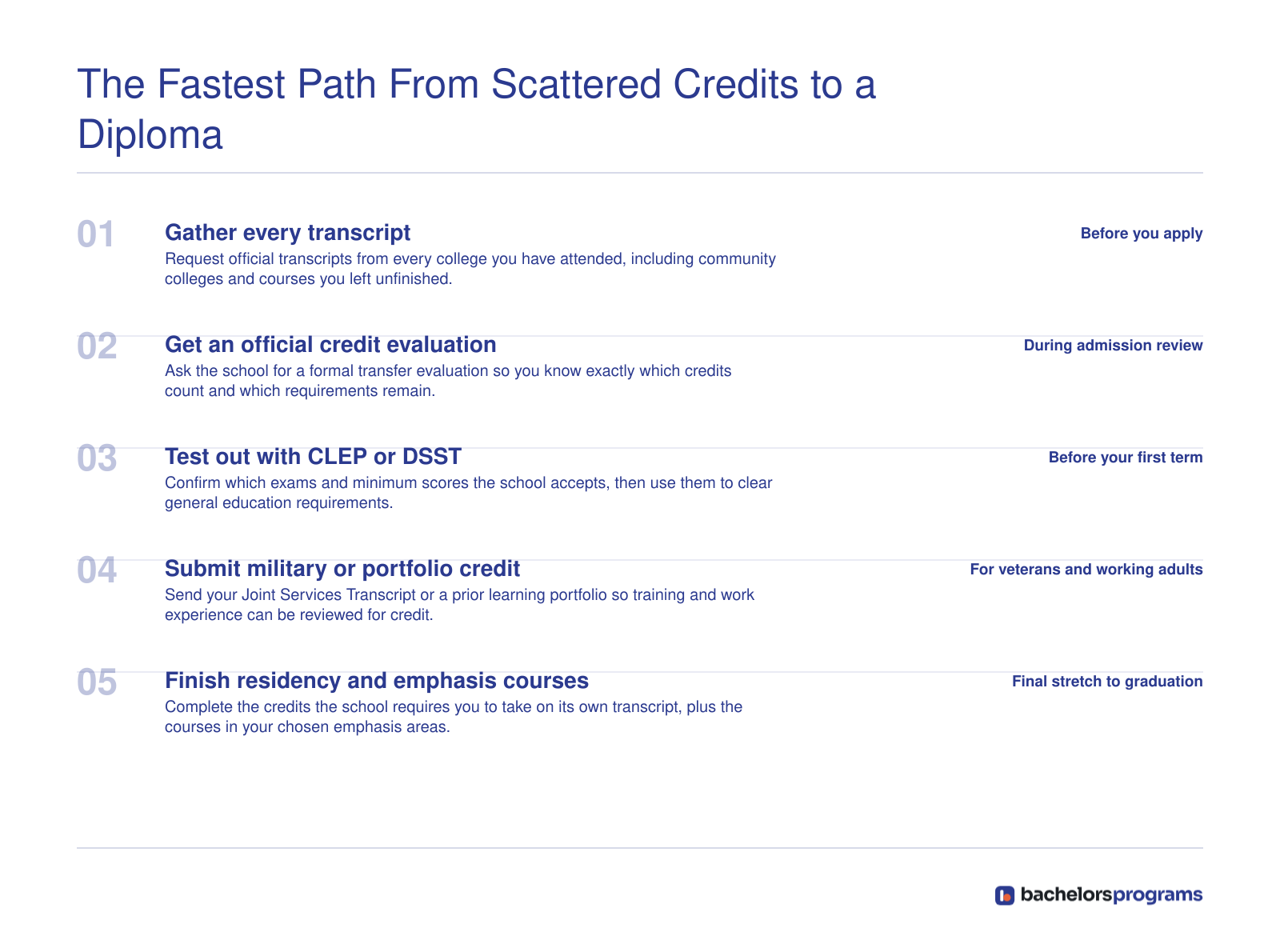
The Fastest Path From Scattered Credits to a Diploma
A bachelor's degree in general studies rewards students who arrive with credits already in hand, but only if those credits are documented and counted before you register for classes. Follow these steps in order. Every credit you earn or verify before enrolling is one you will not pay for at the school's per-credit rate.
Admission Requirements for First-Time, Transfer, and Returning Students
There is no national admission standard for a bachelor's degree in general studies. Rules vary by school and depend on whether you are applying to the university itself or to a degree-completion track.
- First-time: high school GPAThe University of Idaho automatically admits high school graduates with a 3.0 GPA, no test required.
- First-time: test scoresUsually optional. Of 226 public universities surveyed in 2026, 180 were test-optional, but Idaho still requires a test for GPAs of 2.6 to 2.99.
- All applicants: official transcriptsLouisville requires official transcripts from every prior college, even from applicants with fewer than 24 transfer credits.
- Transfer: minimum GPAOften 2.0 (Louisville for 24+ credits, IU Southeast). UConn requires 2.7 overall or 3.0 in your last 12 credits.
- Degree completion: earned creditsBGSU and UConn require an associate degree or 60 credits. IU Southeast requires 26 completed or in-progress credits.
- Returning adults: academic renewalLouisville's Academic Fresh Start resets your cumulative GPA after two or more years away. BGSU's program also welcomes former students.
First-Year Earnings at a Top-Ranked General Studies Program
Georgetown University posts the highest first-year earnings among the schools ranked here. Its program is the online-available Bachelor of Arts in Liberal Studies.
General Studies programs by state
General Studies Degree FAQs
How long does it take to finish a bachelor's degree in general studies?
Can a general studies degree get you into graduate school?
What is the cheapest online general studies degree?
Is a B.A. or B.S. in General Studies better?
Compare General Studies programs on the data that matters
Explore more Liberal Arts & Humanities majors or browse every field of study.
All Liberal Arts & Humanities programs Browse every field of study