Best Interdisciplinary Studies Degree Programs
Compare 360+ accredited Interdisciplinary Studies programs at 340+ colleges, with net price after aid, graduation rates, earnings and debt from IPEDS and the U.S. College Scorecard.

Median federal debt for graduates of this major runs as low as $13,074 at Brigham Young University-Idaho, roughly $139 a month on a standard 10-year repayment plan. The credential is deliberately flexible: students combine two or three fields into one undergraduate major, and schools award it as a Bachelor of Arts (B.A.) or Bachelor of Science (B.S.) in Interdisciplinary Studies.
Flexibility is also the risk. Two programs with identical names can carry very different course requirements, net prices, and completion timelines.
Key Points
- BYU-Idaho graduates carry the lowest median federal debt here: $13,074.
- UCF, FIU, BYU-Idaho, and FAU offer both online and campus formats.
- The University of Oklahoma reports the strongest first-year earnings among ranked programs.
The 10 Best Interdisciplinary Studies Schools Ranked
The schools below award a bachelor's degree in interdisciplinary studies in formats that range from fully online to small, application-only campus majors. Each entry pairs the degree structure a student actually enrolls in with the institution-level picture: net price after aid, completion, admission selectivity, and where the campus sits. Read the program notes closely, because two interdisciplinary degrees with the same name can ask very different things of you.
University of Central Florida
#1Orlando, FL · ~$10,000/yr (est.)
Best for: Online learners exploring multiple concentration paths
UCF is a large public research university in Orlando and one of the biggest enrollment engines in the country, with a long track record in online delivery. Its interdisciplinary studies program sits in the College of Community Innovation and Education and pairs two subject-area concentrations with a required minor, and the whole degree can be finished online. Thirteen concentration options give students room to change focus without changing majors.
- 13 concentration options across two subject-area tracks
- 120 total credit hours, including 3-credit Cornerstone and Capstone courses
- 30 restricted elective credits split across two concentrations
- A minor from UCF offerings is required
- Declare the major at least two semesters before graduation
- Academic Success Coach consultation required to enter
- In-state tuition is $212.28 per credit hour; out-of-state is $891.07
Florida International University
#2Miami, FL · ~$9,000/yr (est.)
Best for: Transfer students building a customized degree plan
Florida International University is a public research university in Miami with a large, diverse student body and heavy transfer and part-time enrollment. Its interdisciplinary studies degree is organized around a customized academic path that students build with advising, and it can be completed entirely online or on campus. Coursework pulls from professional disciplines, the humanities, and the social sciences.
- 120-credit, four-year degree, available fully online or on campus
- Coursework spans professional disciplines, humanities, and social sciences
- Each student builds a customized academic path tied to career goals
- Develops critical thinking, entrepreneurial skills, and cross-cutting competencies
- Open to first-year, transfer, and non-traditional learners
University of North Carolina at Chapel Hill
#3Chapel Hill, NC · ~$12,000/yr (est.)
Best for: High-achievers designing an application-based major
UNC-Chapel Hill is the state's flagship public university and admits a small share of applicants, which shapes how its interdisciplinary major works. The B.A. is application-based and meant for students whose interests do not fit an existing departmental major, with faculty advisors guiding a self-built course plan. Recent approved themes have ranged from disability studies and food studies to environmental justice and infectious disease.
- Application-based major with two deadlines per academic year
- Minimum 3.0 GPA and at least 45 hours remaining before graduation
- Ten courses (30 credits) drawn from at least three departments
- Maximum of four courses from any one department
- Up to 12 hours of professional courses with permission
- Cultural Studies track requires COMM 350
- Honors option through IDST 691H and 692H or an honors thesis
Purdue University
#4West Lafayette, IN · ~$15,000/yr (est.)
Purdue is a large public research university in West Lafayette known for engineering and agriculture as much as for its College of Liberal Arts. Its interdisciplinary studies major is new, opening for fall 2027 entry, and students choose from six named concentrations rather than designing a fully open plan. The College of Liberal Arts reports that 73.4% of its students complete an internship.
- Six concentrations, including African American studies and global studies
- New major for fall 2027 entry; plan of study in the catalog June 2027
- 2.5 minimum GPA for transfer applicants
- Housed in the College of Liberal Arts at West Lafayette
- Career paths include attorney, policy analyst, and social services coordinator
- 73.4% of College of Liberal Arts students complete an internship
Duke University
#5Durham, NC · ~$30,000/yr (est.)
Duke is a private research university in Durham with a highly selective admissions rate and a small undergraduate college. Its interdepartmental major lets students combine two departments into a single major on the transcript, and it can be paired with a second major. The university also runs extensive cross-disciplinary research programs that draw hundreds of undergraduates each year.
- At least 14 courses, split evenly at seven per department
- At least 10 courses at the 200 level or above
- Declare by the Friday before Spring Break of sophomore year
- A B.S. requires both departments to offer a bachelor of science
- Can be combined with a second major
- Graduation with Distinction available through a department or the IDM
- Active tracks include Linguistics and Computer Science and Computational Media
Brigham Young University-Idaho
#6Rexburg, ID · ~$8,000/yr (est.)
BYU-Idaho is a private university in Rexburg with a large online footprint and the same tuition rate for in-state and out-of-state students. Its Bachelor of Interdisciplinary Studies is built for students who want to assemble a degree from three broad categories instead of declaring a single major. A published example four-year plan shows how the sequence fits together.
- Build a degree from three categories instead of a single major
- Categories: STEM; arts and humanities; social sciences and business
- Starts with IDS 101, then IDS 301 Interdisciplinary Innovation
- Customized degree path with problem solving across multiple areas
- Coursework includes AI tools applied to the chosen areas of study
- Example four-year class plan published
Florida Atlantic University
#7Boca Raton, FL · $4,900 – $17,000/yr (est.)
Florida Atlantic University is a public research university in Boca Raton with campuses along Florida's southeast coast. Its interdisciplinary studies major is organized into four named concentrations, each with its own faculty-guided plan of study rather than a single open track. Advising runs through the Office of Student Academic Services in the Dorothy F. Schmidt College of Arts and Letters.
- Faculty-guided plan of study across literature, visual arts, music, and philosophy
- Program objectives cover critical thinking, communication, and research
- Prepares graduates for education, the arts, public service, business, or graduate study
- Advising through Student Academic Services in Arts and Letters
- 39 total credit hours, including 30 upper-division credits
- 15 to 18 credits in a single discipline; maximum 18 credits per area
- Plan of study built with the program director
- Courses in anthropology, history, sociology, and political science
- C or higher required; pass/fail courses do not count
- Faculty-guided personalized plan of study
- Research, internships, and cultural experiences built in
- Prepares students for public service, business, or graduate study
- Housed in the Dorothy F. Schmidt College of Arts and Letters
- Blends visual arts, music, and philosophy with community-focused study
- Plan matches interests and career goals
- Faculty-guided plan across multiple disciplines
- Leads toward careers in education, arts, and public service
University of North Florida
#8Jacksonville, FL · $10,000 – $15,000/yr (est.)
The University of North Florida is a public university in Jacksonville with a mid-sized student body and a strong commuter and transfer mix. Its interdisciplinary studies B.A. requires a proposal approved by the program director and closes with a capstone, so students finish with a defined area of focus. A minor and foreign language or culture hours round out the degree.
- 36-credit major: IDS 3053 plus 33 upper-division credits
- At least 15 credits from the College of Arts and Sciences
- Approved proposal and 2.0 GPA required for admission and graduation
- Capstone options: supervised research, internship, study abroad, or themed course
- Minor required; no more than 12 credits may double-count
- 8 credit hours of foreign language, or 6 hours of foreign culture
Indiana University-Bloomington
#9Bloomington, IN · $12,000 – $42,000/yr (est.)
Indiana University Bloomington is the flagship campus of the IU system and a large public research university. Its individualized major lets students propose a self-designed interdisciplinary B.A. reviewed by a faculty committee rather than choosing from a fixed list of concentrations. Students apply after at least one semester, and faculty sponsors oversee the work through a final oral review.
- Student-designed interdisciplinary majors with a liberal arts emphasis
- Combine courses from two or more College departments and professional schools
- 2.5 GPA and one completed IU semester required to apply
- Faculty sponsors guide the proposal; a two-faculty committee reviews it
- Committee checks the major differs from existing fields
- Final oral reviews and evaluation of the thesis or project
CUNY Queens College
#10Queens, NY · ~$4,200/yr (est.)
CUNY Queens College is a public college in Queens with a large, highly diverse undergraduate population and one of the lowest net prices in this group. Its interdisciplinary studies B.A. is for students whose interests fall outside any single department or program. Proposals are developed with the Office of Interdisciplinary Studies and often need sign-off from several departments.
- Design a concentration that no single department or program covers
- At least 36 credits built around one coherent interdisciplinary theme
- Proposal may need approval from several departments
- Competence in more than one discipline required
- Guidance from the Office of Interdisciplinary Studies
- Visit the Academic Advising Center in Kiely 217 before filing the major form
Cost & outcomes by school
Federal data for the highest-earning Interdisciplinary Studies programs, independent of the ranking above. Earnings are this field's bachelor's graduates four years after completing where the Scorecard reports them, else the school's undergraduate median.
| School | Net price / yr | Grad rate | Earnings | Debt | Grads/yr | Format |
|---|---|---|---|---|---|---|
| University of Health Sciences and Pharmacy in St. Louis MO | $31,817 | 62% | $137,047 | $17,755 | 3 | Campus |
| Stanford University CA | $13,807 | 92% | $124,080 | $12,000 | — | Campus |
| Carnegie Mellon University PA | $31,944 | 94% | $114,862 | $21,750 | — | Campus |
| Santa Clara University CA | $50,062 | 88% | $109,183 | $19,162 | — | Campus |
| Cornell University NY | $28,690 | 95% | $104,043 | $14,000 | — | Campus |
| Georgetown University DC | $40,815 | 95% | $103,494 | $15,500 | — | Campus |
| Villanova University PA | $43,756 | 92% | $100,423 | $25,874 | — | Online or campus |
| Duke University NC | $29,612 | 97% | $97,800 | $13,000 | 23 | Campus |
| University of California-Berkeley CA | $13,481 | 93% | $92,446 | $13,000 | — | Campus |
| University of Chicago IL | $14,860 | 96% | $91,885 | $15,000 | — | Campus |
| Trinity College CT | $34,832 | 84% | $90,779 | $23,000 | 12 | Campus |
| University of San Diego CA | $30,365 | 84% | $86,522 | $22,940 | — | Campus |
Sources: U.S. Department of Education. Net price, graduation rate, earnings and debt: College Scorecard (earnings and debt for this field's bachelor's graduates where reported, else school-wide); graduates: IPEDS. A dash means no figure is reported.
Cost, debt & payoff
Median earnings of this field's bachelor's graduates (4 yrs after completing, else the school's undergraduate median) vs. their median federal loan debt · U.S. College Scorecard
Across these programs the median graduate earns about $53,459 and finishes with roughly $22,899 in debt — a ratio that clears a common rule of thumb (keep debt below first-year salary). Net price and debt vary widely school to school, so check the per-school figures in the table above before you shortlist.
What a Bachelor's Degree in Interdisciplinary Studies Involves (B.A. vs. B.S.)
Two questions matter here: what you actually study, and whether the diploma says B.A. or B.S. The degree lets you combine two or three academic areas into one custom-built major. An integrative seminar usually ties those areas together, and a capstone project or senior thesis closes out the program.
Typical Structure
Most bachelor's degrees total about 120 credits, though each school sets its own split between concentration areas, general education, and electives. The common upper-division pieces are seminars and a capstone. At Fitchburg State, students complete 6 credits of required interdisciplinary seminars, a 9-credit core of three interdisciplinary courses, and a senior capstone that applies several disciplines at once.1 At UCF, the capstone is a 3-credit course taken in the student's graduating semester.3
How the B.A. and B.S. Differ
The split is not uniform nationwide, so check each school's rules. Three examples show the range:
- Fitchburg State: The B.S. is the default. A B.A. is awarded when the student completes foreign-language study through the second year of college-level work and concentrates in liberal arts and sciences fields.1
- William Woods: The B.A. combines two B.A.-labeled areas (30 to 36 credits), a minor, a required foreign language, and an independent-study capstone. The B.S. draws 60 to 70 credits across two or three areas, with at least 20 credits in each.2
- UCF: The B.A. requires one year of college-level language or ASL III. The B.S. asks for one semester of college-level language or a multicultural course.3
In general, the B.A. leans toward humanities, social science, and language study. The B.S. tends to allow broader or more technical coursework.
Which Should You Choose?
If you are aiming at a health-professions program or a STEM master's, favor a B.S. track, or plan to add the science and math prerequisites yourself. Graduate programs set their own admission requirements, so confirm them early. Students headed for law school, policy work, or education can do well with a B.A. Fitchburg State, for example, names law school, a master's in education, and an MFA among its graduate pathways.1
Interdisciplinary Studies vs. General Studies, Liberal Studies, and Double Majors
The core tradeoff is breadth versus integration. General studies lets you spread credits across many fields, while interdisciplinary studies asks you to combine specific fields around one question or problem and show that integration in a capstone.
Interdisciplinary vs. General Studies
Interdisciplinary majors usually come with explicit structure. Boise State requires courses from at least three academic areas, a faculty-approved plan, and a capstone course.1 Utah State's 45-credit major requires at least 15 credits in each of two disciplines, 21 upper-division credits, and a 3-credit senior project or capstone.2 The University of Florida places its 3-credit capstone in the final term.3 General studies programs typically emphasize breadth and flexibility, with fewer depth or capstone rules, though no single national definition exists.
Liberal Studies and Double Majors
Liberal studies generally means broad coursework across the liberal arts and sciences, and it can overlap with general or interdisciplinary studies depending on the school. A double major is two separate majors, each keeping its own requirements and depth, with no integration requirement. At the University of Pittsburgh, a double major usually still earns one degree. If one major leads to a B.A. and the other to a B.S., you choose which. Earning two separate degrees there takes at least 150 credits.4
Credit Loads, Catalog Terms, and Perception
Compare credit totals carefully. Western Oregon's 180-credit total reflects a quarter calendar, so it doesn't line up directly with semester-based programs.5 Program names vary by school, so read each catalog's definition; two programs with the same label may work differently. Because the label alone says little, be ready to explain your focus to employers and graduate programs. A capstone or thesis gives you concrete work to point to.
Who Each Path Suits
Interdisciplinary studies suits a defined problem that spans fields. General studies buys maximum flexibility, liberal studies a broad grounding in the liberal arts, and a double major full depth in two established disciplines.
Self-Designed vs. Structured Concentrations: How Schools Differ
A self-designed major lets you assemble your own course plan across departments, while a structured concentration hands you a preset track inside an existing interdisciplinary degree. Both lead to the same bachelor's credential, but the path to approval is very different.
Where Named Tracks Exist
Several of the ranked schools publish ready-made options. UCF lists 13 concentration options and requires two subject-area concentrations. Purdue lists six, Duke five, and Florida Atlantic four, including an Arts and Humanities track. BYU-Idaho offers three. Indiana Bloomington and UNC Chapel Hill lean toward student-built plans instead.
Typical Self-Designed Rules
Expect a written proposal and faculty sign-off, though the details are school-specific:
- UNC Chapel Hill: 3.0 GPA, a proposed course list with alternates, and fixed application deadlines (September 7, 2026 and January 25, 2027 this cycle).1
- Wake Forest: at least two departments, a 3.3 GPA, and a support letter from a faculty research advisor.2
- Allegheny: 3.0 GPA, faculty evaluation letters, and a Curriculum Committee decision.3
- Louisville: 45 completed credits and a 2.0 GPA, with a stated goal and major title.4
- UW-Madison: faculty-committee approval and a 2.000 GPA.5
Limits You May Hit
Timing is the most common trap. Allegheny wants submissions by the seventh week of the fifth semester3, UW-Madison expects approval by the first semester of junior year, and Minnesota Duluth asks students to declare before 70 credits (with exceptions for transfer and returning students). Combination rules vary, with no national standard. UNC caps courses per department, and Duluth requires coursework across three areas. Ask whether your two fields already have a standalone major before you invest in a proposal.
Which Fits You
Structured concentrations suit transfer and online students who want a predictable path and fewer approval hurdles. Self-designed majors serve students with a specific niche goal that no existing program covers.
Tip: build your proposal around a career or research question, not just two subjects you enjoy. A committee can judge whether a question justifies a particular set of courses far more easily than it can judge a pairing of interests.
Related Articles
Cost, Net Price, and Financial Aid Compared
The schools below are ordered from lowest to highest average net price, an institution-wide figure after grants and scholarships from 2024 IPEDS and College Scorecard data that shifts with family income, so treat it as a benchmark rather than a quote. Residency matters most at public schools: Florida Atlantic University lists $4,879 in-state against $17,324 for nonresidents, and the University of Washington Tacoma lists $13,168 against $43,404. Pell shares near 90 percent at CUNY Queens College and UT Rio Grande Valley point to campuses that enroll many lower-income students and tend to award substantial need-based aid, though American Public University System notes its program is not eligible for federal student aid. Run each school's net price calculator for a personal estimate, and file the FAFSA as early as possible to reach the most grant money.
| School | Location | Sector | In-State Tuition and Fees | Out-of-State Tuition and Fees | Average Net Price | Students Receiving Pell Grants |
|---|---|---|---|---|---|---|
| CUNY Queens College | Queens, NY | Public | $7,538 | $15,488 | $4,195 | 88% |
| The University of Texas Rio Grande Valley | Edinburg, TX | Public | $9,987 | $19,827 | $4,831 | 89% |
| Brigham Young University-Idaho | Rexburg, ID | Private nonprofit | $4,800 | $4,800 | $8,221 | 75% |
| Florida Atlantic University | Boca Raton, FL | Public | $4,879 | $17,324 | $8,752 | 72% |
| Florida International University | Miami, FL | Public | $6,565 | $18,964 | $9,288 | 81% |
| Gods Bible School and College | Cincinnati, OH | Private nonprofit | $7,710 | $7,710 | $9,329 | 82% |
| American Public University System | Charles Town, WV | Private for-profit | $8,400 | $8,400 | $9,597 | 87% |
| University of North Florida | Jacksonville, FL | Public | $6,389 | $20,793 | $10,154 | 61% |
| University of Washington-Tacoma Campus | Tacoma, WA | Public | $13,168 | $43,404 | $10,163 | 63% |
| University of Central Florida | Orlando, FL | Public | $6,368 | $22,467 | $10,411 | 70% |
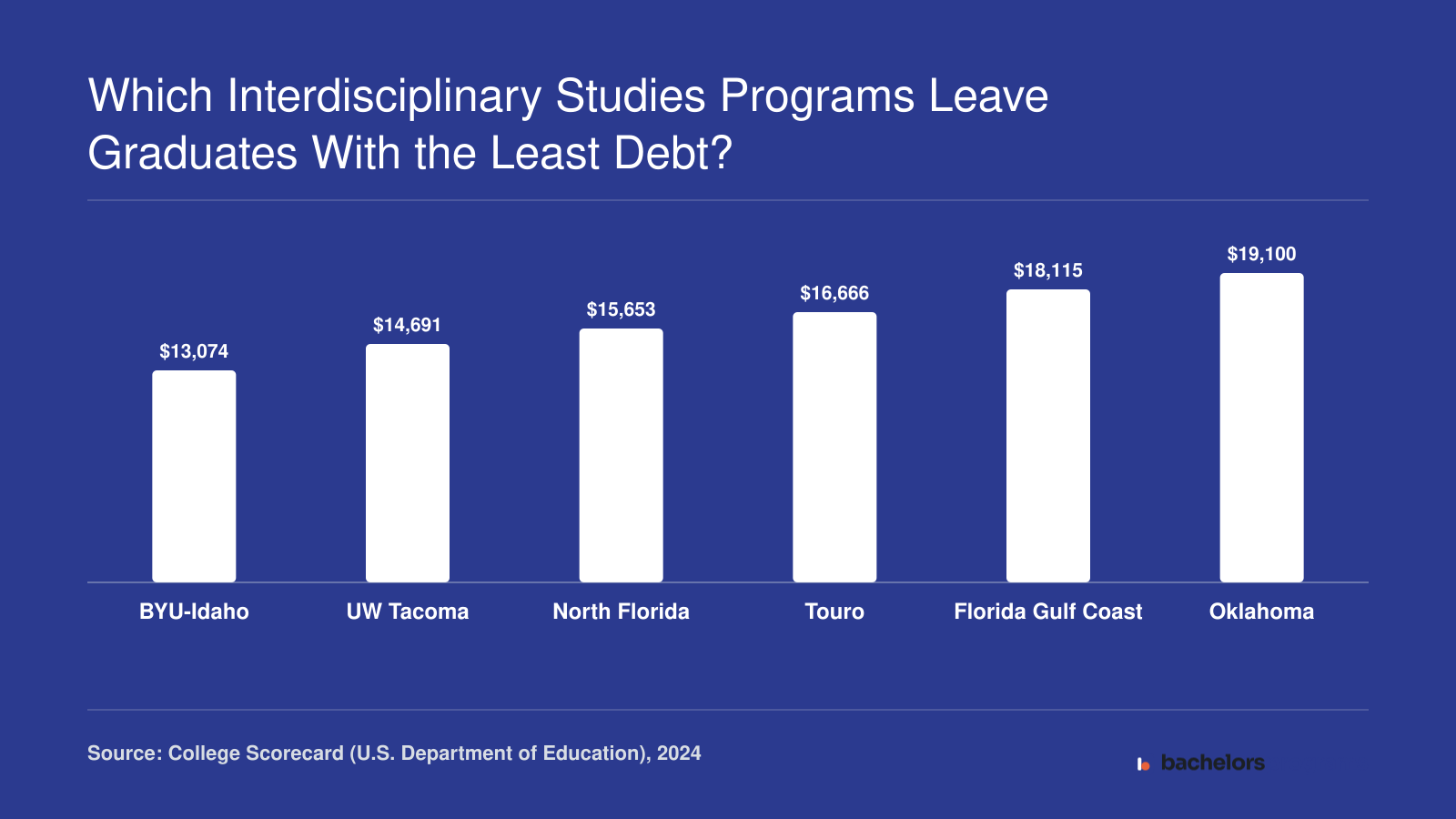
Which Interdisciplinary Studies Programs Leave Graduates With the Least Debt?
Brigham Young University-Idaho has the lowest median federal debt at completion, $13,074. On a 10-year repayment plan, that works out to a median payment of about $139 a month. At the high end of this group, the University of Oklahoma's online Learning and Education Studies track carries $19,100 in median debt, or roughly $202 a month, while UW Tacoma ($156), North Florida ($166), Touro ($177) and Florida Gulf Coast ($192) fall in between. All figures are program-level medians for interdisciplinary studies graduates, not institution-wide averages.
Online, Hybrid, and On-Campus Interdisciplinary Studies Options
You can earn a bachelor's degree in interdisciplinary studies online, and several of the schools ranked here offer one. UCF, FIU, BYU-Idaho, and FAU offer both online and campus formats. The remaining ranked schools, including UNC Chapel Hill, Purdue, Duke, UNF, Indiana Bloomington, and Queens College, are campus-based, so online learners should look at the wider field.
Why Transfer and Completion Students Gravitate Here
The major is built to absorb credits from several fields, which is why it suits students returning to finish a degree. Transfer limits vary widely:
- Campbellsville and Norwich: Both accept up to 90 credits in fully online programs.
- UMass Amherst University Without Walls: Up to 105 credits, including professional training, CLEP, and an essay-based prior-learning portfolio.1
- Eastern Oregon: Up to 135 transfer credits, plus up to 45 for Agency Sponsored Learning such as military or union training.2
- Liberty and LSU: Up to 75% of the degree or of previous credits, depending on the school.3
Residency minimums offset this flexibility. Park requires 30 credits from Park itself7, Eastern Oregon requires 20, and UCF expects 30 of your last 39 hours in residence.
Comparing Online Support
Design freedom differs by school. UCF online students choose from set concentrations and must meet with an Academic Success Coach.6 Corban lets students combine two areas, transferring one and finishing the other online.5 FIU describes a customized academic path alongside its online option. Before enrolling, ask whether courses are asynchronous, whether the capstone can be completed remotely, and whether you get a dedicated advisor.
Get a Credit Evaluation First
Request an unofficial transfer-credit evaluation before you apply. At LSU, an advisor decides how your credits apply4, and prior-learning credit at Norwich depends on course requirements. An early estimate shows how many semesters you actually have left.
Top First-Year Earnings Among Ranked Programs
Among the schools ranked here, the University of Oklahoma reports the strongest early payoff for interdisciplinary studies graduates.
How to Choose the Right Interdisciplinary Studies School
Interdisciplinary programs vary more from school to school than most majors do. Use this checklist to compare your options before you apply.
- Confirm institutional accreditationVerify the school's accreditation with its accreditor or through the U.S. Department of Education's database of accredited institutions. Accreditation affects federal aid eligibility, credit transfer, and graduate school admission.
- Ask about dedicated advisingAsk whether each student is assigned an interdisciplinary advisor. Combining fields takes careful planning, so a dedicated advisor matters.
- Check approved discipline combinationsConfirm that the fields you want to pair are on the approved list. If they aren't, ask whether the school allows a self-designed plan of study.
- Look for built-in applied learningFind out whether internships, capstone projects, or other applied experiences are part of the curriculum or left entirely to you.
- Review transfer and residency rulesAsk for the maximum number of transfer credits accepted and the minimum number of credits you must complete at the school.
- Estimate time and net priceMap out a realistic completion timeline based on your existing credits and course load. Then compare net price after grants and scholarships, not the sticker price. Once you've narrowed your list, request information from two or three schools and compare their answers side by side.
Interdisciplinary Studies programs by state
Compare Interdisciplinary Studies programs on the data that matters
Explore more Liberal Arts & Humanities majors or browse every field of study.
All Liberal Arts & Humanities programs Browse every field of study