Best Literature Degree Programs
Compare 1,200+ accredited Literature programs at 1,150+ colleges, with net price after aid, graduation rates, earnings and debt from IPEDS and the U.S. College Scorecard.

A public flagship that nets out near $6,541 after aid and a private university listing $62,688 both confer the same credential: the Bachelor of Arts (B.A.) in Literature. That gap frames the trade-off in any bachelor's degree in literature, which is built on close reading, argument, and revision and feeds editing, teaching, law, and content work.
The ranked schools run from public research universities to small private colleges, and price tracks institutional aid, not program quality.
Literature graduates enter a market that pays for clear writing without advertising it. What the major returns depends on what a student stacks beside it: a second language, a technical minor, an internship.
Key Points
- Princeton's average net price is $6,128, despite $62,688 in published tuition.
- UCLA literature graduates earn a $72,162 median five years after finishing.
- Federal data puts the median wage for English-degree holders at $65,000.
Best Schools for a Bachelor's Degree in Literature
The strongest programs in this ranking share three traits: an average net price after aid that families can plan around, institution-wide graduation rates that show students actually finish, and published outcomes for the literature major itself rather than for the university as a whole. Each card below gives the school, its location, how the program is delivered, the average net price after aid (an average, not a fixed quote for every student) and the institution-wide graduation rate. Where earnings for the literature program itself are reported, that figure appears with the window it covers.
Georgia Institute of Technology
#1Atlanta, GA · ~$12,000/yr (est.)
Best for: Writers drawn to technology and media
Georgia Tech's School of Literature, Media, and Communication treats literature as one of several forms of representation, so majors read novels, films, games, comic books and scientific documents alongside literary theory. Students pick from several concentrations and pair close reading with hands-on media work. The degree is built for graduates who want writing and analysis skills that hold up in technical and media workplaces, including public relations, publishing and content roles.
- Studies novels, films, games, comic books and web pages
- Pairs literary theory with hands-on media work
- Several concentrations offered within the degree
- Coursework covers scientific and technical documents
- Program names media, public relations and literature careers
University of California-Berkeley
#2Berkeley, CA · ~$13,000/yr (est.)
Best for: California readers focused on critical theory
Berkeley's English department sits in the College of Letters and Science and grants a Bachelor of Arts built on the history of literature in English, literary theory and sustained critical writing. The major opens by declaration rather than competitive admission at entry: students finish the reading and composition requirement and two lower-division courses, then declare once they reach 30 units. An honors track adds a two-semester, eight-unit sequence and a 40 to 60 page thesis. The department also opens its summer literature and writing courses to visiting students from other colleges.
- Covers the history of literature written in English
- Methods and theories of literary and cultural analysis
- Critical writing training across the major
- Entry Level Writing required before any English course
- Declare after 30 units plus two declaration courses
- Honors thesis runs 40 to 60 pages
- Honors admission: 3.51 overall and 3.65 major GPA
- Median earnings four years after finishing: $76,724
Princeton University
#3Princeton, NJ · ~$6,000/yr (est.)
Best for: Independent researchers planning a senior thesis
Princeton's English department runs a thesis-centered major: twelve courses, a junior seminar, a fall junior paper and a two-term senior thesis, closing with a thirty-minute oral exam. Six of the nine departmental courses must land in distribution areas that stretch from pre-1700 literature to theory and criticism. Tracks in creative writing and theater allow cognate courses, and creative writing students may submit a creative thesis instead. There are no specific prerequisite courses.
University of California-Los Angeles
#4Los Angeles, CA · $13,000/yr (est. net price)
UCLA's English major builds from five lower-division preparation courses into ten upper-division courses, all taken for a letter grade and worth four or five units. Majors complete four historical period courses, three breadth courses, two electives and a senior seminar or capstone. Creative writing workshops admit by application, and every major must reach level five in a foreign language. The department names law, business, teaching, media and entertainment as destinations for graduates.
- 5 lower-division preparation courses plus 10 upper-division courses
- Four historical period requirements
- Three breadth areas, including theory and creative writing
- Senior seminar or capstone required
- Creative writing workshops admit by application
- Foreign language through level five
- Median earnings four years after finishing: $62,927
University of Florida
#5Gainesville, FL · ~$7,000/yr (est.)
The University of Florida grants a Bachelor of Arts in English through its College of Liberal Arts and Sciences, with 120 credits and ten English courses at the 3000 level or above. Majors take at least five of those courses in Gainesville and earn a C or better in every one. The department publishes a long list of models of study, from children's literature to film and media studies to writing studies, and students may combine them. Faculty advisors help plan the sequence.
- 120 credits, including 10 English courses at 3000 level or above
- At least five major courses completed at UF
- C or better required in every major course
- Six credits of lower-division English as prerequisite
- Models of study include children's literature and film studies
- Students may combine two models of study
- Median earnings four years after finishing: $48,198
Grove City College
#6Grove City, PA · ~$22,000/yr (est.)
Grove City College is a private Christian liberal arts college in western Pennsylvania that awards a Bachelor of Arts in English within a 36-credit major. Coursework runs across British, American and classical literature, with electives in Chaucer, romantic literature, science fiction, poetry and modern drama. Students can double major or minor in business, marketing, writing, history or communication, and the department runs an annual Christian Writers Conference and publishes The Echo. The college reports that about 95% of graduates land full-time positions or graduate admission within six months.
- 36 credit hours in the major
- Core work in British, American and classical literature
- Electives include Chaucer, science fiction and modern drama
- Annual Christian Writers Conference
- Students submit to The Echo literary publication
- Internships at Rowman and Littlefield and similar publishers
- Room to double major or minor in business or writing
- College reports 95% job or graduate school placement
University of North Carolina at Chapel Hill
#7Chapel Hill, NC · ~$12,000/yr (est.)
UNC's English and comparative literature major is compact at 30 credit hours, but it asks students to choose: seven concentrations or a self-designed run of electives. Options include British and American literature, comparative and world literatures, creative writing, film studies, science medicine and literature, social justice and literature, and writing editing and digital publishing. Honors work requires a 3.3 cumulative and 3.6 major GPA plus a 40 to 70 page thesis, and majors may earn credit for internships.
- 30 credit hours total
- Core surveys plus a depth course on one author or genre
- 7 concentrations, from creative writing to film studies
- Six of ten courses must be at the 200 level or above
- Two writing-intensive courses at the 300 level
- Honors thesis runs 40 to 70 pages
- Credit available for major-related internships
- Median earnings four years after finishing: $54,181
Florida State University
#8Tallahassee, FL · ~$11,000/yr (est.)
Florida State's English department awards a Bachelor of Arts with an emphasis in literature, media and culture, taught in person in Tallahassee rather than online. The 120-credit degree includes 36 semester hours of English, at least 21 of them at the 3000 and 4000 level, plus a three-hour senior seminar capstone. Students add a minor in another department and foreign language proficiency through the intermediate level. The department names writing, editing, teaching and law among representative destinations.
- 120 credits, including 36 semester hours of English
- At least 21 English hours at the 3000 to 4000 level
- 12-hour core plus 12 distribution hours
- 3-hour senior seminar capstone
- Minor in another department required
- Foreign language through the intermediate level
- Upper-division admission at 52 credits and 2.0 GPA
- Face-to-face instruction only; no online option
Stanford University
#9Stanford, CA · $10,000 – $15,000/yr (est.)
Stanford's English major pairs a shared core with an unusually wide choice of emphasis. All majors take Poetry and Poetics, Narrative and Narrative Theory, a writing-intensive seminar and the three-quarter historical sequence, then commit to one of five emphases. Options include literature and philosophy, interdisciplinary studies, creative writing in prose or poetry, and a computational cultural analytics track that adds programming and text mining. Most emphases print on the transcript and diploma.
- 36 to 40 unit core shared by all majors
- English 160 Poetry and Poetics and English 161 Narrative Theory
- Historical sequence: English 10, 11 and 12
- 5 emphases, including Literature and Philosophy
- Computational Cultural Analytics adds CS 106A and 106B
- Creative Writing emphasis in prose or poetry
- Most emphases printed on transcript and diploma
- Capstone course required
Harvard University
#10Cambridge, MA · $15,000 – $20,000/yr (est.)
Harvard College awards the A.B. in English, a concentration built around reading widely and arguing precisely about how language works. Texts range from novels and screenplays to hip hop lyrics, and the emphasis falls on interpreting other people's rhetoric and then communicating your own meaning clearly. The department frames the work as analyzing the language of the past while contributing to the narrative of the future.
- Bachelor of Arts (A.B.) awarded by Harvard College
- Reads novels, screenplays and hip hop lyrics
- Analyzes the language of the past
- Builds expertise in interpreting others' rhetoric
- Focus on communicating meaning clearly
Cost & outcomes by school
Federal data for the highest-earning Literature programs, independent of the ranking above. Earnings are this field's bachelor's graduates four years after completing where the Scorecard reports them, else the school's undergraduate median.
| School | Net price / yr | Grad rate | Earnings | Debt | Grads/yr | Format |
|---|---|---|---|---|---|---|
| Massachusetts Institute of Technology MA | $20,111 | 96% | $143,372 | $14,768 | 3 | Campus |
| California Institute of Technology CA | $16,075 | 94% | $128,566 | — | — | Campus |
| Bentley University MA | $37,930 | 87% | $120,959 | $25,023 | 1 | Campus |
| Carnegie Mellon University PA | $31,944 | 94% | $114,862 | $21,750 | 7 | Campus |
| Stevens Institute of Technology NJ | $41,346 | 87% | $108,772 | $27,000 | — | Campus |
| Claremont McKenna College CA | $28,849 | 91% | $104,736 | $13,500 | 9 | Campus |
| Georgia Institute of Technology GA | $12,116 | 94% | $102,772 | $21,672 | — | Campus |
| Duke University NC | $29,612 | 97% | $97,800 | $15,362 | 19 | Campus |
| Washington and Lee University VA | $23,781 | 94% | $94,810 | $19,500 | 18 | Campus |
| Rice University TX | $13,370 | 95% | $89,718 | $11,000 | 38 | Campus |
| Johns Hopkins University MD | $18,809 | 94% | $87,555 | $10,250 | 9 | Campus |
| Washington University in St Louis MO | $21,786 | 94% | $86,182 | $17,500 | 22 | Campus |
Sources: U.S. Department of Education. Net price, graduation rate, earnings and debt: College Scorecard (earnings and debt for this field's bachelor's graduates where reported, else school-wide); graduates: IPEDS. A dash means no figure is reported.
Cost, debt & payoff
Median earnings of this field's bachelor's graduates (4 yrs after completing, else the school's undergraduate median) vs. their median federal loan debt · U.S. College Scorecard
Across these programs the median graduate earns about $50,299 and finishes with roughly $23,534 in debt — a ratio that clears a common rule of thumb (keep debt below first-year salary). Net price and debt vary widely school to school, so check the per-school figures in the table above before you shortlist.
How We Ranked These Literature Programs
Prestige alone has never been a reliable guide to whether a literature degree pays off, and families are asking harder questions about cost and completion than they did a decade ago.
What Goes Into the Ranking
Each school is measured on institution-level federal data from IPEDS and the College Scorecard: average net price after grant aid, graduation and retention rates, and, where a program publishes them, earnings and debt for its graduates. Each listing also records delivery format, so a reader who wants an online bachelor's degree in literature can filter for it instead of sorting through campus-only options.
Why Outcomes Beat Reputation
A list built purely on name recognition rewards institutions that already hold large endowments and deep alumni networks. This one rewards schools where literature students can realistically afford to finish. A program with a moderate net price, strong retention, and graduates who land on their feet financially is a better bet for most applicants than a famous name with a punishing price tag and a drawn-out path to completion.
Where the Data Runs Out
The data has limits. Graduation rates are school-wide, not specific to an English or literature department. That figure averages every aided student, so any individual family's number will differ. And some literature programs publish no program-level earnings at all, because graduating cohorts are small enough that federal reporting rules keep those figures out of the public file. Where that happens, the ranking leans on the wider institutional picture, and readers should treat it as a starting point rather than a verdict.
Most Affordable Literature Degree Programs by Net Price
Sticker price can mislead: Princeton University, a private school, publishes the same $62,688 tuition for every student, yet its average net price after aid is $6,128, so grants close more than $56,000 of the gap and put it below the University of Florida ($6,541) and the University of Central Florida ($10,411), according to 2024 IPEDS and College Scorecard data. The two Florida schools are public universities with low in-state tuition ($6,381 at UF and $6,368 at UCF), but nonresidents face published rates of $28,659 and $22,467, and a public school's average net price mainly reflects in-state students, so out-of-state applicants should budget closer to the nonresident figure unless they receive substantial aid. Median debt and estimated 10-year monthly payments below apply to graduates of each school's literature or English program, while graduation rates cover the whole institution.
| School | State | Format | Avg. Net Price After Aid | Graduation Rate (Institution-wide) | Median Program Debt | Est. Monthly Payment (10-Year) |
|---|---|---|---|---|---|---|
| Princeton University | NJ | Campus | $6,128 | 97.6% | N/A | N/A |
| University of Florida | FL | Campus | $6,541 | 91.1% | $17,758 | $188 |
| University of Central Florida | FL | Campus and online | $10,411 | 78.0% | $16,750 | $178 |
Literature Degree Careers and Salary Outcomes: Is It Worth It?
What Can You Do With a Bachelor's Degree in Literature?
Literature majors move into several fields, and most reward reading, writing, and argument. Federal data puts the median wage for English-degree holders at $65,000, compared with $73,000 across all fields.1 Bureau of Labor Statistics (BLS) figures for common paths:
- Editors: $77,920 median wage. Employment is projected to decline 1% from 2025 to 2035.2
- Writers and authors: $76,910 median wage, with little or no projected change (0%) over the same period.3
- Technical writers: $90,390 median wage, the highest here, with projected growth of 1%.4
- Paralegals and legal assistants: $62,890 median wage. Growth is projected at 0%, but BLS still expects about 40,800 openings a year on average, mostly from turnover.5
- High school English teachers: Secondary teaching is among the top occupations for English-degree holders, and BLS projects 0% growth for the group from 2025 to 2035.6
These are national medians, so entry-level pay usually starts lower, and wages vary by region and employer.
Where the B.A. Alone Isn't Enough
Teaching is the clearest example. Public school teachers need a state license, which typically means an approved preparation program and a student-teaching placement. Rules differ by state, so check yours early. Paralegal work is less strict, but some employers prefer a paralegal certificate or relevant experience. Editing, writing, and content roles rarely require a credential. They do expect clips, samples, or a portfolio.
Graduate and Law School
Advanced study is common in this field. About 47% of employed English-degree holders have an advanced degree, versus 39% across all fields.1 Among lawyers, 5% hold an English degree, and law schools accept applicants from any major.6 Published data on English majors' LSAT scores and admission rates is limited, so check the Law School Admission Council's current applicant data before assuming any advantage. Law school is also a major added expense, so weigh that cost against likely earnings.
Is a Literature Degree Worth It?
It can be, with conditions. The degree builds writing, analysis, and research skills that employers in many industries want. But it does not point to one job, and the biggest wage gains tend to go to graduates who add something concrete. The case is strongest when you can do most of these:
- You keep tuition and debt low, using in-state, transfer, or affordable online options.
- You complete internships in publishing, marketing, law, or education.
- You build a writing portfolio before graduation.
- You pair the major with a second skill, such as technical communication, data, or a teaching credential.
Without those pieces, a high-cost literature degree is harder to justify on earnings alone.
Top-Paying Career Path for Literature Majors
Technical writing is one of the strongest-paying paths open to literature graduates.
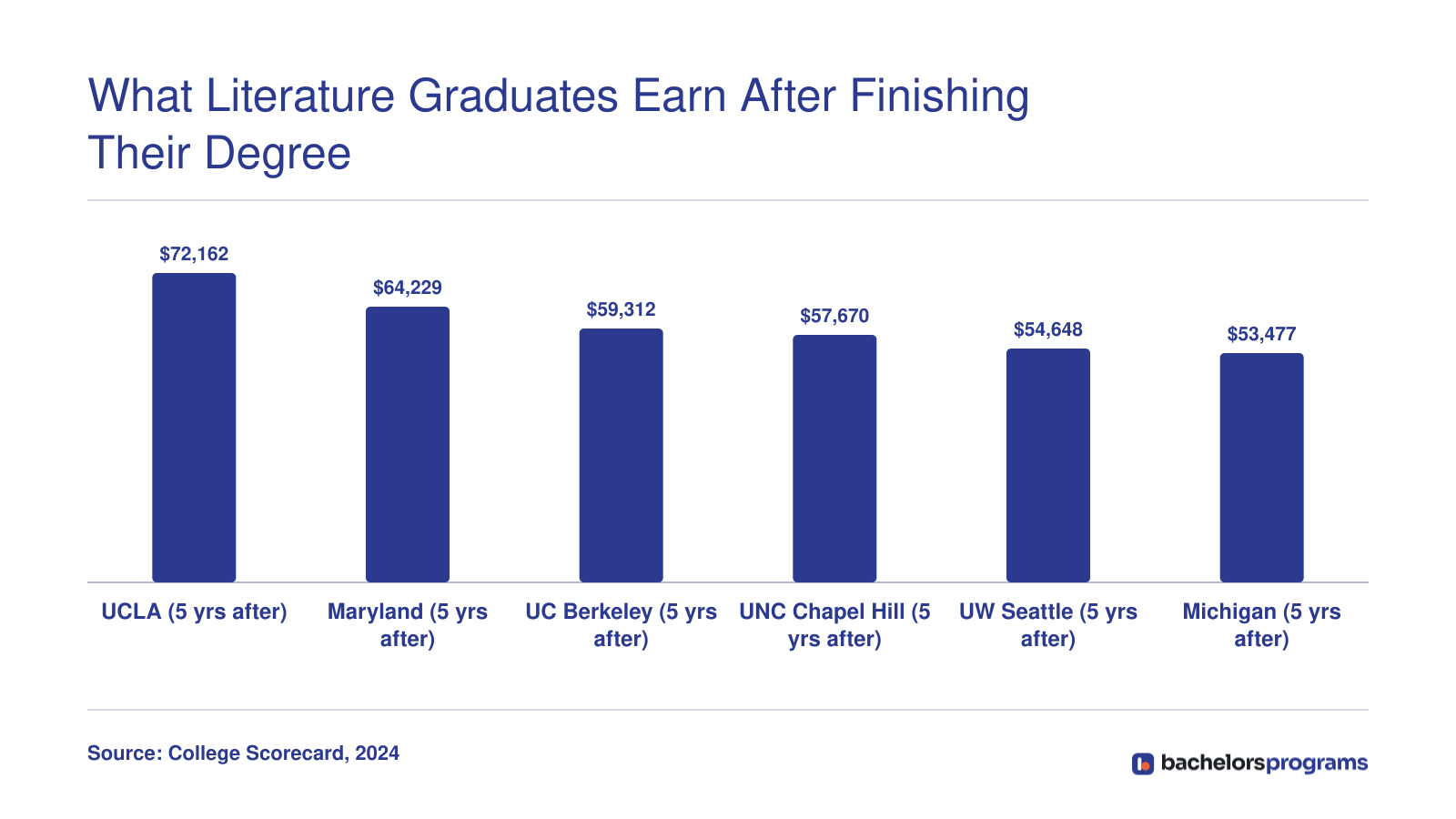
What Literature Graduates Earn After Finishing Their Degree
These are College Scorecard medians for literature and English completers at each school, measured five years after graduation, and only program-level figures are shown. UCLA leads at $72,162, and the University of Michigan rounds out the group at $53,477. The BLS occupational wages above include workers at every career stage, from new hires to seasoned professionals, so these early-career medians naturally run lower.
Related Articles
Online vs. Campus Literature Programs: Can You Earn the Degree Online?
The real question with an online literature degree is not whether one exists. It is what you trade away for the scheduling freedom. Every program on this list is a campus-based degree, so online-only students need a different shortlist and a different set of checks before committing.
Where Online Literature Degrees Actually Live
Fully online bachelor's degrees in this field usually carry an English or English literature title rather than "literature." Arizona State University is a clear example. ASU Online offers a Bachelor of Arts in English in three versions: general English, Narrative Studies, and Creative Writing. Each requires 120 credits and runs to roughly 39 or 40 classes, delivered in 7.5-week sessions. The general English and Creative Writing tracks list a next start date of January 11, 2027. Coursework covers English literature and literary analysis alongside rhetoric, revision, and editing, with fiction workshops in the Creative Writing track.1 ASU also says diplomas and transcripts do not identify the degree as online, which matters if you care how the credential reads to employers.
What You Gain and What You Give Up
- Online: asynchronous coursework, frequent start dates, and generous transfer credit make it realistic to keep working, change majors, or finish a degree you started years ago.
- Campus: seminars where you argue about a text in real time, student literary magazines, visiting writers' readings, and faculty who know your writing well enough to write you a real letter of recommendation.
Verify Accreditation Before You Enroll
Confirm institutional accreditation through an agency recognized by the U.S. Department of Education or the Council for Higher Education Accreditation (CHEA). Search the federal database using the institution's exact legal name, then confirm accredited status, the accreditor, effective dates, and scope. Cross-check CHEA to be sure the listing is institutional accreditation, not just a state authorization or a program-level approval. Accreditation can change, so verify the record for your enrollment year and for the specific entity awarding the degree, online or on campus.
Questions to Ask Yourself
Do you want a pure literature track, or an English program that adds creative writing or rhetoric?
Are you aiming at law school, teacher licensure, or graduate study?
Will you need an online or part-time format, and will your community college credits transfer into the major?
Can you finish with debt that an early-career editor or teacher can comfortably repay?
Accreditation, Admissions, and Transfer Credit: What to Check Before You Apply
Before you apply, confirm these points on each school's own first-year, transfer, and financial aid pages. Requirements vary by institution.
- Institutional accreditationChoose a college with institutional (often called regional) accreditation from an agency recognized by the U.S. Department of Education. Accreditation affects your eligibility for federal aid, whether other schools accept your credits, and how graduate programs view your degree.
- Admissions componentsMost literature majors apply to the college itself, though some schools set later major-declaration or GPA rules. Expect a high school transcript and usually a personal essay. Writing samples are not universal, and test-optional policies differ by school, so check how test scores affect merit aid.
- Transfer pathwaysAn Associate of Arts is built for transfer. In North Carolina, for example, transfer degrees carry about 45 semester hours of general education under articulation agreements. These agreements depend on your grades, catalog year, and admission, and credit that transfers may still not satisfy upper-division literature requirements. Ask for a degree audit.
- FAFSA timingThe FAFSA unlocks grants, work-study, and federal loans. The federal deadline for 2026–27 is June 30, 2027, but each college sets its own earlier priority dates.
- Humanities scholarships and net priceLook for English or humanities department awards. Wesleyan College's Findlay Humanities Scholarship, for example, asks for a statement of interest, a research paper sample, and a 3.4 GPA. Run each school's net price calculator to compare costs side by side.
Literature programs by state
Compare Literature programs on the data that matters
Explore more Liberal Arts & Humanities majors or browse every field of study.
All Liberal Arts & Humanities programs Browse every field of study