Best Bachelor's Degrees in Spanish
Compare 790+ accredited Spanish programs at 770+ colleges, with net price after aid, graduation rates, earnings and debt from IPEDS and the U.S. College Scorecard.

A bachelor's degree in Spanish, usually a Bachelor of Arts (B.A.), succeeds best when paired with a second skill. Fluency is needed in U.S. classrooms, clinics, courtrooms, and customer-facing business roles, yet the major itself rarely maps to a single job title.
That ambiguity shapes the choice. Programs differ in emphasis (literature, linguistics, or applied Spanish), study abroad expectations, and cost. Average net price at these schools runs from about $6,100 to $18,800 a year. Programs are available on campus, online, and in hybrid formats.
Employers rarely hire for Spanish alone. Graduates who combine it with education, health, law, or business coursework tend to have the clearest paths.
Key Points
- Princeton's $6,128 average net price sits far below its $62,688 sticker price.
- Online Spanish degrees match campus coursework, roughly 120 semester credits.
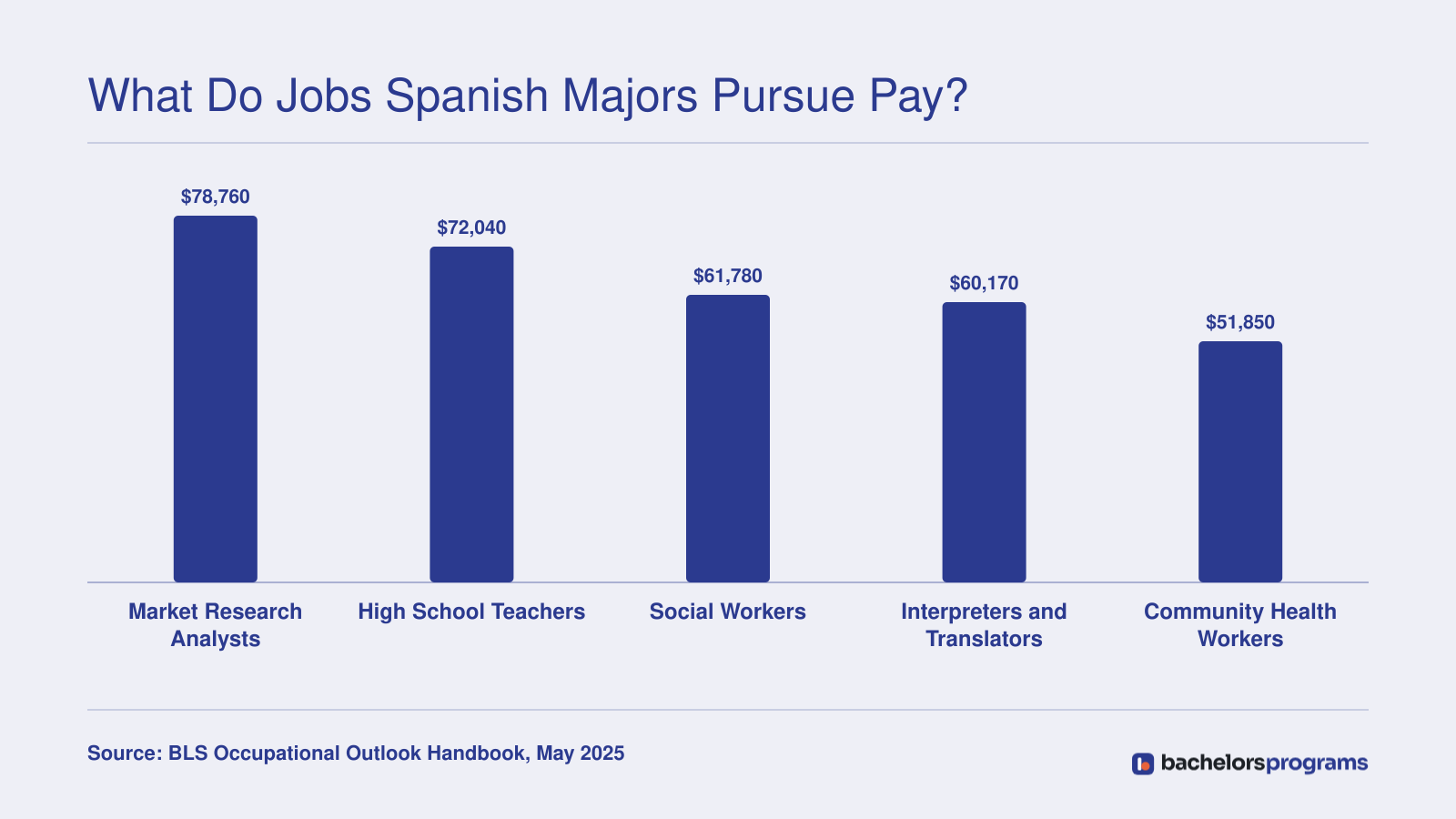
- Median pay ranges from $51,850 to $78,760 across common Spanish-major careers.
Best Schools for a Bachelor's Degree in Spanish: Our Top 10
A top-10 spot here reflects three things: what the degree costs a typical student after aid, how many students actually finish, and how flexibly each program fits different goals. The average net price shown on each card is what students pay on average after grants and scholarships, not a quote for every family. Every program listed is offered on campus, and several build in study abroad credit, honors research or profession-specific tracks.
Princeton University
#1Princeton, NJ · ~$6,000/yr (est.)
Best for: Independent research and thesis writers
Princeton's Spanish and Portuguese department lets majors build a highly individualized degree, with four tracks including an interdisciplinary option that pairs Spanish with fields such as global health, journalism or environmental studies. Independent work is central: a junior paper followed by a year-long senior thesis defended in an oral presentation. The school's overall graduation rate is 98%, and the department points graduates toward journalism, business, law, government and international affairs.
- Four tracks, including an interdisciplinary option
- Creative arts track covers writing, theater and translation
- Junior paper of 5,000 to 8,000 words
- Year-long senior thesis of 15,000 to 20,000 words, defended orally
- Up to three study-abroad courses per semester may count
- Declare the major in April of sophomore year
- Eight SPA or cross-listed courses, four at the 300 level
University of North Carolina at Chapel Hill
#2Chapel Hill, NC · ~$12,000/yr (est.)
Best for: Future translators and interpreters
UNC-Chapel Hill houses Spanish inside a Romance Languages major with four concentrations, from Hispanic literatures and cultures to translation and interpreting. The core runs 24 credit hours, and study abroad in Montpellier, Seville or Florence can supply up to 30 semester hours. The school's overall graduation rate is 91%, and Spanish graduates who finished four years earlier reported median earnings of about $64,570.
- Four concentrations, including translation and interpreting
- 24 credit hours in the major core
- Prerequisite: SPAN 261 or SPAN 267
- Honors thesis available with a faculty member
- Study abroad in Montpellier, Seville and Florence
- Up to 30 semester hours of study abroad credit
- Credit-bearing internship opportunities
- Weekly Spanish conversation tertulia
Rice University
#3Houston, TX · ~$13,000/yr (est.)
Best for: Transfer students with study-abroad credit
Rice's Spanish and Portuguese major is compact by design: 10 courses and 30 credit hours inside a 120-credit degree, with seven courses at the 300 level or above. Hispanic linguistics is part of the core, and strong students can write an honors thesis in the final year. The school's overall graduation rate is 95%.
- 10 courses, 30 credit hours, inside a 120-credit degree
- Seven courses at the 300 level or above
- Up to four courses from study abroad or transfer credit
- Coursework in Hispanic linguistics required
- Honors thesis possible in the final year
- 2.0 GPA minimum in the major
- Cervantes Award for Outstanding Seniors
University of Chicago
#4Chicago, IL · ~$15,000/yr (est.)
Chicago's Spanish program is literature-heavy, with surveys spanning Iberian medieval and early modern texts through Latin American colonial to 21st-century writing. It takes 10 courses beyond second-year language, and study abroad in Mexico or Spain can count toward the major. The school's overall graduation rate is 96%.
- 10 courses beyond second-year Spanish
- Two to four advanced language courses
- Three to four literature survey courses
- No thesis or capstone required
- Honors needs a 3.25 overall and 3.5 major GPA
- Honors BA paper of at least 20 pages
- Study abroad in Mexico or Spain can count for credit
University of Michigan
#5Ann Arbor, MI · $18,000 – $61,000/yr (est.)
Michigan's Spanish major sits in Romance Languages and Literatures and pairs readily with pre-law, pre-med, communications, psychology or economics. Students can add an honors major, independent study or an internship, and Catalan courses count toward the degree. Note that online course credits are not accepted toward the major, and study abroad credit needs faculty pre-approval. The school's overall graduation rate is 93%, and Spanish graduates four years after finishing reported median earnings of about $64,426.
- Honors major, independent study and internships available
- Catalan courses count toward the major
- Study abroad credit requires faculty pre-approval
- Online course credits are not accepted toward the major
- Pairs with pre-law, pre-med, communications and economics
University of Florida
#6Gainesville, FL · ~$7,000/yr (est.)
Florida offers a B.A. in Hispanic and Latin American Languages, Literatures and Linguistics with a Spanish specialization that requires 33 of the degree's 120 credits. Placement runs through AP, IB or AICE scores or the WebCAPE test, and the department offers courses for heritage speakers plus professional Spanish for medical, legal and business settings. The school's overall graduation rate is 91%, and Spanish graduates four years out reported median earnings of about $65,765.
- Spanish specialization requires 33 of 120 credits
- Courses designed for heritage Spanish speakers
- Professional Spanish for medical, legal and business settings
- Placement by AP, IB, AICE scores or WebCAPE test
- Four 4000-level Spanish courses must be taken at UF
- Upper-division focus in Hispanic literatures or linguistics
- Study abroad in a Spanish-speaking country encouraged
Bowdoin College
#7Brunswick, ME · ~$14,000/yr (est.)
Bowdoin's Hispanic Studies major is seminar-driven and capped at nine courses above intermediate Spanish, with at least five taken on the Brunswick campus. Study away is strongly encouraged in the junior year and up to four credits can count toward the major, while an honors project is optional. The school's overall graduation rate is 95%.
- Nine courses above Intermediate Spanish II
- At least five major courses completed at Bowdoin
- Three advanced 3000-level courses, two taught in Spanish
- Study away strongly encouraged in the junior year
- Up to four study-away credits count toward the major
- AP Spanish score of 4 earns general degree credit
- Optional departmental honors project
Johns Hopkins University
#8Baltimore, MD · $19,000/yr (est. net price)
Johns Hopkins requires 41 credits for the Spanish B.A., with at least 15 at the 300 level or higher, and offers a Spanish for the professions track that pairs medical, commerce or public health coursework with a community language practicum. Every student takes a placement exam before the first Spanish course, and study abroad runs through Madrid, Salamanca and Costa Rica. The school's overall graduation rate is 94%.
- 41 credit hours, at least 15 at the 300 level or higher
- Spanish for the professions track with a community practicum
- Placement exam required before the first Spanish course
- Study abroad in Madrid, Salamanca and Costa Rica
- Up to four major courses can be completed abroad
- Honors requires a 3.5 cumulative and 3.7 major GPA
- One course taught in English may count with approval
University of Wisconsin-Madison
#9Madison, WI · ~$17,000/yr (est.)
At UW-Madison the Spanish major takes 36 credits and has no application, GPA or credit barrier to declare, so students can add it without competing for a seat. Nine electives sit at the 400 level or above, and at least six upper-level credits must be taken on campus, with targeted courses such as Spanish for nursing or pharmacy. The school's overall graduation rate is 90%, and Spanish graduates four years after finishing reported median earnings of about $58,565.
- 36 credits in the major and 120 for the degree
- No application, GPA or prerequisite to declare
- Nine electives numbered 400 or above
- At least six upper-level credits taken on campus
- Two-semester Senior Honors Thesis option
- Study abroad programs in more than 80 countries
- Targeted courses such as Spanish for nursing or pharmacy
University of California-Berkeley
#10Berkeley, CA · ~$13,000/yr (est.)
Berkeley's Spanish and Portuguese major offers four concentrations, including Hispanic linguistics and Latin American languages, literatures and cultures. Coursework includes Spanish and Spanish American Literature parts 1 and 2 plus at least three electives drawn from Catalan, Portuguese and Spanish offerings. The school's overall graduation rate is 93%, and Spanish graduates four years after finishing reported median earnings of about $75,715.
- Four concentrations, including Hispanic linguistics
- Spanish and Spanish American Literature, Parts 1 and 2 required
- At least two Literature and Culture electives
- At least three electives from Catalan, Portuguese and Spanish
- Latin American track includes advanced Portuguese coursework
Cost & outcomes by school
Federal data for the highest-earning Spanish programs, independent of the ranking above. Earnings are this field's bachelor's graduates four years after completing where the Scorecard reports them, else the school's undergraduate median.
| School | Net price / yr | Grad rate | Earnings | Debt | Grads/yr | Format |
|---|---|---|---|---|---|---|
| Massachusetts Institute of Technology MA | $20,111 | 96% | $143,372 | $14,768 | — | Campus |
| Stanford University CA | $13,807 | 92% | $124,080 | $12,000 | 3 | Campus |
| Carnegie Mellon University PA | $31,944 | 94% | $114,862 | $21,750 | 6 | Campus |
| Vanderbilt University TN | $15,846 | 94% | $114,368 | $12,000 | 39 | Campus |
| University of Pennsylvania PA | $28,699 | 97% | $111,371 | $15,715 | 12 | Campus |
| Princeton University NJ | $6,128 | 98% | $110,066 | $10,320 | 8 | Campus |
| Claremont McKenna College CA | $28,849 | 91% | $104,736 | $13,500 | 8 | Campus |
| Georgia Institute of Technology GA | $12,116 | 94% | $102,772 | $21,672 | — | Campus |
| Columbia University in the City of New York NY | $21,590 | 96% | $102,491 | $20,250 | 13 | Campus |
| Harvard University MA | $19,066 | 98% | $101,817 | $14,000 | 16 | Campus |
| Yale University CT | $23,777 | 96% | $100,533 | $12,975 | 4 | Campus |
| Duke University NC | $29,612 | 97% | $97,800 | $13,000 | 21 | Campus |
Sources: U.S. Department of Education. Net price, graduation rate, earnings and debt: College Scorecard (earnings and debt for this field's bachelor's graduates where reported, else school-wide); graduates: IPEDS. A dash means no figure is reported.
Cost, debt & payoff
Median earnings of this field's bachelor's graduates (4 yrs after completing, else the school's undergraduate median) vs. their median federal loan debt · U.S. College Scorecard
Across these programs the median graduate earns about $56,277 and finishes with roughly $22,500 in debt — a ratio that clears a common rule of thumb (keep debt below first-year salary). Net price and debt vary widely school to school, so check the per-school figures in the table above before you shortlist.
How We Ranked These Spanish Programs
Some rankings begin with reputation. This one begins with reported outcomes, then layers in the practical questions a prospective Spanish major actually asks: What will I pay, what will I borrow, and will the format fit my life?
The Factors We Weighed
We compared average net price, program-level earnings and median debt from the federal College Scorecard, institution-wide graduation and retention rates from IPEDS, selectivity, and format flexibility. Net price reflects what students actually pay after grant aid, not the sticker price. Program earnings and debt come from Scorecard data tied to the federal CIP code for Spanish, so the figures reflect Spanish graduates specifically rather than the whole institution. Format flexibility covers online, hybrid, and campus options, plus whether a program accepts transfer credit and offers evening or accelerated terms.
The Limits of the Data
Graduation and retention rates are school-wide, not Spanish-specific, so treat them as a signal about institutional support rather than a verdict on the department. Some Spanish programs graduate too few students for the federal government to publish earnings data; when that happens, we do not substitute a number from another program or year. Scorecard figures also lag by a year or more, so this ranking is a snapshot, not a live feed. A school's current costs or outcomes may differ.
Every institution on this list is accredited and degree-granting. Accreditation matters for transfer credit, financial aid, and some licensure pathways; the accreditation section explains what to check.
Online Spanish Degrees vs. On-Campus Programs
Yes, you can earn an online Spanish degree, and a Spanish degree online covers the same bachelor's coursework as a campus major. One quarter credit is about 2/3 of a semester credit, so roughly 180 quarter credits equals the 120 semester credits most campus programs require. Online wins on flexibility, while campus programs make immersion and study abroad easier to build in.
| Factor | Online Spanish degree | On-campus Spanish degree |
|---|---|---|
| Pacing and start dates | Oregon State Ecampus uses 7.5-week classes with three program starts a year: fall, spring and summer | 16-week semesters on a traditional academic calendar |
| Credit system | Quarter credits, with 180 minimum for graduation at Oregon State Ecampus | Semester credits, with 120 as the usual bachelor's total |
| Per-credit tuition | $409 per credit at Oregon State Ecampus (2026), excluding materials, fees and expenses | $1,583 per credit hour for part-time enrollment under 12 hours per semester in 2026 to 2027 at one campus example |
| Immersion and study abroad | Strongly encouraged for language majors, and online students can join Oregon State education-abroad programs, but it takes planning around work and home life | Highly recommended by the Modern Language Department, and easier to schedule within a full-time campus calendar |
| Speaking practice | Spoken Spanish practice and service-based courses delivered online; check whether live sessions are required | In-person conversation, plus native-speaker practice through study abroad in Spain, Costa Rica or Cuba, the Latin American Student Association or Spanish Club |
| Transfer friendliness | Request a transfer credit evaluation, and expect quarter credits to be converted at about 2/3 of a semester credit | Semester credits from most community colleges and universities usually map directly, but confirm with the school |
Related Articles
Affordable Spanish Bachelor's Degrees: Net Price and Debt Compared
Net price is the average amount students actually pay per year after grants and scholarships, so it can differ sharply from tuition: Princeton, a private school, lists $62,688 in tuition and fees for every student yet reports a $6,128 average net price because of large grant aid, while the public University of Florida and Florida State University keep costs low mainly through in-state tuition, according to 2024 IPEDS and College Scorecard data. Program debt is lowest at the University of Florida, where Spanish graduates carry a median of $13,000 (about $138 a month over 10 years), and the College Scorecard also reports each school's Pell Grant share, a useful signal of how well a school serves lower-income students. For most students, the cheapest route to a B.A. in Spanish is in-state public tuition combined with transfer credits earned at a community college, so confirm in advance which language and general education courses your target school will accept.
| School | Sector | Format | Average Net Price (per year) | In-State Tuition and Fees | Out-of-State Tuition and Fees | Median Program Debt | Est. 10-Year Monthly Payment |
|---|---|---|---|---|---|---|---|
| Princeton University (Princeton, NJ) | Private nonprofit | On campus | $6,128 | $62,688 | $62,688 | N/A | N/A |
| University of Florida (Gainesville, FL) | Public | On campus | $6,541 | $6,381 | $28,659 | $13,000 | $138 |
| Florida State University (Tallahassee, FL) | Public | On campus | $11,297 | $5,656 | $18,786 | $20,557 | $218 |
Spanish Degree Tracks: Literature, Linguistics, Translation, Teaching and Applied Spanish
A Spanish major is a single degree that can point in several directions, depending on which courses you choose within it. Knowing the main tracks helps you match a program to the career you want.
Literature and Linguistics
The classic route is a bachelor's degree in Spanish language and literature, built on advanced language courses and surveys of Spanish and Latin American writing. The University of Chicago and UC Berkeley both lean on literature coursework. This track suits graduate study, publishing, or teaching.
Linguistics covers phonetics, sociolinguistics, and how Spanish varies across regions. Rice includes Hispanic linguistics coursework, and the University of Florida builds linguistics into its program title.
Translation, Teaching and Applied Spanish
Translation and interpreting focus on moving meaning between languages accurately. The programs here do not highlight a standalone translation concentration, so expect to assemble this path from advanced language courses, internships, and professional training after graduation. It leads toward interpreting and translation jobs.
The teaching track leads to K-12 certification, and state licensure rules vary, so check your state's requirements early. Wisconsin-Madison points to careers in bilingual and second language education.
Applied Spanish ties language to a workplace. Florida offers professional Spanish for medical, legal, and business settings, and Johns Hopkins includes a community-based Spanish language practicum. These paths lead into healthcare, social services, and business roles.
Widen Your Options With a Second Field
Spanish alone is a strong skill, but it works best paired with a second credential. Michigan notes that its major pairs with pre-law and pre-med, and Princeton offers an interdisciplinary track with a second field. A second major or minor in business, nursing, criminal justice, or education turns fluency into a clear job qualification and gives you more employers to approach.
Questions to Ask Yourself
Do you want to teach Spanish in a public school?
Are you aiming for court or medical interpreting?
Do you want literature as a launchpad to graduate school, or Spanish as a second skill?
What Do Jobs Spanish Majors Pursue Pay?
Spanish graduates often move into interpreting, teaching, social services, community health and business research. The chart compares the national median annual wage for each occupation, from $51,850 for community health workers to $78,760 for market research analysts. These are occupation-wide BLS figures for all workers in each field as of May 2025, not earnings for Spanish graduates specifically, and some roles, such as public school teaching, also require a state license.
Admissions, Placement Testing, and Transfer Credit Checklist
Getting into the university and placing into the right Spanish course are separate steps. Use this checklist to prepare for both and to protect credit you've already earned.
- General admissionHave your high school diploma or GED and official transcripts ready. Many schools are test-optional, so confirm whether SAT or ACT scores are required. Some majors add their own entry rules. Penn State, for example, requires a 2.00 GPA and third-semester standing.
- Spanish placement examExpect an online exam, such as WebCAPE at some schools. It sets your starting course, not your admission. At King's University, placement decides between SPAN 114 and 115, and only courses at 114 or above count toward the major.
- Heritage-speaker placementAsk whether the school has a heritage track. The University of Miami starts second-language learners at SPA 202 and heritage learners at SPA 208.
- AP and IB scoresLook up each school's minimum score for AP Spanish Language, AP Spanish Literature and IB Spanish. Rules differ. Cornell counts AP and IB credit toward its 120 total credits but not toward its 100 Arts and Sciences credits.
- CLEP SpanishConfirm whether CLEP is accepted, the passing score and how many credits it earns. Policies vary by college.
- Back credits for upper-level placementSome schools award credit for demonstrated proficiency. Penn State grants 0 to 12 elective credits by exam. Others only waive courses. CSUN gives no credit below your placement level.
- Community college transfer creditCheck transfer caps and residency rules. Indiana University Online accepts up to 60 transfer credits. IU Indianapolis requires 30 credits after admission and 21 major credits in residence.
- Degree lengthA bachelor's degree in Spanish typically takes 120 semester credits, or about four years full time. AP, CLEP or transfer credit can shorten that. The major itself is only part of the total: 24 credits at Miami, 36 at Penn State and 42 at CSUN.
Questions to Ask Yourself
Can you commit to scheduled live speaking sessions, or do you need a fully asynchronous online Spanish degree?
Will a study-abroad semester fit your budget and schedule, and does the program grant major credit for it?
After AP, CLEP, and transfer credits, how many credits will you still need to finish the B.A.?
Spanish programs by state
Compare Spanish programs on the data that matters
Explore more Liberal Arts & Humanities majors or browse every field of study.
All Liberal Arts & Humanities programs Browse every field of study