Best Philosophy Degree Programs
Compare 700+ accredited Philosophy programs at 690+ colleges, with net price after aid, graduation rates, earnings and debt from IPEDS and the U.S. College Scorecard.

A bachelor's degree in philosophy is a writing and reasoning credential, and employers and law schools treat it that way. Philosophy majors spend four years building formal logic, close reading and argument construction, the same skills that carry the LSAT and the analytical writing sections of standardized tests.
The most common credential is the Bachelor of Arts (B.A.) in Philosophy, though a handful of schools award a B.S. built around formal and mathematical logic. The practical question is not whether the training is useful. It is which program delivers it at a net price a family can carry.
Public options change the math considerably: in-state tuition at some ranked campuses runs near $6,400 a year against $60,000-plus at private peers, while median earnings four years out still clear $56,000 at every program tracked. Philosophy pays back slowly at first and compounds with experience.
Key Points
- Princeton's average net price is $6,128 despite $62,688 sticker tuition.
- Michigan's median philosophy earnings climb from $37,885 to $74,182 by year five.
- Online learners can choose MSU Denver or the University of New Orleans.
Best Schools for a Bachelor's Degree in Philosophy: Top 10 Ranked
Every program in this top 10 is built for full-time campus study, but the similarities stop there. The list stretches from Miami to Cambridge, Massachusetts, and in-state tuition at the public options runs as low as about $6,400 at the University of Florida while private tuition climbs past $70,000 at the University of Chicago. Net price after aid narrows that gap sharply, with Princeton averaging under $6,200.
University of California-Los Angeles
#1Los Angeles, CA · $13,000/yr (est. net price)
Best for: Pre-law students drawn to law and philosophy
UCLA's philosophy major pairs four preparatory courses with 13 major courses spanning history, logic, ethics and metaphysics, all letter-graded. The school's overall graduation rate is 93 percent, and philosophy graduates earned a median $61,754 four years after finishing.
- 52 total credit hours across 13 courses
- Four preparatory courses required before declaring
- 2.0 GPA in prep courses and overall to declare
- Seven courses spread across four subject groups
- History; Logic, Semantics and Philosophy of Science; Ethics and Value Theory; Metaphysics and Epistemology
- All prep and major courses must be letter-graded
- Up to 8 units of Philosophy 199 contract courses
- Departmental honors information available
Princeton University
#2Princeton, NJ · ~$6,000/yr (est.)
Best for: Independent researchers wanting small seminars
Princeton's 20-member department teaches undergraduates in small classes and lets them pursue independent work one on one with faculty. Its 98 percent overall graduation rate leads this group, and average net price after aid comes in under $6,200.
- Small undergraduate philosophy classes
- Independent work guided by a 20-member faculty
- Teaching assistants drawn from the graduate program
- A.B., undergraduate minor and Ph.D. all offered
University of California-Berkeley
#3Berkeley, CA · ~$13,000/yr (est.)
Best for: Honors students pursuing a senior thesis
Berkeley's philosophy B.A. sits in the College of Letters & Science; honors admission requires a 3.5 overall and 3.7 major GPA, plus a thesis and a graduate seminar. Philosophy graduates earned a median $63,326 four years after finishing, and the school's overall graduation rate is 93 percent.
- Bachelor of Arts in the College of Letters & Science
- Honors admission needs a 3.5 overall GPA
- Honors admission also needs a 3.7 major GPA
- Honors students take a graduate seminar
- Honors thesis earns four units under PHIL H195
- Declare by filing a Declaration of Major Form
- Department office in 314 Philosophy Hall
- Philosophy minor available
University of North Carolina at Chapel Hill
#4Chapel Hill, NC · ~$12,000/yr (est.)
UNC spreads nine courses across four distribution areas and adds prelaw-oriented philosophy options plus an Intercollegiate Ethics Bowl team. Philosophy graduates earned a median $70,709 four years after finishing, the strongest showing among the public universities here.
- 27 credit hours across nine philosophy courses
- At least one course in three of four distribution areas
- 2.000 cumulative GPA required
- 45 academic credit hours must be taken at UNC
- Prelaw-oriented philosophy courses available
- Philosophy Outreach Program and Ethics Bowl team
- Take a Philosopher to Lunch and Speaker Series
- Lesher Opportunity Fund support
University of Florida
#5Gainesville, FL · ~$7,000/yr (est.)
Florida's 33-credit major rests on a 15-credit core and adds two advanced seminars plus an optional two-semester honors thesis. In-state tuition is the lowest in this top 10, and philosophy graduates earned a median $52,656 four years after finishing.
- 120 total credits, 33 of them in philosophy
- 15-credit core: ancient, modern, logic, knowledge, ethics
- 18 elective credits, six of them at the 4000 level
- Two advanced 4000-level seminars required
- Minimum grade of C in every major course
- Six major courses must be taken for UF credit
- Optional two-semester honors thesis
- 2.0 UF GPA required for critical tracking
Harvard University
#6Cambridge, MA · $15,000 – $20,000/yr (est.)
Harvard's A.B. in philosophy centers on careful argumentation and deliberately pulls in economics, law, mathematics, psychology and non-Western traditions such as Islam and Buddhism. The school's overall graduation rate is 98 percent and average net price after aid is about $19,100.
- Bachelor of Arts (A.B.) awarded through Harvard College
- Built on systematic, explicit argumentation
- Coursework draws on economics, law, math, psychology
- Engages Islamic and Buddhist philosophical traditions
- Connects to religion and the physical sciences
University of Chicago
#7Chicago, IL · ~$15,000/yr (est.)
Chicago offers a 1,000-unit standard major, a 1,300-unit intensive track with a senior essay and interdisciplinary routes pairing philosophy with math, biology or economics. Philosophy graduates earned a median $71,709 four years after finishing, the highest figure here.
- Three concentration options, including an intensive track
- Standard major totals 1,000 units
- Intensive track totals 1,300 units with a senior essay
- Allied fields track totals 1,200 units
- Two courses from the three-quarter history sequence
- Logic course plus practical and theoretical distribution
- Honors needs a senior essay of distinction and 3.25 major GPA
- Six-course minor available
University of California-Davis
#8Davis, CA · $10,000 – $15,000/yr (est.)
Davis shapes its 52-unit major as a General, Pre-Law or Pre-Med emphasis, with upper-division courses in philosophy of law, bioethics and political philosophy. Philosophy graduates earned a median $58,633 four years after finishing, and the school's overall graduation rate is 86 percent.
- 52 units: 16 preparatory plus 36 upper-division
- Three emphases: General, Pre-Law, Pre-Med
- Symbolic logic required in the preparatory sequence
- Upper-division courses in philosophy of law and bioethics
- Also offers aesthetics and political philosophy
- Departmental honors program for qualifying majors
- Lecture series with well-known philosophers
St. John Vianney College Seminary
#9Miami, FL · ~$26,000/yr (est.)
St. John Vianney teaches philosophy as the intellectual foundation of priestly formation, grounding students in the humanities and preparing them for graduate theology. It is the most narrowly focused entry here, with a 100 percent overall graduation rate and median philosophy earnings of $43,712 five years after finishing.
- Bachelor of Arts in philosophy awarded
- Academic program built around priestly formation
- Philosophical formation prepares students for graduate theology
- Undergraduate theology coursework does the same
- Students grounded in the humanities
- Emphasis on critical thinking and problem analysis
Stanford University
#10Stanford, CA · $10,000 – $15,000/yr (est.)
Stanford requires 60 units, a writing-in-the-major course, a Greek-to-Kant history core and a capstone seminar, with optional concentrations in Philosophy and Literature or History and Philosophy of Science. Average net price after aid is about $13,800, and the school's overall graduation rate is 92 percent.
- 60 units minimum for the major
- PHIL 80 writing course requires a C- or higher
- History core includes PHIL 100 and PHIL 102
- Capstone seminar from the PHIL 194 series required
- Concentrations in Philosophy and Literature or History and Philosophy of Science
- At least nine elective units at the 99 level and above
- Maximum 10 transfer units or two courses apply
- No more than 10 satisfactory or credit units count
Cost & outcomes by school
Federal data for the highest-earning Philosophy programs, independent of the ranking above. Earnings are this field's bachelor's graduates four years after completing where the Scorecard reports them, else the school's undergraduate median.
| School | Net price / yr | Grad rate | Earnings | Debt | Grads/yr | Format |
|---|---|---|---|---|---|---|
| Massachusetts Institute of Technology MA | $20,111 | 96% | $143,372 | $14,768 | 5 | Campus |
| California Institute of Technology CA | $16,075 | 94% | $128,566 | — | — | Campus |
| Stanford University CA | $13,807 | 92% | $124,080 | $12,000 | 16 | Campus |
| Carnegie Mellon University PA | $31,944 | 94% | $114,862 | $21,750 | 21 | Campus |
| Princeton University NJ | $6,128 | 98% | $110,066 | $10,320 | 21 | Campus |
| University of Pennsylvania PA | $28,699 | 97% | $107,454 | $19,000 | 213 | Campus |
| Claremont McKenna College CA | $28,849 | 91% | $104,736 | $13,500 | 19 | Campus |
| Cornell University NY | $28,690 | 95% | $104,043 | $14,000 | 30 | Campus |
| Georgetown University DC | $40,815 | 95% | $103,494 | $15,500 | 22 | Campus |
| Harvard University MA | $19,066 | 98% | $101,817 | $14,000 | 51 | Campus |
| Yale University CT | $23,777 | 96% | $100,533 | $12,975 | 28 | Campus |
| University of Notre Dame IN | $26,780 | 95% | $99,980 | $20,793 | 21 | Campus |
Sources: U.S. Department of Education. Net price, graduation rate, earnings and debt: College Scorecard (earnings and debt for this field's bachelor's graduates where reported, else school-wide); graduates: IPEDS. A dash means no figure is reported.
Cost, debt & payoff
Median earnings of this field's bachelor's graduates (4 yrs after completing, else the school's undergraduate median) vs. their median federal loan debt · U.S. College Scorecard
Across these programs the median graduate earns about $58,891 and finishes with roughly $22,750 in debt — a ratio that clears a common rule of thumb (keep debt below first-year salary). Net price and debt vary widely school to school, so check the per-school figures in the table above before you shortlist.
How We Ranked These Philosophy Schools (And How It Differs From U.S. News and the Philosophical Gourmet Report)
Our ranking is a value comparison for students who want a bachelor's degree in philosophy, built on four questions about the undergraduate experience. It is not a measure of how famous a department is.
What We Looked At
- Affordability: What students actually pay after grants and scholarships, not the sticker price.
- Completion: Graduation and retention, which show whether students tend to finish.
- Program-level outcomes: Earnings and debt for philosophy graduates specifically, drawn from College Scorecard.
- Format flexibility: Whether a student can study on campus, online, or in a mix.
How Other Rankings Differ
U.S. News leans on peer reputation. The Philosophical Gourmet Report (PGR) is narrower still: it ranks PhD programs. Its 2024 survey invited about 550 philosophers, 239 of whom completed some or all of it, and raters judged anonymized faculty lists.2 The PGR states that it measures professional opinion of faculty distinction.1 It does not evaluate undergraduate teaching or student outcomes, and it warns that a strong PhD department may not offer the best undergraduate experience.1
Lists of the best universities for philosophy in the world measure research prestige. A top PGR department is not automatically the best undergraduate value, and a school ranked lower there may cost less, graduate more students, and lead to better outcomes.
Data Caveats
Graduation and retention rates describe the whole institution, not philosophy majors alone. Cost figures here are averages, and what your family pays will vary with income and aid eligibility. Use these figures to narrow your list, then confirm details with each school.
What a Bachelor's Degree in Philosophy Involves: B.A. vs. B.S., Credits and Core Courses
Most philosophy students earn a Bachelor of Arts; a smaller number choose a Bachelor of Science built around math, science and formal analysis. The distinction shapes your general education load far more than it changes the philosophy courses themselves.
Credits and length
The standard structure is 120 total credits, roughly four years of full-time study. Penn State, Oklahoma State, Virginia Commonwealth and Nebraska all set their philosophy degrees at 120.1 Exceptions exist: Louisville lists a 122-credit minimum, and Oregon State runs on quarter credits, requiring 180.2
The major requirement itself is usually modest. VCU, Penn State and Nebraska each require 30 philosophy credits, with VCU asking that 15 be upper-level and Nebraska requiring 24 at the 200 level and 12 at the 300 level.3 Heavier builds exist, including Missouri's 42-credit B.S. (every philosophy course must earn at least a C-) and Oregon State's 48 quarter credits in the major.4 Because the major rarely consumes more than a quarter of your degree, double majors and minors in economics, political science or computer science are straightforward to add.
B.A. versus B.S.
At NC State, the B.A. carries extra humanities and social science work, including a 3-credit foreign language course at the 201 level, while the B.S. adds natural science and math plus a 15-credit science and technology option and one required philosophy of science course.5 Nebraska's B.S. goes further, asking for 60 hours in mathematical, physical and natural sciences.6
Core course areas
- Logic: the mechanics of valid argument. Cal Poly splits this into argumentative writing and symbolic logic.
- Ethics: how we judge right action, from theory to applied cases.
- Metaphysics: what exists and what reality is made of.
- Epistemology: what knowledge is and how claims get justified.
- History of philosophy: ancient Greek through modern and contemporary, a sequence VCU and Oklahoma State both require.7
Most departments close with a capstone. Louisville requires a Philosophy Capstone Seminar; VCU ends with a seminar; honors students typically write a thesis.
Online vs. Campus Philosophy Programs: Can You Earn the Degree Online?
Yes, a philosophy degree can be completed entirely online. Every school ranked here teaches its philosophy major on campus, but several other universities offer the degree fully online. These include MSU Denver, the University of New Orleans, Oregon State Ecampus, the University of Southern Mississippi, UNC Greensboro, the University of Missouri-St. Louis and American Public University.
What to Verify Before You Enroll
- Accreditation: Confirm the school's institutional accreditation directly. It affects federal aid eligibility and how graduate programs view your degree.
- Class format: A "100% online" label rarely says whether courses are self-paced or live. UNC Greensboro, for example, is described as offering both asynchronous and synchronous courses.
- Transfer credit: Limits vary. APU accepts up to 90 credits after evaluation. USM accepts up to 62 toward a 124-credit degree. UNO requires at least 30 semester hours taken at UNO, and Oregon State expects 45 of your last 75 quarter credits through its own courses.
- Completion time: MSU Denver says full-time beginners usually need about four years for its 120 credits. Most online programs publish no standard timeline, so transfer students' pace depends on which credits are accepted.
Online or Campus: Which Fits You?
Online study suits working adults and transfer students who need flexible schedules. APU, for instance, starts courses monthly in 8- to 16-week terms. Degree-completion students who bring 60 or more credits can sometimes finish in one to two years, though that is a general pattern, not a guarantee.
Campus programs trade flexibility for live debate, which matters in a discipline built on argument. Seminars, faculty mentorship and student activities add real value. UNC-Chapel Hill majors can join the Intercollegiate Ethics Bowl and attend a speaker series, while UC Davis hosts lectures with well-known philosophers. If that community matters most, choose campus. If you need to keep working, online is a legitimate path.
Affordable Philosophy Degree Programs: Net Price and Debt Compared
Sticker tuition says little about what a family actually pays. Princeton University lists $62,688 in tuition and fees, yet its average net price after grants and scholarships is $6,128, the lowest among the programs ranked here, which is why net price is the fairer basis for comparing schools. Net price is a federal average for aided students, not a quote, so your cost will depend on family income. A high Pell Grant share signals a school that enrolls and serves many lower-income students well. Median debt and the estimated monthly payment on a 10-year plan reflect philosophy bachelor's graduates specifically, drawn from 2024 IPEDS and College Scorecard data from the U.S. Department of Education, and are marked N/A where no program-level figure is reported rather than replaced with a campuswide number.
| School | Location | Average Net Price After Aid | In-State Tuition and Fees | Out-of-State Tuition and Fees | Pell Grant Share | Median Debt (Philosophy Graduates) | Est. Monthly Payment (10-Year Plan) |
|---|---|---|---|---|---|---|---|
| Princeton University | Princeton, NJ | $6,128 | $62,688 | $62,688 | 81.4% | N/A | N/A |
| University of Florida | Gainesville, FL | $6,541 | $6,381 | $28,659 | 66.7% | $17,413 | $185 |
| Florida State University | Tallahassee, FL | $11,297 | $5,656 | $18,786 | 59.8% | $22,000 | $233 |
Top Program-Level Earnings Among Ranked Philosophy Programs
Among the philosophy programs ranked here, Vanderbilt University reports the highest program-level median earnings in federal outcomes data.
Related Articles
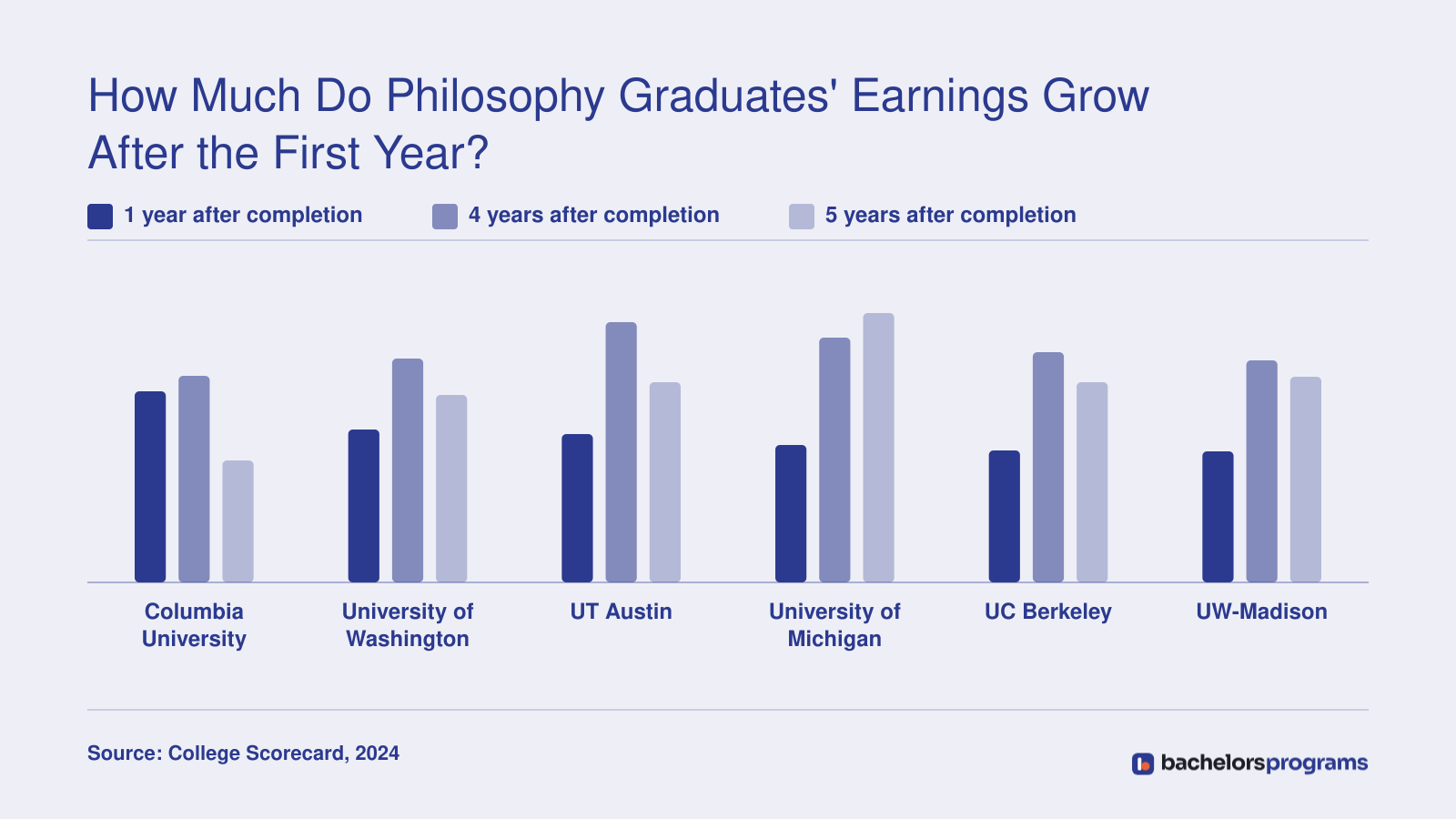
How Much Do Philosophy Graduates' Earnings Grow After the First Year?
Program-level earnings for philosophy majors at these ranked schools generally rise well beyond the first year. Four years after completion, every program shown tops $56,000, and Michigan's median climbs from $37,885 at one year to $74,182 at five years. Columbia is the exception: it posts the highest one-year median at $52,668, but its five-year median is $33,503.
How to Choose a Philosophy Program: Admissions, Fit and Next Steps
Use this checklist to narrow your shortlist before you apply. Each item tells you what to look for and what to ask admissions.
- Regional accreditationConfirm the school holds regional accreditation so your credits transfer and your bachelor's degree in philosophy is recognized by employers and law or graduate schools.
- Net price for your income bracketRun the school's net price calculator with your family's actual income, because the published sticker price rarely reflects what you will pay after grants.
- Faculty strength in your interest areaReview faculty profiles to see whether professors teach and publish in the areas you care about, such as ethics, logic, philosophy of mind or political philosophy.
- Honors thesis or research opportunitiesAsk whether majors can write a senior or honors thesis and work one-on-one with a faculty advisor, which strengthens graduate school and job applications.
- Pre-law advising and logic courseworkIf law school is a goal, ask about dedicated pre-law advising and whether the major requires formal logic or offers courses that build LSAT-style reasoning.
- Internships, ethics bowl or study abroadAsk whether the department supports internships, sponsors an ethics bowl team or offers study abroad, since these experiences give you practical examples to discuss with employers.
- Online format and transfer-credit fitFor online or part-time study, ask how courses are delivered, whether seminars meet live and how many of your existing credits the school will accept toward the degree.
- Next step: request informationPick two or three programs from your shortlist and request information from each so you can compare costs, advising and course offerings side by side.
Philosophy programs by state
Compare Philosophy programs on the data that matters
Explore more Liberal Arts & Humanities majors or browse every field of study.
All Liberal Arts & Humanities programs Browse every field of study