Best English Degree Programs
Compare 1,350+ accredited English programs at 1,150+ colleges, with net price after aid, graduation rates, earnings and debt from IPEDS and the U.S. College Scorecard.

Reputation and return are different numbers. Princeton lists $62,688 in annual tuition but reports an average net price of $6,128 after aid, and a regional public can cost a student more in real dollars than a name-brand private. The credential is the same: a bachelor's degree in English, the Bachelor of Arts (B.A.) in English.
The real question is whether the salary covers the debt. The ranking below weighs published net price, graduation rates, and graduate earnings and debt, not name recognition. What separates these programs is less the reading list than the price attached to it.
Key Points
- Princeton's $62,688 sticker price drops to a $6,128 average net price.
- A B.A. in English typically requires 120 to 123 total credits.
- Technical writing stands out as the highest-paying common path for English majors.
Best Schools for a Bachelor's Degree in English: Our Top 10
All ten programs below are campus-based, so a reader who needs a fully online bachelor's degree should look at the online options further down the page. Six are public universities and four are private, and the list leans west: four California campuses, two in Florida, two in Massachusetts, plus New Jersey and North Carolina.
Princeton University
#1Princeton, NJ · ~$6,000/yr (est.)
Best for: Independent research writers seeking a thesis track
A twelve-course English concentration built around a Junior Seminar and a required senior thesis, with six distribution areas spanning literary history, difference and diversity, and theory. One outside cognate course is allowed, and every major must be in residence in the fall. The school's overall graduation rate is about 98 percent.
- 12 courses: Junior Seminar, senior thesis, nine departmental courses
- Six distribution areas, including pre-1700 literature and theory
- One cognate course from another department allowed
- Fall Junior Paper required; spring Junior Paper optional
- Senior thesis plus 800-word reflection and 30-minute oral exam
- Study abroad encouraged, but fall residency is required
University of California-Los Angeles
#2Los Angeles, CA · $13,000/yr (est. net price)
Best for: Creative writing hopefuls wanting an adjacent minor
The department awards a B.A. in English and a separate B.A. in American Literature and Culture, supported by four minors that include creative writing and professional writing. An honors program and an Author in Residence series run alongside the major. English graduates here reported median earnings of about $55,300 four years after completing the degree.
- B.A. in English and separate B.A. in American Literature and Culture
- Four minors, including Creative Writing and Professional Writing
- Honors program available for English majors
- Author in Residence series and courses in Anglophone literatures
- Coursework builds critical reading, writing, and expression
University of California-Berkeley
#3Berkeley, CA · ~$13,000/yr (est.)
Best for: In-state applicants weighing public university costs
Berkeley's B.A. covers literary history across periods and regions, methods and theories of literary analysis, and sustained critical writing. An Entry Level Writing Requirement must be met before any English course, and declaring the major takes 30 units plus two declaration courses. An optional honors degree adds a two-semester sequence ending in a 40- to 60-page thesis.
- Entry Level Writing Requirement before any English course
- Declaring the major needs 30 units and two declaration courses
- Honors adds a two-semester, 8-unit sequence (ENGLISH H195A/H195B)
- Honors thesis normally 40 to 60 pages
- Honors admission needs 3.51 overall and 3.65 major GPA
University of Florida
#4Gainesville, FL · ~$7,000/yr (est.)
Florida's B.A. requires 120 credits and ten upper-division English courses, at least five of them taken at UF, with concentration options running from children's literature to film and media studies to writing studies. Faculty advisors help students plan a sequence, and internship and honors seminar options are available. The average net price after aid is about $6,500.
- 120 credits, including ten English courses at the 3000 level or above
- At least five upper-division English courses must be taken at UF
- Minimum grade of C in every major course
- 12 concentration options, from children's literature to film and media studies
- Internship course and honors seminars available
- Six credits of lower-division English as a prerequisite
University of North Carolina at Chapel Hill
#5Chapel Hill, NC · ~$12,000/yr (est.)
UNC's 30-hour B.A. in English and Comparative Literature pairs survey work with one of seven concentrations, among them creative writing, film studies, and writing, editing, and digital publishing. Honors students write a 40- to 70-page thesis, and majors can earn credit for internships or study abroad at Oxford. The school's overall graduation rate is about 91 percent.
- 30-hour major with seven concentration options
- 2.0 cumulative GPA required to declare
- Honors seminars offered each semester
- Honors thesis runs 40 to 70 pages
- Honors track needs 3.3 overall and 3.6 major GPA
- Study abroad at Oxford; credit for major-related internships
- Six of 10 courses must be at the 200 level or above
Florida State University
#6Tallahassee, FL · ~$11,000/yr (est.)
Florida State's B.A. requires 36 semester hours of English and lets students emphasize literature, media and culture, creative writing, or editing, writing, and media. The editing track adds a three-hour internship and a senior seminar capstone, and a minor in another department is required. The program runs face-to-face on the Tallahassee campus only.
- 36 semester hours of English, with 21 at the 3000 and 4000 levels
- Three concentrations: Literature, Media & Culture; Creative Writing; Editing, Writing, & Media
- Editing track includes a 3-hour internship and senior seminar capstone
- 12-hour minor in another department required
- Upper-division admission needs 52 credits and a 2.00 adjusted GPA
- Face-to-face only at the Tallahassee campus
Stanford University
#7Stanford, CA · $10,000 – $15,000/yr (est.)
Stanford's 71-unit major combines a three-course literary historical sequence with methodology work, a pre-1800 course, and 35 units of approved literature. A capstone can be a seminar, an honors thesis, a writing workshop, or a computational cultural analytics project. Subplans include creative writing, literature and philosophy, and computational cultural analytics.
- 71 units in the major within 180 university units
- Literary Historical Sequence (English 10, 11, 12) required
- 35 units of approved literature; only one creative writing course counts
- Subplans in Creative Writing, Literature and Philosophy, and Computational Cultural Analytics
- Capstone options include honors thesis, workshop, or analytics project
- Writing in the Major required
Harvard University
#8Cambridge, MA · $15,000 – $20,000/yr (est.)
Harvard's A.B. in English is a concentration that begins with how stories work, from early narrative to novels, screenplays, and hip hop, and builds skill in interpreting other people's rhetoric and communicating clearly. Small creative writing workshops are taught by published authors. The school's overall graduation rate is about 98 percent.
- A.B. in English concentration through Harvard College
- Coursework ranges from early narrative to novels, screenplays, and hip hop
- Training in interpreting others' rhetoric and communicating meaning
- Small creative writing workshops taught by published authors
Massachusetts Institute of Technology
#9Cambridge, MA · ~$20,000/yr (est.)
MIT awards a Bachelor of Science in Literature, which the catalog treats as equivalent to English or literary studies majors elsewhere, with at least ten subjects and seminars capped at 12 students. Joint degrees pair literature with engineering or science, and a two-term senior thesis is available. The average net price after aid is about $20,100.
- Bachelor of Science in Literature (Course 21L)
- At least 10 subjects: three seminars and three subjects before 1900
- Seminars capped at 12 students
- Joint degrees with engineering or science (21E, 21S)
- Two-term senior thesis (21L.THT and 21L.THU)
- 12 concentration options, including film and media studies
- Independent study available with Literature faculty
University of California-Irvine
#10Irvine, CA · $14,000/yr (est. net price)
UC Irvine's 13-course, 52-unit B.A. covers British, American, African, Asian, and Australasian literatures, with required theory and critical writing courses, period surveys, and an advanced seminar. A specialization in English for Future Teachers adds fieldwork and an education course. The school's overall graduation rate is about 87 percent.
- 13 courses, 52 units
- Core work in Introduction to Literary Theory and a critical writing seminar
- Period surveys ENGLISH 102A through 102D plus advanced seminar 106
- English for Future Teachers specialization: 15 courses, 60 units with fieldwork
- English 100, 101W, two 102s, and 106 must be completed at UCI
- Study abroad through the UC Education Abroad Program
Cost & outcomes by school
Federal data for the highest-earning English programs, independent of the ranking above. Earnings are this field's bachelor's graduates four years after completing where the Scorecard reports them, else the school's undergraduate median.
| School | Net price / yr | Grad rate | Earnings | Debt | Grads/yr | Format |
|---|---|---|---|---|---|---|
| Massachusetts Institute of Technology MA | $20,111 | 96% | $143,372 | $14,768 | 3 | Campus |
| California Institute of Technology CA | $16,075 | 94% | $128,566 | — | — | Campus |
| Bentley University MA | $37,930 | 87% | $120,959 | $25,023 | 1 | Campus |
| Carnegie Mellon University PA | $31,944 | 94% | $114,862 | $21,750 | 7 | Campus |
| Claremont McKenna College CA | $28,849 | 91% | $104,736 | $13,500 | 9 | Campus |
| Duke University NC | $29,612 | 97% | $97,800 | $15,362 | 19 | Campus |
| Washington and Lee University VA | $23,781 | 94% | $94,810 | $19,500 | 18 | Campus |
| Rice University TX | $13,370 | 95% | $89,718 | $11,000 | 38 | Campus |
| Johns Hopkins University MD | $18,809 | 94% | $87,555 | $10,250 | 9 | Campus |
| Washington University in St Louis MO | $21,786 | 94% | $86,182 | $17,500 | 22 | Campus |
| Bowdoin College ME | $14,398 | 95% | $82,735 | $18,500 | 27 | Campus |
| Stanford University CA | $13,807 | 92% | $82,036 | $12,000 | 42 | Campus |
Sources: U.S. Department of Education. Net price, graduation rate, earnings and debt: College Scorecard (earnings and debt for this field's bachelor's graduates where reported, else school-wide); graduates: IPEDS. A dash means no figure is reported.
Cost, debt & payoff
Median earnings of this field's bachelor's graduates (4 yrs after completing, else the school's undergraduate median) vs. their median federal loan debt · U.S. College Scorecard
Across these programs the median graduate earns about $49,714 and finishes with roughly $23,250 in debt — a ratio that clears a common rule of thumb (keep debt below first-year salary). Net price and debt vary widely school to school, so check the per-school figures in the table above before you shortlist.
How We Ranked English Degree Programs
English programs are now judged on what graduates earn and owe, not just on a school's name. Our ranking follows that shift, using five inputs from the U.S. Department of Education's College Scorecard and IPEDS:
- Average net price after aid
- Institution-wide graduation rate
- Program-level median earnings after completion
- Program-level median federal debt
- Completions count
Why Program-Level Data Matters
Prestige says little about English outcomes. Earnings and debt for graduates vary widely even among well-known schools, so we weighed the English program itself rather than the university brand. Many competing "best" lists also don't show their math, which leaves readers unable to check the result.
Limits You Should Know
These measures are imperfect. Graduation rates cover the whole school, not just English majors. Net price is an average, and your own aid offer will differ. Some small programs do not publish earnings figures, so those schools were judged on the measures they do report.
Every Format Was Eligible
Online, on-campus, and hybrid programs all qualified. Online options competed on the same measures as campus programs, with no separate track and no handicap. If an online program ranks here, it earned the spot on cost, completion, pay, and debt.
Use the numbers as a starting point, then confirm current figures with each school's financial aid office before you apply.
English Degree Tuition and Net Price Comparison
Published tuition and what students actually pay can be far apart. Princeton University lists $62,688 a year but reports an average net price of $6,128 after aid, and Rice University's $61,247 sticker price falls to $13,370, which is below the out-of-state tuition at every public university in this table. These net prices come from 2024 U.S. Department of Education data (IPEDS and College Scorecard). They are sector-conditional averages, covering in-state students who receive aid at public schools and all aided students at private ones, so your own cost may be higher or lower. Because the table shows averages, run each school's net price calculator with your family's financial details before you compare offers.
| School | Sector | In-State Tuition | Out-of-State Tuition | Average Net Price | Format |
|---|---|---|---|---|---|
| Princeton University | Private | $62,688 | $62,688 | $6,128 | On campus |
| University of Florida | Public | $6,381 | $28,659 | $6,541 | On campus |
| University of Central Florida | Public | $6,368 | $22,467 | $10,411 | On campus and online |
| Florida State University | Public | $6,517 | $21,683 | $11,297 | On campus |
| University of North Carolina at Chapel Hill | Public | $8,994 | $41,203 | $11,655 | On campus |
| University of California-San Diego | Public | $15,788 | $47,676 | $12,470 | On campus |
| University of California-Los Angeles | Public | $14,233 | $46,121 | $12,548 | On campus |
| University of Michigan | Public | $18,848 | $63,081 | $13,138 | On campus |
| Rice University | Private | $61,247 | $61,247 | $13,370 | On campus |
| University of California-Berkeley | Public | $15,377 | $47,265 | $13,481 | On campus |
Online and Hybrid English Degree Options
Where Online Fits Among the Top Schools
Every school in the ranking above is listed as a campus-based program, and Florida State's English major is face-to-face only at its Tallahassee campus. If you need an online bachelor's in English, build a separate shortlist. Programs offering a Bachelor of Arts in English online include University of Phoenix, American Public University System, Maryville University, California Baptist University, National University, University of Texas Permian Basin and University of Arkansas. UMass Dartmouth offers an online Bachelor of Arts in Literature and Criticism, and Buena Vista University runs an online English program.
Why Accreditation Comes First
Institutional accreditation from a recognized accreditor (HLC, MSCHE, SACSCOC, WSCUC, NECHE or NWCCU) is what keeps federal financial aid available, lets credits move between schools, and gives employers and graduate programs a reason to take the diploma seriously. Phoenix has held HLC accreditation since 1978, Maryville since 1941, and APUS is also HLC-accredited.1 For any other school, confirm the accreditor on its own site before applying.
Transfer-Credit Policies to Expect
Published limits vary widely:
- APUS and UMass Dartmouth: Up to 90 credits may transfer.
- Buena Vista: Up to 60 credits from an accredited community college or up to 90 from a four-year college, with a 90-credit total cap.2
- California Baptist: A maximum of 100 transferred units.3
- UT Permian Basin: Transfer applicants need at least 24 transferable credits and a 2.0 GPA in prior college work.4
- National University: At least 30 credits in residence, including 51 upper-division credits.5
Phoenix and Maryville both accept eligible transfer credits without a published cap in the sources reviewed. Most of these schools do not clearly state whether an associate degree transfers as a block or how AP or CLEP scores count, so ask admissions for a written evaluation before you enroll.
Online Versus Campus
Asynchronous courses let you read and write around work and family schedules, and that flexibility is the main draw. The tradeoff is fewer in-person workshops, less access to campus literary magazines and student-run publications, and fewer on-site internship pipelines. Writers who want those experiences should ask each online program how it replaces them, through virtual workshops, remote editorial roles or local internship credit.
Related Articles
English Concentrations: Literature, Creative Writing, Professional Writing and Education
The concentration you pick inside an English major changes your weekly workload, your portfolio, and your first job title more than the degree name does.
Four Tracks, Four Kinds of Work
- Literature: close reading, literary history, and long research papers, usually in small seminars with a thesis at the end. Suits readers who like argument and archival digging.
- Creative writing: workshop critique, heavy revision, and a finished manuscript portfolio. Suits students who want structured feedback on their own drafts.
- Professional or technical writing: document design, editing, usability testing, and client-facing projects. Suits students who want a portfolio that looks like work product.
- English education: pedagogy, adolescent development, classroom management, assessment, and a supervised student-teaching placement. Suits students set on a secondary classroom.
Tracks the Ranked Programs Actually List
Programs describe their options unevenly. Stanford names a Creative Writing subplan and a Literature and Philosophy subplan. UC Irvine describes a teacher track that folds fieldwork into the course sequence. Florida State's program guide carries an Editing, Writing, and Media title. Princeton lists two concentration options, and MIT lists several without naming them on the pages summarized here. Confirm the exact track in the department catalog before you apply, because a named concentration is not the same as a guaranteed seat.
The Teaching License Route
Secondary English/language arts certification generally requires a bachelor's degree, a state-approved educator preparation program, supervised student teaching, background checks and fingerprints, and a content exam. Required clinical hours vary by state.1 Praxis English Language Arts: Content Knowledge (5038) is the common exam: 130 selected-response questions, 150 minutes, $130.2 Each state licensing agency sets its own passing score3, and some states use a different Praxis test or a state-developed equivalent, so check your state's requirement page before you register.
An English major without an education track can still teach, typically through a post-baccalaureate certification program, a master's with certification, or an employment-based route that pairs a provisional certificate with coursework and mentoring. Eligibility and certificate duration differ by state.
Careers for English Majors: Matching Coursework to Jobs
Employers rarely hire for an English degree by name. They hire for the specific skills your coursework builds, so the classes you choose shape the jobs you can credibly pursue.
Skills to Jobs
- Close reading and argument: Seminars that build a case from textual evidence prepare you for law school, paralegal roles and policy analysis. Résumé move: keep one polished research paper ready as a writing sample.
- Workshops and editing: Writers and authors earned a median of $76,9101 in 2025, and editors earned $77,920.2 Résumé move: learn Chicago or AP style and build a portfolio of edited and published pieces, including campus publications.
- Document design: Technical writers earned a median of $90,390, the highest of these paths.3 Résumé move: assemble a portfolio of manuals, how-to guides or help documentation, and show familiarity with a corporate style guide such as Microsoft's.
- Persuasive writing: Public relations specialists earned a median of $74,750.5 Résumé move: collect press releases and campaign samples from an internship.
- Education track: Literature coursework plus student teaching leads to high school English classrooms. Résumé move: finish your state's teacher licensure requirements before graduation.
The Outlook Is Uneven
Bureau of Labor Statistics projections for 2025 to 2035 split these paths sharply. Writing and editing are flat to shrinking: writers and authors show 0 percent growth (a loss of about 500 jobs),1 and editors show a 1 percent decline (about 1,100 fewer jobs).2 Technical writing is steadier at 1 percent growth, adding roughly 400 jobs in a field that held about 56,400 jobs in 2024.4 Public relations looks strongest, with 2 percent growth and about 5,700 new jobs.
If creative or editorial work is your goal, pair it with a document-design or PR course so you have a second path with more openings.
Read Wage Figures Carefully
These medians describe everyone working in each occupation, including people with decades of experience. They are not starting salaries for new English graduates, and they measure something different from College Scorecard earnings, which track recent graduates of a specific program. Early-career pay typically starts below these occupation-wide medians, so use them to compare fields rather than to predict your first paycheck.
Technical Writing: The Highest-Paying Common Path for English Majors
Technical writing is one of the most direct routes from a bachelor's degree in English to a well-paid career.
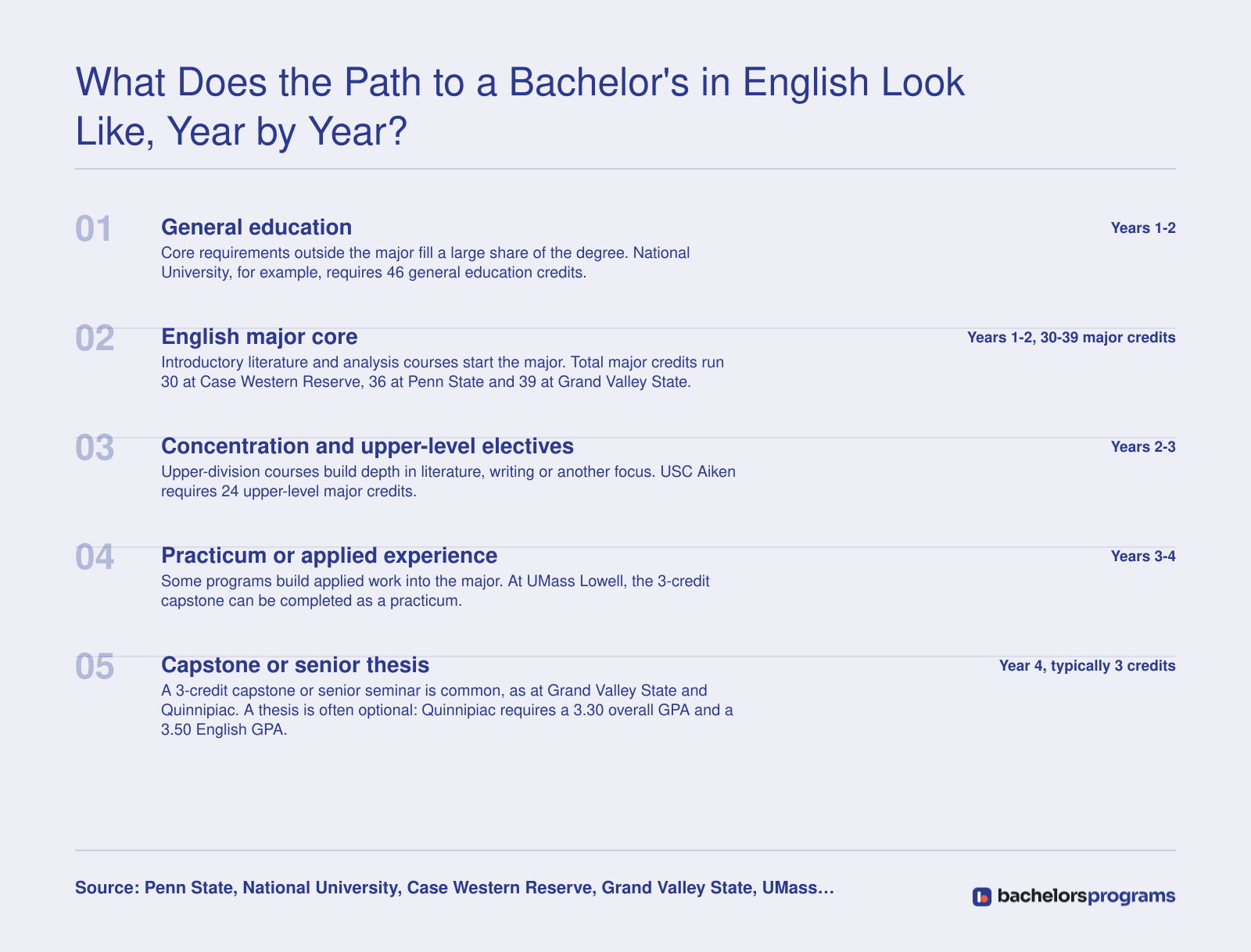
What Does the Path to a Bachelor's in English Look Like, Year by Year?
A Bachelor of Arts in English usually totals 120-123 credits, such as 120 at National University and 123 at Penn State. The English major itself makes up roughly 30-39 of those credits at the schools cited here. National University also offers an accelerated B.A./M.A. pathway: students with at least a 3.0 GPA can count one 3-credit graduate course toward the bachelor's, which shortens the later master's to 9 courses.
English programs by state
Frequently Asked Questions About English Degree Programs
These answers cover the questions prospective English majors ask most often. Details vary by school and state, so confirm specifics with any program you are considering.
What is the best university for an English major?
Which schools offer an online bachelor's degree in English?
How long does it take to earn a bachelor's degree in English?
Can you teach with a bachelor's degree in English if you didn't choose the education track?
Compare English programs on the data that matters
Explore more Liberal Arts & Humanities majors or browse every field of study.
All Liberal Arts & Humanities programs Browse every field of study