Best Online Neuroscience Degree Programs
Compare 7 accredited online Neuroscience programs, with net price after aid, graduation rates, earnings and debt from IPEDS and the U.S. College Scorecard.

A bachelor's degree in neuroscience is a four-year undergraduate program of roughly 120 credits, usually a Bachelor of Science (B.S.), that studies the nervous system through biology, chemistry, and behavior.
Can you earn one online? Yes. Every program on this list is fully online, and hybrid formats are excluded.
The sticking point is lab science. Few schools deliver that sequence without some on-campus component, so online neuroscience majors remain far rarer than online psychology majors, and cost varies widely between them.
Key Points
- FIU's $9,288 yearly net price undercuts Wilson College's by $12,453.
- Lab requirements, not lectures, are the biggest hurdle in online neuroscience study.
- Graduates often start in clinical, data, and public health support roles.
Best Fully Online Neuroscience Bachelor's Degree Programs
This list is limited to bachelor's degree programs in neuroscience that students can complete online, and no in-person residency is required to qualify. The field is genuinely narrow in 2026, so a short list reflects a strict bar rather than a thin search. Each card pairs the federal cost and completion picture with the program details that actually separate one degree from another.
Florida International University
#1Miami, FL · ~$9,000/yr (est.)
Best for: Students targeting clinical and lab careers
Florida International University is a large public research university in Miami and a designated Hispanic-serving institution. Its Bachelor of Science in Behavioral Neuroscience sits in the College of Arts, Sciences, and Education, building from foundational STEM courses into clinical, systems, and behavioral neuroscience. Research methods, statistics, and data analysis are woven through the degree, which points graduates toward laboratory and health services work or graduate study in medicine, pharmacology, or neuropsychology.
- 120 credits over four years of full-time enrollment
- Coursework in clinical, systems, and behavioral neuroscience
- Neuroplasticity and mental health disorders covered in depth
- Research methods, statistics, and data analysis required
- Prepares students for lab technician and health services roles
- Pathway to graduate study in neuroscience, medicine, or pharmacology
- Offered by the College of Arts, Sciences, and Education
Arizona State University
#2Scottsdale, AZ
Best for: Working adults needing flexible online coursework
Arizona State University delivers a large slate of degrees through ASU Online, and its Department of Psychology awards the neuroscience bachelor's degree at the Tempe campus, online, or at ASU Local sites. The curriculum covers behavioral, cellular and molecular, cognitive, and systems and computational neuroscience, with research methods and quantitative analysis introduced early. Online applicants follow general university admission requirements, and the program maintains research ties to the Barrow Neurological Institute.
- 120 credit hours, beginning with Calculus for Life Sciences
- Four domains: behavioral, cellular, cognitive, and systems
- Sample courses include NEU 101 and NEU 290 Data Science
- Higher Learning Commission accredited
- Accelerated BS plus MS option completed in five years
- McKenna program lets students earn two degrees in four years
- Research ties to Barrow Neurological Institute
- Fully online option available; STEM-OPT extension for F-1 students
Wilson College
#3Chambersburg, PA · ~$22,000/yr (est.)
Best for: Psychology majors wanting a research capstone
Wilson College is a small private college in Chambersburg, Pennsylvania, where neuroscience is taught as an Integrative Neuroscience concentration inside the psychology major. Every psychology major completes a capstone, and concentration students can choose a Senior Thesis that runs from research design through data analysis, an APA manuscript, and a public presentation. Part of the coursework is delivered online through a Rize Education partnership, and the college extends tuition discounts to employees of partner health systems such as Summit Health and WellSpan Gettysburg.
- Integrative Neuroscience concentration inside the psychology major
- Coursework spans psychology, biology, chemistry, and neuroscience
- Capstone options include a Senior Thesis research project
- Students design a study, analyze data, and write an APA manuscript
- Research presented at the college's Student Research Day
- Select courses delivered online through a Rize Education partnership
- Rolling admissions with financial aid for nearly all students
Cost & outcomes by school
Federal data for the highest-earning Neuroscience programs, independent of the ranking above. Earnings are this field's bachelor's graduates four years after completing where the Scorecard reports them, else the school's undergraduate median.
| School | Net price / yr | Grad rate | Earnings | Debt | Grads/yr | Format |
|---|---|---|---|---|---|---|
| Florida International University FL | $9,288 | 74% | $60,249 | $16,500 | 60 | Online or campus |
Sources: U.S. Department of Education. Net price, graduation rate, earnings and debt: College Scorecard (earnings and debt for this field's bachelor's graduates where reported, else school-wide); graduates: IPEDS. A dash means no figure is reported.
Cost, debt & payoff
Median earnings of this field's bachelor's graduates (4 yrs after completing, else the school's undergraduate median) vs. their median federal loan debt · U.S. College Scorecard
Across these programs the median graduate earns about $63,292 and finishes with roughly $20,651 in debt — a ratio that clears a common rule of thumb (keep debt below first-year salary). Net price and debt vary widely school to school, so check the per-school figures in the table above before you shortlist.
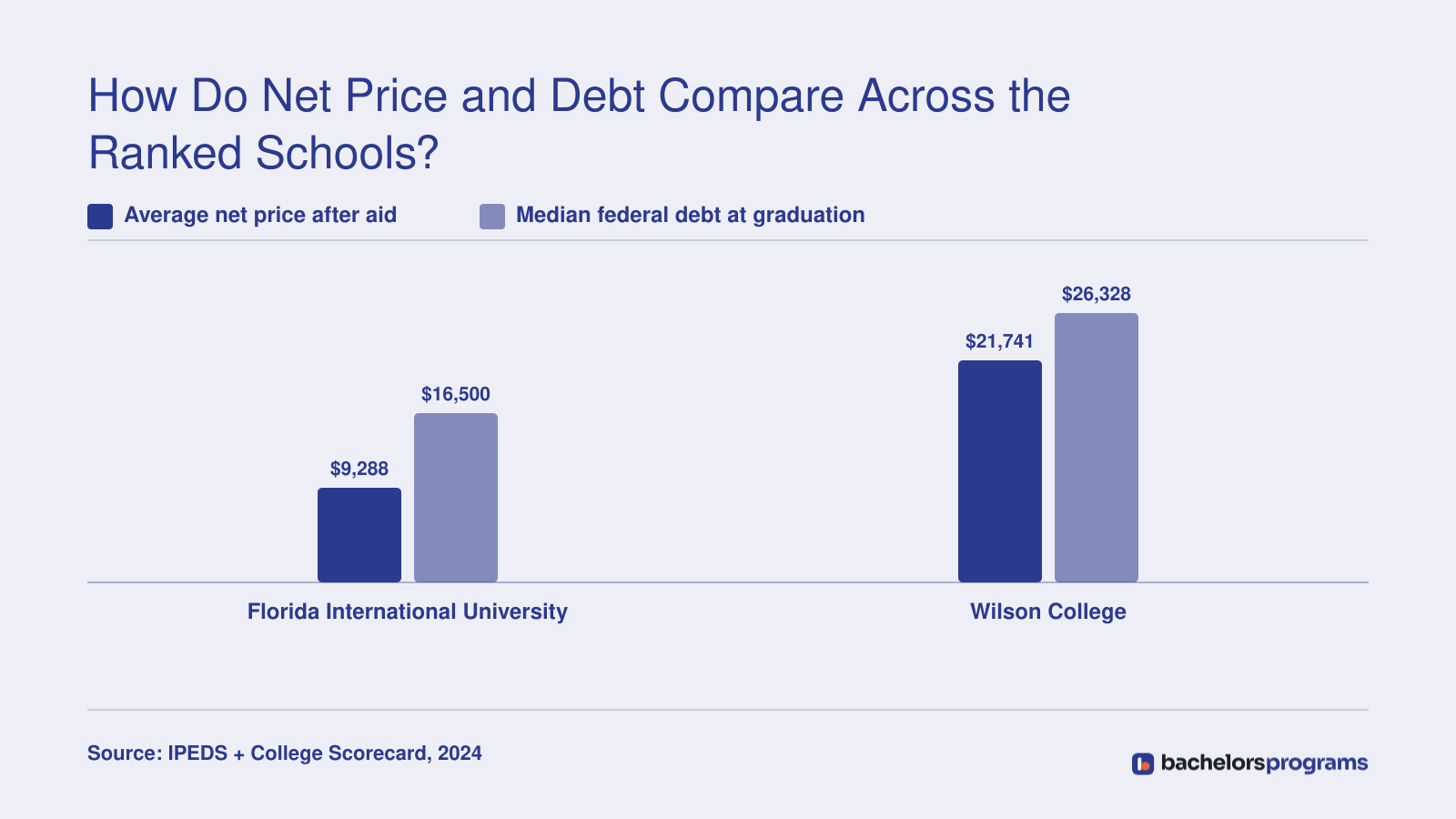
How Do Net Price and Debt Compare Across the Ranked Schools?
Net price is an institution-wide average after grants and scholarships, so your own cost will differ based on aid, residency, and enrollment status. Florida International University's average net price of $9,288 a year is $12,453 less than Wilson College's $21,741. The median federal debt figures cover each school as a whole, not the neuroscience major alone.
What a Bachelor's Degree in Neuroscience Covers Online, Including Labs
The hard part of an online neuroscience degree is not the lectures; it is the lab requirement.
Core Coursework
A B.S. in neuroscience usually begins with introductory biology and chemistry, then adds neuroanatomy, cognitive and behavioral neuroscience, research methods, and statistics. Two examples: Arizona State University's online B.S. in Neuroscience and Drexel University's fully online program.
Labs and Research
Lab delivery varies. Programs may use virtual simulations and supervised assignments, with some physical work at approved local facilities. The University of Arizona Online's 120-credit B.S. in Neuroscience and Cognitive Science includes a senior course with hands-on lab work recording electrical signals from living cells, though the format is not specified. At-home kits are possible but not confirmed as common.
Research is harder to deliver remotely, and it matters for graduate or medical school. Campus programs show the range of options. UAB pairs students with faculty mentors and publishes a mentor directory.1 Northwestern's NEURON Scholars requires an in-lab mentor and monthly meetings. Saint Louis University offers capstone options including a neurophysiology lab, practicum, and independent research.2 Ask whether an online program can approximate any of this through a capstone, remote data analysis, or research credits, and confirm lab fees.
Accreditation, Admissions, and Transfer Credit Checklist
Before you apply, confirm each program's credentials and how your background fits.
- Institutional (regional) accreditationMake sure the university holds institutional accreditation, which affects federal aid eligibility and credit transfer. Look up the school in the U.S. Department of Education's accreditation database or the CHEA directory rather than relying on the program page.
- High school diploma and GPAExpect to need a diploma or equivalent. ASU Online asks for 14 high school competency courses plus one of the following: top 25% class rank, a 3.00 competency GPA, an ACT of 22 (Arizona) or 24 (nonresident), or an SAT of 1120 or 1180.
- Science and math preparationASU's competencies include four years of math and three of lab science. Coursework in biology, chemistry, and algebra or precalculus will prepare you for the major.
- Transfer credit limitsAsk each school for its maximum transferable credits and residency minimum in writing, because these limits vary and often are not listed on program pages.
- Diploma and transcript wordingAsk the registrar whether your diploma or transcript will indicate online delivery.
Related Articles
Online Neuroscience Degree vs. Psychology and Biology
Is a neuroscience degree better than a psychology degree? Not automatically. It depends on whether you want biological depth or clinical-behavioral depth. Neuroscience leans toward the biology of the nervous system, while psychology leans toward behavior and research methods.
| Factor | Neuroscience (B.S.) | Psychology | Biology |
|---|---|---|---|
| Core focus | Nervous system science, drawing on biology, psychology, chemistry, and physics | Behavior and mental processes, with a strong research emphasis | Living systems broadly, supported by chemistry and physics |
| Science and lab intensity | Three laboratory courses plus required biology, chemistry, and physics coursework | Advanced psychology laboratory work and one Natural Science with Lab course | Chemistry I and II with labs, plus a physical-sciences course |
| Math and statistics load | Meets the B.S. math requirement; Biostatistics and Experimental Design is an option | One semester of statistics, plus research methods | Calculus for Social and Life Sciences I and Introductory Statistical Reasoning |
| Typical careers | Pre-health paths, graduate study, and the biotech industry | A foundation for training and careers in other fields | Graduate or professional work in biology, and careers such as law or business |
| Fit for medical or graduate school | Suits pre-health tracks; many graduate programs recommend chemistry, genetics, and statistics | Built as a foundation for advanced graduate work; cognitive neuroscience programs often favor psychology coursework | Prepares students for graduate study or professional school |
| Rule of thumb | Choose it for biological depth in brain science | Choose it for clinical-behavioral depth and research training | Choose it for the broadest biological science base |
Questions to Ask Yourself
Do you plan to apply to medical school, and will your target schools accept online lab science credits?
Do you want wet-lab research experience or data-focused neuroscience work?
Can you attend optional in-person lab sessions or arrange a local research placement?
Would a psychology or biology degree fit your career goal better?
What Can You Do With an Online Neuroscience Degree?
Neuroscience graduates are entering the workforce less through academic labs alone and more through clinical, data, and public health support roles.
Entry roles and what they pay
A bachelor's degree in neuroscience is a starting point, not a final credential. These roles hire at this level; pay figures are May 2025 BLS median annual wages.
- Biological technicians: $57,5101, with a bachelor's degree listed as the typical entry-level education.
- Health education specialists: $64,070.2
- Psychiatric technicians: $45,130.3
- Clinical research coordinator: a standard route into academic medical centers and trial sites; BLS does not publish a separate median for the title, so scope pay locally.
Health education specialists and biological technicians both clear the $50,9804 median for all occupations.
Occupational pay vs. program earnings
BLS medians describe everyone in a job, at every experience level. Program-level earnings are narrower: they track graduates of one specific program one year after finishing. The two answer different questions, and neither is a starting-salary promise.
Medical school and graduate study
Many graduates continue to medical school, physician assistant programs, or graduate study in neuroscience. Medical schools set their own prerequisites, and online lab formats are where the details matter most, so confirm what each admissions office accepts before you enroll.
An online neuroscience degree is the right call if you need schedule flexibility, want a biology-heavy view of behavior, and can plan lab and research work in advance.
Confirm two things before enrolling: how lab experiences are delivered, and whether your target medical schools accept online prerequisites. Then compare the ranked programs and request information from the ones that fit.
Neuroscience programs by state
Compare Neuroscience programs on the data that matters
Explore more Natural & Applied Sciences majors or browse every field of study.
All Natural & Applied Sciences programs Browse every field of study