Best Biology Degree Programs
Compare 1,500+ accredited Biology programs at 1,250+ colleges, with net price after aid, graduation rates, earnings and debt from IPEDS and the U.S. College Scorecard.

Which biology programs pair strong completion rates with a net price a family can carry? At the schools ranked here, average net price after grants runs from $9,288 to $19,857, and school-wide graduation rates span 74% to 93%.
The bachelor's degree in biology is the standard entry point for medical school, biotech labs, and field research, and the Bachelor of Science (B.S.) in Biology is the most common credential. Cost and completion do not move together: the least expensive option is not the highest-graduating one.
Aid packages, transfer credit for organic chemistry, and access to upper-division labs decide more than sticker price.
Key Points
- University of Florida posts the lowest net price here: $4,815 after aid.
- Top research schools' net prices span $13,370 (Rice) to $20,111 (MIT).
- University of Washington-Seattle biology grads post the highest first-year median earnings.
Best Schools for a Bachelor's Degree in Biology: Our Top 10
The ten schools below all award a bachelor's degree in biology, and each brings a distinct strength, from pre-health advising to large upper-division laboratory programs. Every entry is a campus program, so you can compare cost, completion and admission figures side by side and then read what the biology curriculum actually asks of you.
University of California-Irvine
#1Irvine, CA · $14,000/yr (est. net price)
Best for: Pre-health students wanting upper-division lab depth
UC Irvine's Charlie Dunlop School of Biological Sciences runs a five-quarter core from ecology and evolutionary biology through genetics, biochemistry and molecular biology, with lab technique taught in upper-division laboratories. Majors pick three of six upper-division courses, then add two upper-division labs and four biology electives. Median earnings for biology graduates were $25,388 one year after finishing, against $15,767 in federal debt.
- Five-quarter core series from ecology to molecular biology
- Lab technique taught in upper-division laboratories
- Choose three of six upper-division major courses
- Two upper-division labs plus four biology electives
- Transfer applicants need one year of organic chemistry with lab
- Transfer applicants must hold a 3.0 GPA
- Double majors with Nursing or Public Health not permitted
University of North Carolina at Chapel Hill
#2Chapel Hill, NC · ~$12,000/yr (est.)
Best for: Plant biology students seeking research partnerships
UNC-Chapel Hill's Biology Major sits in the Department of Biology in Coker Hall and takes 64 to 67 credit hours inside a 120-hour degree spread over eight semesters. Students can join research labs as early as their second year, and the department's plant science work links to shared research facilities and a regional herbarium managed with Duke. Median earnings for biology graduates were $33,471 one year after finishing, against $15,100 in federal debt.
- 64 to 67 credit hours in the major
- 120 academic hours across eight semesters
- Two of five intermediate core courses required
- Four biology electives above 200 level, two with labs
- Honors track adds BIOL 692H and a 3.3 GPA
- Research can start as early as second year
- 2.000 GPA required in the major core
University of California-Los Angeles
#3Los Angeles, CA · $13,000/yr (est. net price)
Best for: Students building a broad life-sciences foundation
UCLA's undergraduate Biology major is deliberately broad, letting students assemble a program across the life and physical sciences rather than a single narrow track. The upper division asks for two courses from each of five core principles, plus at least five upper-division ecology and evolution courses and two labs, one of them upper division. Median earnings for biology graduates were $28,242 one year after finishing, against $16,028 in federal debt.
- Two courses from each of five core principles
- At least five upper-division ecology and evolution courses
- Two lab courses, one of them upper division
- Only AP Calculus credit accepted for major preparation
- C-minus or better in Life Science core courses
- 2.0 GPA minimum overall and in upper division
Florida International University
#4Miami, FL · ~$9,000/yr (est.)
Florida International University awards a Bachelor of Science in Biological Sciences through its College of Arts, Sciences, and Education, a 120-credit, four-year degree with tracks in biotechnology, forensic biomolecular biology, and Quantifying Biology in the Classroom, plus an honors option. Pre-health curricula and advising are built into the program, and coursework runs from ecology and genetics to molecular and cell biology. Median earnings for biology graduates were $21,529 one year after finishing, against $15,000 in federal debt.
- 120-credit, four-year degree
- Tracks in biotechnology and forensic biomolecular biology
- Quantifying Biology in the Classroom track available
- Honors track in biological sciences available
- Pre-health curricula and advising built in
- Coursework spans ecology, genetics and cell biology
University of California-San Diego
#5La Jolla, CA · $10,000 – $15,000/yr (est.)
UC San Diego's School of Biological Sciences awards a bachelor of science in general biology built for breadth across the subdisciplines, with 48 upper-division units on top of 71 or 72 lower-division units. A 12-unit honors thesis spread over fall, winter and spring can earn distinction, and research internship credit is available. The La Jolla campus sits near the Salk Institute and Scripps Research Institute. Median earnings for biology graduates were $34,504 one year after finishing, against $17,667 in federal debt.
- 48 upper-division units, 71 or 72 lower-division units
- Biochemistry, genetics, molecular biology and human physiology required
- One or two upper-division labs required
- 12-unit honors thesis over fall, winter and spring
- At least 20 upper-division units taken in the school
- Campus sits near Salk and Scripps research institutes
The University of Texas at Austin
#6Austin, TX · ~$20,000/yr (est.)
UT Austin awards a Bachelor of Science and Arts in Biology through the College of Natural Sciences, pairing deep coursework in ecology, genetics, genomics and molecular biology with room to explore humanities interests elsewhere in the university. The program prepares graduates for health professions, business, law and academia, and students get a dedicated career coach plus a college career guide. Median earnings for biology graduates were $31,832 one year after finishing, against $21,893 in federal debt.
- Bachelor of Science and Arts in Biology
- Coursework spans ecology and evolution to biochemistry
- Room for humanities exploration outside the major
- Degree checklists, honors checklist and four-year plan published
- Career coach through Natural Sciences Career Services
University of California-Berkeley
#7Berkeley, CA · ~$13,000/yr (est.)
UC Berkeley teaches Integrative Biology as a Bachelor of Arts, with two emphases: Ecology, Evolution, and Organismal Biology, or Integrative Human Biology. Lower-division requirements are identical in both, and upper-division lecture and lab work is drawn from three course groups spanning evolution and genetics to structure, function and human health. Honors students write a thesis and present a poster, and staff and faculty advisers are involved at declaration. Median earnings for biology graduates were $36,642 one year after finishing, against $14,000 in federal debt.
- Bachelor of Arts major taught in person
- Two emphases: ecology and evolution, or human biology
- Upper-division work drawn from three course groups
- Honors needs 3.3 overall and major GPA, plus thesis and poster
- Staff and faculty advisers involved at declaration
- Transfer students advised to finish lower division first
University of Michigan
#8Ann Arbor, MI · $18,000 – $61,000/yr (est.)
Michigan's Biology major lives in the College of Literature, Science, and the Arts and requires 30 credits in the major, including genetics, biochemistry and evolution plus three lab courses. Up to two approved cognate courses count toward the total, independent research is capped at three credits, and the Honors major adds a thesis and a public presentation. Median earnings for biology graduates were $26,888 one year after finishing, against $20,000 in federal debt.
- 30 credits in the major with a 2.0 major GPA
- Genetics, biochemistry and evolution required
- Three lab courses required
- Four quantitative courses from calculus, physics or statistics
- Honors major requires 3.4 GPA, thesis and public talk
- Independent research capped at three credits
Stanford University
#9Stanford, CA · $10,000 – $15,000/yr (est.)
Stanford's BS in Biology requires at least 89 units in the major inside a 180-unit degree, with subplans running from biochemistry and biophysics to cellular, molecular and organismal biology, computational and systems biology, microbial sciences and neurosciences. Capstone options include honors research, an independent capstone and the Notation in Science Communication, and departmental honors requires a research thesis approved by two readers. BioBridge peer advisers and three types of advisers support students through the major.
- 89 units minimum in the major, 180 university units
- Subplans include computational biology and neurosciences
- Capstone options include honors research and science communication
- Departmental honors needs a thesis approved by two readers
- Honors requires 10 units of approved research
- AP credit fulfills some requirements
Florida State University
#10Tallahassee, FL · ~$11,000/yr (est.)
Florida State offers both a BA and a BS in Biological Science on its Tallahassee campus, built on 38 hours of biological science coursework with at least 20 taken at FSU, five lab or field courses, and collateral chemistry, math and physics. Subspecialty areas include cell and molecular biology, ecology, marine biology, plant sciences and zoology, and an honors program in marine biology is available. Median earnings for biology graduates were $26,140 one year after finishing, against $21,517 in federal debt.
- BA and BS options at the Tallahassee campus
- 38 major hours, with at least 20 taken at FSU
- Five lab or field courses required
- Subspecialties include marine biology and plant sciences
- Honors program in marine biology available
- Covers prerequisites for medical, veterinary and dental programs
Cost & outcomes by school
Federal data for the highest-earning Biology programs, independent of the ranking above. Earnings are this field's bachelor's graduates four years after completing where the Scorecard reports them, else the school's undergraduate median.
| School | Net price / yr | Grad rate | Earnings | Debt | Grads/yr | Format |
|---|---|---|---|---|---|---|
| Massachusetts Institute of Technology MA | $20,111 | 96% | $143,372 | $14,768 | 25 | Campus |
| Harvey Mudd College CA | $35,924 | 92% | $138,687 | $25,000 | 1 | Campus |
| Carlow University PA | $20,786 | 60% | $134,677 | $27,000 | 29 | Hybrid |
| California Institute of Technology CA | $16,075 | 94% | $128,566 | — | 12 | Campus |
| Stanford University CA | $13,807 | 92% | $124,080 | $12,000 | 76 | Campus |
| Carnegie Mellon University PA | $31,944 | 94% | $114,862 | $21,750 | 27 | Campus |
| Claremont McKenna College CA | $28,849 | 91% | $104,736 | $13,500 | 13 | Campus |
| Georgia Institute of Technology GA | $12,116 | 94% | $102,772 | $24,250 | 126 | Campus |
| University of Notre Dame IN | $26,780 | 95% | $99,980 | $20,750 | 97 | Campus |
| Washington and Lee University VA | $23,781 | 94% | $94,810 | $19,500 | 20 | Campus |
| Vanderbilt University TN | $15,846 | 94% | $91,565 | $14,000 | 16 | Campus |
| Rice University TX | $13,370 | 95% | $89,718 | $11,000 | 131 | Campus |
Sources: U.S. Department of Education. Net price, graduation rate, earnings and debt: College Scorecard (earnings and debt for this field's bachelor's graduates where reported, else school-wide); graduates: IPEDS. A dash means no figure is reported.
Cost, debt & payoff
Median earnings of this field's bachelor's graduates (4 yrs after completing, else the school's undergraduate median) vs. their median federal loan debt · U.S. College Scorecard
Across these programs the median graduate earns about $55,433 and finishes with roughly $23,327 in debt — a ratio that clears a common rule of thumb (keep debt below first-year salary). Net price and debt vary widely school to school, so check the per-school figures in the table above before you shortlist.
How We Ranked These Biology Programs
Every program here was evaluated against CIP code 26.0101, the federal classification for general biology and biological sciences, so the outcome figures describe biology graduates specifically rather than the campus as a whole.
What went into the ranking
- Program-level outcomes: Median earnings and median federal loan debt for biology graduates, drawn from the U.S. Department of Education's College Scorecard where those figures are published.
- Completions: The number of bachelor's degrees awarded in biology, which shows whether a department graduates a substantial cohort or only a handful of majors.
- Average net price: What students actually pay after grants and scholarships, not the published sticker tuition.
- Graduation and retention rates: Evidence that students who enroll tend to finish.
Which numbers are biology-specific
This distinction matters when you compare schools. Earnings, debt, and completions are tied to the biology program itself. Graduation rate and net price describe the entire institution, since the federal data does not break those out by major. A university with a strong overall completion rate can still have an uneven biology department, which is why program-level earnings carry more weight here than campus-wide figures.
Net price is also an average across students receiving aid. Your own cost may land well above or well below it depending on family income, residency, and merit awards, so treat it as a starting point for comparison rather than a quote.
What we left out, and the data year
Reputation surveys and research expenditure totals were excluded. Both track graduate-level prestige and faculty grant activity, and neither tells you much about what an undergraduate pays or earns. Figures come from the latest College Scorecard snapshot available at the time of writing, and online, campus, and hybrid formats were all eligible.
Biology Schools Compared: Cost, Debt, and Earnings
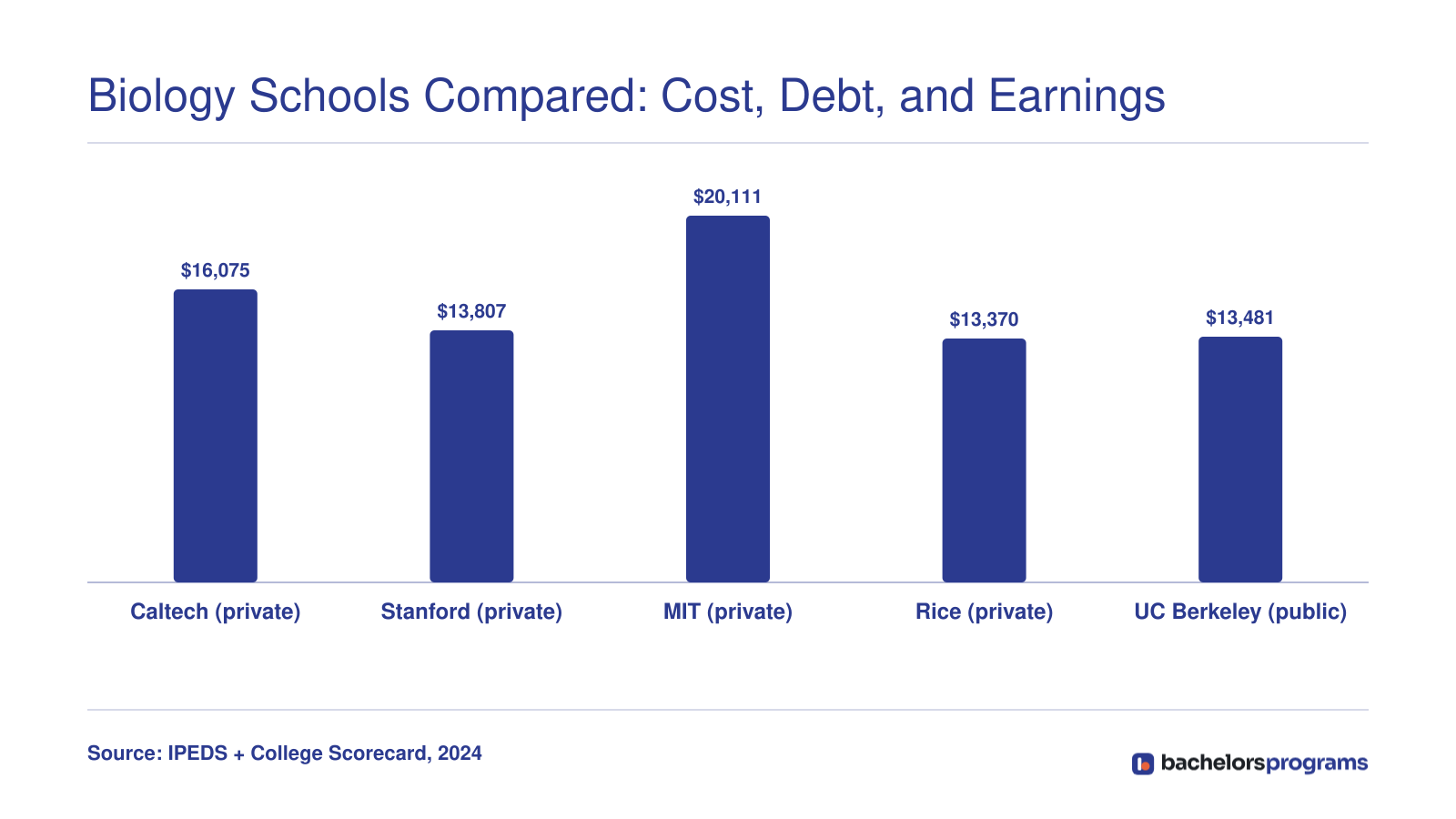
Caltech, Stanford, MIT and Rice are private and UC Berkeley is public, yet average net price after grants falls in a fairly tight band, from $13,370 at Rice to $20,111 at MIT. The test that matters is debt against early pay: the lower a program's median debt is relative to graduates' first-year earnings, the faster that debt can realistically be repaid. Program-level debt and earnings for these biology majors are published only for UC Berkeley, where graduates leave with a $13,000 median debt and earn a median $36,642 one year after completion, roughly 35 cents owed for every dollar earned.
Best Value and Affordable Biology Degree Programs
The lowest-cost biology programs here are all at public Florida universities, where the average net price after aid runs from $4,815 at the University of Florida to $9,812 at the University of South Florida; none of the cheapest options is private, because state funding keeps resident costs low. Published tuition is the sticker price before any grants or scholarships, and at these public schools out-of-state students pay roughly $10,900 to $12,700 more per year than Florida residents, so the in-state savings apply only if you qualify for residency. Low cost is not the same as good value, so read each school's Pell Grant share (66.7% to 81.3%, a sign of how many lower-income students it enrolls) alongside its graduation rate (74.4% to 84.7%), based on 2024 U.S. Department of Education data from IPEDS and the College Scorecard.
| School | Location | Format | Average Net Price (After Aid) | In-State Tuition (Published, Before Aid) | Out-of-State Tuition (Published, Before Aid) | Pell Grant Share | Graduation Rate |
|---|---|---|---|---|---|---|---|
| University of Florida | Gainesville, FL | Campus | $4,815 | $3,876 | $16,579 | 66.7% | 84.7% |
| Florida International University | Miami, FL | Campus | $9,288 | $6,565 | $18,964 | 81.3% | 74.4% |
| University of South Florida | Tampa, FL | Campus | $9,812 | $6,410 | $17,324 | 68.6% | 76.8% |
Related Articles
Online vs. Campus Bachelor's Degrees in Biology: How Labs and Accreditation Work
Labs are the hard part of an online biology degree. The schools ranked above are all campus-based programs, and Florida State, for one, notes its biology program is in-person only at Tallahassee. The online examples below come from other universities. Even a program that is fully online for lectures may still require in-person lab time.
Three Ways Online Programs Deliver Labs
- At-home kits: Doane's online Biology I requires a lab kit bought through its lab-equipment partner. ASU Online's Biology and Society concentration pairs immersive virtual labs with kits and requires no in-person lab. Wilmington University's Bachelor of Science in Biology can be completed 100% online with kits, but its core science courses are listed at the Brandywine and New Castle campuses, so confirm which pathway you are enrolling in.
- Virtual labs: American Military University's 120-credit online Bachelor of Science in Biology uses virtual laboratory exercises in 8-16 week courses.
- Short on-campus intensives: ASU's online biological sciences degree includes one organic chemistry lab, completed in a one-week session at Tempe or at an approved institution near you. LSU Alexandria's Modern Biology concentration offers a one-week summer residency worth 3 credits, covering General Biology I, General Biology II, and Microbiology. Students may instead complete labs at a college of their choice and transfer the credits, subject to LSU's transfer rules.
A Quick Accreditation Check
Start with institutional accreditation. Confirm the school is accredited by an agency recognized by the U.S. Department of Education or the Council for Higher Education Accreditation (CHEA).1 The Department of Education's DAPIP database lets you search by the school's exact legal or operating name, and CHEA's directory lists recognized accrediting organizations and institutions.1
Biology works differently from nursing. No programmatic accreditor exists for general biology bachelor's degrees, so there is no separate program seal to look for.1 Institutional accreditation is the check that matters.
A Warning for Pre-Health Students
If you plan to apply to medical or dental school, this is the detail to get right. Some of these schools limit or question lab credit earned online, and virtual-only labs may not satisfy their requirements. Before you enroll, check the policies of the schools you hope to attend, and ask admissions offices directly how they treat online or kit-based lab coursework.
B.S. vs. B.A. in Biology: What to Expect in the Curriculum
Both degrees typically total about 120 credits and take four years of full-time study. The B.S. usually asks for more chemistry, physics, and math, while the B.A. leaves room for a double major or minor in areas like science writing, policy, or teaching. Requirements vary by university, so check each school's published curriculum before you commit.
| Factor | B.S. in Biology | B.A. in Biology |
|---|---|---|
| Total credits to graduate | At least 120 credits, including university degree requirements | At least 120 credits, including General Education and major requirements |
| Upper-division biology (quarter-system example) | 48 upper-division quarter units | 36 upper-division quarter units |
| Chemistry | General chemistry plus organic chemistry I and II, organic lab, and biochemistry I (11 credits at one university) | General chemistry with lab; many pathways add organic chemistry with lab |
| Physics and math | Physics with lab in the core; math plus a three-course quantitative or statistics sequence | Physics generally not required; math remains part of the pre-biology core |
| Lab or field work | At least one upper-division course with a lab or field component | At least two lab courses among the required biology electives |
| Foreign language | One-year second-language requirement | Third-semester proficiency in a foreign language |
| Biology major credits (University of Washington, Seattle) | 86 to 98 credits | Fewer credits than the B.S., with physics and third-quarter organic chemistry omitted |
| Best fit | Pre-med, lab research, and science-heavy careers | Flexible plans pairing biology with a second major or minor |
| Time to completion | About four years full time, with sample four-year plans available | About four years full time, with sample four-year plans available |
| Undergraduate research or thesis | Often optional but valuable | Often optional but valuable |
What New Biology Graduates Earn
Among the schools ranked here, biology graduates of the University of Washington-Seattle post the highest median earnings in the first year after finishing their bachelor's degree in biology.
Questions to Ask Yourself
Are you content starting as a lab or biological technician, or does your target role require an advanced degree?
Would an accelerated bachelor's-to-master's track get you to your goal faster and cheaper?
Have you built research or clinical hours that make you competitive?
Can your budget absorb several more years of school given the debt you will carry?
Biology programs by state
Frequently Asked Questions About Biology Degree Programs
These answers cover the questions students ask most when planning a bachelor's degree in biology. Policies differ by school, so confirm details with an advisor before you commit.
Can I finish a biology degree faster through an accelerated bachelor's-to-master's program?
Will community college biology and chemistry credits transfer to a four-year biology program?
Do medical schools accept biology lab credits earned online?
Which biology programs provide the best value after financial aid?
Compare Biology programs on the data that matters
Explore more Science & Engineering majors or browse every field of study.
All Science & Engineering programs Browse every field of study