Best Health Education Degree Programs
Compare 280+ accredited Health Education programs at 270+ colleges, with net price after aid, graduation rates, earnings and debt from IPEDS and the U.S. College Scorecard.

A bachelor's degree in health education, usually a Bachelor of Science, is the standard entry point to roles such as health educator, community health worker and school health teacher. Yet programs differ sharply in price and in what they prepare you to do. The practical question is which programs deliver solid preparation at a price you can afford.
The schools ranked here are scored on College Scorecard cost, completion and program-level earnings data. They include online and campus formats, and every one is an undergraduate program.
Some lead toward teaching licensure and others toward the CHES exam. That split matters more than a school's name.
Key Points
- At CUNY Brooklyn, average net price is just $3,103 per year.
- Most programs split into community health and school (P-12 teaching) tracks.
- Students can apply for NCHEC's CHES exam within 90 days of graduating.
Best Health Education Degree Programs Ranked: Our Top 10
Average net price after aid across this top 10 runs from roughly $4,800 to $17,400 a year, and the formats vary almost as widely: one health education program runs fully online alongside its campus version, while the rest are campus degrees with an internship, practicum or student teaching block built into the requirements. Every school listed awards a bachelor's degree, and each card shows the institution-wide graduation rate and, where the program reports it, median earnings four years after finishing.
University of Florida
#1Gainesville, FL · ~$4,800/yr (est.)
Best for: Working students needing a fully online path
Florida's health education degree runs on campus in Gainesville and through UF Online, and students can stack approved graduate public health courses during their junior and senior years. Average net price after aid is about $4,800 and roughly 85% of students graduate institution-wide. Median earnings four years after finishing are about $68,600.
- Community Health Promotion concentration, 120 credits
- Same curriculum offered on campus and through UF Online
- 15-credit health education internship (HSC 4876)
- Graduates eligible for the CHES exam
- Employers include CDC, NIH and county health departments
- Health and Wellness Coaching Certificate available
- Specialization coursework in junior and senior years
- Health Studies concentration, 120 credits
- Prerequisite coursework for medicine, dentistry, pharmacy and PT
- HIV/AIDS counseling and testing certificate
- More than 60 years of health education instruction
- Prepares students for the CHES exam
- Combination degree options available
- Graduate study in public health and epidemiology
University of Illinois Urbana-Champaign
#2Champaign, IL · ~$14,000/yr (est.)
Best for: Students weighing several public health tracks
Health education and promotion is one of four tracks inside Illinois's public health major, so students share core coursework in biostatistics and health equity with future administrators and epidemiologists. Average net price after aid is about $14,400. Median earnings four years after finishing are about $52,400.
- 120 credit hours, including 40 upper-division hours
- One of four public health concentrations
- Coursework in social marketing and health advocacy
- Third-semester language requirement
- 8-hour health internship required
- Biostatistics and health data analysis coursework
- Health Equity in the United States course required
University of Wisconsin-Madison
#3Madison, WI · ~$17,000/yr (est.)
Best for: Future educators focused on health equity
Madison's major pairs a 31-credit health promotion core with 9 elective credits chosen from five emphasis areas, and a Community Health Internship Program adds supervised practice. Average net price after aid is about $17,400, the highest in this group, and about 90% of students graduate institution-wide. Median earnings four years after finishing are about $48,400.
- 40-credit major inside a 120-credit degree
- 31-credit health promotion core
- 2.5 cumulative GPA required for admission
- 9 elective credits across five emphasis areas
- Community Health Internship Program
- 2-3 week summer study abroad courses
- Direct entry for new freshmen
University of Georgia
#4Athens, GA · ~$14,000/yr (est.)
Georgia's degree leads to P-12 certification in health, physical education and adapted physical education, and about 80% of graduates go straight into teaching; a non-certification track serves community sport and recreation. Average net price after aid is about $13,900. Median earnings four years after finishing are about $56,000.
- Leads to Georgia P-12 health and physical education certification
- 52 hours of core physical education, 9 hours of health education
- 15 weeks of full-time student teaching
- Non-certification track for community sport and recreation
- Red Cross first aid and CPR certification included
- About 80 percent of graduates enter teaching
- Accredited by the Georgia Professional Standards Commission
- At least 18 financial awards available
California State University-Fullerton
#5Fullerton, CA · $7,000 – $20,000/yr (est.)
Fullerton's 18-unit concentration sits inside a 120-unit public health degree and stresses vulnerable populations and cultural competency alongside program planning and evaluation. Average net price after aid is about $6,600, with an institution-wide graduation rate near 70%. Median earnings four years after finishing are about $63,800.
- 18-unit health education concentration
- 28-unit public health core
- Epidemiology and environmental health coursework
- Emphasis on vulnerable populations and health equity
- 6-9 units of public health electives
- Minimum C- grade required in major courses
Brigham Young University
#6Provo, UT · $15,000 – $20,000/yr (est.)
BYU keeps the health promotion emphasis compact at 58 to 59 credits and requires applied learning through a practicum, internship, global health experience or mentored research, capped by a program planning capstone. Average net price after aid is about $15,600. Median earnings four years after finishing are about $49,300.
- 58 to 59 credit hours across 12 core courses
- 3 credits of applied learning: practicum, internship or research
- Program Planning Capstone required
- 15-hour elective block across six topic areas
- Core courses include Health Behavior Change and Health Systems and Policy
University of Washington-Seattle Campus
#7Seattle, WA · ~$14,000/yr (est.)
Health education and promotion is an option inside Washington's Public Health-Global Health bachelor's degree rather than a standalone major, built around community health assessment and a 150-hour internship. The option maps to the competencies behind the certified health education specialist credential. Average net price after aid is about $14,100.
- Option within the Public Health-Global Health bachelor's degree
- 150-hour internship (SPH 495) for 5 credits
- 20 required public health elective credits
- Community Health Assessment course required
- Aligns with CHES credential competencies
- Declare the option with an adviser after major admission
San Jose State University
#8San Jose, CA · ~$14,000/yr (est.)
San Jose State adds 18 concentration units on top of a 36-unit public health core, covering community mental health, health social marketing, advocacy and assessment before a capstone. The major is 54 units inside a 120-unit degree, and transfer students have ADT pathways. Average net price after aid is about $13,800.
- 54 units in the major, including an 18-unit concentration
- 36-unit public health core
- Community health education capstone required
- Coursework in health social marketing and advocacy
- C or better required in core courses
- ADT pathways available for transfer students
California State University-Long Beach
#9Long Beach, CA · $7,000 – $20,000/yr (est.)
Long Beach houses health education inside its public health degree through the Department of Health Science. The option, formerly School Health Education, takes a new title in fall 2027, and enrolled students keep the same requirements and may use either name. Average net price after aid is about $10,400.
- Option in Health Education within the public health BS
- Renamed from School Health Education, effective Fall 2027
- Approved by the Academic Senate in October 2026
- Enrolled students keep the same curriculum
- Students may use either the old or new program title
University of North Florida
#10Jacksonville, FL · $10,000 – $15,000/yr (est.)
North Florida's concentration is accredited by the Council on Education for Public Health and follows the eight competencies the health education credentialing body uses. A 300-hour internship and a pre-internship course are required, and juniors can apply to a 4+1 pathway into the MPH. Average net price after aid is about $10,200, and median earnings four years after finishing are about $52,500.
- Accredited by the Council on Education for Public Health
- Aligned with NCHEC's eight competencies
- 300-hour internship plus a pre-internship course
- 4+1 pathway to the MPH, both degrees in five years
- At least three semesters after Foundations of Public Health
- Level II background check required before internship
Cost & outcomes by school
Federal data for the highest-earning Health Education programs, independent of the ranking above. Earnings are this field's bachelor's graduates four years after completing where the Scorecard reports them, else the school's undergraduate median.
| School | Net price / yr | Grad rate | Earnings | Debt | Grads/yr | Format |
|---|---|---|---|---|---|---|
| Utah State University UT | $14,936 | 59% | $93,161 | $14,340 | 14 | Campus |
| Illinois State University IL | $19,398 | 65% | $84,790 | $20,009 | 22 | Campus |
| San Jose State University CA | $13,760 | 69% | $78,988 | $15,000 | 162 | Campus |
| Linfield University OR | $26,536 | 71% | $78,638 | $25,000 | 3 | Campus |
| University of Georgia GA | $13,936 | 90% | $78,085 | $20,788 | 136 | Campus |
| University of Wisconsin-Madison WI | $17,354 | 90% | $73,792 | $20,484 | — | Campus |
| University of Rhode Island RI | $21,440 | 73% | $69,743 | $22,250 | — | Campus |
| University of Florida FL | $6,541 | 91% | $68,605 | $15,454 | 200 | Online or campus |
| University of Florida FL | $4,815 | 85% | $68,605 | $15,454 | 22 | Online or campus |
| San Francisco State University CA | $12,278 | 50% | $68,077 | $15,371 | 140 | Campus |
| University of Arkansas AR | $18,209 | 71% | $67,891 | $23,000 | 156 | Campus |
| Pacific Lutheran University WA | $19,589 | 69% | $66,990 | $22,578 | — | Campus |
Sources: U.S. Department of Education. Net price, graduation rate, earnings and debt: College Scorecard (earnings and debt for this field's bachelor's graduates where reported, else school-wide); graduates: IPEDS. A dash means no figure is reported.
Cost, debt & payoff
Median earnings of this field's bachelor's graduates (4 yrs after completing, else the school's undergraduate median) vs. their median federal loan debt · U.S. College Scorecard
Across these programs the median graduate earns about $52,021 and finishes with roughly $22,500 in debt — a ratio that clears a common rule of thumb (keep debt below first-year salary). Net price and debt vary widely school to school, so check the per-school figures in the table above before you shortlist.
How We Ranked Health Education Bachelor's Programs
Our ranking is built from public federal data you can check yourself, not from reputation surveys or paid placements. Four inputs drive it: what a school costs, whether students finish, what health education graduates earn, and how flexibly the program is delivered.
The four inputs
- Affordability: the average net price once grants and scholarships are subtracted, not the sticker price.
- Completion: institution-wide graduation and retention rates, which signal whether students stick around and finish.
- Program-level outcomes: median earnings and typical federal student debt for health education completers, drawn from College Scorecard.
- Format flexibility: whether a program runs online, hybrid, or on campus, and how well that fits working adults.
Where the numbers come from
Everything traces to the 2026 snapshot of College Scorecard and IPEDS, the federal data systems that collect it. We publish the criteria because most competing lists do not, which leaves you guessing why one school outranks another.
What we did not measure
We left out reputation surveys and admissions selectivity. Those matter to some students, so weigh them yourself alongside the numbers.
Where the data thins out
The graduation figures cover everyone at the school, not just health education majors. The net price shown is a school-wide figure, not a quote for you. And some small programs publish no earnings data, so those schools stand or fall on the other inputs.
What You Learn in a Bachelor's Degree in Health Education
A bachelor's degree in health education splits early into two broad directions: the community track, which points toward agencies, clinics and workplace wellness programs, and the school track, which points toward P-12 teaching certification. The core coursework is largely shared; the concentration and the placement site are what differ.
The core curriculum
Most B.S. in Health Education programs build around the professional functions NCHEC uses to define the field: assessing needs and capacity, planning, implementation, evaluation and research, advocacy, communication, leadership and management, and ethics.1 In practice that translates to courses in health behavior theory and foundations, community health, needs assessment, intervention design, health communication, and research methods with basic epidemiology and data analysis. There is no nationally mandated course list, so credit totals vary; several programs ranked here run 120 credit hours.
The capstone is almost always a supervised internship or practicum, in a community or public health agency, a worksite wellness program, or a clinical setting2, where you carry a real workload rather than observe. Requirements differ by school. The University of Washington option lists a 150-hour internship. The University of Florida requires a 15-credit internship, and its internship guidance expects 85 percent of hours to align with NCHEC responsibilities and competencies, across a minimum number of competency areas.3
Concentrations you will choose between
The concentration labels in our data cluster into a few patterns: community health promotion at the University of Florida, health education and promotion at Illinois, Cal State Fullerton and the University of Washington, community health education at San Jose State, health promotion at BYU, and health and physical education at the University of Georgia, which leads to Georgia P-12 teaching certification.
How it differs from nearby majors
Public health degrees sit a level up, emphasizing population science, epidemiology and policy. Health promotion is a practice area delivered through health education interventions, not a separate profession. Healthcare administration prepares you to run facilities, budgets and staff rather than design behavior-change programs.
Health education remains the most direct undergraduate route to CHES eligibility and to school health teaching.
Online vs. Campus Health Education Programs: Pros and Cons
The right format depends on where you are starting. Transfer students and working adults often get the most from online programs, while traditional first-year students may benefit more from campus resources and structure. The programs below include online, campus and hybrid options, so weigh these trade-offs before you narrow your list.
- Online courses let you study around a full-time job or family schedule, which matters most for working adults finishing a degree.
- You can earn a bachelor's degree in health education from a school in another state without relocating or giving up local work.
- Many online programs are built for transfer students and accept prior college credits toward general education and some major requirements.
- Some schools charge the same online tuition rate regardless of where you live, which can lower costs for out-of-state students.
- Online coursework often uses the same curriculum and faculty as the campus version, so the degree you earn is typically the same credential.
- Online students usually must find and arrange their own internship or field placement with a health department, clinic or nonprofit near home.
- You get fewer in-person networking opportunities with classmates, faculty and local public health employers than campus students do.
- Teacher licensure tracks may require in-person student teaching, sometimes in the state where the school is located, which limits online flexibility.
- Campus programs offer easier faculty mentoring, including office hours and undergraduate research projects that can lead to strong recommendation letters.
- Campus students benefit from built-in community health partnerships and easier access to science labs for anatomy, physiology and other pre-health courses.
Related Articles
How Much a Health Education Degree Costs
In-state public tuition, out-of-state public tuition and private tuition each sit in a different price band. For a bachelor's in health education, average net prices across the ranked schools run from $3,103 a year at CUNY Brooklyn College to $12,547 at Andrews University. Net price is the average out-of-pocket cost once grant aid is applied.
Tuition: In-State, Out-of-State and Private
Sticker prices vary more than net prices do. In-state tuition is $3,876 at the University of Florida, $5,964 at the University of North Florida and about $7,400 to $7,950 at the CUNY and California State campuses on this list. Out-of-state rates climb to $15,360 to $20,550 at those same public schools. Brigham Young University-Idaho charges $4,800 regardless of residency. Andrews University, a private school, lists $35,056, yet its average net price stays near $12,500 because of institutional aid.
What Borrowing Looks Like
Where program-level figures are published, median federal debt is modest:
- CUNY Brooklyn College: $13,857 in median debt, about $147 a month on a 10-year plan.
- University of Florida: $15,454 in debt, about $164 a month.
- Cal State Fullerton: $14,265 in debt, about $151 a month.
- BYU-Idaho: $11,675 in debt, about $124 a month.
A Plain-Language Payback Check
Set those payments against what graduates earned a year after finishing. Brooklyn College graduates earned $46,233, so a $147 monthly payment is a manageable share of income. At BYU-Idaho the figure is $42,094 against a $124 payment. The University of Florida shows $30,056 against $164, a tighter fit, though still a payment most graduates can cover. Early-career pay is a starting point, not a ceiling.
Run Your Own Numbers
Every number above is an average across students. Your own figure depends on family income, residency, scholarships and enrollment status. Before you compare programs, run the net price calculator each school publishes and treat its result as your real cost.
CHES Certification and Which Programs Prepare You for It
The Certified Health Education Specialist (CHES) credential is a national professional certification for people who plan and deliver health education, administered by the National Commission for Health Education Credentialing (NCHEC).1 Public health departments, hospitals and nonprofits often list it in job postings. Grant-funded programs tend to favor staff who hold it because it signals training in the field's core competencies.
Eligibility for Bachelor's Graduates
You need a bachelor's degree from an accredited institution, plus one of two routes:
- Health education major: Your transcript shows the major explicitly.
- Other majors: At least 25 semester credits (37 quarter hours) of coursework aligned to NCHEC's Areas of Responsibility, with grades of C or better.2
NCHEC's own materials give different counts. Its FAQ says eight, while the 2025 HESPA III competency framework lists nine.1 Check the current count on NCHEC's site before mapping your courses.
Exam Basics
The exam has 175 multiple-choice questions: 150 scored and 25 pilot.3 You get three hours of question time, with an optional 10-minute break after question 88. Testing happens at PSI centers or through live remote proctoring, and PSI seat time runs about 3.5 hours.6 The exam is given twice a year, in April and October. Applications are due Nov. 1 to Jan. 31 for April and May 1 to July 31 for October.2
Fees are tiered. Early-bird registration is $250 for students and $300 for nonstudents.4 Nonstudents pay $360 at the regular rate and $435 if late. Student rates require current enrollment in at least 9 semester credits (12 quarter) when you apply, or documented full-time status. A $100 processing fee is nonrefundable if you're found ineligible or withdraw, and an optional $40 prescreen is credited toward registration if you qualify. Confirm exact deadlines on NCHEC's current schedule.
How to Check a Program's Alignment
- Look for approval: Find out whether the program holds SOPHE/AAHE approval.
- Request a course-to-competency map: It should show which courses cover each Area of Responsibility.
- Ask about first-time pass rates: Programs that track CHES results should be willing to share them.
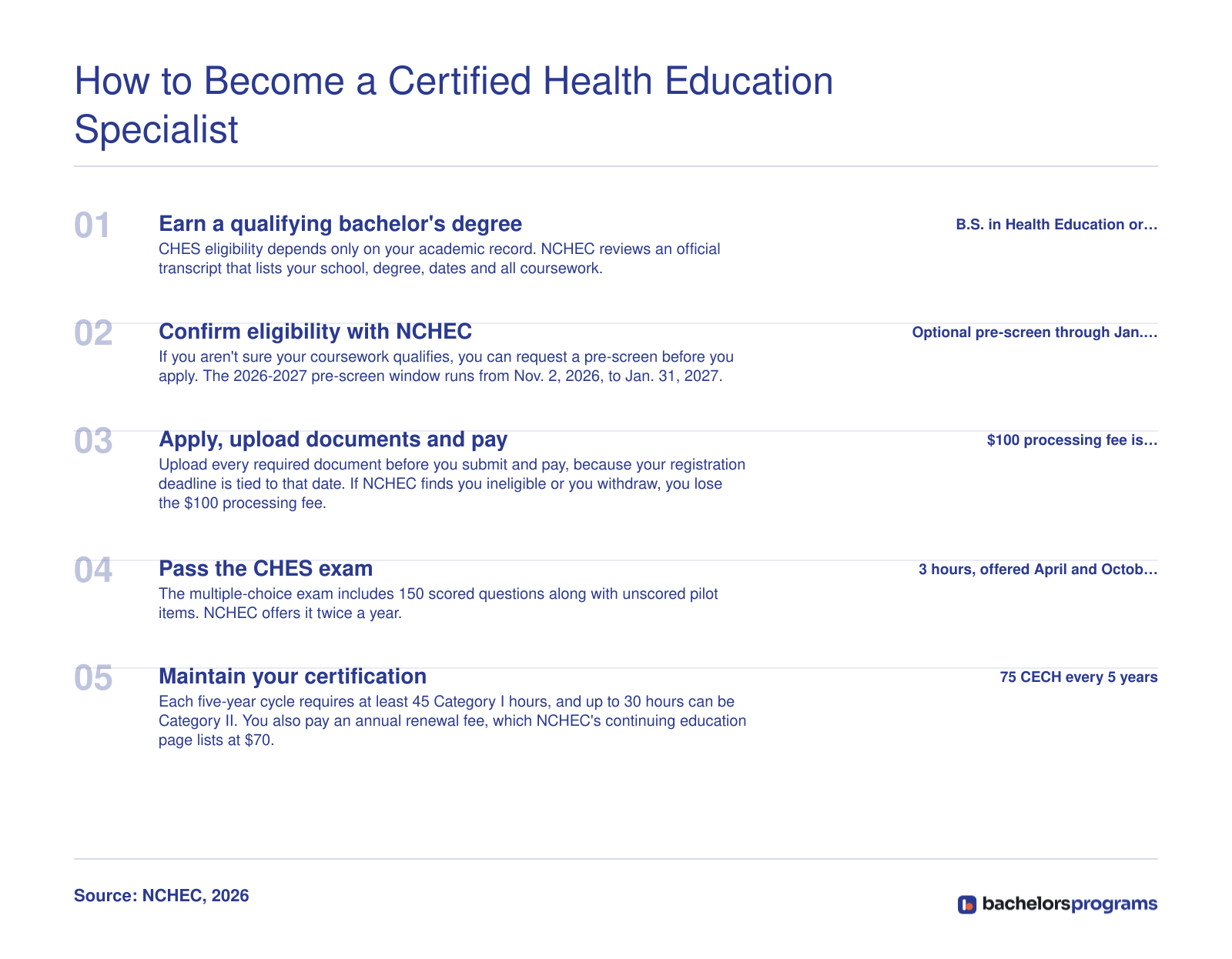
How to Become a Certified Health Education Specialist
You don't have to wait for your diploma to start the CHES process. NCHEC lets students close to graduation apply through a 90-day option or as full- or part-time students, using an advisor letter on school letterhead that lists their projected graduation date, current status and degree program.
What the Typical Health Educator Earns
For most graduates with a bachelor's degree in health education, the job title is health education specialist, and the Bureau of Labor Statistics tracks its pay nationally.
Questions to Ask Yourself
Do you want to teach in a K-12 classroom, or work in community and clinical settings?
Does the coursework meet NCHEC's credit requirements for the CHES exam?
Might you apply to nursing, physical therapy or physician assistant school later?
If you study online, will the school help you secure a local internship site?
Health Education programs by state
Compare Health Education programs on the data that matters
Explore more Healthcare majors or browse every field of study.
All Healthcare programs Browse every field of study