Best Online Oceanography Degree Programs
Compare 9 accredited online Oceanography programs, with net price after aid, graduation rates, earnings and debt from IPEDS and the U.S. College Scorecard.

Most oceanography bachelor's degrees require about 120 credit hours and award a Bachelor of Science (B.S.). Only a handful of schools offer it fully online, so many online options carry ocean-adjacent titles such as marine biology or coastal science.
Every program ranked here is 100% online. Hybrid formats were excluded. Cost per credit, lab delivery and career payoff come after the rankings.
The real constraint is hands-on training. Ocean science still depends on field and data experience, so how a program delivers labs matters more than its title.
Key Points
- Fully online B.S. in Oceanography programs are rare; marine science titles dominate.
- Geoscientists, including oceanographers, earned a $101,920 median wage in May 2025.
- Before applying, verify how each program delivers its labs and fieldwork.
Best Fully Online Oceanography Degree Programs Ranked
Only a handful of accredited universities let you finish an ocean science bachelor's degree entirely online, so this list is close to the full set of options rather than a tight cut. Hybrid and campus-based programs are excluded. Each entry names the actual major and concentration, because several of these degrees carry a marine, fisheries or ocean futures title rather than the word oceanography.
Arizona State University
#1Scottsdale, AZ
Best for: Future ocean scientists seeking a dedicated major
Arizona State University runs its ocean science degrees through a dedicated School of Ocean Futures, and the fully online coastal and marine science concentration is the closest match here to a straight oceanography track. The 120-credit major covers ocean chemistry, marine biology, ecosystems and climate interactions, and the school's first graduating class, including online students, finished in 2026. Field and study-away options reach Bermuda, Hawai'i and Antarctica. The average net price after aid is about $19,500.
- 120 total credit hours; online students typically finish in eight semesters
- Coastal and marine science concentration, not a general marine biology track
- Coursework spans ocean chemistry, marine biology, ecosystems and climate
- Includes an ocean futures capstone and an introduction to oceanography course
- Higher Learning Commission accredited; STEM-OPT eligible for F-1 students
- Fieldwork in Arizona, Bermuda and Hawai'i, plus an Antarctica study abroad
- Accelerated bachelor's plus master's pathway in as little as five years
University of Alaska Fairbanks
#2Fairbanks, AK · ~$11,000/yr (est.)
Best for: Cold-water and polar science enthusiasts
The University of Alaska Fairbanks offers the only true oceanography concentration in this group, housed inside a 121-credit Fisheries and Marine Sciences B.S. that is an ocean-adjacent major rather than a standalone oceanography degree. In-state students pay $8,736 in tuition and fees and out-of-state students pay $22,320, though eligible Western residents can receive a reduced rate of $465 per credit against the standard $934. The average net price after aid is about $10,892, and the school's graduation rate is 38%.
- 121 total credit hours, with 27 upper-division credits required
- Oceanography concentration inside a fisheries and marine sciences major
- Thesis or capstone option; C- or better required in every course
- Semester-by-semester study roadmaps published by the department
- Core coursework spans marine biology and oceanography
- Marine Biology track runs 41 to 43 credits
- Choose three electives from six, including marine bird ecology
- Marine Mammals of the World and scientific diving among the options
- Capstone: Human Impacts to the Marine Biosphere or a senior thesis
- Three concentration options, including Fisheries Science
Unity Environmental University
#3New Gloucester, ME · ~$19,000/yr (est.)
Best for: Transfer students focused on aquaculture careers
Unity Environmental University is a small, career-focused environmental school in New Gloucester, Maine, whose marine biology and sustainable aquaculture degree is an ocean-adjacent major delivered entirely online, with 120 credits required. Tuition runs $470 per credit, is locked through 2030 and includes no hidden fees, with a reduced rate for military students. The average net price after aid is about $19,104, and the school's graduation rate is 29%.
- $470 per credit, locked through 2030 with no hidden fees
- 120 total credit hours; up to 90 transfer credits accepted
- Core includes Introduction to Oceanography, Ichthyology and Fish Health
- No application fee, essay or test scores required to apply
- Some coursework involves field partnerships and applied projects
Georgia Southern University
#4Statesboro, GA · $15,000 – $20,000/yr (est.)
Georgia Southern University is a large public university in Statesboro whose biology department carries six concentrations, including marine biology, making it an ocean-adjacent major with 124 credits required and a fully online option. Marine biology students study conservation of oceans under pressure from overfishing, warming water and pollution. Tuition is $6,022 in state and $17,734 out of state, the average net price after aid is about $15,267, and the school's graduation rate is 55%.
- 124 total credit hours; fully online option available
- Marine biology concentration within a six-track biology major
- Electives include ichthyology, marine pollution and sea turtle biology
- Immersive experience required: internship, course project or research
- Undergraduate research grants of up to $2,500
Cost & outcomes by school
Federal data for the highest-earning Oceanography programs, independent of the ranking above. Earnings are this field's bachelor's graduates four years after completing where the Scorecard reports them, else the school's undergraduate median.
| School | Net price / yr | Grad rate | Earnings | Debt | Grads/yr | Format |
|---|---|---|---|---|---|---|
| The University of Texas at Austin TX | $19,857 | 89% | $75,121 | $20,500 | — | Hybrid |
| Arizona State University AZ | $14,967 | 68% | $62,668 | $19,500 | — | Online or campus |
Sources: U.S. Department of Education. Net price, graduation rate, earnings and debt: College Scorecard (earnings and debt for this field's bachelor's graduates where reported, else school-wide); graduates: IPEDS. A dash means no figure is reported.
Cost, debt & payoff
Median earnings of this field's bachelor's graduates (4 yrs after completing, else the school's undergraduate median) vs. their median federal loan debt · U.S. College Scorecard
Across these programs the median graduate earns about $53,775 and finishes with roughly $22,000 in debt — a ratio that clears a common rule of thumb (keep debt below first-year salary). Net price and debt vary widely school to school, so check the per-school figures in the table above before you shortlist.
Can You Earn a Bachelor's Degree in Oceanography Fully Online?
Can you actually finish a bachelor's degree in oceanography without setting foot on campus? Yes, though dedicated online B.S. in Oceanography programs are rare. Most fully online paths carry a marine science, ocean studies or ocean-adjacent title instead.
What you will study
The academic core is the same across titles: physical, chemical, biological and geological oceanography, built on calculus, physics, chemistry, statistics, and data analysis or GIS work. Oregon State's campus-based Oceanography B.S., for example, requires two terms of calculus, introductory oceanography, physical geology, chemical oceanography and general physics. Expect the same scientific backbone from a credible online version.
Where to look
Arizona State University offers an online Bachelor of Science in Ocean Futures with a Coastal and Marine Science concentration, covering oceanography, chemistry, biology, calculus, statistics and data analysis. Oregon State University Ecampus offers an online bachelor's in Marine Studies, which approaches marine systems through natural sciences alongside social sciences and humanities.
Check the diploma title
Read the exact degree name, not the marketing page. Federal oceanographer job series and graduate admissions committees look at the credential title and the specific science coursework behind it, so a studies-oriented degree may require extra math and physics later.
How Do Oceanography, Marine Biology and Coastal Science Degrees Compare?
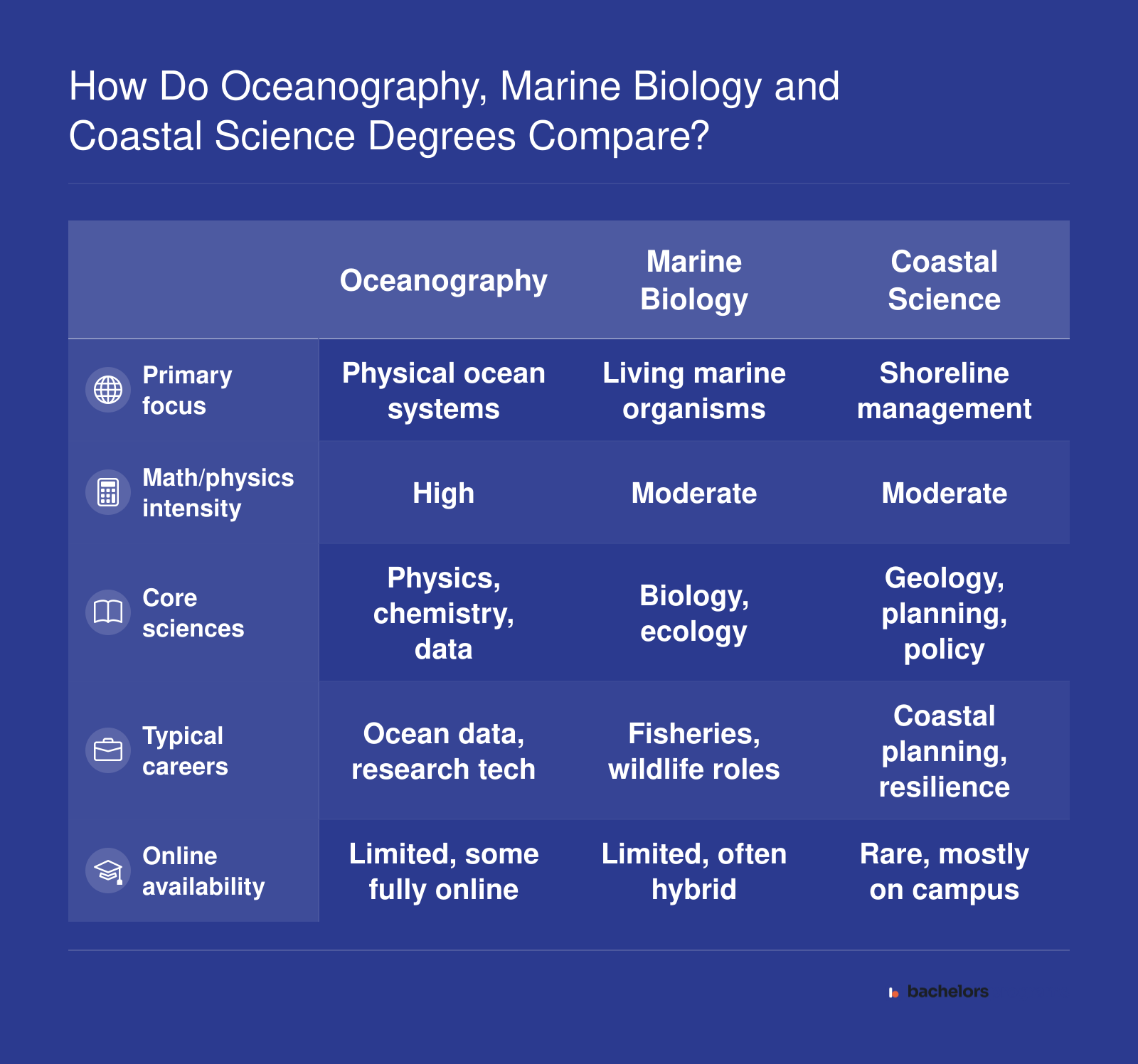
Oceanography leans on physics, chemistry and data to explain how ocean systems move and change, while marine biology centers on organisms and ecology, and coastal science focuses on managing shorelines. That difference shapes how much math you take and which jobs you qualify for. Pick oceanography for ocean data or physical science jobs, and marine biology for fisheries or wildlife roles.
Online Oceanography Degree Cost per Credit and Total Price
The schools below are ordered from lowest to highest average net price after aid. Annual tuition and fees are shown for in-state and out-of-state students, and Pell share and median graduate debt describe each institution as a whole, not the ocean science major alone. Unity Environmental University charges a flat $470 per credit regardless of residency, which puts 120 credits near $56,400 in tuition before fees. Confirm per-credit rates directly with the other schools, and budget separately for distance-learning, technology and lab kit fees, which many online programs bill on top of tuition.
| School | Program | In-State Tuition and Fees (Annual) | Out-of-State Tuition and Fees (Annual) | Average Net Price After Aid (Annual) | Per-Credit Rate | Credit Hours | Estimated Total Tuition | Pell Share (Institution-Wide) | Median Graduate Debt (Institution-Wide) |
|---|---|---|---|---|---|---|---|---|---|
| University of Alaska Fairbanks | Fisheries and Marine Sciences B.S. (Marine Biology concentration) | $8,736 | $22,320 | $10,892 | N/A | 121 | N/A | 66% | $20,291 |
| Georgia Southern University | Biology (BS), Marine Biology concentration | $6,022 | $17,734 | $15,267 | N/A | 124 | N/A | 59% | $23,250 |
| Unity Environmental University | B.S. in Marine Biology and Sustainable Aquaculture | $12,640 | $12,640 | $19,104 | $470 (same for all residencies) | 120 | About $56,400 | 48% | $25,000 |
Related Articles
Accreditation, Labs and Fieldwork: What to Verify Before You Apply
Online flexibility is the draw, but an ocean science degree still has to teach you to work with real data and samples. Ask how each program runs its labs.
Accreditation
Start with regional (institutional) accreditation. University of Alaska Fairbanks is accredited by the Northwest Commission on Colleges and Universities (NWCCU)1. Arizona State University is generally understood to be accredited by the Higher Learning Commission, but confirm this on the school's site. No programmatic accreditor exists specifically for oceanography, so institutional accreditation is the check that counts. It also affects financial aid and credit transfer.
Labs, fieldwork and technology
Online science labs usually take one of three forms: at-home kits, virtual simulations, or assignments built on real oceanographic datasets. Ask UAF and ASU admissions directly which method they use and whether either requires an on-site field course or summer residency. ASU notes that some of its online science majors include a short in-person lab. Expect to need a reliable computer, steady broadband, and possibly GIS or data analysis software.
Transfer credit
ASU's degree totals 120 credits, typically over eight semesters, and transfer credits can shorten that. Maximum transfer limits were not confirmed, so request a written credit evaluation. Community college biology, chemistry, and math courses are the usual starting point.
Questions to Ask Yourself
Do you want to study the ocean itself or the organisms living in it?
Can you travel for a short in-person field course or lab requirement?
Does the online major include the calculus-based math and physics your goals require?
How many of your existing credits will actually transfer?
Is an Online Oceanography Degree Worth It? Earnings and Career Paths
Geoscientists, the Bureau of Labor Statistics category that includes oceanographers, earned a median annual wage of $101,920 in May 2025, and the agency projects 3% growth from 2025 to 2035.1 Hydrologists earned $96,6002, while environmental scientists and specialists earned $82,220, with 6% growth and roughly 7,300 openings projected each year.3
Program Earnings Five Years Out
Georgia Southern University reports median earnings of $62,838 five years after finishing, against median graduate debt of $47,219. Unity Environmental University reports $39,424 for the same window. Several programs do not publish outcomes, so weigh the tuition you would actually pay against the earnings data that does exist rather than assuming a salary.
Where Graduates Work
- Ocean data analyst: turns buoy, satellite and sonar output into usable datasets.
- Fisheries technician: supports stock surveys and hatchery work for state or tribal agencies.
- Environmental consultant: handles permitting, water-quality sampling and coastal impact reports.
- Government scientist: NOAA, state environmental agencies and coastal management offices.
Verdict
An online oceanography degree pays off when tuition stays moderate and you pair it with data skills and field experience. For research-level roles, plan on graduate school.
How to Choose an Online Oceanography Program as a Career Changer, Transfer or International Student
Your starting point shapes which program fits you best.
- Career changers: Look for programs with solid calculus, statistics and data-analysis coursework, since ocean science leans heavily on quantitative work. Asynchronous delivery lets you study around a full-time job.
- Transfer students: Favor schools with generous transfer credit limits and articulation agreements with community colleges, so your prior science and math credits count toward the major rather than electives.
- International students: A fully online degree generally does not qualify you for an F-1 student visa.1 F-1 rules count only one online class, or 3 credits, per term toward full-time enrollment2, so you would typically complete the degree from your home country. Published details vary, so ask each school which English proficiency tests (such as TOEFL or IELTS) it accepts and at what minimum score, whether it requires a foreign transcript evaluation, and whether online international students pay the out-of-state rate.
Before you apply, request a degree audit of your existing credits and a syllabus for the lab sequence. Together they show what transfers and how the labs are run.
Oceanography programs by state
Compare Oceanography programs on the data that matters
Explore more Natural & Applied Sciences majors or browse every field of study.
All Natural & Applied Sciences programs Browse every field of study