Best Online Science Education Degree Programs
Compare 130+ accredited online Science programs, with net price after aid, graduation rates, earnings and debt from IPEDS and the U.S. College Scorecard.

A bachelor's degree in science education now comes two ways: a campus program with wet labs down the hall, or an online one that ships the lab kit to your kitchen table. Only programs delivered 100% online qualify for this ranking.
Net price runs from about $3,800 to $29,200 a year after grants. Licensure is the tighter constraint: nearly every state requires student teaching in a physical classroom near your home, so the degree pays off only if the program is state-approved where you plan to teach.
Key Points
- Student teaching is always in person, even in fully online programs.
- BLS projects about 63,500 high school teacher openings yearly, 2025 to 2035.
- Only state-approved initial licensure programs lead directly to a teaching license.
Best Fully Online Science Education Bachelor's Programs
A bachelor's degree in science education should pair deep science content with a clear path to the classroom. Every entry below is listed as a fully online bachelor's program with a science-rich core, and hybrid formats are not included. Each card shows the school's average net price after aid and graduation rate, plus program-level debt and earnings where the school reports them.
Ohio State University
#1Columbus, OH · $17,000/yr (est. net price)
Best for: Degree-completion students balancing work and family
Ohio State's online Bachelor of Science in Health Sciences is a 120-credit completion degree for students who already hold about 30 college credits. It is fully online, takes most students about two years, and does not include clinical placements. The school's graduation rate is 88%, and net price averages about $17,339 after aid. Graduates report median earnings of $52,459 four years after finishing and median debt of $23,250.
- 120-credit degree completion program
- Most students finish in about two years
- Fully online, with no clinical placements
- Requires six prerequisites and 30 prior college credits
- Minimum 2.5 GPA and $60 application fee
- Estimated total tuition of about $32,000
- Ranked #4 in the country by U.S. News & World Report
- Authorized in 49 SARA states
California State University-Sacramento
#2Sacramento, CA · $8,000 – $21,000/yr (est.)
Best for: Transfer students exploring health science careers
California State University, Sacramento offers a Bachelor of Science in Health Science that pairs biology and physical science with social, environmental, and ethical perspectives on health. Students build an individualized set of electives and can earn credit for approved healthcare work experience or an optional internship. The school's graduation rate is 56%, and net price averages about $9,338 after aid. Graduates report median earnings of $82,062 four years after finishing and median debt of $30,515.
- Interdisciplinary blend of biological, physical, and social sciences
- Individualized electives around career or graduate school goals
- Optional HLTH 195 internship earns elective credit
- Credit possible for approved healthcare work experience
- Coursework includes health informatics and AI in healthcare
- Advisors from first semester through graduation
University of Oklahoma
#3Norman, OK · $15,000 – $20,000/yr (est.)
Best for: Working adults seeking asynchronous online classes
The University of Oklahoma offers a 120-credit Bachelor of Science in Information Science and Technology through its School of Library and Information Studies, with asynchronous online courses and four areas of study. The program includes a required 135-hour internship and accepts students with 24 prior college credits and a 2.5 GPA. The school's graduation rate is 75%, and net price averages about $15,300 after aid. Graduates report median earnings of $51,533 four years after finishing and median debt of $25,500.
- 120 credits, fully online and asynchronous
- Four areas of study, including data science and analytics
- Required 135-hour internship in information studies
- Admission requires 2.5 GPA and 24 college credits
- $550 per credit hour and a $50 application fee
- Fall, spring, and summer start terms
- Rolling admissions with a $250 deposit
University of North Carolina at Charlotte
#4Charlotte, NC · $15,000 – $20,000/yr (est.)
UNC Charlotte's Bachelor of Science in Biology is a 120-credit degree with a strong lab and research focus. Students can shape the upper-level biology coursework with an advisor, and eligible students may join the Biology Honors Program or the Early Entry path to a master's. The school's graduation rate is 69%, and net price averages about $15,435 after aid.
- 120-credit degree with heavy lab and research focus
- Fully online and on-campus formats available
- Students shape upper-level biology coursework with an advisor
- Biology Honors Program available
- Early Entry path to a master's degree
- Small class sizes for undergraduates
- Course-based and faculty-driven research projects
Northwestern University
#5Evanston, IL · $29,000/yr (est. net price)
Northwestern University's Bachelor of Science in General Studies is awarded through the School of Professional Studies and lets students choose a major in biological sciences, economics, English, humanities, organization behavior, psychology, or social sciences. The degree requires 45 units, including writing and distribution requirements, with science options that range from astronomy to physics. The school's graduation rate is 95%, and net price averages about $29,167 after aid.
- 45 units, including writing, distribution, and major requirements
- Majors include biological sciences, economics, and psychology
- Science distribution spans astronomy, chemistry, physics, and earth science
- Writing requirement: English 111 or 205 plus English 113
- Performance-Based Admission completes writing in first four courses
- Degree conferred by Weinberg College of Arts and Sciences
Murray State University
#6Murray, KY · $10,000 – $20,000/yr (est.)
Murray State University awards a Bachelor of Science in Agricultural Science through the Hutson College of Agriculture, with a 100% online option and an agribusiness focus. Coursework covers animal science, crop science, mechanized agriculture, agricultural finance, marketing, and policy, and four emphasis areas allow further specialization. The school's graduation rate is 61%, and net price averages about $9,096 after aid.
- 100% online option through the Hutson College of Agriculture
- Agribusiness option covers management, finance, marketing, and policy
- Agriscience technology option covers precision agriculture and GPS
- Four emphasis areas allow further specialization
- Coursework includes animal science, crop science, and mechanized agriculture
- Dedicated online degree advisor
- Asynchronous online course rotation
California State University-San Marcos
#7San Marcos, CA · $10,000/yr (est. net price)
California State University San Marcos offers online bachelor's completion programs in computer information systems, cybersecurity, and wildfire science and the wildland urban interface. The computer information systems degree is a 60-unit cohort program that blends computing, business, and social sciences, while the cybersecurity and wildfire science options add specialized technical training. The school's graduation rate is 55%, and net price averages about $10,229 after aid.
- 60-unit cohort program completed in four semesters
- Fully online, with rolling admissions
- $545 per unit and financial aid eligible
- Core areas include systems analysis, databases, cybersecurity, and project management
- Requires 60 transferable semester units and prerequisites
- 2+2 partnership with Southwestern College
- Credit for Prior Learning accepted
- $545 per credit, five-semester program
- Fully online option requires no campus visits
- Accepts 60+ transfer units and CompTIA/Cisco certifications
- Capstone partners with real organizations
- Prepares for cybersecurity analyst roles
- Military benefits accepted
- Rolling admissions; apply by 2026-12-02
- $490 per credit, five-semester program
- Fully online and asynchronous
- Built with Cal Fire and fire associations
- Accepts 60 transferable units and prior learning credit
- Prepares for fire ecologist and fire behavior analyst roles
- Only program of its kind in California
- Rolling admissions; apply by 2027-04-07
Faith Baptist Bible College and Theological Seminary
#8Ankeny, IA · $15,000 – $20,000/yr (est.)
Faith Baptist Bible College and Theological Seminary offers a Bachelor of Science or Bachelor of Arts in Biblical Studies with a Biblical Foundations emphasis, available on campus, fully online, or in a hybrid format. Students can add emphases such as apologetics, biblical counseling, camp ministry, women's ministry, or sports management. The school's graduation rate is 68%, and net price averages about $16,282 after aid.
- Biblical Foundations emphasis
- On campus, fully online, or hybrid format
- Four-year B.S. or B.A. degree
- Add-on emphases include apologetics and biblical counseling
- 15:1 student-faculty ratio
- 37 areas of study
- B.S./M.A. in five years with seminary
Indian River State College
#9Fort Pierce, FL · ~$3,800/yr (est.)
Indian River State College offers a Bachelor of Science in Biology that lets students explore biotechnology, microbiology, genetics, plant or marine biology, and ecology. The college positions the degree as a pathway into health, medicine, research, environmental work, agriculture, and education. The school's graduation rate is 45%, and net price averages about $3,815 after aid. Graduates report median earnings of $52,554 four years after finishing.
- Coursework spans biotechnology, microbiology, genetics, and ecology
- Options include plant or marine biology
- Positions graduates for health, medicine, research, and education
- Bachelor's degrees designed for busy adults
Arizona State University
#10Tempe, AZ · ~$15,000/yr (est.)
ASU's Bachelor of Science in Biological Sciences requires 120 credits and covers genetics, evolution, ecology, physiology, zoology, microbiology, and cell and molecular biology. Students choose the general degree or a concentration such as biomedical sciences, conservation biology and ecology, or neurobiology, physiology and behavior. ASU lists high school teacher among career outcomes for the degree. The school's graduation rate is 68%, net price averages about $14,967 after aid, and graduates report median earnings of $55,713 four years after finishing.
- 120 credits covering genetics, evolution, ecology, and physiology
- Five concentrations, including biomedical sciences and conservation biology
- Also covers zoology, microbiology, and cell and molecular biology
- ASU lists high school teacher among career outcomes
- Accelerated bachelor's plus master's option in five years
- Higher Learning Commission accredited
- STEM-OPT extension eligible for on-campus students
Cost & outcomes by school
Federal data for the highest-earning Science programs, independent of the ranking above. Earnings are this field's bachelor's graduates four years after completing where the Scorecard reports them, else the school's undergraduate median.
| School | Net price / yr | Grad rate | Earnings | Debt | Grads/yr | Format |
|---|---|---|---|---|---|---|
| Northwestern University IL | $29,167 | 95% | $89,363 | $15,000 | 6 | Online or campus |
| California State University-Sacramento CA | $9,338 | 56% | $82,062 | $15,000 | 25 | Online or campus |
| Charter Oak State College CT | $15,815 | 67% | $64,209 | $18,683 | — | Online |
| Ohio State University OH | $17,339 | 88% | $52,459 | $20,829 | 186 | Online |
Sources: U.S. Department of Education. Net price, graduation rate, earnings and debt: College Scorecard (earnings and debt for this field's bachelor's graduates where reported, else school-wide); graduates: IPEDS. A dash means no figure is reported.
Cost, debt & payoff
Median earnings of this field's bachelor's graduates (4 yrs after completing, else the school's undergraduate median) vs. their median federal loan debt · U.S. College Scorecard
Across these programs the median graduate earns about $51,747 and finishes with roughly $23,750 in debt — a ratio that clears a common rule of thumb (keep debt below first-year salary). Net price and debt vary widely school to school, so check the per-school figures in the table above before you shortlist.
How We Ranked These 100% Online Programs
Science teacher shortages are pushing more career changers toward online bachelor's programs, even as state licensure rules remain uneven. This ranking considers only bachelor's-level science education programs delivered fully online; hybrid and campus-based options were excluded. Each program is weighed on average net price after aid, the institution's overall graduation and retention rates, and, where the federal College Scorecard publishes them, program-level earnings and typical federal student debt. Two limits matter. Graduation rates and net price describe the whole institution, not the science education major alone, and federal earnings figures are not published for every program. The ranking also does not confirm that a program meets licensure requirements in your state. Treat it as a starting point, then verify eligibility with your state board and the school before you enroll.
How to Choose a Bachelor's Degree in Science Education Online
Accreditation is the first filter, and it takes two separate checks: the school's institutional accreditation and the educator-preparation program's own approval. A regionally accredited university can still run a science teaching program that no state recognizes.
Check Accreditation and State Approval
CAEP accredits educator preparation providers, including initial teaching-certification programs.1 AAQEP accredits providers against four standards, and its Accredited Programs directory lists currently accredited programs; membership alone is not accreditation. Verify status with CAEP's Accredited Provider & Recognized Program Search, the AAQEP directory, and your state education department's list of approved teacher preparation programs. National accreditation does not automatically equal state approval.2
Match the Concentration and Grade Band
Programs specialize in biology, chemistry, physics, earth science, or broad-field science, and target grades 5-9 or 6-12/7-12. The grade band determines the certification area you qualify for.
Confirm How Labs and Courses Run
Ask whether courses are synchronous or asynchronous, how long terms run, and how lab science requirements are met: at-home lab kits, virtual labs, or short on-site intensives. Science degrees are lab-heavy, so lab delivery matters more here than it would in a humanities program.
Ask admissions in writing whether the program is approved to recommend you for licensure in your state.
From Online Coursework to Your Own Classroom
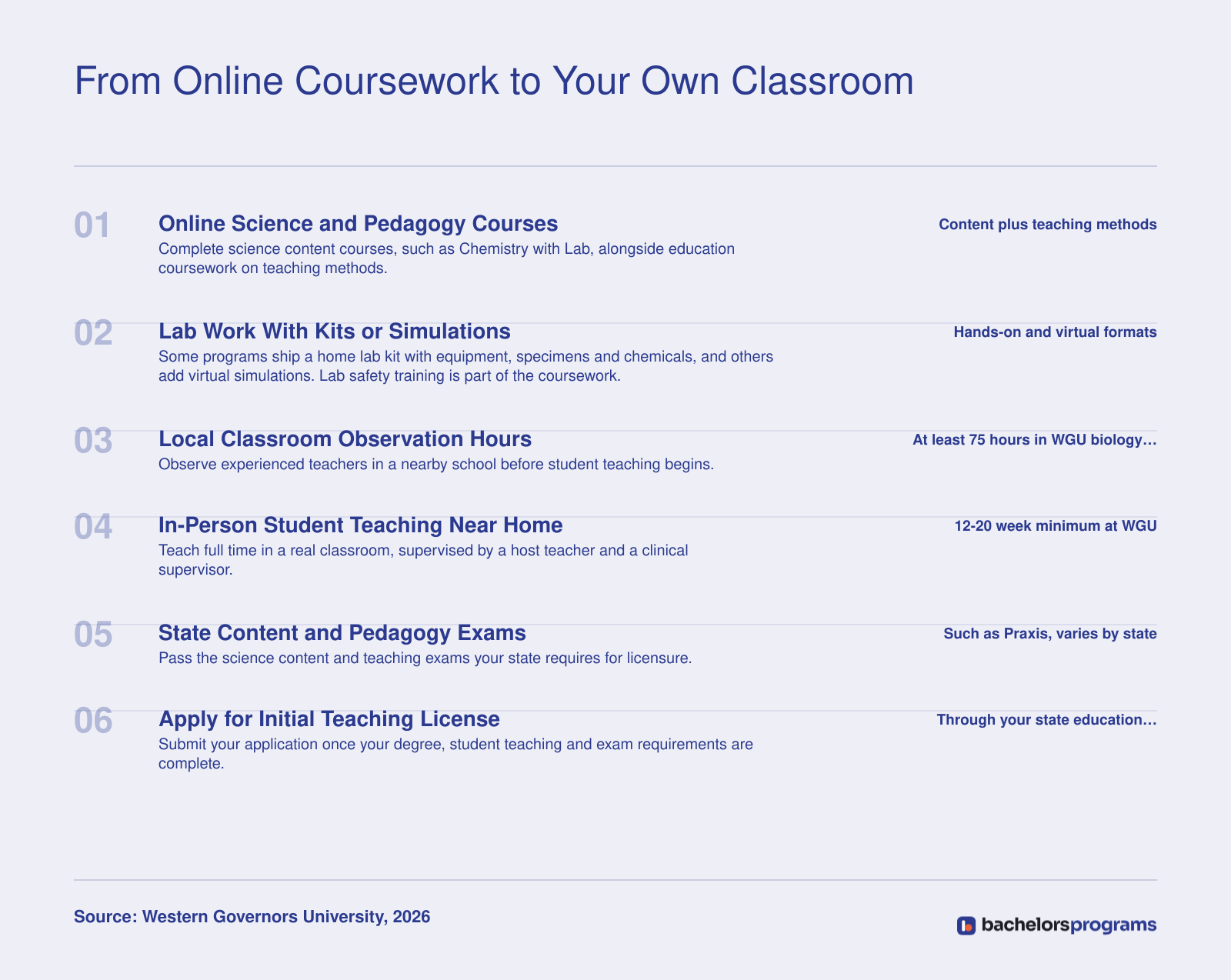
Coursework in an online bachelor's degree in science education happens remotely, but student teaching is always in person. Online programs typically arrange a placement in a school near your home. At WGU, you may recommend a school, but its Field Placement Office generally makes the final selection, so your first choice is not guaranteed.
Will an Online Degree Get You a Teaching License?
Yes, provided the program is a state-approved initial licensure program. A bachelor's degree in science education that carries licensure-track status includes supervised student teaching and meets a specific state's preparation standards. A non-licensure version of the same degree, often marketed to people already teaching on a provisional or emergency certificate, will not by itself make you eligible for a first license in most states.
Licensure starts with one state, then travels
Your license is issued by a state education agency, usually the one where the program's curriculum is approved. The NASDTEC Interstate Agreement, signed by all 50 states plus DC, Guam, and DoDEA1, is a set of individual agreements rather than a national license. It generally gives you eligibility to apply in another state, not an automatic transfer2; the receiving state may still require its own tests, coursework, or mentoring.
Confirm the program's state disclosures first
Under federal rules at 34 CFR 668.43, online programs must publish whether their curriculum meets licensure education requirements in each state, based on where you were located when you first enrolled.3 If a program does not meet or has not determined your state's requirements, the school owes you that notice before you enroll.4
Expect additional state conditions beyond the degree: content exams such as Praxis Subject Assessments in biology, chemistry, or physics, fingerprinting, and criminal background checks.4
Related Articles
Most Affordable Fully Online Science Education Degrees
These are the lowest-cost options in our data, ordered by average net price, which is an approximate yearly cost after grants and scholarships rather than a quote from the school. Earnings come from U.S. Department of Education College Scorecard data for each school's subject-area teacher education graduates, shown with the number of years after completion. Beyond tuition, budget for lab kits, licensure exam fees, background checks and lost income during unpaid full-time student teaching, and keep in mind that flat-rate or competency-based tuition means your total cost depends on how quickly you finish.
| School | Location | Featured Program | In-State Tuition and Fees | Out-of-State Tuition and Fees | Average Net Price After Aid | Program Median Earnings |
|---|---|---|---|---|---|---|
| St Petersburg College | St. Petersburg, FL | Biology B.S. Degree (Cellular & Molecular Biology) | $2,682 | $9,286 | $1,471 | $49,435 (1 year after completion); $51,755 (4 years after completion) |
| Turtle Mountain College | Belcourt, ND | Bachelor of Science in Biology | $2,794 | $2,794 | $3,428 | N/A |
| Indian River State College | Fort Pierce, FL | Biology (B.S.) | $2,764 | $10,201 | $3,815 | $52,554 (4 years after completion); $49,780 (5 years after completion) |
What Science Teachers Earn
Steady turnover keeps science classrooms hiring. BLS projects about 63,500 high school teacher openings each year from 2025 to 2035.
Science programs by state
Online Science Education Degree FAQs
How long does an online bachelor's degree in science education take?
How many transfer credits do online science education programs accept?
Do online science education programs require in-person labs or student teaching?
What can you do with a bachelor's degree in science education besides teach?
Compare Science programs on the data that matters
Explore more Education & Teaching majors or browse every field of study.
All Education & Teaching programs Browse every field of study