Best Applied Behavior Analysis Degree Programs
Compare 30+ accredited Applied Behavior Analysis programs, with net price after aid, graduation rates, earnings and debt from IPEDS and the U.S. College Scorecard.

Behavior analysis credentialing splits at the master's degree: a bachelor's in the field now carries a credential of its own. Graduates qualify for BCaBA status; the BCBA still demands a master's, qualifying graduate coursework, and supervised fieldwork. That gap shapes the choice. In-state tuition across the schools ranked here runs from roughly $6,600 to $15,500, and delivery splits among fully online, campus, and hybrid formats. Regional accreditation says nothing about whether coursework satisfies the Behavior Analyst Certification Board, and that single distinction decides whether the degree counts.
Key Points
- A full-time bachelor's takes four years; a master's, 1.5 to 2 more.
- Forty U.S. states regulate behavior analysts, so confirm your board's rules.
- Check BACB Verified Course Sequence status, not just institutional accreditation.
The 10 Best Applied Behavior Analysis Schools Ranked
These ten programs stand out for how directly their coursework maps to behavior-analytic credentialing, whether that means preparation for the assistant-level certification or a verified sequence that shortens the path to graduate study. Each entry below notes the degree, the format, the location, the published tuition, and the school's overall graduation rate so you can compare like with like.
Florida International University
#1Miami, FL · ~$9,000/yr (est.)
Best for: Florida residents who want to study online
Florida International University runs one of the largest online undergraduate operations in the country, and its psychology degree with an applied behavior analysis track brings that scale to a fully online format with fall, spring, and summer entry points. Students get a personal success coach alongside faculty who work in behavior analysis, and the track is built around defining behavior, reading functional relationships, and designing interventions. It is also one of the few programs on this list where the entire degree can be completed without relocating to Florida.
- 120 total credit hours, fully online
- Three start terms: fall, spring, and summer
- Personal success coach assigned to each student
- Coursework prepares students for BCaBA certification
- Focus on autism and related developmental disabilities
- Honors College option available to qualified students
Binghamton University
#2Vestal, NY · $20,000 – $25,000/yr (est.)
Best for: Future clinicians seeking supervised practicum hours
Binghamton University pairs a research-intensive psychology department with an autism spectrum disorder track that puts undergraduates in direct contact with autistic youth and their families. Much of that happens at the on-campus Institute for Child Development, where students complete practicum work under supervision. The program leans on evidence-based assessment, ethics, and special education law rather than pure theory, which makes it a strong choice for students aiming at graduate study in behavior analysis or a related clinical field.
- Concentration in autism spectrum disorder
- Practicum placement at the Institute for Child Development
- Direct work with autistic and neuro-divergent youth
- Coursework in ethics, assessment, and intervention design
- Covers state and federal special education regulations
- Faculty-led research opportunities for undergraduates
- Two concentration options within the major
California State University-Fresno
#3Fresno, CA · ~$7,000/yr (est.)
Best for: California students wanting local fieldwork placement
California State University, Fresno offers a standalone applied behavior analysis program inside its psychology department, with a curriculum that maps to the Behavior Analyst Certification Board's coursework requirements. Required supervised internships are coordinated with local ABA employers, so students accumulate fieldwork hours without hunting for placements on their own. Faculty advisors track students through the sequence, and the degree functions equally well as a route into entry-level practice or as preparation for a master's program.
- Meets BACB academic coursework requirements
- Supervised internship coordinated with local ABA employers
- 2.8 GPA minimum for admission to the program
- Electives include behavioral and cognitive change techniques
- Core psychology sequence plus ABA-specific coursework
- Prepares graduates for BCaBA certification
Murray State University
#4Murray, KY · $10,000 – $20,000/yr (est.)
Murray State University offers an applied behavior analysis track within the psychology major at a price point that is well below the national average for public universities. The curriculum covers operant conditioning, behavior measurement, intervention design, and the ethics of practice, with attention to autism spectrum disorder and organizational behavior management. Internships and faculty research projects supply the applied side, and transfer students can finish the track in two years.
- Four-year track, completable in two years for transfers
- Coursework in operant conditioning and behavior measurement
- Ethics training specific to behavior analysis practice
- Internship and faculty research opportunities
- Preparation for BCaBA certification
- Includes organizational behavior management content
William Carey University
#5Hattiesburg, MS · ~$14,000/yr (est.)
William Carey University delivers a general studies in education degree with an applied behavior analysis concentration entirely online through Canvas, which suits working adults who need to keep a job while they study. The 128-credit structure includes two 18-hour concentrations, giving students room to pair behavior analysis with another teaching or human-services area. Graduates typically move into behavior therapist or ABA technician roles, or continue to graduate study for the full analyst credential.
- 100% online delivery through Canvas
- 128 total credit hours including two 18-hour concentrations
- Four concentration options within the degree
- Coursework in applied behavior therapy techniques
- Focus on autism and related developmental disabilities
- Prepares graduates to pursue BCBA requirements after the bachelor's
Mississippi State University
#6Mississippi State, MS · ~$18,000/yr (est.)
Mississippi State University grants a Bachelor of Science in Applied Behavior Analysis outright rather than as a track inside psychology, built on a scientist-practitioner model with two semesters of supervised experiential learning. The program holds Verified Course Sequence status from the Association for Behavior Analysis International, which matters if you plan to pursue certification later, and students can enroll through campus or online degree plans. Graduates are eligible for the BCaBA exam and for Registered Behavior Technician certification.
- 120 credit hours with fall and spring start dates
- ABAI Verified Course Sequence
- Two semesters of supervised experiential learning
- Prepares students for the BCaBA exam
- Registered Behavior Technician eligibility
- On-campus and online degree plans available
- Student organization in behavior analysis
- Prerequisite coursework required for admission
University of North Texas
#7Denton, TX · $11,000 – $21,000/yr (est.)
The University of North Texas created the first bachelor's degree in applied behavior analysis in the country and still houses it in a department known for leadership in the field. Students get intensive training in behavioral assessment, intervention strategy, and ethical practice alongside a broad general education, and the faculty bring active research programs into the classroom. Graduates move into autism therapy, education, organizational behavior management, and human services, or continue to graduate study.
- First bachelor's degree of its kind in the nation
- Intensive training in ABA principles and application
- Coursework in behavioral assessment and intervention
- Ethics and professional practice embedded in the curriculum
- Research opportunities with behavior analysis faculty
- Prepares graduates for graduate study toward BCBA certification
Ball State University
#8Muncie, IN · $10,000 – $15,000/yr (est.)
Ball State University offers its applied behavior analysis degree with an autism spectrum disorder focus in both on-campus and online formats, so students can choose the delivery that fits their life. The program is ABAI-verified and prepares graduates to sit for the BCaBA exam after completing supervised fieldwork, and the Teachers College behind it is nationally recognized. The online version was the first of its kind in Indiana and carries CAEP accreditation.
- ABAI-verified coursework
- 120 total credit hours, on-campus delivery
- Concentration in autism spectrum disorder
- Prepares students for the BCaBA exam
- Faculty drawn from clinics, schools, and home settings
- Also offered through an online degree plan
- CAEP-accredited online program
- 120 credit hours with full-time and part-time options
- Asynchronous online classes
- First online ABA bachelor's degree in Indiana
- Prepares students for BCaBA credential eligibility
- Regional tuition savings for Kentucky and Ohio residents
University of Nebraska at Omaha
#9Omaha, NE · $10,000 – $15,000/yr (est.)
The University of Nebraska at Omaha places its applied behavior analysis concentration inside the psychology major, with a lab course and a dedicated ethics and practice seminar that most undergraduate programs skip. Small class sizes and independent study options give students room to work closely with faculty on single-case research, and seniors complete an assessment capstone. The campus setting in Omaha puts students near a large concentration of behavioral health and clinical employers.
- 120 total credit hours
- Dedicated laboratory course in applied behavior analysis
- Practice and ethics in behavior analysis seminar
- Single-case research methods and statistics
- Senior assessment and capstone requirement
- Foreign language requirement for the BA
Southern Connecticut State University
#10New Haven, CT · ~$21,000/yr (est.)
Southern Connecticut State University builds its psychology degree around an applied behavior analysis concentration with coursework in assessment, intervention, ethics, and research methods. The standout feature is an accelerated pathway: students with a 3.0 GPA can take graduate-level ABA courses during senior year and apply the credits toward both the bachelor's and a master's degree. That structure shortens the route to the graduate credential that most analyst roles require.
- 120 total credit hours
- Coursework in ABA assessment and ethics
- 3.0 GPA minimum to access graduate coursework
- Dual credit applies to both bachelor's and master's degrees
- Research methods and data-based decision making emphasized
Cost & outcomes by school
Federal data for the highest-earning Applied Behavior Analysis programs, independent of the ranking above. Earnings are this field's bachelor's graduates four years after completing where the Scorecard reports them, else the school's undergraduate median.
| School | Net price / yr | Grad rate | Earnings | Debt | Grads/yr | Format |
|---|---|---|---|---|---|---|
| Northeastern University MA | — | — | $92,538 | $24,250 | — | Online or campus |
| Binghamton University NY | $21,620 | 82% | $80,596 | $18,500 | — | Campus |
| University of Florida FL | $6,541 | 91% | $71,588 | $15,000 | — | Campus |
| University of New Hampshire NH | $23,805 | 76% | $66,479 | $26,814 | — | Online |
| University of New Hampshire College of Professional Studies Online NH | $10,864 | 30% | $66,479 | $26,814 | 13 | Online |
| California State University-Fresno CA | $7,000 | 57% | $61,244 | $14,505 | 70 | Campus |
| University of Nevada-Reno NV | $15,927 | 61% | $60,614 | $18,922 | — | Campus |
| Florida International University FL | $9,288 | 74% | $60,249 | $16,500 | — | Online |
| Long Island University NY | $33,062 | 57% | $59,950 | $23,577 | — | Campus |
| University of South Florida FL | $9,812 | 77% | $57,743 | $17,988 | — | Campus |
| Felician University NJ | $40,045 | 47% | $57,602 | $25,000 | — | Hybrid |
| Salem State University MA | $15,996 | 50% | $56,662 | $25,000 | 5 | Campus |
Sources: U.S. Department of Education. Net price, graduation rate, earnings and debt: College Scorecard (earnings and debt for this field's bachelor's graduates where reported, else school-wide); graduates: IPEDS. A dash means no figure is reported.
Cost, debt & payoff
Median earnings of this field's bachelor's graduates (4 yrs after completing, else the school's undergraduate median) vs. their median federal loan debt · U.S. College Scorecard
Across these programs the median graduate earns about $52,163 and finishes with roughly $22,500 in debt — a ratio that clears a common rule of thumb (keep debt below first-year salary). Net price and debt vary widely school to school, so check the per-school figures in the table above before you shortlist.
What Shaped Our ABA School Rankings
A strong ABA program is one you can afford, finish, and repay out of the salary it leads to, so the rankings weigh exactly those questions. Anyone aiming for BCBA certification still faces graduate study, supervised fieldwork, and an exam, which makes the cost and payoff of the first degree matter even more.
- What will it cost? Tuition is shown at the degree level you are considering, next to the average net price students pay once grants and scholarships are counted.
- Will I finish? Each school's graduation rate shows how many students complete their degree.
- What will I earn? Program-level earnings come from the U.S. Department of Education's College Scorecard.
- How much will I owe? Median debt for program graduates, also from College Scorecard, shows the typical borrowing load.
- How will I learn? Delivery format (online, campus, or hybrid) is noted so working students can filter quickly.
Two cautions apply. Graduation rates cover the entire institution, not the ABA program specifically. Net price is an average across aided students, not a personal quote, so your own aid package may differ. College Scorecard reports earnings and debt only where enough students have completed the program, so some schools show fewer figures than others.
Most Affordable Applied Behavior Analysis Degree Programs
These are the lowest-cost bachelor's options in applied behavior analysis, compared by price rather than by rank. Each cost figure is the average net price after aid from 2024 IPEDS and College Scorecard data from the U.S. Department of Education, which reflects what students typically pay once grants and scholarships are applied. Published tuition and fees appear alongside for context. Purdue Global graduates of this program report a median debt of $33,000, or roughly $350 a month on a standard 10-year repayment plan. One tip: in-state public tuition and employer tuition assistance at ABA clinics often matter more than sticker price, so ask prospective employers about reimbursement before you enroll.
| School | Location | Format | Average Net Price After Aid (per year) | Tuition and Fees (In-State / Out-of-State) | Program Median Debt (10-Year Monthly Payment) |
|---|---|---|---|---|---|
| California State University-Fresno | Fresno, CA | Campus | $7,000 | $7,350 / $19,950 | N/A |
| Louisiana State University-Shreveport | Shreveport, LA | Campus | $7,022 | $7,518 / $7,518 | N/A |
| Purdue University Global | West Lafayette, IN | Online | $7,770 | $10,101 / $14,412 | $33,000 (about $350/month) |
Applied Behavior Analysis Degree Accreditation: Institutional, ABAI, and BACB Verified Course Sequences
A school can look legitimate on one layer of accreditation and still leave you short of BCBA eligibility on another. Three terms get blurred together, so separate them first.
The three layers
- Institutional accreditation: Covers the whole college or university and is required for federal aid. It is the institution-level requirement in BACB Pathway 2, but it says nothing about the ABA program itself.1
- ABAI program accreditation: A voluntary quality mark, awarded by the ABAI Accreditation Board, for a specific behavior-analysis degree at the bachelor's, master's, or doctoral level. It is the route into BACB Pathway 1.1
- ABAI Verified Course Sequence (VCS): A course set ABAI verified against BACB coursework requirements. The system ran from 2018 to 2025 and was discontinued January 1, 2026, so a VCS listing is no longer current evidence.2
What the BACB expects now
Pathway 1 requires a degree from an ABAI-accredited program, conferred while the program held that accreditation. Programs without it can still teach under Pathway 2, but they need a full-time faculty member with active BCBA or BCBA-D certification who reviews each student's coursework. For applications submitted on or after January 1, 2026, the BACB requires either a VCS coordinator attestation that coursework was completed by December 31, 2025, or an attestation from a registered Pathway 2 Program Contact at the university. Updated Pathway 2 coursework requirements take effect January 1, 2027.
Are online programs accredited?
Format does not change accreditation. An online program carries the same institutional status, and the same ABAI status or lack of it, as its campus counterpart. Verify both rather than assuming.
A five-minute check before you apply
- Step 1: Confirm the school's institutional accreditation through the U.S. Department of Education database or the accreditor's own site.
- Step 2: Search ABAI's Accredited Programs directory for the specific degree, not just the university, and check that the listed dates cover your expected graduation.
- Step 3: If the program is not listed, ask the department in writing who its Pathway 2 Program Contact is and which BCBA faculty member reviews coursework.
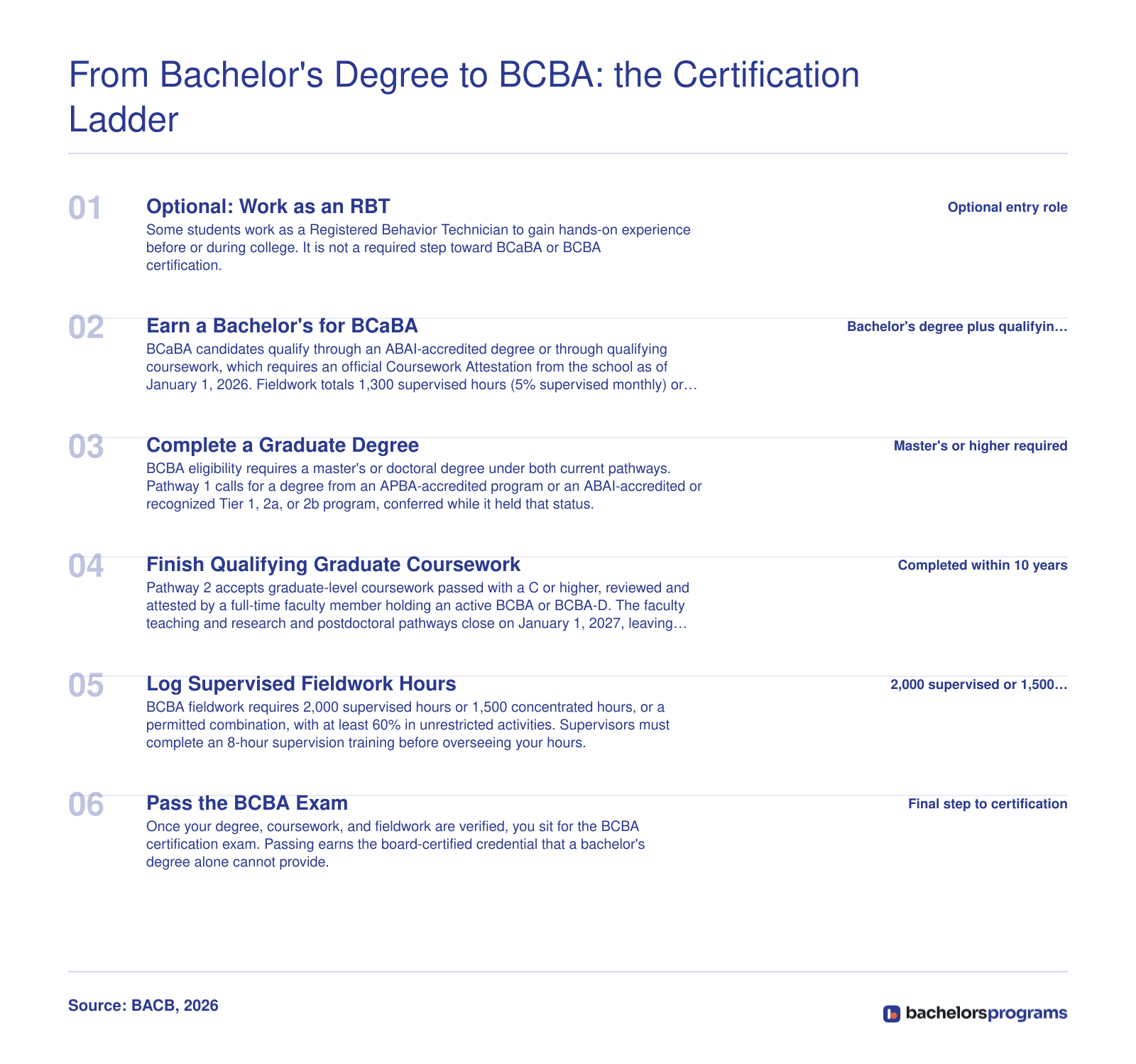
From Bachelor's Degree to BCBA: the Certification Ladder
The key distinction is simple: a bachelor's degree leads to the BCaBA credential, while BCBA certification requires a master's degree or higher. Each rung below follows current Behavior Analyst Certification Board requirements for 2026.
Related Articles
How Long Does an Applied Behavior Analysis Degree Take?
A degree timeline and a BCBA timeline are two different clocks. A full-time bachelor's in ABA takes about four years, and a full-time master's runs roughly 1.5 to 2 years. Part-time study stretches both. Supervised fieldwork can add more time on top.
Fieldwork Can Extend the Clock
Under the 2026 framework, the standard pathway requires 2,000 hours and the concentrated pathway requires 1,500. Monthly accrual is capped at 130 hours, so the fastest possible finish is about 16 months for standard and 12 for concentrated. That assumes no gaps. At a steadier 80 hours a month, standard fieldwork takes about 25 months. Many students log hours during their master's coursework, but an online master's does not always cover the full requirement, and extra hours are often needed afterward.
Who Arranges Your Placement
Placement varies by program. Some schools arrange partner sites and handle the paperwork. Others expect you to find an eligible setting and a BCBA supervisor yourself. Remote supervision may be possible, but confirm it in writing.
When you pay for independent supervision, rates are typically $50 to $150 an hour, with averages near $75 to $80. Standard fieldwork requires supervision for 5% of hours, about 100 hours across 2,000. At the average rate, that works out to roughly $7,500 to $8,000, which is a calculation rather than a quoted price. Employer sponsorship can remove the cost. John Carroll University lists a $1,000 fieldwork course fee with supervision included, but that is one program's arrangement.
A Realistic Total
Count four years for the bachelor's, about two for the master's, and 16 to 25 months of fieldwork. If fieldwork overlaps coursework, you can sit for the exam in roughly six years. If it follows the degree, expect closer to eight.
Online vs. Campus ABA Degrees: Fieldwork, Licensure, and Flexibility
Online and campus ABA degrees lead to the same BCBA certification and state licensure pathways, so the real differences are in logistics. Forty U.S. states now regulate behavior analysts, so confirm that any program you choose satisfies the board in the state where you plan to practice. Some online programs also cannot enroll residents of certain states because of state authorization rules, so check that before you apply.
| Factor | Online ABA Degree | Campus ABA Degree |
|---|---|---|
| Schedule flexibility | Coursework can usually be completed around work and family commitments, though some programs set live sessions or deadlines | Fixed class times and a set location, which gives structure but less room to work around a job |
| Fieldwork placement | You often arrange your own site near home, so confirm how much placement help the program offers | Local clinics, schools, and partner sites may be easier to reach through faculty and program contacts |
| Supervision access | Supervision must comply with state rules, and BACB prefers in-person, on-site observation, so plan for a qualified local supervisor | Faculty and nearby supervisors can make in-person observation easier to schedule |
| State authorization | Programs may be unable to enroll residents of certain states, so verify eligibility before applying | Campus programs still must fit your practice state's licensure rules, but location and attendance rules differ from distance-education authorization |
| Licensure fit | Coursework and fieldwork must match your home state's requirements, and ABAI advises students to look up the requirements where they will practice | The same state-by-state check applies, and it matters most if you plan to practice outside the school's state |
| BCBA pathway | Pathway 2 requires a master's degree or higher, qualifying coursework, and supervised fieldwork | Identical requirements, so the format does not change the certification standard |
| Mobility and reciprocity | 27 of the 40 licensing states include a reciprocity provision for out-of-state licensees, which helps if you relocate | Same reciprocity provisions apply, so format has no effect on moving later |
| Cost considerations | Can reduce commuting and relocation costs, but compare tuition, fees, and any supervision costs | Housing, transportation, and relocation can add expense, so compare total cost, not tuition alone |
Median Pay for Behavior Analysts Nationwide
The BLS does not report behavior analysts as a separate occupation. The closest federal category is substance abuse, behavioral disorder, and mental health counselors, so treat these figures as a benchmark rather than a guarantee for every ABA role.
Applied Behavior Analysis programs by state
Applied Behavior Analysis Degree FAQs
These answers cover the questions prospective ABA students ask most, from degree requirements to exam pass rates. Each one is written to stand on its own, so you can jump to what matters most for your path.
What degree do you need to become a BCBA?
Is a bachelor's degree enough to become a BCBA?
How long does it take to get a degree in applied behavior analysis?
Are online applied behavior analysis programs accredited?
How much do applied behavior analysts make?
What BCBA exam pass rate should I look for in an ABA program?
Do I need a state license in addition to BCBA certification?
Compare Applied Behavior Analysis programs on the data that matters
Explore more Psychology majors or browse every field of study.
All Psychology programs Browse every field of study