Best Forensic Psychology Degree Programs
Compare 50+ accredited Forensic Psychology programs at 40+ colleges, with net price after aid, graduation rates, earnings and debt from IPEDS and the U.S. College Scorecard.

A bachelor's in forensic psychology does not make you a forensic psychologist. That title requires a doctorate and licensure; the bachelor's degree leads to entry-level roles in courts, corrections, and human services.
Programs take two shapes: standalone majors, like John Jay's BA, and concentrations inside a general psychology degree, as at Western Kentucky. The schools ranked here span online, campus, and hybrid delivery and are weighed on cost, completion, and graduate outcomes.
Net price separates them most. Average annual net price across the schools here runs from about $3,200 to more than $41,000, a gap of roughly $38,000 for a single year.
Key Points
- Embry-Riddle forensic psychology graduates earn a median $41,456 one year out.
- Arizona State and Maryville deliver the bachelor's degree largely online.
- Six-figure forensic psychology salaries belong to licensed psychologists, not bachelor's holders.
Top 10 Forensic Psychology Degree Programs for 2027
Ten programs make up this year's forensic psychology list, and they differ sharply in setting and structure. Some sit inside large public universities with online delivery and accelerated graduate pathways, while others are smaller campus programs that build internships and capstone research directly into the major. The notes below focus on what each school does well for a student heading toward the intersection of psychology and law.
CUNY John Jay College of Criminal Justice
#1New York, NY · ~$3,200/yr (est.)
Best for: New Yorkers drawn to psychology and law
CUNY John Jay College of Criminal Justice is a public college in Manhattan built around criminal justice and public service, and forensic psychology is one of its signature majors. Undergraduates can move from the bachelor's into an accelerated forensic psychology master's, a forensic mental health counseling track that begins in the junior year, or a combined psychology and law pathway. The school graduates 56% of students, and the average net price after aid is about $3,203.
- BA blends psychology with criminal justice and legal settings
- Coursework in psychological theory and research methods
- Internships in hospitals, prisons, family courts, youth agencies
- Accelerated BA/MA pathway in forensic psychology
- Combined MA/JD option through CUNY School of Law and New York Law School
- Forensic mental health counseling track starts in the junior year
- Median earnings of $35,656 one year after completing
Arizona State University
#2Tempe, AZ · ~$15,000/yr (est.)
Best for: Online learners seeking accelerated master's options
Arizona State University is a large public research university whose psychology department offers a forensic concentration both online and at its West Valley campus. The curriculum leans quantitative, with coursework in criminal law, criminal behavior, and legal decision making, and students can stack an accelerated master's in forensic psychology or criminal justice on top of the bachelor's. ASU graduates 68% of students, and the average net price after aid is roughly $14,967.
- Available online and at the West Valley campus
- Coursework in criminal law, criminal behavior, legal decision-making
- Accelerated bachelor's plus master's in forensic psychology
- Quantitative research and statistical analysis emphasis
- Multiple enrollment sessions each year
- Western Undergraduate Exchange eligible
- Global education opportunities available
John Carroll University
#3University Heights, OH · ~$29,000/yr (est.)
Best for: Students seeking court and clinic internships
John Carroll University is a private Jesuit school in the Cleveland area where psychology majors choose from five concentrations, including forensic psychology. The program pairs coursework in psychopathology and criminology with internships at courts, counseling centers, and community organizations, and every student completes a capstone plus undergraduate research with a faculty mentor. The university graduates 79% of students, and the average net price after aid is about $28,746.
- Five concentration options within the psychology major
- Capstone required for graduation
- Internships at courts, counseling centers, community organizations
- Undergraduate research with a faculty mentor
- Courses include forensic psychology, psychopathology, criminology
- Psychology Club and Psi Chi honor society
Western Kentucky University
#4Bowling Green, KY · $12,000 – $27,000/yr (est.)
Western Kentucky University is a public university in Bowling Green with a forensic psychology concentration inside the psychology major. Students pair core psychology coursework with criminal justice, philosophy, and political science electives, and the concentration requires a second major or a minor. The university graduates 56% of students, and the average net price after aid is roughly $10,990.
- 40 total credit hours in the concentration
- 2.5 GPA minimum for the concentration
- Requires an additional major or minor
- Restricted electives from criminal justice, philosophy, political science
- Courses include Psychology and the Law and Abnormal Psychology
- ACT or SAT scores required for admission
University of Nebraska at Omaha
#5Omaha, NE · $10,000 – $15,000/yr (est.)
The University of Nebraska at Omaha is a public university whose forensic concentration leans on required courses in law and psychology. Undergraduates study competency to stand trial, jury behavior, and eyewitness testimony, with research opportunities in a department that runs about 15 students per instructor. The university graduates 47% of students, and the average net price after aid is about $13,441.
- Required courses in Law and Psychology and Forensic Psychology
- Study competency to stand trial, jury behavior, eyewitness testimony
- Electives include social psychology and abnormal psychology
- Faculty mentorship and undergraduate research opportunities
- Prepares for law enforcement, victim advocacy, correctional counseling
Maryville University
#6Saint Louis, MO · ~$22,000/yr (est.)
Maryville University is a private university in suburban St. Louis that delivers its forensic psychology bachelor's entirely online. The degree includes a 135-hour internship and a senior capstone, and working adults can start in fall, spring, or summer and use an Early Access option to bank graduate credits at undergraduate tuition. The university graduates 66% of students, and the average net price after aid is roughly $22,066.
- 100% online coursework, no campus visits required
- 135-hour internship required
- Senior capstone research project
- Fall, spring, and summer start dates
- Early Access option: up to 12 graduate credits at undergraduate rates
- 120 total credit hours, completable in as few as two years
- $0 application fee and no SAT required
Westfield State University
#7Westfield, MA · $15,000 – $20,000/yr (est.)
Westfield State University is a public liberal arts campus in western Massachusetts where the psychology major carries a forensic concentration. The program mixes forensic psychology and criminal justice coursework with a required capstone that can take the form of a practicum, a research project, or independent study. The university graduates 54% of students, and the average net price after aid is about $16,721.
- Capstone can be a practicum, research, or independent study
- Courses include Forensic Psychology and Introduction to Criminal Justice
- No SAT or ACT required for admission
- Prepares for case manager, court liaison, and probation roles
- Foundation for graduate study in forensic psychology
Seattle University
#8Seattle, WA · ~$35,000/yr (est.)
Seattle University is a private Jesuit institution that offers forensic psychology as both a BA and a BS through its Department of Criminal Justice, Criminology, and Forensics. The BS adds mathematics and science coursework for students aiming at graduate study, and internships place students in prisons, law enforcement agencies, law firms, and crime labs. The university graduates 76% of students, and the average net price after aid is roughly $34,662.
- Separate BA and BS tracks in forensic psychology
- BS adds mathematics and science coursework for graduate study
- 120 semester credits over four years
- Coursework includes abnormal psychology and criminal profiling
- Internships in prisons, law enforcement agencies, law firms, crime labs
- Home to the Crime and Justice Research Center
Embry-Riddle Aeronautical University-Daytona Beach
#9Daytona Beach, FL · ~$41,000/yr (est.)
Embry-Riddle Aeronautical University's Daytona Beach campus brings its aviation and engineering mindset to a Bachelor of Science in Forensic Psychology. Students work in the Forensic Science Laboratory, join a Cold Case Task Force with law enforcement, and mentor juvenile offenders, with small classes taught by faculty. The university graduates 67% of students, and the average net price after aid is about $41,272.
- 120 total credit hours
- Work in the Forensic Science Laboratory
- Cold Case Task Force participation with law enforcement
- Mentor juvenile offenders
- Small classes taught by faculty, not teaching assistants
- Median earnings of $41,456 one year after completing
Western Illinois University
#10Macomb, IL · ~$13,000/yr (est.)
Western Illinois University is a public university in Macomb whose forensic psychology bachelor's is housed in a psychology department with its own Laboratory for the Investigation of Psychology and Law. Students gain field experience at mental health agencies, can volunteer with a student-run crisis hotline, and can apply for departmental research grants. The university graduates 45% of students, and the average net price after aid is roughly $12,937.
- Laboratory for the Investigation of Psychology and Law
- Field placements at mental health agencies
- Student-run HOTLINE crisis intervention service
- Undergraduate seminars and individual reading projects
- Research grants available for student projects
- Prepares for psychiatric technician and correctional roles
Cost & outcomes by school
Federal data for the highest-earning Forensic Psychology programs, independent of the ranking above. Earnings are this field's bachelor's graduates four years after completing where the Scorecard reports them, else the school's undergraduate median.
| School | Net price / yr | Grad rate | Earnings | Debt | Grads/yr | Format |
|---|---|---|---|---|---|---|
| Embry-Riddle Aeronautical University-Worldwide FL | $18,725 | 21% | $84,131 | $23,666 | — | Campus |
| Embry-Riddle Aeronautical University-Daytona Beach FL | $41,272 | 67% | $82,023 | $23,733 | 36 | Campus |
| Embry-Riddle Aeronautical University-Prescott AZ | $40,287 | 68% | $82,023 | $23,733 | 14 | Campus |
| George Mason University VA | $17,915 | 68% | $76,343 | $19,500 | — | Campus |
| Seattle University WA | $34,662 | 76% | $75,272 | $19,883 | 7 | Campus |
| John Carroll University OH | $28,746 | 79% | $62,860 | $26,000 | — | Campus |
| Arizona State University AZ | $14,967 | 68% | $62,668 | $19,500 | 35 | Online |
| Maryville University MO | $22,066 | 66% | $62,105 | $22,000 | 32 | Online |
| Walla Walla University WA | $23,329 | 60% | $61,885 | $26,842 | 1 | Campus |
| Louisiana State University and Agricultural & Mechanical College LA | $19,151 | 69% | $61,251 | $20,500 | — | Online |
| Hamline University MN | $20,744 | 61% | $61,106 | $23,770 | — | Campus |
| University of New Haven CT | $34,192 | 63% | $60,126 | $27,000 | — | Campus |
Sources: U.S. Department of Education. Net price, graduation rate, earnings and debt: College Scorecard (earnings and debt for this field's bachelor's graduates where reported, else school-wide); graduates: IPEDS. A dash means no figure is reported.
Cost, debt & payoff
Median earnings of this field's bachelor's graduates (4 yrs after completing, else the school's undergraduate median) vs. their median federal loan debt · U.S. College Scorecard
Across these programs the median graduate earns about $53,623 and finishes with roughly $23,666 in debt — a ratio that clears a common rule of thumb (keep debt below first-year salary). Net price and debt vary widely school to school, so check the per-school figures in the table above before you shortlist.
Inside Our Scoring: Cost, Completion, and Graduate Outcomes
A program earns the word "top" only when it can show two things: what students actually pay and how graduates actually fare. Every entry here answers one of those questions and carries the same core figures, so schools compare cleanly against one another.
What Each Measure Tells You
- Net price: what a year of study typically costs once grants and scholarships are counted, usually far below the published tuition figure.
- Completion and retention: the share of students who return after their first year and the share who finish a degree, reported for the institution as a whole.
- Earnings and debt: program-level income and borrowing figures reported through the federal College Scorecard for graduates who received federal aid.
- Completions: how many credentials a program awards, a practical signal of scale, stability, and course availability.
Ranked programs include bachelor's-level forensic psychology majors and forensic psychology concentrations, whether they run fully online, on campus, or in a hybrid format. A concentration housed inside a broader psychology or criminal justice degree is judged on the same measures as a standalone major.
Where the Numbers Stop
Federal reporting has limits worth naming. Graduation and retention rates describe an entire institution, not a single major, so a strong rate at a large university says more about overall student support than about one department's advising. The net price figure averages every aid recipient, so your own cost depends on your income, residency, and transfer credits. Some programs simply do not publish earnings data, which usually means too few graduates to report without identifying them. Where that happens, cost and completion carry the case instead.
Highest Program-Level Earnings on Our List
Among the programs ranked here, one on-campus bachelor's program stands out for graduate earnings.
Most Affordable Forensic Psychology Programs by Net Price
These are the lowest-cost programs on our list, ranked by net price, which is the average annual amount students pay after grants and scholarships, based on 2024 U.S. Department of Education data from IPEDS and the College Scorecard. Your own cost will depend on your financial aid package and household income. All of these schools are public, so compare the in-state and out-of-state tuition columns: Western Kentucky charges out-of-state students more than twice the in-state rate, while Western Illinois charges the same rate to both.
| School | Program | State | Format | Average Net Price | Graduation Rate | In-State Tuition and Fees | Out-of-State Tuition and Fees |
|---|---|---|---|---|---|---|---|
| CUNY John Jay College of Criminal Justice | Bachelor of Arts in Forensic Psychology | NY | On campus | $3,203 | 55.8% | $7,470 | $15,420 |
| Western Kentucky University | Psychology, Forensic Psychology concentration | KY | On campus | $10,990 | 55.6% | $11,652 | $27,000 |
| Western Illinois University | Forensic Psychology | IL | On campus | $12,937 | 45.2% | $15,264 | $15,264 |
Forensic Psychology or Criminal Justice: How the Degrees Differ
Forensic psychology centers on human behavior, assessment, and research. Criminal justice centers on the systems of law enforcement, courts, and corrections. Some schools blur the line by offering criminal justice degrees with a forensic psychology concentration, but those programs usually keep the criminal justice core and add a few psychology electives. A psychology-based major typically gives you more preparation for graduate study.
| Factor | Forensic Psychology Degree | Criminal Justice Degree |
|---|---|---|
| Core focus | General psychology plus criminal law, criminal behavior, mental disorders, and legal decision-making | Broad study of law enforcement, corrections, courts, and private security |
| Typical specialized coursework | Criminal behavior, juvenile delinquency, correctional psychology, police psychology, psychology and law | Criminal justice theory paired with real-world application across policing, corrections, courts, and security |
| Research methods and statistics | Heavier load; students may complete a faculty-guided independent research project to prepare for advanced study | Generally lighter and more applied; the source material does not describe a research capstone requirement |
| Typical home department | Psychology, often within a college of arts and sciences | Criminal justice or criminology, often a separate department or professional studies unit |
| Hands-on experience | Programs may require at least 150 hours of internship or practicum in a community setting | Internships and field experience vary by school |
| Common bachelor's-level jobs | Administrative and corrections roles or technician positions; many other careers need further education | Law enforcement, corrections, courts, and private security |
| Fit for psychology graduate school | Strong fit; psychologists typically need at least a master's degree, and applicants usually hold a bachelor's in psychology, education, or social science | Weaker fit on its own; no universal graduate-school pathway is described, and you may need to add psychology prerequisites |
| Best suited for | Readers headed to graduate study in clinical, counseling, or forensic psychology, or to research, victim advocacy, or law | Readers aiming for direct entry into policing, corrections, courts, or private security |
Related Articles
Studying Forensic Psychology Online, on Campus, or Both
Can you earn a forensic psychology degree online? Yes. Arizona State University and Maryville University both deliver the bachelor's largely online, and both are ranked here. Most other programs ranked here run on campus, clustered in the Midwest and Northeast, with New York, Ohio, Kentucky, Nebraska, Illinois, and Massachusetts each represented.
What Online Study Buys You
Flexibility. Maryville built its BA for adults returning to school: 100% online coursework, starts in fall, spring, or summer, and a capstone. ASU runs multiple enrollment sessions a year and lets students stack an accelerated master's in forensic psychology on top of the bachelor's.
What Campus Study Buys You
Access. Seattle University places students in prison and jail internships and runs a Crime and Justice Research Center. Western Illinois students work in the Laboratory for Investigation of Psychology and Law and present at professional conferences. Faculty mentorship, and the letters of recommendation that come with it, comes more easily when you are on site.
Ask Before You Enroll
If you choose online, ask one question first: how does the program arrange field experience where you live? Maryville's 135 clinical hours have to happen somewhere, and a program that leaves placement entirely to you is a different proposition from one with partner sites nearby. Get the answer in writing before you pay a deposit.
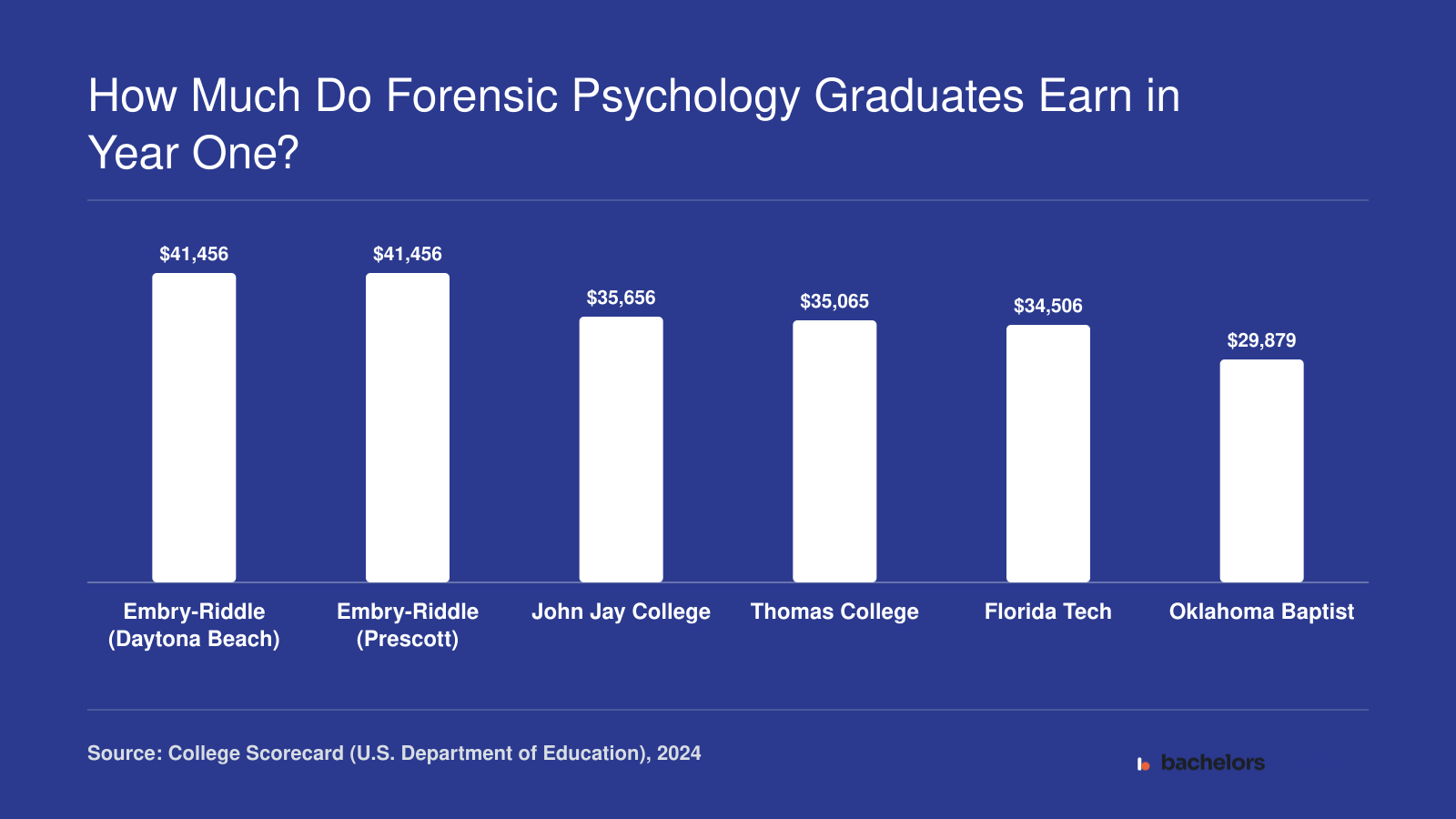
How Much Do Forensic Psychology Graduates Earn in Year One?
Embry-Riddle's Daytona Beach and Prescott campuses lead the schools shown here, with forensic psychology graduates earning a median $41,456 one year after finishing. These are College Scorecard medians for program completers. Many forensic psychology majors go straight into graduate school, so first-year earnings tend to understate long-term pay.
Psychologist Pay at the Doctoral Level
The six-figure salaries often linked to forensic psychology belong to licensed psychologists, not to bachelor's degree holders.
Forensic Psychology programs by state
Forensic Psychology Degree Questions, Answered
These answers cover the questions prospective students ask most often about forensic psychology bachelor's degrees. Requirements vary by school, so confirm details with any program you are considering.
Can you earn a bachelor's specifically in forensic psychology, or only a concentration?
What does a bachelor's in forensic psychology prepare you to do?
Is a forensic psychology degree worth the cost?
Is forensic psychology the same thing as criminal justice?
Will graduate schools respect a fully online forensic psychology bachelor's?
How many credits and years does a forensic psychology bachelor's usually take?
Compare Forensic Psychology programs on the data that matters
Explore more Psychology majors or browse every field of study.
All Psychology programs Browse every field of study