Best Industrial Organizational Psychology Degree Programs
Compare 40+ accredited Industrial Organizational Psychology programs, with net price after aid, graduation rates, earnings and debt from IPEDS and the U.S. College Scorecard.

Almost no undergraduate catalog lists industrial-organizational psychology as a standalone major. It arrives as a track inside a psychology B.S., an emphasis in a business school, or a 24-unit concentration bolted onto a liberal arts degree, and the price swings hard: in-state tuition at CUNY Baruch College runs $7,464 a year, while Detroit Mercy posts $32,946.
That spread is the real decision. The programs ranked here span online, campus and hybrid delivery, with capstones, applied research projects and practicum placements separating the serious tracks from the ones that only sound applied. Most job titles carrying the words "I-O psychologist" expect a master's, so the bachelor's is usually step one.
Key Points
- SIOP's 2025 training guidelines replaced versions from 1985, 1999 and 2016.
- BLS lists a master's as typical entry-level education for I-O psychologists.
- Among ranked schools, Embry-Riddle Prescott reports the strongest I-O bachelor's earnings.
The 10 Best Industrial-Organizational Psychology Schools
Industrial-organizational psychology rarely shows up as a standalone bachelor's major. Most of the programs below deliver it as a track, concentration, or emphasis inside a psychology degree, and a few build it into a business school instead. Each entry notes what the program is genuinely good at, so you can compare fit rather than just names.
CUNY Bernard M Baruch College
#1New York, NY · $7,000 – $15,000/yr (est.)
Best for: Business school students eyeing HR roles
Baruch College anchors its I/O psychology offering inside the Zicklin School of Business, so undergraduates take psychology and business coursework side by side. The New York City campus puts students within reach of corporate HR, consulting, and talent management employers, and the same faculty community supports CUNY's doctoral training area in I/O psychology. Students who want a business-facing psychology degree without leaving the city have an unusually direct path here.
- Part of the Zicklin School of Business
- Core coursework in research methods and I/O psychology
- Electives in diversity, leadership development, occupational health
- Requires general psychology and business statistics
- Careers in HR, marketing, sales and government
- Prepares students for master's and PhD study
San Diego State University
#2San Diego, CA · $15,000/yr (est. net price)
Best for: California students comparing psychology pathways
San Diego State treats I/O psychology as an emphasis inside a broader B.A. in Psychology, one of three pathways majors can choose. Every psychology major completes the same pre-major foundation before specializing, which keeps the degree flexible if your interests shift. The emphasis points toward human resources, organizational consulting, and training roles, and the university also runs a related applied psychology master's for students who continue.
- One of three B.A. psychology degree pathways
- All psychology majors share the same pre-major courses
- Minimum 2.50 GPA required for most pathways
- Upper-division specialization in workplace psychology
- Prepares for HR, organizational consulting and training
University of Central Florida
#3Orlando, FL · ~$10,000/yr (est.)
Best for: Working adults needing a fully online degree
UCF offers a dedicated industrial/organizational track inside its psychology B.S., and the degree can be completed entirely online. Students on the Orlando campus can add research experience, internships, and psychology student organizations to the coursework. Course titles such as Psychology of Teamwork and Advanced Organizational Psychology show how applied the upper division becomes.
- 120 total credit hours
- Can be completed fully online
- Starts in fall, spring or summer
- Capstone required
- Includes Introduction to I/O Psychology and Psychology of Teamwork
- 21 semester hours residency requirement
- C or better required in core courses
- 2.0 GPA minimum
United States Military Academy
#4West Point, NY
West Point's behavioral sciences major carries an organizational psychology concentration built around leadership, teams, and leading change. The curriculum template is small and highly structured: a few required methods courses, a three-course organizational track, and a wide menu of electives and support courses. It is a campus program with a capstone seminar, an honors option, and STEM depth satisfied through cyber coursework.
- Curriculum template covers the Class of 2029
- Three-course organizational psychology track
- Includes leading teams and leadership theory and practice
- Choose 2 of 13 depth electives and 3 of 71 support courses
- Capstone seminar in behavioral science required
- STEM depth requirement met through cyber courses
- Honors version requires a 3.5 major GPA
State University of New York at New Paltz
#5New Paltz, NY · ~$19,000/yr (est.)
SUNY New Paltz pairs a psychology B.S. with a formal I/O concentration and requires business administration coursework in management, human resources, and marketing. The concentration runs 59 credits and closes with a capstone seminar and research experience. It suits students who want workplace psychology grounded in both lab methods and business fundamentals, at a public university price.
- 59 total credit hours
- Combines psychology with business administration
- I/O core covers organizational, industrial and testing
- Business courses include management, HR and marketing
- Capstone seminar and research experience required
- Advanced electives such as cognitive neuroscience, disaster psychology
- Math placement level 3 required
Farmingdale State College
#6Farmingdale, NY · $11,000/yr (est. net price)
Farmingdale State College frames its I/O concentration inside an applied psychology B.S., with personnel management and organizational development at the center. A two-semester senior project sequence covers professional development and career planning, and students complete either an applied research project or an internship. The program is explicitly not a licensure track; it is built for entry-level HR and business roles or for graduate study.
- Prepares for entry-level HR and business positions
- Applied research project or internship required
- Coursework in personnel management and organizational behavior
- Two-semester senior project on career planning
- Psychology Club and Psi Chi honor society
- Not a licensure-track program
California State University-San Bernardino
#7San Bernardino, CA · $4,600/yr (est. net price)
Cal State San Bernardino offers an I/O concentration within a 120-unit psychology B.A., with 24 units devoted to workplace psychology. Required courses in organizational psychology, industrial psychology, and tests and measurements are rounded out by electives in occupational health, diversity at work, and program evaluation. The concentration ends with an advanced seminar in I/O psychology or an experimental psychology capstone.
- 24-unit I/O concentration within a 120-unit degree
- Required courses in organizational and industrial psychology
- Tests and Measurements course required
- Electives include Diversity, Work, and Family and Occupational Health Psychology
- Culminating Advanced Seminar in I/O Psychology
- Program code PYIO
Grace College and Theological Seminary
#8Winona Lake, IN · ~$20,000/yr (est.)
Grace College offers an I/O concentration inside its psychology major at a small Christian liberal arts campus in Winona Lake, Indiana. Classes are interactive and group-based, coursework is taught from a biblical worldview, and every student has the chance to conduct and publish research. A culminating practicum or internship places students in hospitals, nonprofits, or corporate offices.
- One of four psychology concentrations
- Coursework in organizational psychology and HR management
- Culminating practicum or internship
- Research publication opportunity for every student
- Courses integrate a biblical worldview
- School reports 96% of behavioral science alumni employed or in graduate school
- Paths into HR, case management and social work
University of Detroit Mercy
#9Detroit, MI · ~$15,000/yr (est.)
University of Detroit Mercy builds its I/O psychology B.A. around both business and psychology, with coursework in personnel assessment, performance appraisal, job analysis, and leadership development. Practicum internships at partner organizations give students applied experience, and an accelerated five-year track lets strong students earn a bachelor's and master's together. It is a campus program in Detroit with a generalist foundation that transfers well to HR, consulting, or an MBA.
- Dual emphasis on psychology and business
- Coursework in personnel assessment and job analysis
- Practicum internship at partner organizations
- Accelerated five-year bachelor's to master's track
- Prepares for HR, talent management and organizational development
- Foundation for MBA or graduate I/O study
Colorado State University-Fort Collins
#10Fort Collins, CO · ~$21,000/yr (est.)
Colorado State University houses its I/O concentration inside a 120-credit psychology major, with seminars on leadership, motivation, training, and work-life balance. Internships and research assistantships are encouraged, and the degree ends in a capstone seminar. Students get a research-heavy psychology department and a clear route either into HR and consulting work or into graduate I/O study.
- 120 total credit hours
- Capstone seminar required
- Coursework in organizational behavior and psychological measurement
- Internships and research assistantships encouraged
- Seminar topics include leadership, motivation and training
- Preparation for HR, consulting or graduate study
Cost & outcomes by school
Federal data for the highest-earning Industrial Organizational Psychology programs, independent of the ranking above. Earnings are this field's bachelor's graduates four years after completing where the Scorecard reports them, else the school's undergraduate median.
| School | Net price / yr | Grad rate | Earnings | Debt | Grads/yr | Format |
|---|---|---|---|---|---|---|
| Embry-Riddle Aeronautical University-Prescott AZ | $40,287 | 68% | $82,023 | $23,733 | 14 | Campus |
| University of Illinois Urbana-Champaign IL | $14,355 | 85% | $81,054 | $19,500 | — | Campus |
| The College of New Jersey NJ | $27,646 | 86% | $73,323 | $23,250 | — | Campus |
| CUNY Bernard M Baruch College NY | $3,033 | 72% | $73,007 | $11,512 | 17 | Campus |
| California State University-East Bay CA | $9,320 | 48% | $71,401 | $16,544 | — | Campus |
| University of Detroit Mercy MI | $15,232 | 67% | $71,030 | $23,250 | 4 | Campus |
| DePaul University IL | $30,902 | 68% | $68,751 | $23,168 | — | Campus |
| La Salle University PA | $19,409 | 57% | $67,416 | $25,000 | — | Campus |
| University of Massachusetts Global CA | $32,654 | 43% | $65,703 | $24,276 | — | Online |
| San Diego State University CA | $15,364 | 76% | $64,909 | $15,000 | — | Campus |
| Christian Brothers University TN | $9,854 | 55% | $64,897 | $37,500 | — | Campus |
| University of St Francis IL | $13,006 | 67% | $63,926 | $21,079 | — | Campus |
Sources: U.S. Department of Education. Net price, graduation rate, earnings and debt: College Scorecard (earnings and debt for this field's bachelor's graduates where reported, else school-wide); graduates: IPEDS. A dash means no figure is reported.
Cost, debt & payoff
Median earnings of this field's bachelor's graduates (4 yrs after completing, else the school's undergraduate median) vs. their median federal loan debt · U.S. College Scorecard
Across these programs the median graduate earns about $56,899 and finishes with roughly $22,750 in debt — a ratio that clears a common rule of thumb (keep debt below first-year salary). Net price and debt vary widely school to school, so check the per-school figures in the table above before you shortlist.
What Earned a Program a Spot on This List
Industrial-organizational psychology is still mostly taught as a concentration inside a broader psychology or business major, which makes side-by-side comparison harder than it looks. Every program below had to prove its value on paper, not in a brochure.
What We Looked At
- Cost: Published in-state and out-of-state tuition and fees for each program.
- Outcomes: Program-level earnings and median debt, where College Scorecard publishes them.
- Scale: Completions, which show how many students actually finish the program.
- Institution health: The school's overall graduation rate.
- Format: Whether the program is offered on campus, online or in a hybrid arrangement.
Where the Data Runs Thin
Two limits matter. Graduation rates describe the whole institution, not the I-O program, so treat them as a signal about the school's general student support. Program-level earnings and debt figures are also missing for some schools, especially smaller programs and those with few graduates. A missing figure is not a penalty. It simply means that part of the picture is blank, and we left it blank rather than guess.
SIOP alignment gets its own section further down. No formal accreditor exists for I-O programs, and SIOP status was not a ranking input, so do not read it into the order here.
Lowest Published Tuition Among Ranked I-O Programs
The most affordable options among the ranked schools are all bachelor's-level programs, so the figures below are published annual undergraduate tuition. Like any published graduate rate, they are the sticker price before grants, scholarships or assistantships, not the net price you will actually pay. If you plan to continue to an I-O master's, the cost picture changes, and funding policies differ sharply by school. At Middle Tennessee State University, most I-O master's students obtain a graduate assistantship. Those who hold one pay no more than half the in-state rate, even if they come from out of state, and receive a monthly stipend. MTSU also offers in-state tuition to Georgia and West Virginia residents through the Academic Common Market. Its Regional Scholars rate cuts out-of-state tuition by nearly half for students living within 250 miles or in a bordering state. The University of Texas at Arlington, by contrast, states that department assistantships and fellowships are not currently available to its M.S. I/O students, and it points them to scholarships, loans and paid internships with local businesses. SIOP Foundation scholarships and fellowships are open only to SIOP student members, and many named awards are aimed at doctoral students. If you already work, ask your employer whether it offers tuition assistance. Before you apply, ask each program what share of its students receive funding and what that funding actually covers.
| School | Program | Format | Degree Level | In-State Tuition | Out-of-State Tuition |
|---|---|---|---|---|---|
| CUNY Bernard M Baruch College | Industrial/Organizational Psychology | Campus | Bachelor's | $7,464 | $15,414 |
| California State University-San Bernardino | B.A. in Psychology, Industrial-Organizational Psychology concentration | Campus | Bachelor's | $8,088 | $20,688 |
| Purdue University Global | B.S. in Psychology in Industrial/Organizational Psychology | Online | Bachelor's | $10,101 | $14,412 |
Related Articles
Online, Hybrid and Campus I-O Psychology Programs: What Actually Differs
The real tradeoff in an I-O psychology program is not online versus on-campus; it is how much structure you are buying. An asynchronous online degree can fit a full-time job, a hybrid program trades some flexibility for face-to-face time, and a campus program trades convenience for daily access to faculty and labs. Most programs on this list are campus-based, while UCF's psychology track carries a fully online option.
Asynchronous, Synchronous and Hybrid Realities
George Mason's online MPS runs asynchronously but still sets weekly deadlines, so it is not self-paced. Golden Gate offers a fully online asynchronous route or a hybrid version that brings students to campus for two weeks per term. Kansas State's hybrid cohort meets in person for two weeks each summer and otherwise works online, with occasional synchronous sessions. Touro's 100% online format uses eight-week courses and no residency. Arizona State's online option is flexible but not self-paced: 30 credits delivered in 7.5-week classes. The format generally does not change the credential; online and campus students in the same program earn the same degree and transcript.
GRE Policy Is the Bigger Variable
Testing rules vary more than delivery mode. Mason, Golden Gate and Touro do not require the GRE. Montclair waives it for applicants with a 3.3 GPA or a prior master's, and St. Mary's accepts waiver requests. Middle Tennessee State's on-campus program still requires the GRE, with a 141 quantitative minimum.
STEM Designation and the OPT Question
STEM designation is tied to a program's CIP code, and I-O psychology's code, 42.2804, can qualify. That matters for international students on an F-1 visa: standard OPT gives 12 months of work authorization, and a STEM extension adds 24 months for eligible graduates. But designation and eligibility are not the same. Golden Gate is STEM designated. Arizona State lists its online program as not STEM-OPT eligible and says the extension is unavailable through ASU Online. Verify current status directly with each program.
Top Program-Level Earnings Among Ranked I-O Schools
Among the ranked schools, Embry-Riddle's Prescott campus posts the strongest published earnings for graduates of its I-O psychology bachelor's program.
SIOP-Aligned I-O Psychology Programs: Competencies, Practicums and STEM Status
The Society for Industrial and Organizational Psychology published its current Guidelines for Education and Training in Industrial-Organizational Psychology in 2025, replacing versions from 1985, 1999 and 2016.
What the Guidelines Do, and Don't Do
They frame what master's and doctoral curricula should cover, but they are not enforceable standards or certification requirements, and they are not a rigid prescription. Programs weigh two things: whether a competency appears and how deeply students must master it. SIOP does not accredit programs.
The Competency Core
SIOP describes its graduate training resources as a high-level summary of core competencies typically covered in master's and doctoral programs. Areas the guidelines address include ethical, legal, diversity and international issues; foundational psychology; history and systems; and professional skills such as communication, business and research development, consulting and project management. Selection, training, motivation, and research methods and statistics form the applied core of I-O coursework.
How to Verify Alignment
Start with SIOP's Graduate Training Program Directory, which lists master's and PhD programs in I-O and related fields. Listing is not endorsement: SIOP does not screen programs or guarantee quality, and a listing alone does not establish SIOP membership eligibility. Pull the program's course list and match it against the guideline areas, then ask admissions which courses cover statistics and research design.
Applied Requirements Vary
- UTA: The MS requires 400 hours of outside internship plus a thesis or capstone at the end of the second year.
- UMBC: The MPS includes a Practicum for I/O Psychology course, and the PSYC 698 capstone is a supervised internship in the final semester requiring at least 9 on-site hours per week; working students may build a placement at their own employer.
- National University: The MS ends in a capstone, and an internship alternative adds weekly professor meetings, a site supervisor, evaluations and a final presentation.
No SIOP rule requires every master's program to carry a practicum, internship, thesis or capstone, so read each requirement list closely.
If industry entry is the goal, favor programs that require the applied component over ones where it is optional. A required internship or capstone delivers supervised, resume-ready work rather than a line on a syllabus.
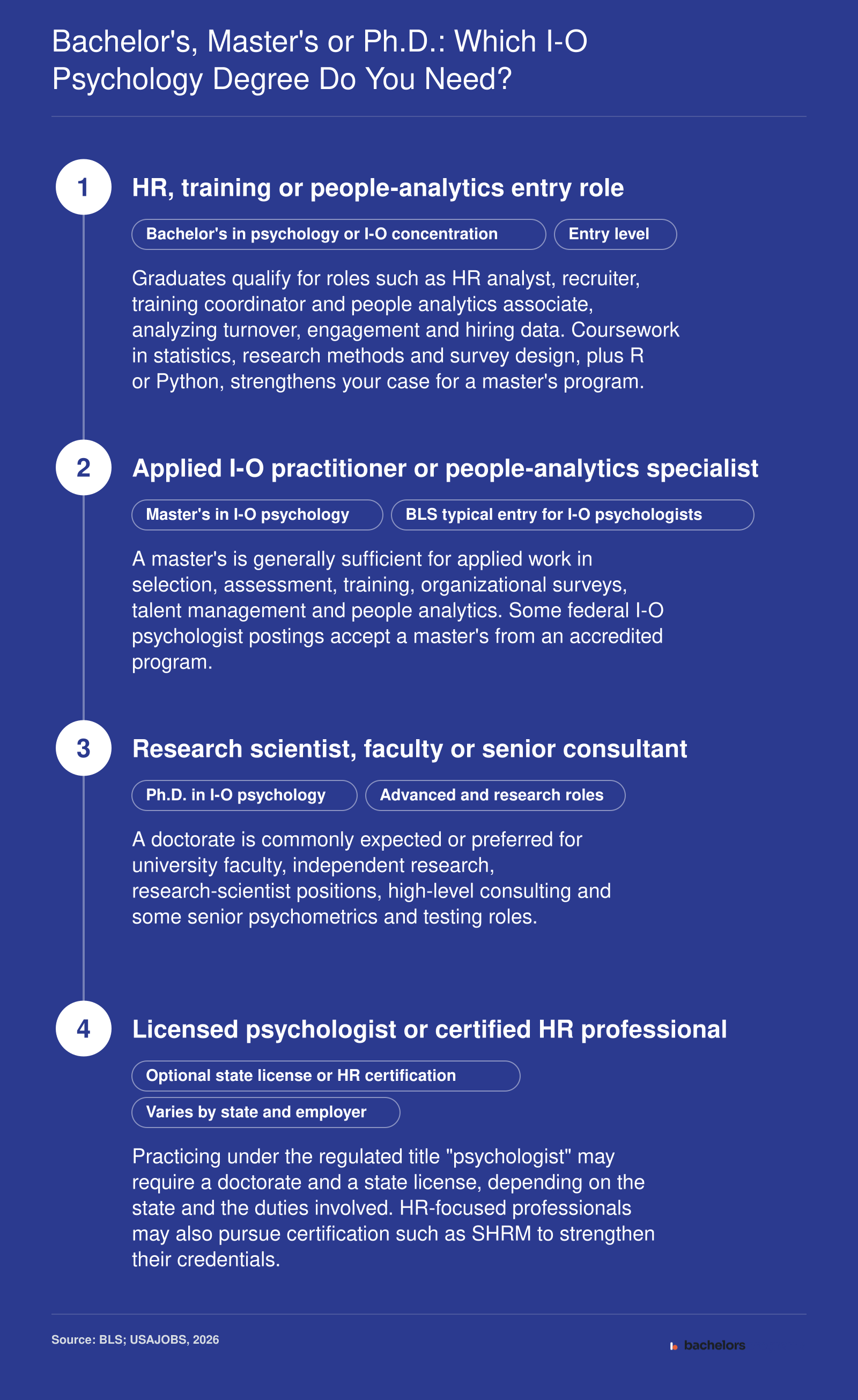
Bachelor's, Master's or Ph.D.: Which I-O Psychology Degree Do You Need?
Most practitioner I-O psychology roles expect a master's degree, which the Bureau of Labor Statistics lists as the typical entry-level education for industrial-organizational psychologists. A bachelor's in psychology or an I-O concentration is a stepping stone: it opens adjacent HR, training and people-analytics jobs, but it does not meet the entry requirement for the psychologist title itself.
IO Psychology Degree Salary and Job Outlook
I-O psychology pays well at the top, but the occupation is small and the biggest salaries go to relatively few people. The most recent occupation-specific benchmark from the Bureau of Labor Statistics (BLS) dates to May 2023. It puts the national median annual wage for industrial-organizational psychologists at $147,420, or $70.87 an hour. The 10th percentile earned $45,860 and the 90th percentile earned $219,810, so the spread is wide. The mean was $154,380.
Job Outlook and Competition
BLS projects 6% growth from 2025 to 2035, with employment rising from 4,000 to 4,300 jobs, an increase of about 300. An older BLS employment matrix showed a different base: 8,600 jobs in 2023 growing to 9,100 by 2033 (5.8%). The two sources use different years and the discrepancy is not explained, so treat the occupation as a few thousand positions at most. The May 2023 wage survey counted only 1,030 jobs. Either way, openings with the exact title are scarce and competitive.
Where the Pay Runs Highest
Among industries with published mean wages in May 2023, consulting led:
- Management, scientific and technical consulting: $169,890 (about 470 jobs)
- Local government, excluding schools and hospitals: $164,850
- Scientific research and development: $132,560
- Management of companies and enterprises: $127,950
BLS withholds some industry estimates, so this is not a full ranking. These wages also leave out nonproduction bonuses, employer benefit costs and self-employed workers.
Occupational Wages vs. Program-Graduate Earnings
These BLS figures describe people already working as I-O psychologists, typically with advanced training and experience. They are not the same as the College Scorecard earnings cited earlier for program graduates, which cover recent completers in all jobs, whatever their title. Expect the graduate figures to run lower.
Many master's graduates start in adjacent roles such as HR manager, training and development specialist or management analyst. Those jobs draw on the same skills in selection, assessment and organizational change, and they are the more common first step toward the $100,000-plus range.
Industrial Organizational Psychology programs by state
Quick Answers on I-O Licensure and Program Length
Do industrial-organizational psychologists need a state license to practice?
How many credit hours does an I-O psychology master's program usually require, and how long does it take?
What degree do you need to become an industrial-organizational psychologist?
Compare Industrial Organizational Psychology programs on the data that matters
Explore more Psychology majors or browse every field of study.
All Psychology programs Browse every field of study