Best Clinical Psychology Degree Programs
Compare 40+ accredited Clinical Psychology programs at 30+ colleges, with net price after aid, graduation rates, earnings and debt from IPEDS and the U.S. College Scorecard.

Can a bachelor's degree in clinical psychology lead directly to clinical work? Not by itself. Independent practice as a psychologist generally requires a doctorate, so the undergraduate years are about foundation, fieldwork, and a competitive graduate application.
The degree most commonly awarded is a Bachelor of Arts (B.A.) in Clinical Psychology. It pairs psychopathology and assessment coursework with liberal arts breadth, which suits students drawn to mental health work.
The ranking draws on federal cost and outcome data, and net price after aid varies by more than $30,000 a year. Format and fieldwork matter as much as the name on the diploma.
Key Points
- Yearly net price ranges from $10,411 (UCF) to $41,704 (Boston College).
- Many online options are general psychology majors with clinical concentrations.
- Licensure typically requires a doctorate, roughly 11 years past high school, per APA.
10 Top Schools for a Bachelor's Degree in Clinical Psychology
The ten schools below pair a clinical psychology pathway with a price after aid and a completion record that make the degree finishable. Some are large public universities with fully online tracks; others are small private colleges where a fieldwork placement is built into the major. What they share is a clear undergraduate route toward mental health work, whether that means a job after graduation or a graduate program later.
University of California-San Diego
#1La Jolla, CA · $10,000 – $15,000/yr (est.)
Best for: Research-focused students seeking clinical specialization
UC San Diego is a public research university on the La Jolla coast, and its psychology department connects to the UC San Diego School of Medicine's psychiatry department. Students aiming at clinical or research psychology careers are often steered toward the department's B.S. track instead, so the B.A. suits readers who want the clinical lens without the full science load.
- Covers causes and treatments of mental illness in children and adults
- 24 lower-division units including statistics and research methods
- 48 upper-division units with three specialization courses
- C- or better required in every major course
- 2.0 upper-division major GPA needed to graduate
- No more than three upper-division courses taken off campus
University of California-Irvine
#2Irvine, CA · $14,000/yr (est. net price)
Best for: Students comparing several psychology concentrations
UC Irvine is a public research university in Orange County where psychology sits inside the Department of Cognitive Sciences rather than a standalone psychology department. Undergraduates pick from four areas of study, clinical psychology among them, and build a science-heavy foundation with a statistics series, Scientific Python for Research, and two lab-based methods courses. An honors track adds a senior thesis and a poster symposium for students aiming at graduate study.
- Four concentration areas, including clinical psychology
- COGS 9A-9B fundamentals plus the 10A-10C statistics series
- COGS 14P Scientific Python for Research required
- Two research methods courses with labs
- Six science courses spanning at least three disciplines
- Honors track: 3.2 major GPA, senior thesis, poster symposium
- No double major permitted within the department
Indiana University-Bloomington
#3Bloomington, IN · $12,000 – $42,000/yr (est.)
Best for: Hands-on learners wanting clinical practicum experience
Indiana University Bloomington is a large public flagship in southern Indiana that offers a dedicated Clinical Psychological Science B.S. rather than a general psychology major. The curriculum layers psychopathology, assessment, and evidence-based treatment onto a base of neuroscience, cognitive science, and public health, and students get real exposure through practicum courses that place them at community mental health centers or in local school prevention programs. It also works as a pre-med path, with a behavioral science foundation that supports MCAT preparation.
- Specialized coursework in psychopathology and assessment
- Practicum shadowing clinicians at community mental health centers
- Prevention program placements in local schools
- Electives in clinical skill acquisition and mindfulness interventions
- Clinical science lab research experience available
- Prepares for graduate work in clinical psychology, social work, or public health
- Bachelor-level roles include case manager and research assistant
University of Central Florida
#4Orlando, FL · ~$10,000/yr (est.)
The University of Central Florida is a large public university in Orlando whose psychology department runs a clinical psychology track that can be completed fully online, a rarity among the schools on this list. A capstone and career readiness coursework round out the degree, and research, volunteering, and internship options give students a way to add experience alongside the coursework. It is a practical fit for working adults and transfer students who need scheduling flexibility.
- Fully online option available
- 120 total credit hours
- 15-16 credits in the clinical psychology track
- Three start dates per year: fall, spring, and summer
- Capstone required
- Departmental residency of 21 upper-level hours
- Honors in the Major available
Tufts University
#5Medford, MA · ~$40,000/yr (est.)
Tufts University is a private research university just outside Boston with a small undergraduate college and a reputation for close faculty contact. Its clinical psychology major is compact at twelve courses, blending psychopathology and psychological evaluation with statistics, experimental psychology, and a senior capstone sequence. Students can add related field courses or an independent study, and the Boston area's hospital and clinic network gives the clinical orientation somewhere to land.
- 12 courses total, including a senior capstone sequence
- Required coursework in psychopathology and psychological evaluation
- Two related field courses, with an independent study option
- AP or IB credit can satisfy the introductory course
- Small classes with access to faculty office hours
- Prepares for graduate study or work with psychiatric patients
Boston College
#6Chestnut Hill, MA · ~$42,000/yr (est.)
Boston College is a private Jesuit research university in Chestnut Hill with a psychology department that treats clinical training as an upper-division specialization rather than a separate major. Undergraduates apply during junior year, then combine psychopathology and clinical psychology coursework with a fieldwork placement and two advanced electives. Research experience is strongly encouraged, and the concentration appears on the final transcript.
- Open to psychology and neuroscience majors
- Apply junior year by March 15, with decisions by April 1
- PSYC3336 Clinical Psychology plus an introduction to psychopathology
- PSYC4436 Clinical Fieldwork in Psychology required
- Two 3000-level psychology electives required
- At least two semesters of research strongly recommended
- Concentration noted on the final transcript
George Mason University
#7Fairfax, VA · $15,000 – $20,000/yr (est.)
George Mason University is a public research university in Fairfax, Virginia, just outside Washington, D.C. Its psychology B.A. offers nine concentrations, and the clinical one requires clinical psychology and psychopathology plus electives such as behavior modification and therapeutic communication. A foreign language requirement and an honors thesis option give the degree a liberal arts frame, and the department points to its capital region location for policy-relevant research.
- Nine concentration options within the psychology B.A.
- 12 credits in the clinical psychology concentration
- Required Clinical Psychology and Psychopathology courses
- Electives include Behavior Modification and Therapeutic Communication
- Minimum 2.00 GPA required in the concentration
- Honors thesis can substitute for a concentration course
- 120 total credit hours with a foreign language requirement
Lehigh University
#8Bethlehem, PA · ~$37,000/yr (est.)
Lehigh University is a private research university in Bethlehem, Pennsylvania, with a psychology B.S. built as a structured behavioral science major rather than a loose liberal arts degree. The clinical and behavioral health concentration adds psychopathology, assessment, and intervention to a base of math, computer science, and natural science coursework. The science load is heavy and elective room is limited, which suits students aiming at graduate study or a health profession.
- Four concentration options within the B.S.
- Clinical and behavioral health focus on psychopathology and intervention
- Requires coursework in math or computer science
- Strong natural science base for pre-med and allied health paths
- Limited elective opportunity in a highly structured major
- Prepares for graduate study in psychology
Franciscan University of Steubenville
#9Steubenville, OH · ~$24,000/yr (est.)
Franciscan University of Steubenville is a private Catholic university in eastern Ohio that teaches psychology through a faith-and-reason lens. The clinical psychology major pairs a 150-hour senior internship with a thesis or capstone and offers optional minors in neuroscience or psychology. Both campus and online versions exist, and graduates commonly continue into clinical mental health counseling or doctoral psychology programs.
- 150-hour senior internship required
- Senior thesis or capstone seminar option
- Research opportunities alongside faculty
- Neuroscience or psychology minor available
- Psi Chi honor society membership
- Study abroad in Austria
- Catholic faith-based curriculum
- 61-66 credit hours required
- Four-year online format
- Rolling admissions with fall, spring, and summer starts
- Entrance exam required, with no letters of recommendation needed
- $0 application fee
- 150-hour optional internship
- Thesis or capstone option
University of Massachusetts-Lowell
#10Lowell, MA · ~$17,000/yr (est.)
UMass Lowell is a public university northwest of Boston with a psychology department that runs a distinct clinical concentration inside its B.A. program. The concentration adds developmental psychopathology and a practicum placement to a research methods and statistics sequence, and students must hold a 3.0 GPA both overall and in psychology to stay in it. A world language track runs alongside the major requirements, and a sample four-year pathway helps students finish on schedule.
- 123 total credit hours
- 3.0 GPA required overall and in psychology
- Concentration practicum included
- Coursework in developmental psychopathology and research methods
- World ready language track
- Grade of C or better in key courses
- Sample four-year pathway with faculty adviser guidance
Cost & outcomes by school
Federal data for the highest-earning Clinical Psychology programs, independent of the ranking above. Earnings are this field's bachelor's graduates four years after completing where the Scorecard reports them, else the school's undergraduate median.
| School | Net price / yr | Grad rate | Earnings | Debt | Grads/yr | Format |
|---|---|---|---|---|---|---|
| Lehigh University PA | $36,931 | 88% | $105,584 | $21,960 | — | Campus |
| Drexel University PA | $38,509 | 78% | $84,648 | $25,325 | — | Campus |
| Tufts University MA | $39,998 | 94% | $83,214 | $16,250 | 34 | Campus |
| University of Illinois Urbana-Champaign IL | $14,355 | 85% | $81,054 | $19,500 | — | Campus |
| University of California-Irvine CA | $14,251 | 87% | $80,735 | $15,000 | — | Campus |
| George Mason University VA | $17,915 | 68% | $76,343 | $19,500 | — | Campus |
| Boston College MA | $41,704 | 91% | $76,328 | $17,223 | 116 | Campus |
| Los Angeles Pacific University CA | $22,677 | 21% | $71,935 | $12,500 | 38 | Online |
| Lawrence Technological University MI | $32,918 | 61% | $69,151 | $27,000 | — | Campus |
| University of Massachusetts-Lowell MA | $17,163 | 65% | $64,874 | $23,704 | — | Campus |
| Indiana University-Bloomington IN | $16,264 | 80% | $63,742 | $19,509 | 81 | Campus |
| Walsh University OH | $20,493 | 59% | $59,764 | $27,000 | — | Campus |
Sources: U.S. Department of Education. Net price, graduation rate, earnings and debt: College Scorecard (earnings and debt for this field's bachelor's graduates where reported, else school-wide); graduates: IPEDS. A dash means no figure is reported.
Cost, debt & payoff
Median earnings of this field's bachelor's graduates (4 yrs after completing, else the school's undergraduate median) vs. their median federal loan debt · U.S. College Scorecard
Across these programs the median graduate earns about $53,615 and finishes with roughly $24,580 in debt — a ratio that clears a common rule of thumb (keep debt below first-year salary). Net price and debt vary widely school to school, so check the per-school figures in the table above before you shortlist.
Behind the List: What Earned Each School Its Spot
Net price across these clinical psychology programs runs from $10,411 a year at the University of Central Florida to $41,704 at Boston College, a gap that can reshape a college list. That gap is why the schools on this list stand out: each pairs a workable price with outcomes a family can check.
The Numbers That Matter
Average net price reflects what students pay after grant aid, not sticker tuition. Retention at these schools runs from 84% to 96%, and graduation rates from 64.8% to 93.5%, both signals of whether students stay and finish. Admission rate tells you how accessible a program is, while Pell share shows how many students come from lower-income backgrounds. Where program-level earnings and debt figures are published, they show what graduates earn and borrow. Each profile also flags campus, online, or hybrid format, so you can spot the delivery style you need at a glance.
Where the Data Stops
Both the graduation rate and the net price describe the whole institution, not the clinical psychology major. Earnings data is not published for every program, so some profiles lean on cost and completion instead. Treat each figure as a question for admissions and financial aid offices, not a final verdict.
How a B.A. in Clinical Psychology Differs From a General Psychology Major
Start with the transcript. Clinical-track curricula tend to build around the same handful of courses: abnormal psychology (psychopathology), psychological assessment and testing, research methods and statistics, counseling or intervention fundamentals, and ethics. Tufts requires 12 courses for its clinical psychology major, eight of them specified, plus two psychology electives and two related-field courses.1 Marywood's Psychology-Clinical Services program (a B.S., so the label varies by school) includes a 12-credit clinical block covering clinical psychology, field placement, and assessment and testing.3
Where the General Major Spreads Out
A general psychology degree usually distributes advanced work across learning and cognition, social and personality, biological, and developmental areas. Penn State's B.A. is a good example: at least 15 credits at the 400 level, and at least 3 credits in each of six categories.2 A clinical B.A. narrows those electives toward mental health, diagnosis, and treatment. The general degree keeps more breadth; the clinical one trades some of it for depth.
Practicum and Capstone Experience
Applied work is where clinical programs stand out, though requirements differ. Marywood runs a spring field placement in settings such as crisis services, hospice, veterans programs, and schools.3 Tufts culminates in senior capstones.1 California Lutheran's B.A. in Psychology with Clinical and Behavioral Applications offers practicum options, though its Clinical Practicum is permission-only.4 Penn State lists practicum among its capstone choices, so it is an option there, not a universal requirement.2 Confirm hours and eligibility with each school.
Same Graduate Paths, Different Signal
Both degrees lead to the same graduate routes: master's programs in counseling or social work, and doctoral study in psychology. The clinical label signals focus and preparation. It is not a professional credential, and it does not license you to practice.
Related Articles
Campus, Online, or Hybrid: Which Format Gets You Real Field Experience?
Online psychology degrees now far outnumber programs that carry a true "clinical psychology" label, so field experience is where you should look hardest before enrolling. Many online options are general psychology majors with clinical or mental-health tracks, and their practicum rules vary.
Programs That Name a Field Requirement
- Brenau University: The online B.S. in Psychology lists 100 hours of fieldwork through a capstone.1 Ask whether the school arranges placement or you find your own site.
- Palo Alto University: The online B.S. includes a six-month senior internship at nonprofit or community agencies, with an in-person internship option.
- Southern Illinois University Carbondale: The 100% online B.A. advertises a hands-on practicum.2 Confirm how it works for students who live far from campus.
- FranU: Students can pursue an internship or practicum with community partners.3
Programs Where the Requirement Is Less Clear
Montclair State's online B.A. is fully asynchronous, and American Public University's B.A. starts monthly with 8 to 16 week courses. Neither program's published information identifies a required placement. Maryville's 100% online B.A. includes applied experience, and UT Permian Basin lists a 3-credit, 16-week course called Clinical Practice and Mental Health Therapy.4 In both cases, ask admissions whether the experience is supervised and whether it happens in person.
What a Structured Model Looks Like
For contrast, Fort Hays State's online/hybrid clinical program is a master's degree, not a bachelor's. It pairs five-day on-campus workshops with 15 practicum and internship credits and a 600-hour off-campus internship.5 Bachelor's programs rarely go that far.
If hands-on exposure matters to you, put three questions to every admissions office: Is the placement required? Who finds the site? Can you complete it near home? A campus or hybrid format usually makes supervision easier to arrange. An online degree can work well too, but only if the field component is written into the curriculum.
Lowest Debt, Strongest Payoff: Three Clinical Psychology Programs Worth a Look
These schools pair modest borrowing with strong long-term earnings, based on 2024 federal data from IPEDS and the College Scorecard. Debt and earnings figures are school-wide, not specific to the psychology major. Both University of California campuses keep median debt near $15,000 with net prices under $15,000 a year, while Boston College costs more but posts the highest median earnings and graduation rate.
| School | Location | Program | Average Annual Net Price | Median Debt at Graduation | Median Earnings 10 Years After Entry | Graduation Rate |
|---|---|---|---|---|---|---|
| University of California-San Diego | La Jolla, CA | Clinical Psychology B.A. | $12,470 | $15,500 | $84,943 | 86.0% |
| Boston College | Chestnut Hill, MA | Concentration in Clinical Psychology | $41,704 | $19,000 | $103,937 | 90.8% |
| University of California-Irvine | Irvine, CA | Psychology, B.S. | $14,251 | $15,000 | $80,735 | 86.9% |
Questions to Ask Yourself
Does the program line up practicum sites for you, or will you have to secure a placement on your own?
Are you aiming for a clinical PhD or a PsyD, and does this program give you research experience toward that?
Could a lower-net-price public university with similar graduation rates cut your debt before graduate school?
Do you need a specific concentration, such as substance use treatment or child and family work, that only some programs offer?
Psychiatric Technician Pay at a Glance
Psychiatric technician work is a direct way to apply a bachelor's degree in clinical psychology in a treatment setting.
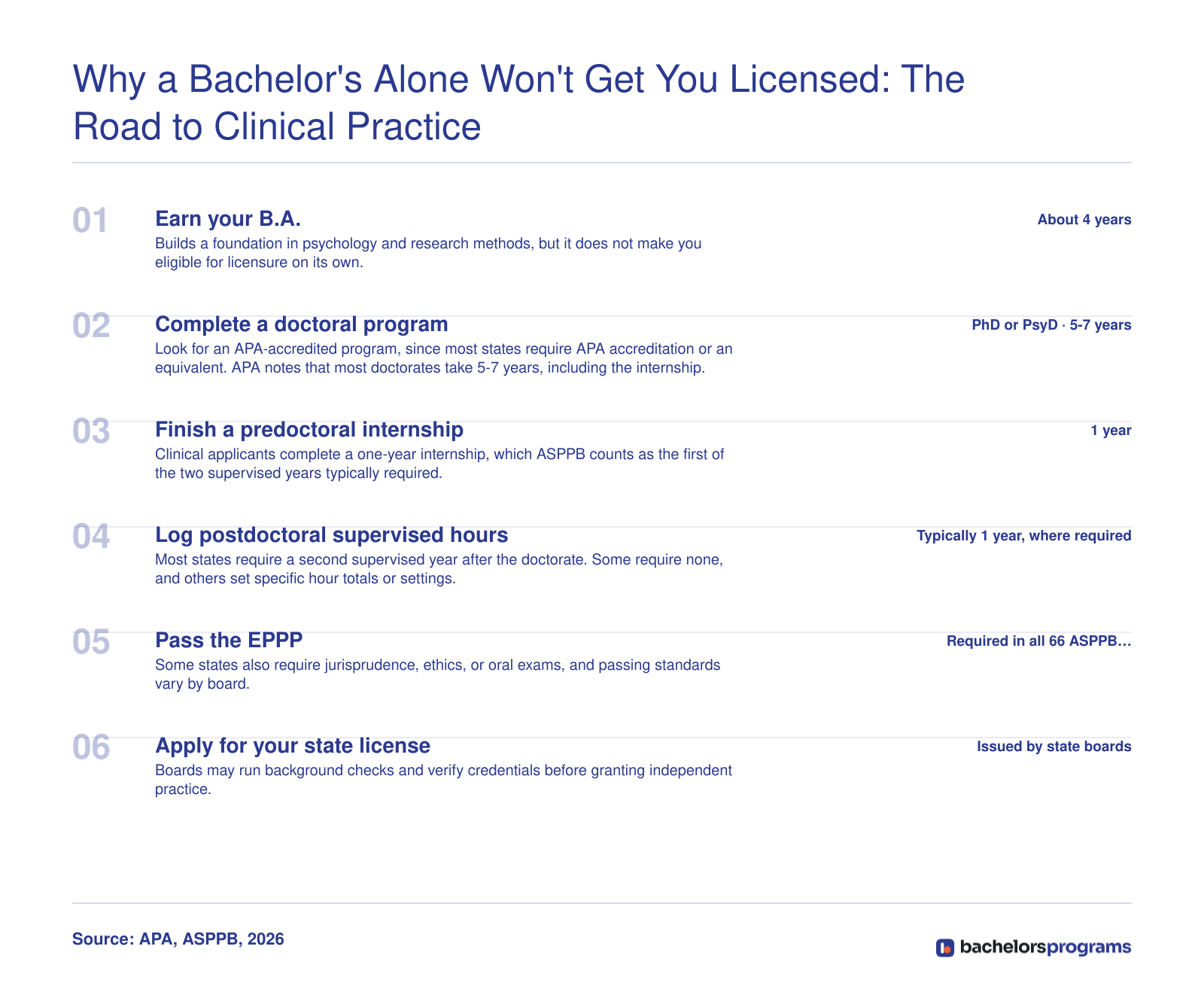
Why a Bachelor's Alone Won't Get You Licensed: The Road to Clinical Practice
A bachelor's degree in clinical psychology is the first step, not the finish line. Most states require a doctorate for independent practice, and APA estimates the full route at roughly 11 years after high school. State boards set the final hour and exam rules, so confirm the details with your own state board, and if you want a shorter route into counseling, compare master's-level licenses such as the LPC or LMFT.
Clinical Psychology programs by state
Clinical Psychology Degree Questions, Answered
These quick answers cover the questions students ask most when comparing a bachelor's degree in clinical psychology across schools. Figures come from the latest federal data and program requirements, so check each school for current details.
How much does a bachelor's degree in clinical psychology cost after financial aid?
Can you earn an online bachelor's in clinical psychology and still complete hands-on hours?
Do clinical PhD and PsyD programs require a clinical psychology major, or will any psychology bachelor's work?
Compare Clinical Psychology programs on the data that matters
Explore more Psychology majors or browse every field of study.
All Psychology programs Browse every field of study