Best Addiction Psychology Degree Programs
Compare 30+ accredited Addiction Psychology programs at 20+ colleges, with net price after aid, graduation rates, earnings and debt from IPEDS and the U.S. College Scorecard.
Colorado's CAC-I credential path, built into Colorado State University's addictions counseling concentration, shows how the field really works: a bachelor's degree in addiction psychology qualifies graduates for entry-level roles such as technician or case aide, and little more on its own.
Treatment programs do need trained staff. But independent practice as a licensed counselor generally requires a master's degree, an exam and supervised hours, so a bachelor's degree is only the first step.
The real choice is how well a program's coursework, cost and format fit the state credential you plan to pursue, since boards set their own education requirements.
Key Points
- Independent licensure as an LPC or LADC typically requires a counseling master's.
- Southern New Hampshire, Liberty and Purdue Global deliver addiction coursework online.
- Compare coursework hours against your state board's list before applying.
Best Schools for a Bachelor's Degree in Addiction Psychology
These programs come in two shapes: standalone addiction studies degrees and psychology degrees with an addictions concentration. Both cover the same core ground, including assessment, counseling skills and the biology of addiction, but they differ in how much of the degree is devoted to addiction coursework and how directly they map onto state certification.
Colorado State University-Fort Collins
#1Fort Collins, CO · ~$21,000/yr (est.)
Best for: Coloradans aiming for state counselor certification
Colorado State pairs a research university psychology core with an Addictions Counseling concentration built around Colorado's addiction counselor certification steps. Students take an applied counseling skills lab and a required internship, so the degree mixes classroom theory with supervised practice in treatment settings. The school graduates about 67% of students, and the department runs clinics and community partnerships that support field placements. It suits Colorado residents who want a campus-based route into addiction counseling or a foundation for graduate study.
- Addictions Counseling concentration inside the psychology major
- Prepares students for Colorado's Certified Addiction Counselor I credential
- Required internship and placement in a treatment setting
- Applied basic counseling skills lab
- Five concentration options within the psychology major
- Path continues to CAC-II and CAC-III levels
- Prerequisite courses required before the concentration
University of New Hampshire
#2Durham, NH · $24,000/yr (est. net price)
Best for: Working adults wanting fully online study
New Hampshire's flagship public university delivers its Applied Psychology degree with an Addictions Studies option entirely online through Granite State College. The 120-credit curriculum covers the biology of addiction, counseling foundations and work with special populations, capped by an internship or project. About 76% of students graduate. It suits adults who need a fully online degree that still leads to addiction counseling employment or graduate study.
- 120 credit hours delivered online through UNH Granite State College
- Capstone with internship or project options
- Coursework in the biology of addiction and addiction counseling foundations
- Covers cognitive, biological, developmental and sociocultural theories
- Includes a course on special populations in addiction
- Prepares for addiction counseling jobs or graduate study
University of Central Arkansas
#3Conway, AR · $15,000 – $20,000/yr (est.)
Best for: Arkansas students seeking a local program
Central Arkansas awards the state's only bachelor's degree in addiction studies, and its Treatment concentration is the deeper of the program's two tracks. Coursework runs from counseling theory and assessment to group skills, family systems and behavioral addictions, with a substance abuse practicum before graduation. The school graduates about 54% of students. It fits Arkansas students who want a campus program that maps directly onto alcohol and drug counselor certification and into hospitals, clinics and drug courts.
- Only bachelor's degree of its kind in Arkansas
- Treatment concentration requires 32 credit hours
- Coursework in counseling theory, assessment, group skills and family systems
- Substance abuse practicum for supervised clinical experience
- Prepares for Alcohol and Drug Counselor certification
- Two concentration options within the major
- Graduates work in hospitals, outpatient clinics, drug courts and employee assistance programs
Virginia Commonwealth University
#4Richmond, VA · ~$23,000/yr (est.)
Virginia Commonwealth pairs a full psychology major with an Addiction Studies concentration, so graduates leave with both a broad science foundation and addiction-specific training. Fieldwork in human services and a capstone sit alongside courses on theories of addiction, treatment approaches and the pharmacological effects of drugs. About 63% of students graduate. The program suits students who want a campus degree in an urban setting with plentiful community mental health and substance use agencies nearby.
- 120 credit hours with a 2.0 GPA minimum
- Theories of addiction and treatment of addiction courses
- Fieldwork in human services plus a capstone course
- Covers pharmacological effects of drugs and evidence-based protocols
- Addresses socioeconomic factors that shape recovery
- Three psychology content domains required
Liberty University
#5Lynchburg, VA · ~$29,000/yr (est.)
Liberty runs addiction-focused psychology degrees both fully online and on its Lynchburg campus, so students can choose a pace and format that fits their life. The online version uses 8-week courses with no set login times, while the residential track adds a required internship and faculty research mentorship. The school graduates about 65% of students. It suits students who want faith-integrated counselor training, generous transfer credit and military-friendly policies.
- Fully online with 8-week courses and no set login times
- 120 credit hours; transfer up to 75% of the degree
- Faith-integrated approach to addiction counseling
- Covers biological and sociocultural factors in addictive behavior
- Prepares for addiction counselor and rehabilitation counselor roles
- No entrance exam required
- Campus track with a required internship for real-world experience
- Christ-centered coursework with faculty research mentorship
- Test optional admission
- Psychology club and academic trips abroad available
- SACSCOC-accredited institution
Keene State College
#6Keene, NH · $18,000/yr (est. net price)
Keene State houses its addiction training inside a Health Sciences degree, with the Addiction option one of three tracks in the major. The 32-credit option covers addiction theory, counseling skills, drug fundamentals and co-occurring disorders, and it finishes with a capstone plus an optional practicum. About 60% of students graduate. It suits students in northern New England who want a small-college campus experience and a direct path into entry-level addiction and case management work.
- Addiction option requires 32 credit hours
- One of three options inside the health sciences major
- Coursework in addiction theory, counseling skills and co-occurring disorders
- Alcohol and other drug fundamentals course
- Capstone required; practicum opportunity available
- Covers New Hampshire licensure and certification requirements
- Internship application required
- 40 upper-level credits required within the 120 total
Purdue University Global
#7West Lafayette, IN · $5,000 – $10,000/yr (est.)
Purdue University Global offers a fully online psychology in addictions degree built for adults who are already working. The program is accredited by the National Addiction Studies Accreditation Commission, prepares students for national addiction counselor certification exams, and offers both business foundations and practicum tracks. Half of students graduate. It suits working adults who need flexible terms, credit for prior college and a national certification pathway.
- 180 quarter credit hours with a capstone
- Accredited by the National Addiction Studies Accreditation Commission
- Approved education provider for addiction counseling continuing education
- Prepares students for national addiction counselor certification exams
- Advanced start credit for a prior degree
- Optional peer recovery support specialist credential
- Business foundations concentration inside the addictions degree
- Prepares for NCC AP Level I and Level II certification
- Employer tuition reimbursement supported
- Prior learning credit accepted
- Practicum track adds supervised field experience
- Prepares for peer recovery support specialist certification
- Three-week no-cost trial period
- Military tuition reduction available
Columbia Southern University
#8Orange Beach, AL · $15,000/yr (est. net price)
Columbia Southern wraps addiction training into a human services degree aimed at adults moving into treatment centers, social service agencies and community outreach. Courses cover risk factors, the physiology of substance abuse, intervention, prevention and counseling techniques, and new sessions start 11 times a year. About 33% of students graduate. It suits working adults who want a flexible online path with textbooks included in tuition and plenty of room for transfer credit.
- $278 per credit hour with textbooks included
- 120 credit hours; up to 90 transfer credits accepted
- 11 start dates per year, fully online
- Coursework in risk factors and physiological effects of substance abuse
- Covers intervention, prevention and counseling techniques
- SACSCOC-accredited institution
Arizona State University
#9Scottsdale, AZ
Arizona State runs its Substance Abuse and Addictions concentration inside a counseling and applied psychological science degree, and it is offered both on campus and online. The 40-course sequence moves quickly on 7.5-week terms and includes 135 clinical hours plus coursework in diagnosis, assessment and treatment planning. It suits students who want a large research university's resources and a program designed to lead into graduate-level counseling licensure.
- 120 credit hours across 40 courses, each 7.5 weeks long
- Offered both on campus and online
- 135 clinical hours included
- Coursework in diagnosis, assessment and treatment planning
- Described as the first program of its kind at a major research university
- Prepares students for graduate study toward state counseling licensure
- Test optional with no entrance exam required
Southern New Hampshire University
#10Manchester, NH · $37,000/yr (est. net price)
Southern New Hampshire offers a 120-credit online psychology degree with an Addiction Studies concentration and no application fee, essay or test requirement. Eight-week terms and a free transfer credit evaluation make it easy to start with existing college work, and the university is an approved provider of addiction counseling continuing education. About 43% of students graduate. It suits students who want a low-friction online start, with the clear caveat that the degree does not lead directly to licensure.
- 120 credit hours; transfer up to 90 credits
- $354 per credit, about $42,480 for the full degree
- 8-week terms, no application fee, no test scores and no essay
- Addiction Studies is one of five concentration options
- 12-credit embedded certificate in Data Literacy in Psychology
- Approved provider of addiction counseling continuing education
- Does not lead directly to licensure
Cost & outcomes by school
Federal data for the highest-earning Addiction Psychology programs, independent of the ranking above. Earnings are this field's bachelor's graduates four years after completing where the Scorecard reports them, else the school's undergraduate median.
| School | Net price / yr | Grad rate | Earnings | Debt | Grads/yr | Format |
|---|---|---|---|---|---|---|
| United States University CA | — | — | $80,980 | $15,244 | — | Online |
| University of New Hampshire NH | $23,805 | 76% | $66,479 | $26,814 | — | Online |
| University of New Hampshire College of Professional Studies Online NH | $10,864 | 30% | $66,479 | $26,814 | — | Online |
| Arizona State University AZ | $14,967 | 68% | $62,668 | $19,500 | — | Online or campus |
| Arizona State University AZ | — | — | $62,668 | $19,500 | — | Online or campus |
| Colorado State University-Fort Collins CO | $21,279 | 67% | $60,543 | $20,000 | — | Campus |
| Virginia Commonwealth University VA | $23,433 | 63% | $58,128 | $21,500 | — | Campus |
| Southern New Hampshire University NH | $36,708 | 43% | $57,701 | $21,584 | 39 | Online |
| University of Jamestown ND | $19,567 | 49% | $56,621 | $27,000 | — | Campus |
| Ottawa University-Ottawa KS | $27,963 | 28% | $55,552 | $21,500 | — | Online |
| Union Adventist University NE | $23,716 | 52% | $55,045 | $27,000 | — | Campus |
| Keene State College NH | $17,887 | 60% | $54,368 | $25,749 | 3 | Campus |
Sources: U.S. Department of Education. Net price, graduation rate, earnings and debt: College Scorecard (earnings and debt for this field's bachelor's graduates where reported, else school-wide); graduates: IPEDS. A dash means no figure is reported.
Cost, debt & payoff
Median earnings of this field's bachelor's graduates (4 yrs after completing, else the school's undergraduate median) vs. their median federal loan debt · U.S. College Scorecard
Across these programs the median graduate earns about $50,567 and finishes with roughly $24,750 in debt — a ratio that clears a common rule of thumb (keep debt below first-year salary). Net price and debt vary widely school to school, so check the per-school figures in the table above before you shortlist.
How We Ranked These Addiction Psychology Programs
Every school below had to prove its value in dollars, completion and outcomes, not brochure copy. Competing lists rarely show their criteria, so you can't tell whether a top spot reflects quality or marketing. Here is what went into this one.
What We Measured
- Net price: what students pay on average after grants and scholarships, not the sticker price.
- Graduation rate: the share of students who finish at the institution.
- First-year retention: how many students return for a second year, an early sign of whether a school supports them.
- Earnings and debt: program-level earnings and federal debt from the College Scorecard, used where the U.S. Department of Education publishes them.
- Pell share: the portion of students receiving Pell Grants, read as a signal of access for lower-income students.
What the Numbers Can and Cannot Tell You
Both figures are institution-wide averages. They describe the whole school, not the addiction psychology program specifically, and they are not a personal quote. Your own cost depends on your aid package, transfer credits and household finances, so request a net price estimate from any school you're considering.
Online, campus and hybrid formats were all eligible. Some schools appear more than once because they offer more than one program listing, such as separate online and on-campus versions. Use the list to start comparing, then confirm the details with each admissions office.
Lowest-Cost Addiction Psychology Degrees by Average Net Price
Average net price, drawn from federal IPEDS and College Scorecard data, is what students actually paid after grants and scholarships, so your own addiction psychology degree cost will rise or fall with family income. The programs below post the lowest averages in this ranking, from $7,770 at Purdue University Global to $14,580 at Columbia Southern University, and every other ranked school averages more, with Purdue Global also showing the highest graduation rate of this group at 50%. Before you commit, run each school's net price calculator with your own finances, and ask admissions about military or veteran tuition rates and whether GI Bill benefits apply to the program.
| School | Program | Format | Total Credits | Average Net Price | Graduation Rate |
|---|---|---|---|---|---|
| Purdue University Global (West Lafayette, IN) | Bachelor of Science in Psychology in Addictions | Online | 180 | $7,770 | 50% |
| University of New Hampshire College of Professional Studies Online (Manchester, NH) | Applied Psychology Major: Addictions Studies Option | Online | 120 | $10,864 | 30% |
| Columbia Southern University (Orange Beach, AL) | B.S. Human Services: Substance Abuse and Addiction | Online | 120 | $14,580 | 33% |
Earning an Addiction Psychology Degree Online: Practicum, Pacing and Transfer Credits
Yes, you can earn an addiction psychology degree online, and several ranked schools deliver coursework that way, including Southern New Hampshire University, Liberty University, Purdue Global, Columbia Southern University and the University of New Hampshire. Arizona State University lists both online and on-campus formats, while Colorado State, Central Arkansas, Virginia Commonwealth and Keene State are campus-based.
Pacing: 8-Week Terms and Flexible Logins
SNHU runs its online B.A. in Psychology (Addictions concentration) and its B.A. in Human Services (Substance Abuse concentration) in 8-week terms.1 Classes have no set meeting times, so the format is asynchronous.2 Liberty also lists 8-week courses with no set login times. Shorter terms mean fewer classes at once but a faster weekly pace. We could not verify term length or live-session rules at the other online schools, so ask admissions before you apply.
Practicum and Fieldwork
Online often describes the classes, not the hands-on training. Colorado State requires an internship, Keene State offers a practicum, VCU includes fieldwork in human services, and Purdue Global has a practicum track. SNHU does not publish a required hour total for its addiction programs, though the Human Services concentration ends with a capstone. Neither SNHU program has an established on-campus residency requirement. Ask any online school how a local treatment-site placement is arranged and who finds the supervisor.
Transfer Credits
Prior credits and associate degrees can shorten the path. SNHU accepts up to 90 of the 120 credits, offers a free evaluation, and requires at least 30 credits completed at SNHU, 12 of them in the major.3 Columbia Southern also accepts up to 90 transfer credits, and Liberty lets you transfer up to 75 percent of the degree.
Fully Online or Hybrid?
SNHU, Liberty, Columbia Southern and ASU all list online options. Campus-based programs expect you on site. Confirm which format each school actually offers before you enroll.
Related Articles
Psychology With an Addictions Concentration or a Standalone Addiction Studies Degree?
The ranked list includes both degree types, and you can tell them apart by the concentration field listed for each school. A psychology degree with an addictions concentration keeps graduate options broader, while a standalone counseling-focused degree often maps more directly to credential coursework. Federal labor data does not separate these paths, so treat the differences below as general patterns and confirm details with each program and your state board. Rule of thumb: choose psychology with a concentration if graduate school is likely, and choose a standalone counseling or addiction studies degree if you want the shortest route to credential coursework and entry-level work.
| Factor | BA/BS Psychology with Addictions Concentration | BS Addiction Studies | BS Substance Abuse Counseling |
|---|---|---|---|
| Core coursework focus | Broad psychology (research methods, abnormal and developmental psychology) plus a short sequence of addiction electives | Addiction science, prevention, treatment models, and recovery support | Counseling skills, assessment, ethics, and treatment planning for substance use disorders |
| Fit for graduate study in psychology or counseling | Strongest. Psychology is a common undergraduate field for mental health counselors, and most psychologist roles require graduate training | Workable for counseling programs, though psychology prerequisites may need to be added | Workable for counseling programs, though research and statistics coursework varies by school |
| Alignment with state counselor education hours | Partial. Concentration courses may count, but gaps often remain | Often good, but varies by state and program | Usually the closest match, since coursework is built around credential requirements |
| Typical career entry points | Social and human service assistant, case management, and support roles (median pay of $45,930 as of May 2025 for assistants) | Recovery support, prevention, and community outreach roles, with eligibility depending on state rules | Entry-level addiction counseling roles where states allow a bachelor's degree, since the minimum for substance abuse counselors is at least a bachelor's degree |
| Typical degree title | BA or BS in Psychology (addictions concentration) | BS in Addiction Studies | BS in Substance Abuse Counseling |
| Longer-term licensure outlook | Psychologist licensure typically needs a graduate degree, and counselor entry often requires a master's | Counselor licensure generally requires state-specific steps beyond the bachelor's degree | Some counselors need a state-issued license, so check your board's requirements |
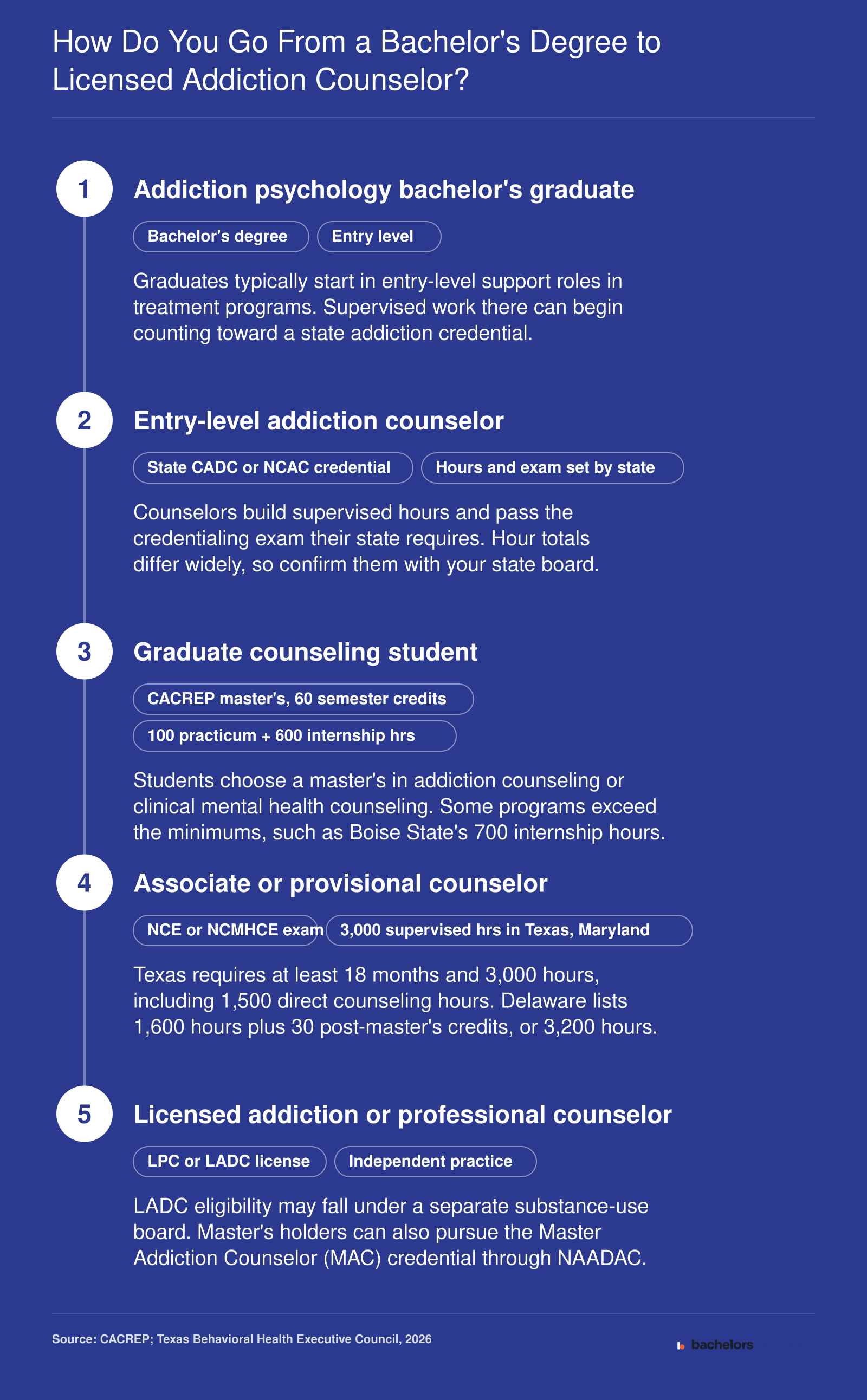
How Do You Go From a Bachelor's Degree to Licensed Addiction Counselor?
A bachelor's degree in addiction psychology is the first rung, not the last. Independent licensure as an LPC or LADC typically requires a counseling master's, an exam and post-master's supervised hours, and each state board sets its own totals.
Median Pay for Substance Abuse and Behavioral Disorder Counselors
Federal wage data gives a useful benchmark for the career a bachelor's degree in addiction psychology can lead toward.
Checklist for Choosing an Addiction Psychology Program
Use this list to compare a bachelor's degree in addiction psychology on the points that affect credentialing, cost and your next step.
- Accreditation confirmedVerify regional or national institutional accreditation first. If the program also holds National Addiction Studies Accreditation Commission (NASAC) accreditation, that is a plus.
- Coursework matches state hoursCompare the addiction-specific courses with your state board's required education hours for counselor certification.
- Practicum or internship includedLook for supervised field hours built into the degree. Online students should ask whether the school helps place them at approved local sites.
- Transfer credits fitAsk for an unofficial credit evaluation so you know how many prior or associate-degree credits will count.
- Format fits your scheduleDecide whether asynchronous online, hybrid or campus classes match your work and family commitments.
- Net price checked against aidWeigh the net price after grants and scholarships, along with any military and veteran benefits you qualify for.
- Clear graduate pathwayConfirm that the degree prepares you for a master's in addiction counseling or clinical mental health counseling if you plan to seek licensure.
- Next stepRequest information from two or three shortlisted programs and compare their answers side by side.
Addiction Psychology programs by state
Addiction Psychology Degree Questions Students Ask Most
Do you need a master's degree to become an addiction counselor?
How much do addiction counselors make?
Can you earn a bachelor's degree in addiction psychology fully online?
Which jobs can you get with a bachelor's in addiction psychology?
How is addiction psychology different from an addiction counseling degree?
Can bachelor's coursework count toward CADC education hours?
Can people in recovery use lived experience to become a certified peer recovery specialist?
Compare Addiction Psychology programs on the data that matters
Explore more Psychology majors or browse every field of study.
All Psychology programs Browse every field of study