Best Sport Psychology Degree Programs
Compare 40+ accredited Sport Psychology programs, with net price after aid, graduation rates, earnings and debt from IPEDS and the U.S. College Scorecard.

Can a bachelor's in sport psychology qualify you to work as a mental performance consultant? Not by itself. The Certified Mental Performance Consultant (CMPC) credential from the Association for Applied Sport Psychology requires a master's degree plus mentored hours, and licensure as a psychologist requires a doctorate.
Undergraduate options still vary widely: full majors, psychology concentrations, kinesiology tracks, and minors. In-state tuition among the programs below runs from $5,970 at Northwestern Oklahoma State University to $40,407 at Seattle Pacific University. Kent State offers its degree fully online, while most of the others are campus-based.
The strongest bachelor's choice usually leaves room, financially and academically, for graduate school.
Key Points
- AASP's CMPC application fee is $375, or $300 for CSPA Student/Apprentice members.
- Expect 400 mentored hours for CMPC, the stage where many candidates stall.
- Depression and eating disorders require a licensed provider, not a CMPC.
Top 10 Sport Psychology Degree Programs, Ranked
The ten programs below stretch from a fully online bachelor's at a large public university to a small Christian college concentration that requires a supervised practicum, and their price points spread just as widely. Every one is an undergraduate entry point into sport and performance psychology, and several feed straight into a graduate degree or a mental performance credential.
University of South Carolina
#1Columbia, SC · ~$23,000/yr (est.)
Best for: Future counselors drawn to sport settings
South Carolina's flagship campus in Columbia built its Bachelor of Science in Applied Sport Psychology and Counseling as the only degree of its kind in the state, drawing faculty from psychology, social work, exercise science and counseling. Students can move directly into the university's master's in coaching, which includes a mental performance coaching track. The program is campus-based and housed in the College of Education, and the school graduates about 79 percent of its students.
- Combines psychology, social work and physical education coursework
- Only sport psychology and counseling degree of its kind in South Carolina
- Accelerated pathway into an advanced coaching degree
- Housed in the College of Education
- Faculty from exercise science, psychology, social work and counseling
Western Kentucky University
#2Bowling Green, KY · $12,000 – $27,000/yr (est.)
Best for: Interdisciplinary learners avoiding a second major
Western Kentucky University in Bowling Green runs its sport psychology coursework as a concentration inside the psychology major, so students graduate with a BA in Psychology and a specialized line on the transcript. The design pulls in exercise physiology, anatomy, nutrition and sports communication without requiring a second major or minor. Admission to the major opens at an ACT of 20 or a 2.5 GPA after 30 college hours, which keeps the concentration reachable for transfer students.
- Concentration inside the psychology major, no second major needed
- Interdisciplinary work in exercise physiology, anatomy and nutrition
- Admission with ACT 20 or a 2.5 GPA after 30 college hours
- Concentration courses include Sport Psychology and Psychology of Motivation
- Core sequence includes research methods
Grace College and Theological Seminary
#3Winona Lake, IN · ~$20,000/yr (est.)
Best for: Students wanting faith-integrated performance psychology
Grace College is a small Christian liberal arts school in Winona Lake, Indiana, where sport psychology sits inside the psychology major. Behavioral science core courses are paired with kinesiology, nutrition, health psychology and motivation, and a practicum or internship places students in a sports league, athletic center or mental health setting. Class sessions are interactive and built around real-world case studies, and the curriculum is taught from a biblical worldview that frames athlete well-being in terms of human dignity.
- Behavioral science core paired with kinesiology and nutrition
- Practicum or internship in sports leagues or mental health settings
- Interactive group classes built around real-world case studies
- Taught from a biblical worldview centered on human dignity
- Prepares students for athletic teams, schools, hospitals and nonprofits
Texas A&M University-Kingsville
#4Kingsville, TX · ~$12,000/yr (est.)
Texas A&M University-Kingsville places performance psychology inside its kinesiology degree, so students earn a B.S. in Kinesiology with a Performance Psychology concentration plus a required psychology minor. That structure fits students heading toward coaching, human services or therapy systems, or planning graduate work in sport or health psychology. A dedicated program coordinator and a published course map make the path easy to follow on this Hispanic-serving campus in South Texas.
- B.S. in Kinesiology with a Performance Psychology concentration
- Requires a minor in psychology
- Prepares students for coaching, human services or therapy systems
- Foundation for graduate study in sport or health psychology
- Dedicated program coordinator and published course map
Tennessee Wesleyan University
#5Athens, TN · ~$15,000/yr (est.)
Tennessee Wesleyan University is a small private university in Athens, Tennessee, that offers sport psychology as a concentration inside the psychology major rather than a standalone degree. The school lists more than 80 majors and minors and notes that most programs, wherever they are taught, blend some online and hybrid coursework. The credential awarded is the bachelor's in Psychology with the concentration noted.
- Sports psychology concentration inside the psychology major
- More than 80 majors and minors offered
- Most programs blend online and hybrid coursework
Northwestern Oklahoma State University
#6Alva, OK · ~$10,000/yr (est.)
Northwestern Oklahoma State University is a public regional campus in Alva that pairs a psychology major with a sports psychology minor. Every student works from an individual Student Success Plan, and the department supplements coursework in human behavior and research methods with topics such as substance abuse. It is a low-cost route for students who intend to continue into graduate study in psychology, and the school graduates about 30 percent of its students.
- Psychology major paired with a sports psychology minor
- Individual Student Success Plan for every student
- Coursework in research methods and substance abuse topics
- Psychology department scholarship application available
Liberty University
#7Lynchburg, VA · ~$29,000/yr (est.)
Liberty University is a large private Christian university in Lynchburg, Virginia, and it delivers sport psychology as a concentration inside the B.S. in Psychology. Students complete 120 credit hours, can transfer up to 75 percent of the degree, and sit in classes averaging 25 students with professors who bring field experience. Internships let students shadow working professionals, study abroad trips have run to Ecuador and Poland, and the university is accredited by SACSCOC.
- 120 credit hours with up to 75% transfer credit accepted
- Average class size of 25 students
- Internship shadowing working sport professionals
- Coursework in human nutrition, group dynamics and sport management
- Study abroad trips including Ecuador and Poland
- Accredited by SACSCOC
- Lab rooms equipped with recording technology
Kent State University
#8Kent, OH · ~$21,000/yr (est.)
Kent State University offers the list's fully online option, a Bachelor of Science in Sport, Exercise and Performance Psychology delivered 100 percent online through the university's online division. The 120-credit degree covers motivation, mental training, stress management and the psychology of sport injury, with a practicum built in, and it is designed to be finished in four years. Graduates head into coaching, mental performance work or graduate study. The school graduates about 64 percent of its students.
- 100% online delivery
- 120 credit hours designed to finish in four years
- Includes practicum and mental skills training
- Covers sport injury psychology and exercise psychology
- Coursework includes ethics in sport
Adams State University
#9Alamosa, CO · $13,000/yr (est. net price)
Adams State University in Alamosa, Colorado, offers a standalone BA in Sport Psychology rather than a concentration tucked inside a general psychology major. The program emphasizes applying psychological technique to human performance across diverse populations, alongside research design and written and oral communication skills. A campus Mental Training Lab gives undergraduates applied practice, and the school graduates about 39 percent of its students.
- Standalone BA in Sport Psychology
- Campus Mental Training Lab for applied practice
- Focus on psychological techniques for human performance
- Builds research design and communication skills
- Prepares graduates for performance-focused careers
Seattle Pacific University
#10Seattle, WA · ~$24,000/yr (est.)
Seattle Pacific University is a private Christian university in Seattle whose psychology department houses a sports psychology track within the BA in Psychology. The track requires 72 credits, 36 of them upper division, and includes internship and independent research opportunities. Students must earn a C- or better in major courses, complete a senior seminar, and meet the university's undergraduate admission criteria.
- 72 credits, including 36 upper-division credits
- Internship and independent research opportunities
- C- or better required in major courses
- Core includes statistics and psychological research methods
- Senior seminar required before graduation
- Cross-cultural and social psychology coursework
Cost & outcomes by school
Federal data for the highest-earning Sport Psychology programs, independent of the ranking above. Earnings are this field's bachelor's graduates four years after completing where the Scorecard reports them, else the school's undergraduate median.
| School | Net price / yr | Grad rate | Earnings | Debt | Grads/yr | Format |
|---|---|---|---|---|---|---|
| National University CA | $22,878 | 43% | $67,548 | $25,000 | 6 | Online |
| Seattle Pacific University WA | $24,488 | 62% | $64,506 | $24,000 | — | Campus |
| Arizona State University AZ | $14,967 | 68% | $62,668 | $19,500 | 35 | Online |
| Arizona State University AZ | — | — | $62,668 | $19,500 | 142 | Online or campus |
| Western Washington University WA | $21,193 | 65% | $62,569 | $18,500 | — | Campus |
| University of South Carolina SC | $22,811 | 79% | $62,177 | $21,500 | — | Campus |
| California Baptist University CA | $26,285 | 62% | $61,504 | $26,063 | 11 | Online |
| Concordia University-Saint Paul MN | $18,462 | 46% | $59,871 | $17,832 | — | Campus |
| LeTourneau University TX | $28,185 | 59% | $57,103 | $26,000 | 1 | Campus |
| West Virginia University WV | $15,634 | 65% | $55,939 | $22,500 | — | Campus |
| Eastern Mennonite University VA | $24,588 | 67% | $54,869 | $24,813 | — | Campus |
| Lubbock Christian University TX | $24,456 | 51% | $53,787 | $20,948 | — | Campus |
Sources: U.S. Department of Education. Net price, graduation rate, earnings and debt: College Scorecard (earnings and debt for this field's bachelor's graduates where reported, else school-wide); graduates: IPEDS. A dash means no figure is reported.
Cost, debt & payoff
Median earnings of this field's bachelor's graduates (4 yrs after completing, else the school's undergraduate median) vs. their median federal loan debt · U.S. College Scorecard
Across these programs the median graduate earns about $45,745 and finishes with roughly $23,815 in debt — a ratio that clears a common rule of thumb (keep debt below first-year salary). Net price and debt vary widely school to school, so check the per-school figures in the table above before you shortlist.
Behind the List: The Data That Shaped These Rankings
Most of the numbers on each school card come from the U.S. Department of Education's College Scorecard. The figures come from the most recent federal snapshot available in late 2026, so they reflect reported outcomes, not marketing claims.
What the Numbers Cover
The comparison rests on a handful of practical measures:
- Cost: published tuition and the average net price, what students actually pay once grants and scholarships are applied.
- Completion: graduation and retention rates for the whole institution.
- Outcomes: program-level earnings and debt, where the federal government publishes them.
- Access: admissions selectivity and whether the program is offered online, on campus, or both.
Where the Data Falls Short
Several of these figures describe the entire school, not the sport psychology program. A university's graduation rate blends every major, and net price can vary by field and aid package. Program-level earnings and debt are often suppressed for small programs, which is common in a specialized field like this one. A card with fewer stats does not mean a weaker program. It usually means the federal sample was too small to report.
What the List Cannot Tell You
The data says nothing about the things that shape your training most:
- Whether faculty research and applied work match your interests.
- Whether coursework lines up with the knowledge areas behind CMPC certification.
- How strong the practicum or supervised-experience placements are.
Ask each program directly about all three. Request a sample course sequence, find out who supervises applied hours, and ask where recent graduates ended up. Use the numbers here to build a shortlist, then let those answers decide.
Sport Psychology Degree Cost vs. Payoff: Tuition, Debt, and Early-Career Earnings
A sport psychology bachelor's degree pays off when borrowing stays modest and the degree serves as a launch point rather than a finish line. The numbers below show why.
Tuition and Net Price at a Glance
Sticker prices vary widely. Published undergraduate tuition runs from $9,582 per year for in-state students at Western Washington University to $40,407 at Seattle Pacific University. Arizona State University and the University of South Carolina also list in-state tuition under $13,000.
Net price, the average annual amount students pay after grants and scholarships, falls in a tighter band. It ranges from $19,932 at Grace College to $32,839 at Arizona Christian University. Once aid is applied, several private schools land close to the public options.
Debt and Earnings Four Years After Finishing
Program-level outcomes are published for several smaller private schools:
- Tiffin University: median earnings of $50,934 four years after finishing; median debt of $27,000, about $286 a month on a 10-year plan.
- Arizona Christian University: $46,659 in earnings; $21,500 in debt, roughly $228 a month.
- Oklahoma Baptist University: $46,512; $24,250 in debt, about $257 a month.
- Faulkner University: $39,459; $25,875 in debt, about $274 a month.
- Grace College: $39,291; $19,500 in debt, about $207 a month.
Toccoa Falls College graduates carry median debt of $23,250 (about $246 a month), with median earnings of $33,831 four years after finishing. These are bachelor's-level outcomes, recorded before any graduate training.
Where the Earnings Ceiling Sits
The bigger payoff comes with advanced credentials. The Bureau of Labor Statistics reports a 2025 median annual wage of $99,110 for psychologists overall, a field that generally requires a doctorate and state licensure. Employment is projected to grow 6% from 2025 to 2035. Mental performance consultants, who typically hold a master's and may pursue CMPC certification, earn less: one 2026 industry estimate places most between $49,500 and $76,000, with an average of $64,781.1 Individual postings, such as a federal USAJOBS listing at $125,000 to $165,000, reflect specific employers rather than typical pay.2
Is It Worth It?
Yes, conditionally. A bachelor's alone produces modest early earnings, so the return depends on what comes next. A licensed doctoral path offers the highest ceiling, while master's-level consulting pays moderately. Keep undergraduate debt well below expected starting pay, and preserve room to borrow for the graduate degree the field requires.
What Psychologists in Specialty Fields Earn Nationally
Sport psychologists fall under a broad federal occupational category, so this figure shows what the wider specialty field earns, not what graduates of the programs ranked here earn.
Related Articles
CMPC Certification Requirements: What Your Degree Covers and What It Doesn't
The Certified Mental Performance Consultant credential is issued by the Association for Applied Sport Psychology (AASP), and the standard application fee for new applicants is $375, or $300 for CSPA Student/Apprentice members.
The Eligibility Pieces
- Degree: A master's or doctoral degree in sport science, psychology, or a clearly related field from a regionally accredited U.S. institution.
- Coursework: All eight AASP knowledge areas, K1 through K8, covered through university credit or AASP courses. Graduate-level credit is specifically required for K1, K2, K5, K6 and K8.
- Mentored experience: 400 hours, including at least 200 hours of direct client contact (100 of them with competitive sport populations), 150 support hours and 50 mentorship hours. AASP's October 2026 mentorship update describes a 40-hour mentorship minimum instead, so confirm the current structure with AASP before you log hours. Each mentor must be approved by the Certification Council and verify your hours in Certemy.
- Exam: 115 items in 90 minutes. Your application and documentation must be approved before you can schedule, and you must sit for the exam within six months of approval, at a testing center or through live online proctoring.
What Your Degree Does and Doesn't Cover
When a program advertises that its curriculum is "aligned with CMPC knowledge areas," read that as coursework that may satisfy some of the K1 through K8 requirements. No degree confers certification automatically, and no transcript substitutes for mentored hours under an approved mentor. Complete your coursework and hours before creating a Certemy account.
What to Ask a Program
- Does the program help arrange CMPC-eligible mentorship and practicum placements, and with which approved mentors?
- Which required courses carry graduate credit and map to K1, K2, K5, K6 and K8?
- For online programs, who supervises the practicum, and how are site placements found?
For online candidates especially, those questions separate a program that prepares you for certification from one that only mentions it.
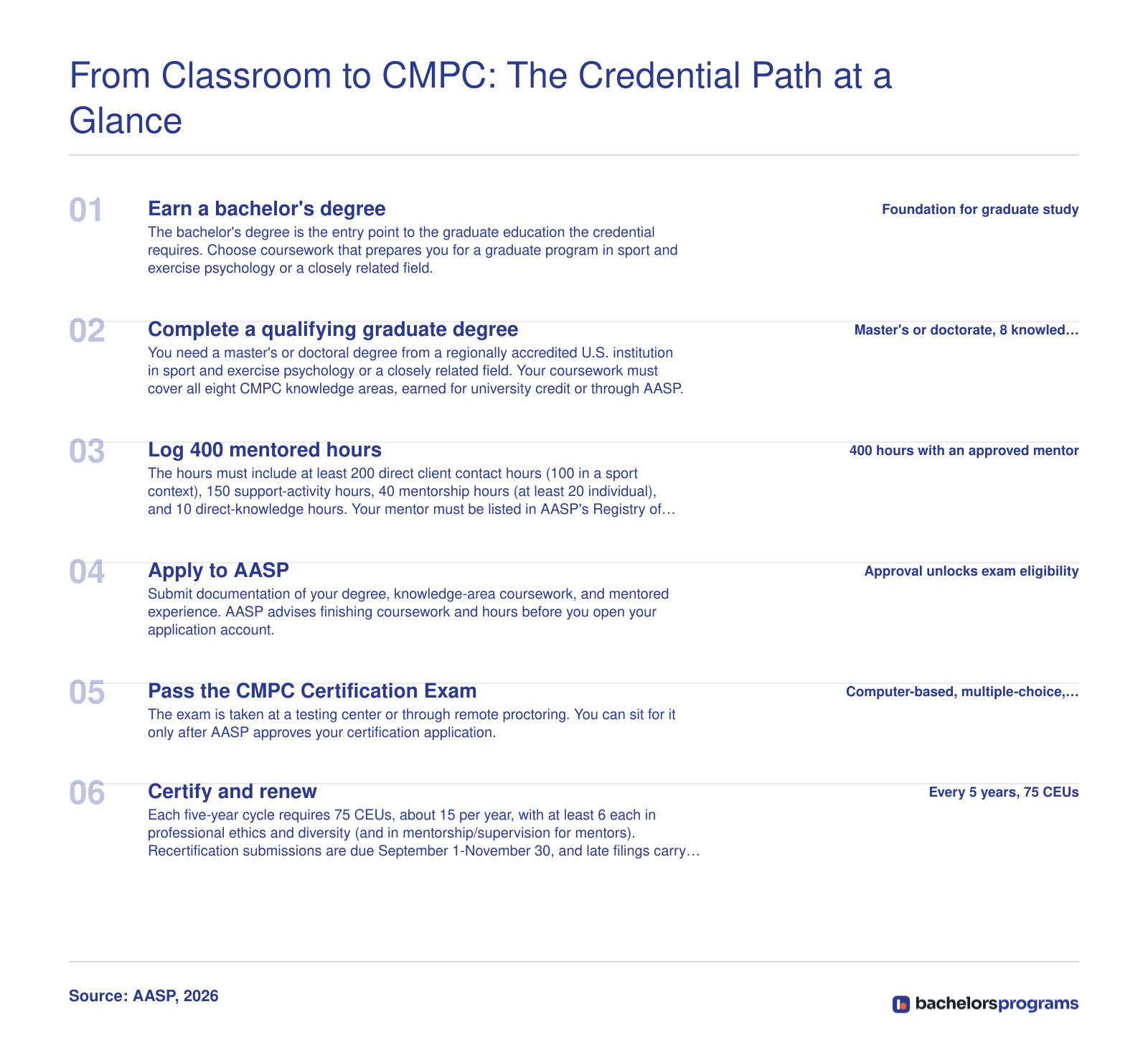
From Classroom to CMPC: The Credential Path at a Glance
Earning the Certified Mental Performance Consultant (CMPC) credential from AASP is a sequential process, and each step unlocks the next. The 400 mentored hours are the stretch where many candidates stall. Plan your mentor, placements, and client contact while you are still in your graduate program, not after you finish it.
Mental Performance Consultant vs. Licensed Psychologist vs. Licensed Counselor
These three routes can all involve sport psychology coursework, but they carry very different legal authority. CMPCs teach performance skills such as focus, confidence, and routines. Clinical problems such as depression or eating disorders belong with a licensed provider. Licensure rules for psychologists and for LPC/LMHC counselors are set state by state, so check your state board before choosing a path.
| Factor | Certified Mental Performance Consultant (CMPC) | Licensed Psychologist | Licensed Counselor (LPC/LMHC) |
|---|---|---|---|
| Degree required | Set by the certifying organization; confirm current eligibility rules before enrolling | Doctoral degree | Master's degree in counseling (CACREP-accredited programs are preferred or tied to eligibility in some states) |
| Credentialing body | A professional certifying organization, not a state agency | State psychology licensing board (for example, the California Board of Psychology or the Arizona Board of Psychologist Examiners) | State counseling licensing board |
| Can diagnose and treat mental-health conditions | No. Must refer clinical concerns to a licensed provider | Yes. Assessment, diagnosis, and psychotherapy, subject to state law | Psychotherapy and counseling, yes. Diagnosis is state-dependent |
| Typical supervised hours | Mentorship requirements set by the certifying organization; check its current handbook | About 1,500 to 6,000 or more, depending on state (California requires 3,000 total, with at least 1,500 postdoctoral) | Commonly about 2,000 to 4,000 post-graduate hours, varying by state |
| Licensing exam | Certification process set by the certifying organization, not a state licensing exam | EPPP, which has a knowledge part and a skills part as of 2026, plus state-specific requirements | State-recognized counseling licensure exam |
| Use of the "psychologist" title | Generally not allowed; state law reserves the title for licensed psychologists | Yes, once licensed in the state | Generally not allowed; check your state's rules |
| Typical scope of work | Mental-skills training and performance consultation for athletes and teams | Clinical and performance work, with clinical services delivered under the license | Counseling and psychotherapy within the state's defined scope |
Accredited Sport Psychology Degree Programs: How to Verify What Counts
A degree titled "sport psychology" can sound like the perfect fit. Its accreditation, though, determines what the degree can do for you, and a mismatch is where many licensure plans stall.
Start With the Institution
The baseline is institutional accreditation from an accreditor recognized by the U.S. Department of Education or the Council for Higher Education Accreditation (CHEA). Neither body accredits colleges directly. Both recognize the accrediting organizations that do. Department of Education recognition is tied to federal student aid, so a school outside that system may not qualify you for federal grants or loans. Apply this check to every school you consider, including the ones ranked on this page.
No Accreditor Covers Sport Psychology Itself
No U.S. accreditor reviews sport psychology as a standalone field. The programmatic accreditation that matters depends on the underlying degree:
- APA: The American Psychological Association's Commission on Accreditation reviews clinical, counseling and school psychology programs, plus internships and postdoctoral residencies. It is voluntary and covers only the specific program accredited, not the whole department. A sport psychology concentration inside an APA-accredited doctorate does not make the concentration itself accredited.
- CACREP: Accredits counseling education programs at the master's and doctoral levels.
- MPCAC: Covers master's programs in counseling and applied psychology. It is not a substitute for APA accreditation.
If you want to become a licensed psychologist, an APA-accredited clinical or counseling doctorate is the main credential to look for. A sport psychology degree outside these frameworks may suit mental performance work, but it can dead-end a licensure plan and send you back for another degree.
A 10-Minute Verification Routine
- Step 1: Look up the school in the Department of Education or CHEA database and confirm a recognized accreditor.
- Step 2: Identify the exact degree type (counseling master's, counseling psychology Ph.D., sport psychology M.A.) and match it to the relevant accreditor.
- Step 3: Find that specific program in the APA, CACREP or MPCAC directory and note its status. APA lists programs as accredited, accredited on contingency or under review.
Sport Psychology programs by state
Quick Answers for Prospective Sport Psychology Students
These answers cover the questions students ask most often before choosing a program. Each one points to a deeper section of this page if you want the details.
What degree does a sport psychologist need?
Is a bachelor's in sport psychology enough to work in the field?
Can you study sport psychology fully online?
Is a sport psychology degree worth it?
Compare Sport Psychology programs on the data that matters
Explore more Psychology majors or browse every field of study.
All Psychology programs Browse every field of study